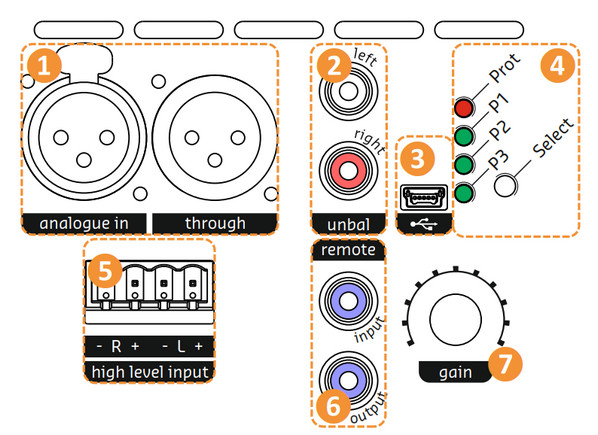
 Reading up on nCore Fusion specs, we see insignificant 350µs latency. The max 19.2ms latency spec would take 6.6 metres to zero out with physical placement. The exact delay and distance depend on how much extra DSP we invoke. The more complex EQ we dial into the Hypex firmware past its A/D stage, the longer on-the-fly math takes. Its magnitude is for power users to calculate should we add custom DSP beyond Zu's coding.
Hifi covers from casual to extremely committed users, carefree beginners to advanced practitioners who train their ears to perceive and care about minutiae. As long as enjoyment rules, all approaches are valid. Learning about alternate ways should never prompt us to invalidate our own. Neither should our inability to validate an alternate way call it names. Live and let live is much friendlier.
Friendliness in fact is a Zu core credo. Sean has never promoted fussiness of setup, fussiness of sound nor fussy music for his trade-show demos. The Method monitor's broader off-axis response is all about better sound across a bigger window than a laser-guided lone-wolf show in a basement. My latency mention only keeps things honest for time warriors. They will prefer to handle complex room-correction bass EQ in player software like Audirvana, HQplayer or Roon. Now any delay affects the complete signal to be academic.
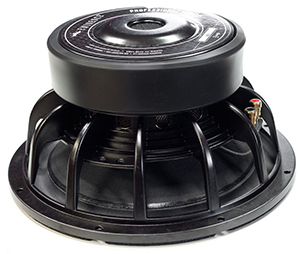 So for the Method sub, fussiness too is off the menu. All three presets build in the recommended roll-in freq. All our ears have to do is select the appropriate gain for our room and taste. The big woofer was chosen for speed over ultimate reach and output. It prioritizes music completion over bragging rights for beast-mode home theatre SPL at infrasonics. For that Zu already have the tall down-firing $6'500 Submission. "The Method sub is 'fast' with incredible attack, making it your best choice for breathing dynamics and life into contrabass and sub contrabass content. The new cone is even more efficient than what was in the original Method. That creates even better transients and detail." It's a different type of driver than this long-throw unit of the Submission and Undertone subs.
In the Eminence Kappa 15" woofer range for example, to get from 97.8dB to 101dB sensitivity nets resonant frequencies between 31Hz and 47Hz. As the decibel specs go up, so does resonant frequency. As the latter goes down, moving mass grows from 72g to 105g so the cones, surrounds, spiders and voice coils get heavier. Compare that to an Audio Technology 12" woofer whose 92dB efficiency couples to a resonant frequency of 25Hz and 61g of moving mass; or a Dayton 12er which combines 90dB with 100g and 23Hz. Any designer of speakers or subs must juggle many parameters to arrive at the desired tuning.









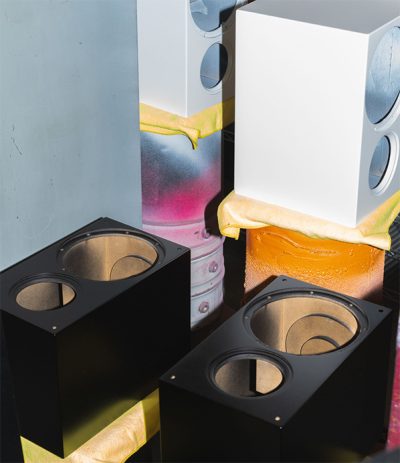
 The Method sub clearly blew up my earlier prediction for a small driver and box. But as far as 15" woofers go, it remains tidy enough. We net big cone surface from still manageable dims. Unlike heroic stroke designs with huge rubber-roll surrounds which rely on visual pumping to do their intended job, we'd expect Sean's driver to barely move at domestically acceptable SPL. Whatever earlier roll-off the Method's mechanical limits build in, the Hypex DSP's PEQ can move downward.
If you want to learn more about the interdependence of power, stroke, frequency and SPL, Pat McGinty's website has a useful 6-page primer here.
"The bookshelf is $1'399/pr. The two standard finishes are black satin in a camera-body type finish; and satin white which is perfectly smooth and snow white. Still working out the costing on the sub which shouldn't end up far off the monitors. We'll again have virtually unlimited surcharge colours. We're also working with the Ply shop on real veneers but that's still a few weeks out."
The combination of widebanders and active sub/s even works conceptually. Both drive their voice coils direct without interceding electrical filter. The sub does with its built-in amp, the widebander with whatever amp we leash up to it. The theme of direct drive is continuous. As already shown, the 8-incher has no whizzer but "a 2-inch voice coil, large-radius cone profile and the tweeter throat and expansion ratio are tuned for a mechanical/acoustic filter function at 5kHz whilst critically damping the tweeter membrane."
Once more, all of music's fundamentals down to ~60Hz in half space radiate off the main cone. The throat tweeter just handles overtones [piggy-backed coaxial geometry upper right]. In full space involving typical room gain, Sean tells us to expect a pretty solid 40Hz with still useful content into the mid thirties. That wraps tech and theory but not before I allow myself a final comment. Should the new 8" coax offer enough of a sonic alternative to the 10.3" coax in my teal Soul VI, might we see an eventual 8" Soul with downfiring 10" or 12" woofer embedded in its bottom to wink at people allergic to an outboard sub's third box or worse, a stereo LF pair's fourth?
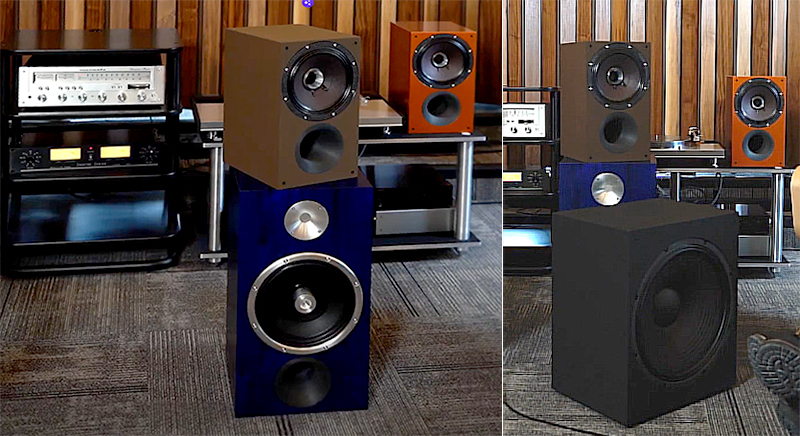 By February 1st 2025, Zu announced the monitor's release for February 8th. Above left we saw how its cabs are really just wide enough to house driver and port. We saw cut-outs upcycled as reinforcements for the top panel. By February 3rd, this industry feature had Cees Ruijtenberg make a distinction between augmented widebanders which are time coherent in their step response; and those which are not. Given how Zu's tweeter mounts behind the widebander's motor, the Method monitor must belong to the second group. A few weeks later, The Audiophiliac Steve Guttenberg released his YouTube review, Zu their promo from which these screen captures show the Method sub and monitor vs the DWX.
In the video Sean apologized that whilst he thinks the Method monitor compact, others tell him that it's not really small. To be a Zu of sensitivity higher than normal, bigger driver diameters are a must. That puts fashionably narrow baffles out to pasture. But the video also intros new paint options so the custom crowd can get creative with colour codes. For my loaners we settled on White Starlight which Sean described as containing a subtle fleck which in the right light creates a fine glow. Matching colours are available for the sub so this all-grey white guy signed up for a (cough!) all-white threesome including the white magnetic grille option. The presets in the sub amp are a 1st-order low-pass for the A position, a 2nd order under B and wall compensation under C.
The Method monitor omits Sean's customary branding even signature aluminium trim ring to be as domestically docile as possible. The speaker wasn't just meant to have a small physical but also psychological footprint. Unobtrusive. Should sufficient buyers ask to bling out their bookshelf, Sean might be persuaded to run off some retrofit surcharge trim rings? If so, my screwdriver and I would cheer. We've always considered the heavy metal rim to be intrinsic to Zu's identity.