Categorically not! Before the hyperbolic police hands out tickets, check into this track by Antonio Ramos 'Maca' called "How low can you go?" from Hotel Groove. Solo Method captured the full range of the e-bass, no drop-outs. Whilst the very lowest tones were rolled off, they remained well audible, just not as loud. That's the decider. Though Method's foundation cover had limits, they didn't out themselves. Unless we're experts with a constant 25Hz reference, we won't notice them. The response wasn't tipped up, whitish or lightweight. Antonio's bass had fulsome growl, pop and gravitational anchor. Nothing raised its eager hand for a contrary hello. Defeating 'bypass' obviously showed difference. The most obvious was less room sound because Method's omni LF rode my transverse 70Hz room mode to thicken those textures. The super-dipole sub with its lateral anti-phase cancellation had superior damping without ringing. On most music, adding about an uncut octave below Method was secondary to the greater textural linearity from harder stoppages.
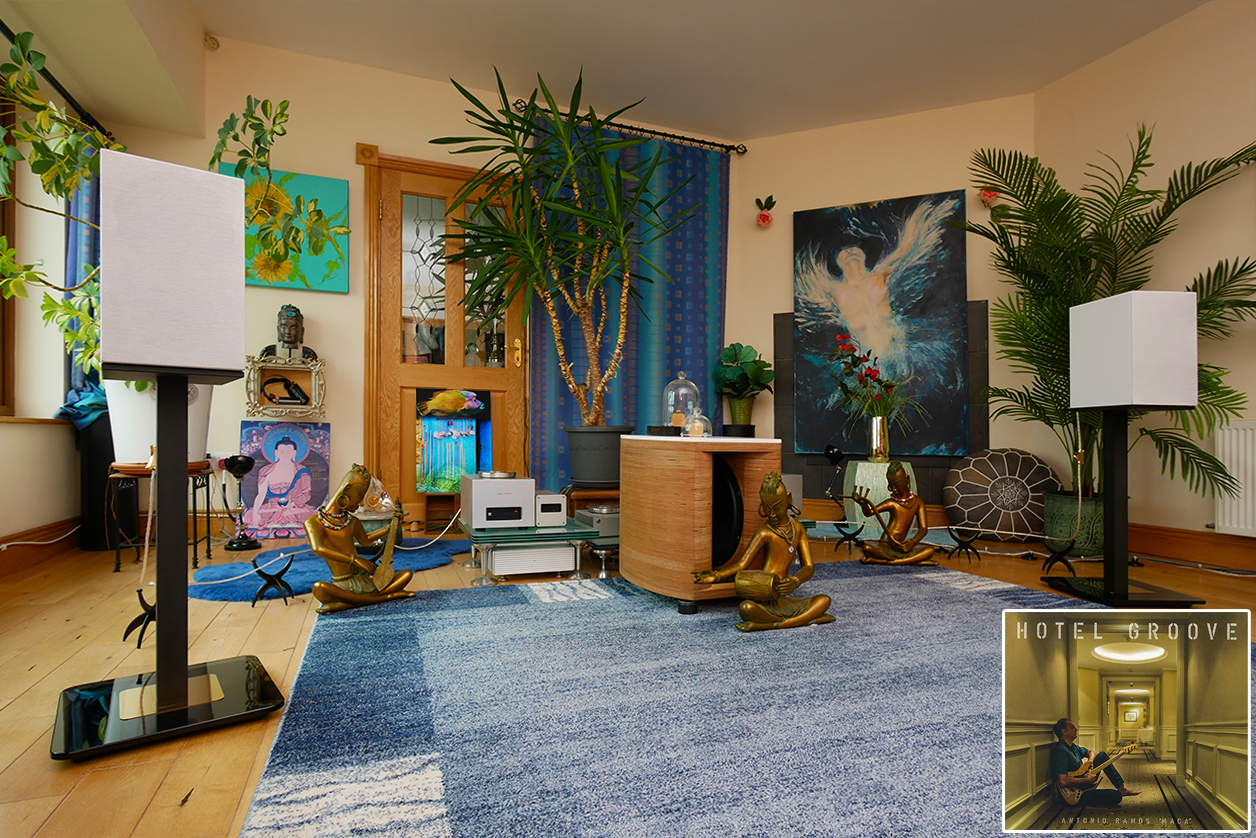 How much more unobtrusive could a stand-mounted speaker possibly be?
But this review isn't on cardioid bass and its advantages. Today's point is that even in this 'free-space' setup facing greater cubic air volume, Method without sub was perfectly satisfying even with my library's ambient, trance and electronica. Again, Method's omissions aren't blatant. They're sneaky. If we know what true low bass is, we identify what's merely hinted at or missing but still wonder why it doesn't bother us. How that sentiment might shift in a still bigger room I couldn't say. I have no such room. What I still had was Ivette's pair of EnigmAcoustics Mythology M1 6½" 2-way monitors.

They're the original occupants of these stands. 11 years ago those just slightly deeper boxes retailed for a whopping $13.7K/pr ten times beyond Zu. Whilst they improve on audiophile aspects which aren't prime Method strengths, they don't get close to where Method triumphs: dynamics, tonal juiciness and sheer fun. The Zu let their hair down and party. The M1 wear a suit and tie. One really can splurge out mega and still not hit upon Method's core virtues. The smart money remembers the old Greek triplets Heraclitus, Pythagoras and Socrates. One of them supposedly coined 'know thyself'. If you know thy listening tastes to overlap with Method's delivery, this could be the easiest way to happiness.









Onto Sean's filter presets for the sub: "I tuned the handover behaviour based on a normal home and how the sub would be used there. But let's dive into the complexity of the reasons. There are a few things going on. It's true that a bass-reflex resonant port results in about a 24dB/octave average slope between the roll-off's start and the point where the port no longer resonates. It's an air pump that no longer makes much by way of sound as membrane and air mass are out of phase. But the phase difference between electrical input signal and acoustic output signal along this region is complex. Most all amplified subwoofers including ours introduce significant phase shift to their woofer signal. There are workarounds like analog filters in a feedback loop or corrections in the digital domain but those still wouldn't address the phase interaction between location of sub and speakers plus the room's compounding influence. The 2nd-order filter of the N°2 position of the Fusion amp's three presets should be the one most will prefer with the Method monitor. But with the amp's easy user interface, owners can readily modify our presets. All three presets can be customized because we don't block access."
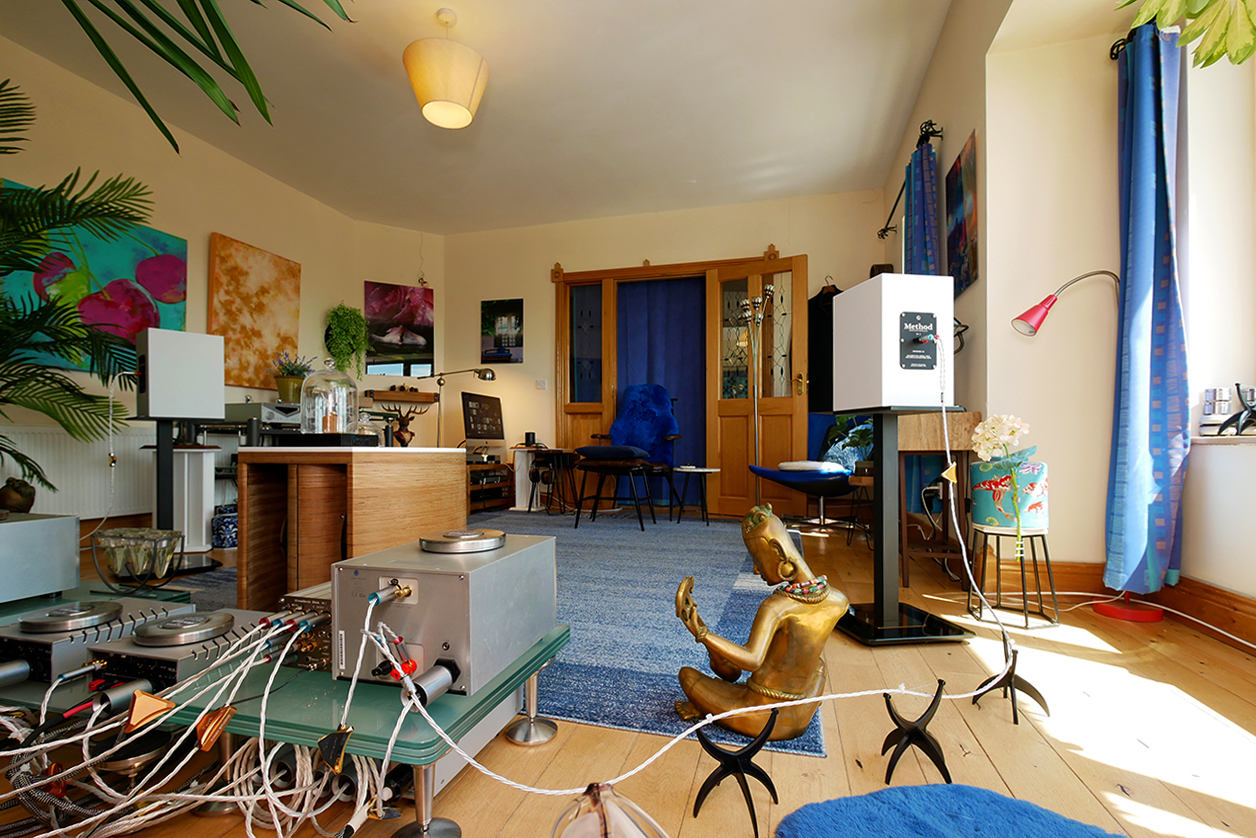
The solution to placement-borne time delay is a sub equidistant with the speakers relative to our chair. That locks in path-length equality. The other variables are DSP latency and phase shift from the sub's low-pass filter. As already mentioned, to eliminate phase shift I use an active external crossover. That rolls out the mains and segues in the sub at mirror-imaged 24dB/oct. slopes. Being sensitive to timing, I placed my sample between the downstairs speakers at their precise distance to my seat. Not all household cosmetics get away with that but equidistant can remain in play if we park our sub outside one speaker. In a short-wall layout this could mean close to a sidewall. For my sub sample, Sean agreed to leave preset N°3 unconfigured. Aside from the 1st/2nd-order presets, this gave me an alternate setting for my external crossover to also filter the monitors. For input options, "one sub will run left and right RCA to sum internally; or high level left/right via Phoenix connector [right] for which we can build cables. Two subs use a single XLR, RCA or Phoenix input each. For an extra 3dB of gain, use a Y-splitter to exploit dual RCA/XLR inputs with twin subs." Two subs? "One Method sub in each corner is more fun. Want two?" Two it was particularly since sexy synchronicity was at play. Hours earlier I'd published an industry feature on exactly that twofer topic. I love it when the gods of timing and generosity have a fling at my local by-the-hour motel. To make the fling permanent takes $1'449 for one Method sub in a stock colour. It measures 48.3×40.7×31.5cm and weighs 16.4kg. Here's how Zu frame those dims. "Our first Method sub launched back in 2005 and featured twin short-throw lightweight front-firing 15" drivers. In those days we lived in the workshop and thought all audio freaks did; or in a barn or at least big basement. Now we know that only a few live is such places and space is at a premium. So with Method Sub MkIII we use just one 15" driver."