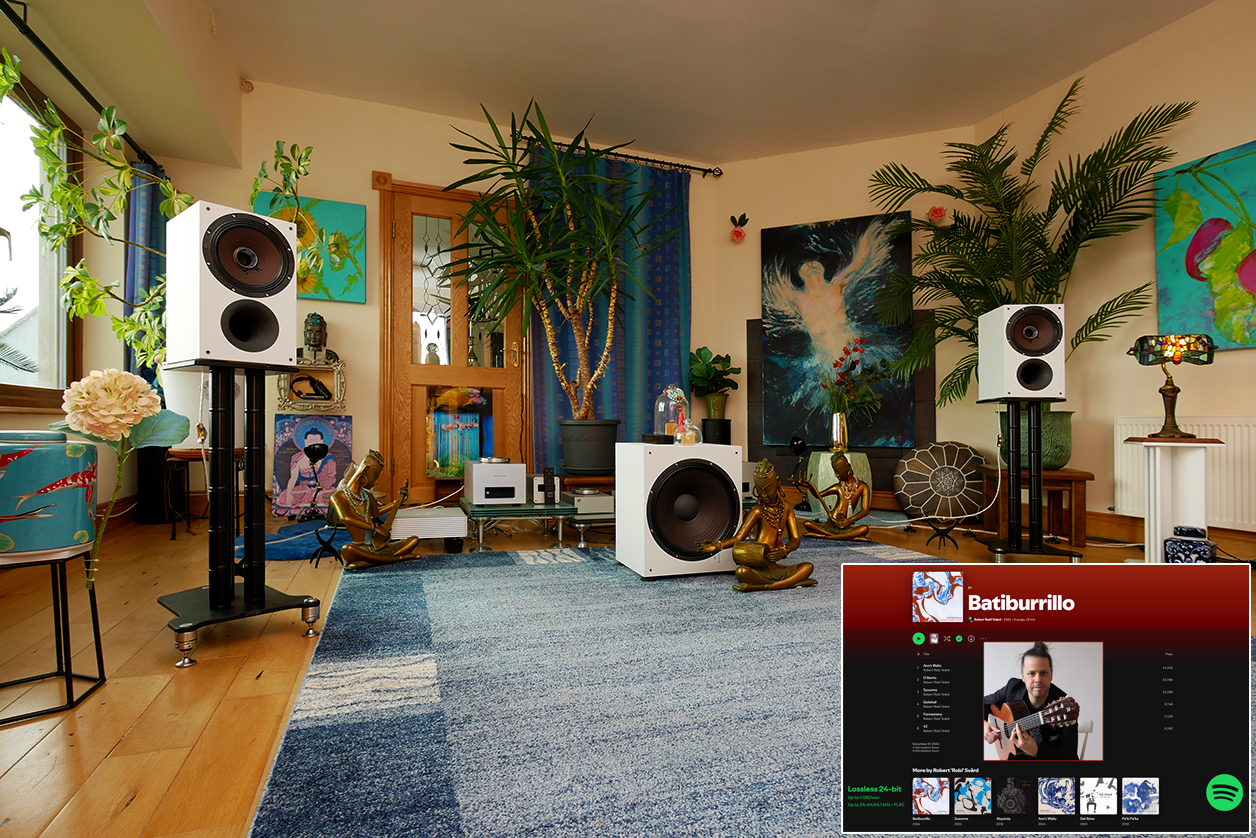
Old dog, new tricks? Being ear/brain-washed by my usual setup with central twin 15" sub wired in stereo, I had a clear preference for the location not even an audiophile's mum could love. But in terms of best deleting the point.1 channel from notice to sum as an indivisible whole, P3 Central had my vote for best damped most continuous LF. Because there's no hifi without music, let me briefly plug Swedish flamenco guitarist Robert 'Robi' Svärd. Start out with Batiburillo to work up to Del Alma which is as compositionally sophisticated in this genre as are France's Juan Carmona with Zyriab 6.7 and Poland's Miguel Czachowski with Indialucía. Back on the Method sub, its demeanour wasn't bone dry. For that you'd likely need a perfectly dead far heavier cab à la Magico or YG. Hence Method wasn't brutally damped like a clipped marching band but had a bit more swing in its step. With its surprisingly shallow enclosure for limited cubic volume, there was good control over this driver's mechanical stoppage so no droning. But thankfully that didn't cross over into what I call cyborg bass because it suggests robotic drum machines. With a grill not yet included with my early sample, I can't show that look but predict that once topped with some decorative items even a potted plant, a central location might in fact be far less domestically invasive than I joked about; particularly if the whole show moves closer to the front wall. For maximal depth and letting the speakers detach from the room, I practice a bit of extreme spacing because my dedicated listening lounge gets away with it.
Back on Flamenco and timely bass, spin up the collab between Vicente Amigo and Marcus Miller on the former's Andenes del Tiempo album from last year. The track is "Corcovado". Sadly compressed to within an inch of its popping life, focus not on the redlined lack of dynamic range. Tune into the rhythmic grittiness led by the supercharged guitar artistry on top which the bass ace duplicates at the bottom. Should a system have the latter slack, the tune's relentlessly taut timing falls apart. No such danger with the Method 2.1 attack. At this juncture it's opportune to invoke the typical subwoofer small print. Writ as large as the obvious snap, crackle, pop and shove in the bassment is the effect which mature LF have on our perception of space and colour saturation. Low bass injects true black into the tonal palette. It also scales up our notice of ambient recovery and how real playback feels. Spatial attributes become more cinematic rather than squeeze through a tellie if that communicates. It's not just bass-buster fare which benefits from a well-integrated active subwoofer. Tracks with nearly subliminal low pedals parlay different when their barely-there subtlety vanishes. The sonic panorama shrinks, its substance dilutes. In short, subs aren't just for bass heads and reggae ravers. They're for 'sophisticated' listeners who notice the difference between the bottom octave amiss and restored even on acoustic music which appears to contain few LF to begin with.













The Method sub doesn't pack a small 6½" woofer with monster-roll surround plus two matching passive radiators to square a soccer ball into a compact Velodyne cube. It doesn't pursue Devialet's "heart-implosion" sidefiring small woofers in their egg-head monitors which virtually jump out of their hoops with goosed SPL as though visual motion was proof of quality. That's for ill-informed adolescents. The Method sub exploits a hard-hung pro-audio woofer of large surface which in my time with it I didn't see move. I'm sure that some extremists firing up an Interstellar blockbuster could get it to visibly shudder. With my civilian usage, I saw nada. Despite its bodacious cone the Method sub doesn't chase infrasonics but quickness; clean and to the point. Minimized motion stops easier and quicker. That's exactly what I think a proper music sub should be all about. Now enters your friendly neighbourhood accountant. A pair of Method monitors on Q Acoustics stands plus one Method sub come in wildly below a pair of Zu Druid VI. Even versus Soul VI you'll have plenty of cash left for a nice pair of amps like my 250-watt Kinki monos. You'll also have demonstrably more low-end bandwidth; even a bit more presence-region articulation and insight.
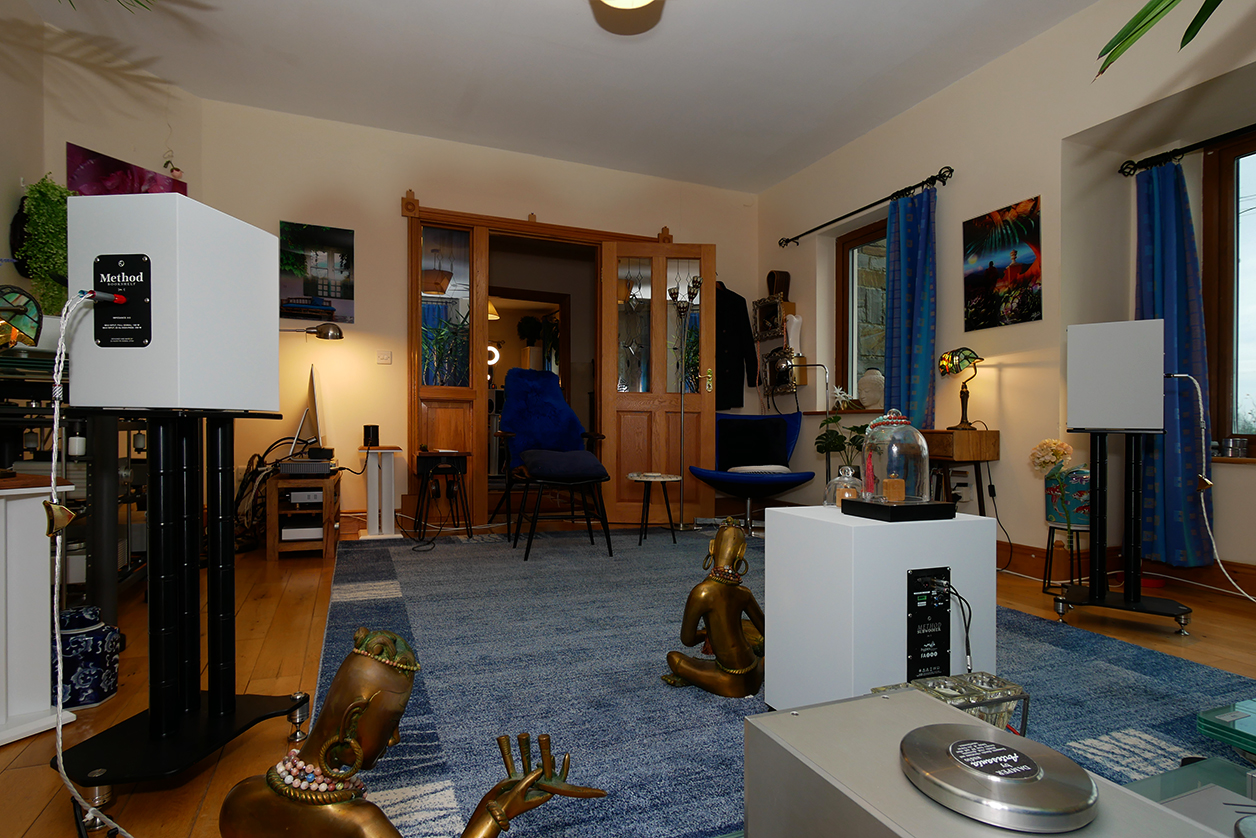
So the 2.1 method gets us more for less. If in the final analysis it's perhaps a bit less polished than the stablemate towers, that's a small compromise indeed. About which, as we steepen the handover slope between monitors and sub, the warmer thicker if also sloppier Zu sound gets progressively more clean and 'audiophile'. By that I mean less divergence from a neutral linear wideband dynamic headphone. In headfi Meze pursue a clear fun voicing. Stax are far more technical. In active hi/lo-pass mode and central placement, Zu's house sound veered unexpectedly deep into technical turf without undermining its native chunkiness and dynamic vitality. In my room, running the monitors wide open and adding the sub on the P1 preset generated a far warmer thicker milieu with less separation and definition. Where that means more fun, the unorthodox 1st-order low pass is the ticket.