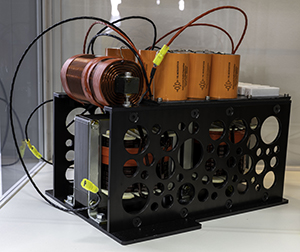
 That's the widebander method; why a few stubborn designers remain bullish. They prioritize time fidelity by avoiding filter-induced phase shift and energy losses. Meanwhile the landslide majority of speakers prioritizes amplitude linearity¹. This could add notch filters, impedance linearization, baffle-step correction and more. If that equates many big parts as in this YG Acoustics crossover, so be it. Back on Zu tweets, in 2008 "we'd been working with TangBand and Raal Ribbon to upgrade our treble units which had often been criticized for lack of refinement." This led to the short-lived Essence with ribbon tweeter. By 2022, the Definition 6 flagship sported a separate ring radiator whose 35kHz reach adds an extra octave atop Zu's regular Radian compressor. Method's Eminence tweeter is a 1-inch 104dB Titanium dome that needs 10dB resistive padding to match the 94dB cone. That compression tweeter drops sharply off at 19kHz. Whilst normal human hearing doesn't breach 20kHz, extension far beyond minimizes or eliminates phase shift and dome break-up in the audible range. Hello beryllium and diamond. Lower phase shift is also why Definition 6 now orients its active woofer forward. It improves phase integration with the parallel coaxial widebanders to sharpen up inter-driver timing.
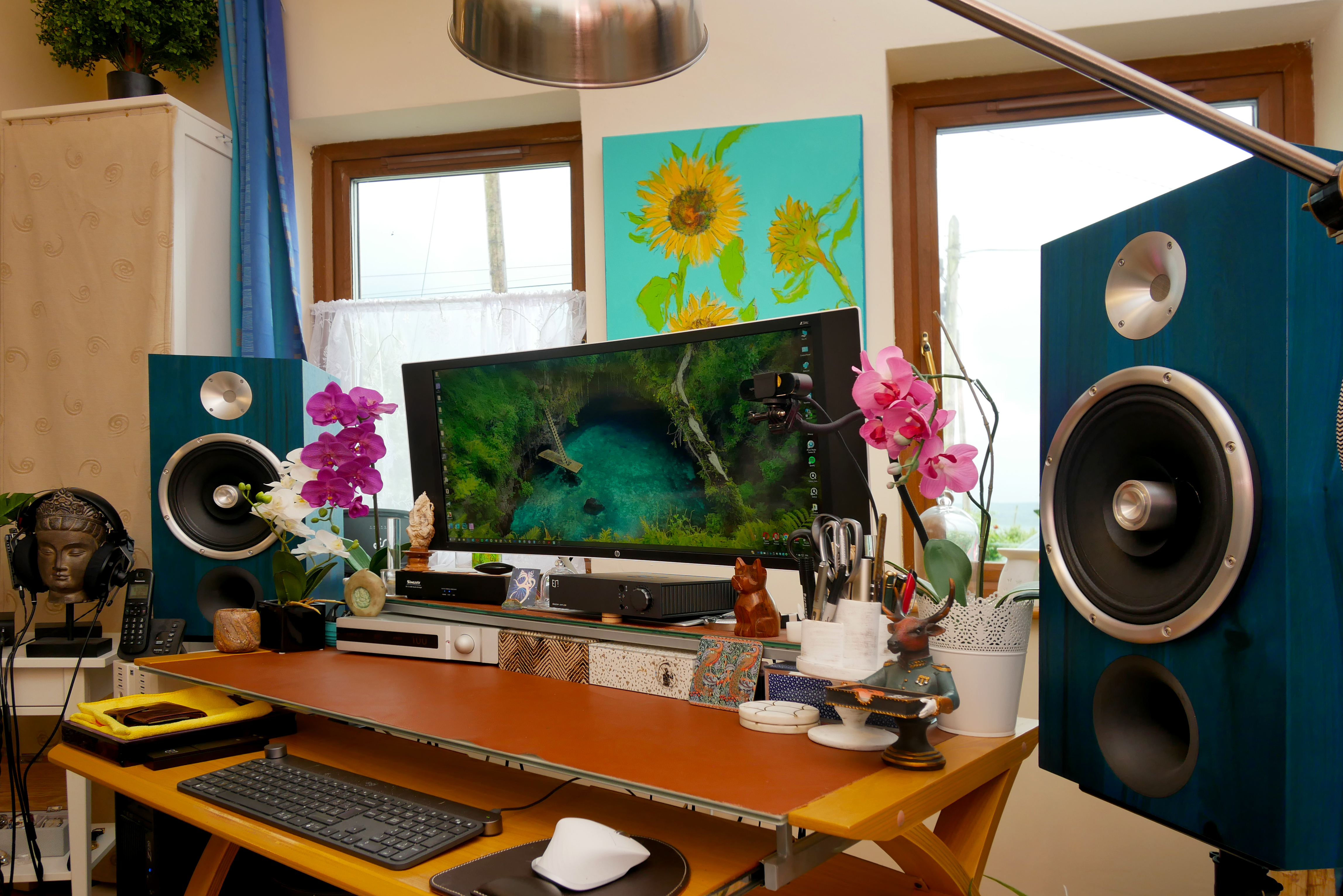
"Method bookshelf isn't big visually but sonically has a healthy amount of Zu realism and dynamics for otherwise cramped areas like desktops, bookshelves and commercial installs where space is at a premium. Being coaxial with a nice wide uniform spray, it's perfect for centre and effects channels, too." Today's Method presses downmarket to bring Sean's sonic aesthetic to an audience which doesn't have the funds or space for a Soul 6 or even DWX. After all, not everyone is prepared to pork out their desktop as I did for my review of Zu's über monitor.
___________________________
¹ There's also the class of Richard Vandersteen & Co. which pursues the time domain with minimum-phase 1st-order filters and physically time-aligned drivers. In another class operate Wilson who combine steeper filters with user-adjustable time alignment for their top models. And certain Accuton drivers are designed for perfect physical time alignment on a classic vertical baffle. So the time/amplitude question isn't black or white but has many intermediate hues. Yet we might say that filterless widebanders push the pursuit of time fidelity hardest to be that field's extremists.
Where one wants more bass, the Method sub supports a staggered build to regrow the wallet. With ports rolling off at 24dB/octave, the virtually default 4th-order low pass on most subwoofer plate amps becomes a correct mirror entry. Now integration is a matter of matching the monitors' in-room -6dB response with the sub's crossover frequency then dialling in relative LF output. Critical listeners know about latency as a DSP-based processing delay. Wherever subwoofers use DSP filters and room compensation, digital latency factors. Within reason, that can get offset physically by moving a sub closer to the seat. With my upstairs Dynaudio sub, latency is 2.5ms. Its output syncs up when the sub sits 86cm closer to me than the speakers. Those who don't believe in time alignment might place a sub in a front corner instead. That puts it farthest from the seat for extra delay but boosts LF output with maximum boundary gain. So we decide not just on placement but relative bass balance. With that being any room's most unpredictable sonic influence, a separate bass volume control can be a real difference maker. We can even counter the Fletcher-Munson curve of reduced LF sensitivity at low volumes so late-night listening doesn't wash out the same. All of this is subwoofer 101. It's not specific to a particular brand.





Often overlooked is mechanical coupling between a sub and our dwelling's structural elements. The lower and louder we play, the more a sub's physical jackhammer action leaks into the floor particularly a suspended upper floor. Like an adolescent boom truck's hard-coupled woofers turn an entire car chassis into a ringy mess, so a potent sub can turn our floor and anything on it into resonators. At worst this causes audible ringing behind the beat. It also leaks LF into adjoining rooms, making trouble for terrace housing and flats. The obvious antidote are decouplers. I use sound|kaos Vibra 30 wire-suspended isolators to excellent effect. Carbide Audio's hybrid approach of elastomers and roller balls too is very good whilst Virtual Hifi's Vibron are by far the cheapest of my bunch. With basics ticked off, what are the particulars of Zu's Method?
 "I'm pretty excited about the new monitor. All the hard parts of drivers, high pass and other bits are nearing completion. The cab is the bottleneck. Same for the sub. My current focus is on bookshelf production, marketed and shipping. Then attention is back on the sub. One feature uncommon for us is quick burn-in. The Method bookshelf is engineered to sound as designed within a week of you lighting it up. We give it 12 hours of insane-SPL torture at our factory then another 12 hours of regular domestic SPL.
"Its front port has equal diameter and length to keep group delay at bay and remove pipe turbulence and acoustic resistance. I'm no fan of long port pipes. While there's just enough baffle space for driver and port, having the port's inner flare extremely close to the 8" cone helps to quickly communicate dynamic pressures between them for less destructive interference. This low-noise port with tight communication between driver and box-exit flow allows us to use a forward port without needing the extra low-pass filtering you get from a rear port which then better integrates the reflex of the port and driver cone.
"The 8" coax also gives us a pretty broad polar response, helping to fill rooms and spaces where listeners might be quite out of focus or where centre and rear-effect needs want a more encompassing sound field. The tweeter high pass is three-pole so 3rd-order 18dB/octave executed with some parts not from the audio industry to be more cost-effective without sacrificing quality.
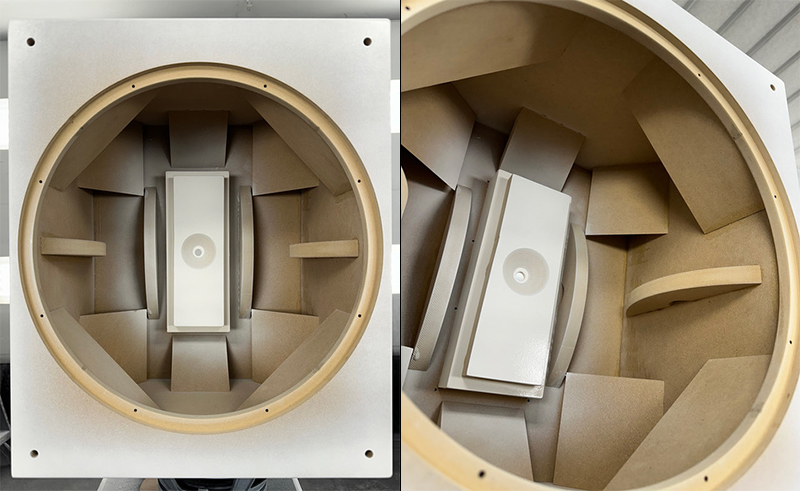
"The Method sub is very similar to the original but with a single 15" woofer. It's a stockier build that focuses on excellent attack and thus detail, decay and nuance, not just thud. I love thud and thunder but also grit and subtle colour. I hate a sub that just plays along adding weight to music and sounds that have little. This lightweight 15" paper cone fits into a pretty small sealed cabinet with a whole lot of webbing to remove cabinet contributions. Webbing and braces also function as internal diffusors. Electronics are a stock Hypex Fusion plate amp pre-programmed with three DSP profiles but left open so a user can easily plug in and change presets. Using this excellent-sounding amp helps keep costs down."