Assumptions. As a stereo 2.2 newb I had two based on home-theatre propaganda and apparent common sense. One talks of more linear bass distribution in a room. Would that matter for a single stationary listener not crew of four on a wide couch; or folks constantly changing position as they might dancing in a club? The other considers potential advantages for stereo bass. They oppose belief that below 100Hz most recordings are actually mono. According to far from infallible Google AI, "it is standard professional practice to make most recordings mono between 60-150Hz to prevent phase cancellation, improve bass punch and ensure compatibility with vinyl pressing and club sound systems. Whilst not a strict rule for all music, a mono low end is common." If so, would stereo bass not be magical thinking from Hogwash? Even so, twin subs will still add cone surface, reduce excursion demands and possibly linearize room interactions to sum less peaky. Seeing how by then my larger upstairs system had featured a Method sub for many months solid, that's where the second one set up shop.
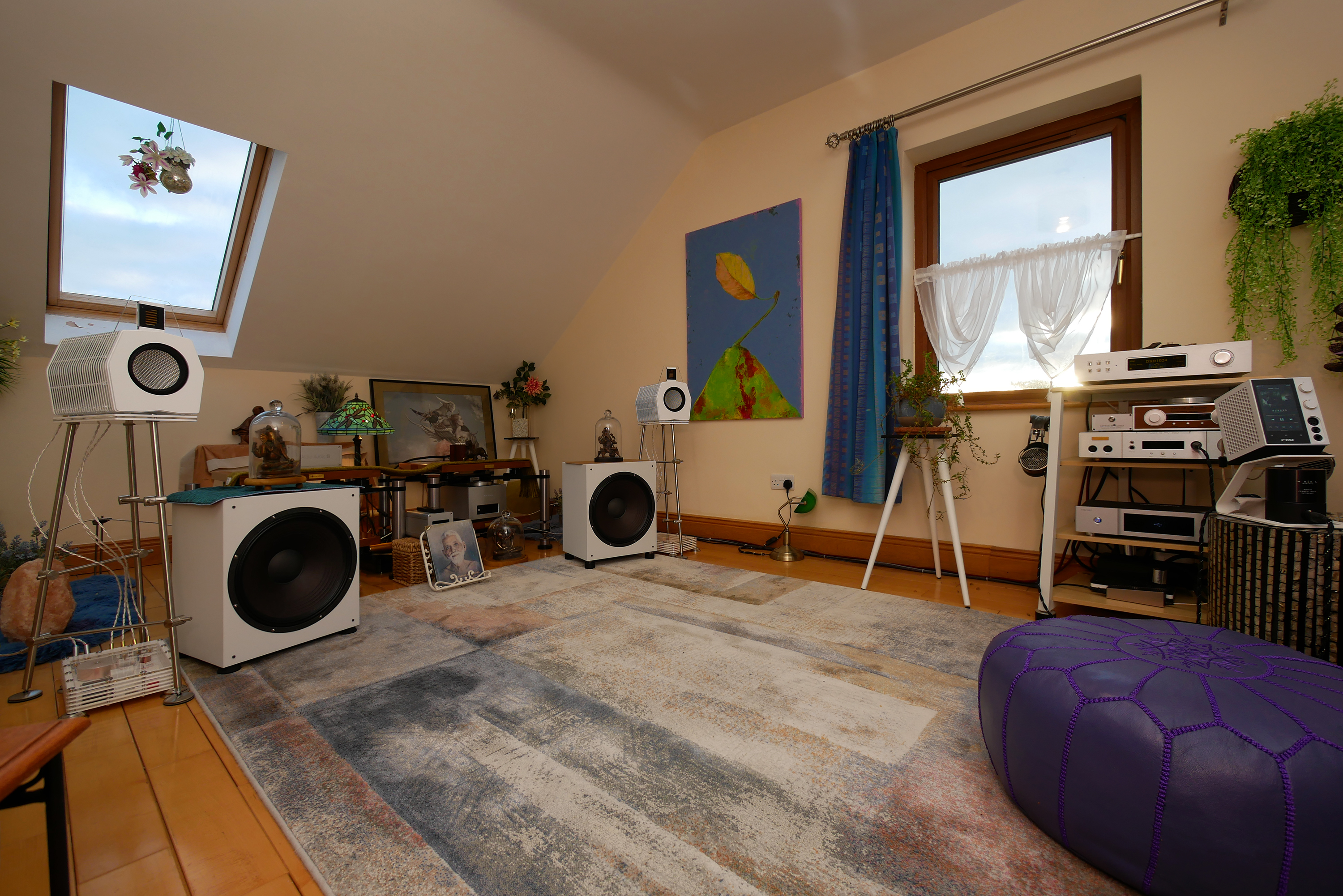
It took no time to appreciate that a compound 21-inch woofer registers different on the ol' body/mind-ear/brain; and stays twitching into even lower SPL without compensating with the active crossover's bass attenuator. Infrasonic chicane at the edge of audible sounds and sheer pressure sense was more intelligible. Subjective scale increased. The overall presentation relaxed. Dropping still deeper heavier anchor increased the presence of ease. Things felt more settled as though grounding was the secret to nonchalance. Without touching the resolution of the 100Hz+ range, its sense of obviousness had given way to something more ordinary. I'm groping for the right phrasing to describe this greater easefulness. Hi-res can telegraph certain look-at-me airs of self-consciousness like the acting of Tom Cruise. Now those were gone. Calling the upshot more ordinary connotes zero loss of quality—just a shift from head to belly perhaps. These were my unfiltered first impressions when newness was keenest. Clearly the 2nd subwoofer made its presence known in ways I'd not anticipated. Was this a shortcut to listen from the hara? Something along those lines seemed to be in action. Now a brief note from your friendly neighbourhood overkill inspector. On the face of it, he'd write me a hefty ticket. In actuality, he didn't even visit though this was obviously predicated upon a ginger touch on the Hypex plate-amp pots. Whilst this level of woofer weaponry could wreck havoc if one were a mindless 16-year old in a Porsche, seamless integration just wants mirror-imaged crossing over; path-length equality with the speakers; and proper respect for shove potential by not overdoing LF output.












More even Steven—or Stephanie for the ladies—was the oft-cited benefit from multiple subs I didn't hear. I already enjoyed fine non-lumpy bass from a single central sub. To be sure, my room's layout is virtually symmetrical other than a deliberate small offset from the longitudinal centre line to not duplicate the speaker sidewall distance. If my room or layout within it were far more asymmetrical, two subs could well behave different and reap greater linearity even to a single set of ears in a fixed seat. In my case, the win of going twin wasn't that. It was a playback climate that had grown darker, chewier and chunkier. This didn't register as extra warmth. Again, no resolution changed across the majority speaker bandwidth. Instead extra air mass and definition in the bass parlayed darker substance in the colour palette's black end. It's this deeper darkness which my body related to as more restful relaxation hence ease. Hello ordinariness taken at face value rather than a special delivery requiring fussy white-glove handling. Contemplating this cause/effect could stir lengthy debates about modern hifi's obsession with hyper-realist detail; and why it so often fails the desired more persuasive profundity and instead develops nervy undertones. More intense brain data equals a busier load on our neural processing. More work means greater effort. The dual subs' darkening effect made the very same data easier to assimilate. This was a far more significant shift in perception than forever futzing with formats and filters, 16/44.1, 32/706.4 or DSD2'048 and other frilly faff. The impact of proper 1st-octave coverage on the playback experience is far grander than audiophiles acknowledge whose lazy grip on dated dogma—subs are for movies and too difficult to integrate for music—shuns active bass and analogue crossovers by purist penchant only to miss out on something very foundational.

The smart money now wonders. Are two half-priced subs better than a single full-priced one? I don't feel qualified to answer that yet. Instinctively I'd lean toward quality over quantity so a single superior sub for less distortion. What I do feel qualified to cover are size and orientation. Big woofers do things which small ones with monster surrounds and stroke cannot. I now have two systems with dual 15-inch woofers and one with dual 9½". This is one instance where size does matter. And yes, looking for the Good Housekeeping Seal of Approval is another pursuit. Orientation is simply about line-of-sight shockwave impact. If it came down to perfectly matched choices except for that aspect, I'd now always favour a front-firing sub aimed directly at the seat to optimize my transient experience in the LF over a side- or downfiring sub.