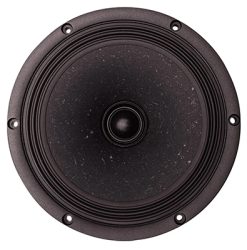
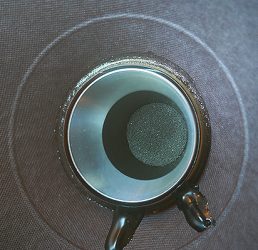
 Toeing the line? Attentive viewers see below that I no longer aimed Method straight in. Here I sat off-axis by roughly half of what Sean calls his coax's spray pattern. For reasons unclear to me, in the nearfield this achieved sharper stereo focus than my original face-on aim. That had been minorly dual mono. With my pro-audio Gravity stands featuring height-locking pins, I loosened their screw collars to very quickly rotate sliding shafts how I wanted. I was surprised that my ~25° final toe-in value triggered no tonal-balance shift or treble loss, just superior image lock. Clearly Method attended kindergarten. It arrives socialized not a very beamy sort. Unlike SB Acoustic's Satori coax [left] whose dome tweeter we see, Zu's sits deeply behind the main cone. It then funnels through foam then a slightly flared metal sleeve. I always rubbish math. I've not the faintest how this influences the tweeter's µs time response. Unlike standard 2-ways with vertical baffles, Method's tweeter across its two top octaves simply can't arrive at our ears early. It must be late. Whilst we could run Method upside down or sideways and suffer no misoriented badge—with nearby sidewalls I'd expect a possible difference between ports out/in—I stuck with the classic orientation.
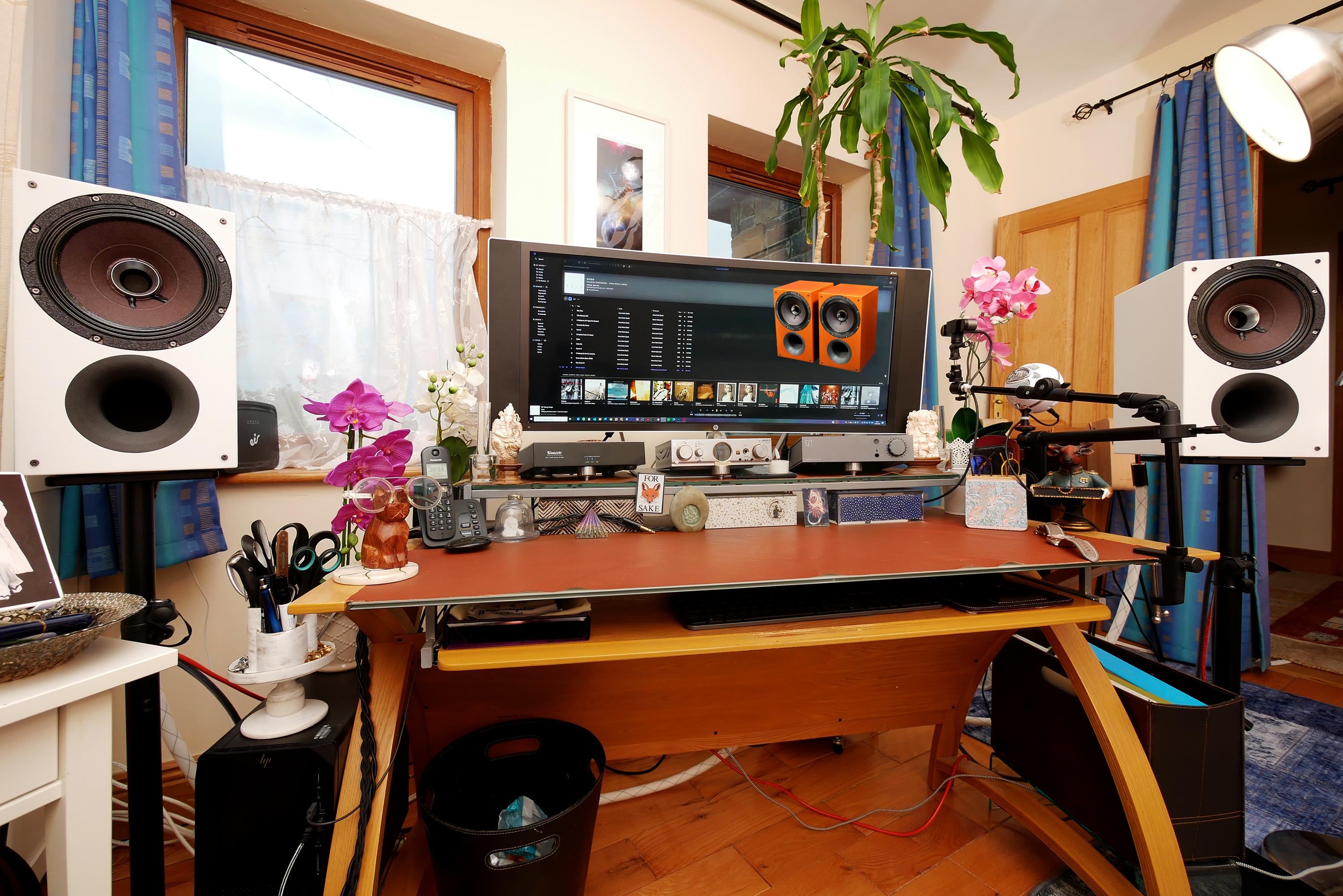
Contrasting my pro-audio monitors with advanced digital phase/time correction, I heard two very different flavours. They were equally compelling for virtually opposite reasons. Zu's top end was mellower. I didn't think of it as primarily lesser amplitude but a mellowing of the transients' upper harmonics which undercut all forwardness. On brisk plectrum-hard guitar arpeggios closely mic'd for example, the 6" 2-ways were sharper, Method rounder. It toned down the brilliance and air ranges not with roll-off but high overtones arriving microscopically delayed. Continuing the effect was the coaxial's greater image density and brisker dynamic response. With their respective tunings, each speaker represented a maxed-out example for a juxtaposition far apart. Most speakers split the difference to occupy the broader middle. The Slovakian gestalt was technically superior so more correct and linear. It also was tighter and smaller. There was no denial about Sean's looser rockier vibe being more fun and bigger theatre. It reminded me of the deep comfort of great home cooking which many rediscovered during Covid. It had one question the sanity of eating out only to leave underwhelmed. Frilly and filling are different. To return from kitchen to speaker-design lab, we might say that Andrew Startsev's active boxes are guided by advanced measurements. Sean Casey works for a special effect to trigger the user. It's why spec chasers tend to shun Zu, why certain music lovers adore them. They couldn't care less about measured proof to the contrary. Experiencing Method in my office, I heard their point. Realists now wonder. What happens when Method vacates its nearfield perch to face a larger room?









With hifi or train spotting, the Hippocratic oath becomes 'don't dare compare'. Sure, comparisons are a reviewer's staple. But when they prevent revealing the fullness of an experience by deconstructing it into lifeless bits, they kill an occasion which is maximum possible harm. This form of death means that we avoid intimacy with a reading's present merits and frame it against something that's not there; like making love to one person whilst imagining another. Method now high-passed at 100Hz 4th-order dovetailed seamlessly with the big 2×15" cardioid sub whose asymmetrical dispersion creates the least room involvement. That's assisted by two active PSI Audio bass traps below 150Hz in the front corners. Right off it really sounded fab. It was an altogether different temperament and flavour from my usual transducers but compelling in its own right. Then I had to wear the itchy cap of comparisons. A simple remote press hit 'bypass'. The active analog crossover routed the full-range input signal to the Kinki Studio 250-watt class AB amps fronting Method. No sub. Click. Sub. Click. No sub. Having listened to the teal Soul VI in this same spot, I preferred Method's greater upper-mid/lower-treble resolution, even its purely harmonic tweeter coverage. I'm more of a modern than vintage sound fan. Fronted by 2.5MHz DC-coupled class AB amps preceded by the ultra-res Sonnet Pasithea DAC, that aspect of Method portrayed without trying. With full 25Hz support of the sub, the tonal balance was spot on, bandwidth complete. Tone textures and colour temps were classic Zu. New to the recipe was greater subjective speed from better detail illumination. And choosing my own stands meant a tweeter axis on ear without requiring angling or elevating the squat Soul VI. Again, the sonic shift to a now smaller coax is an opening which looks at potential buyers who thus far sat on the fence.
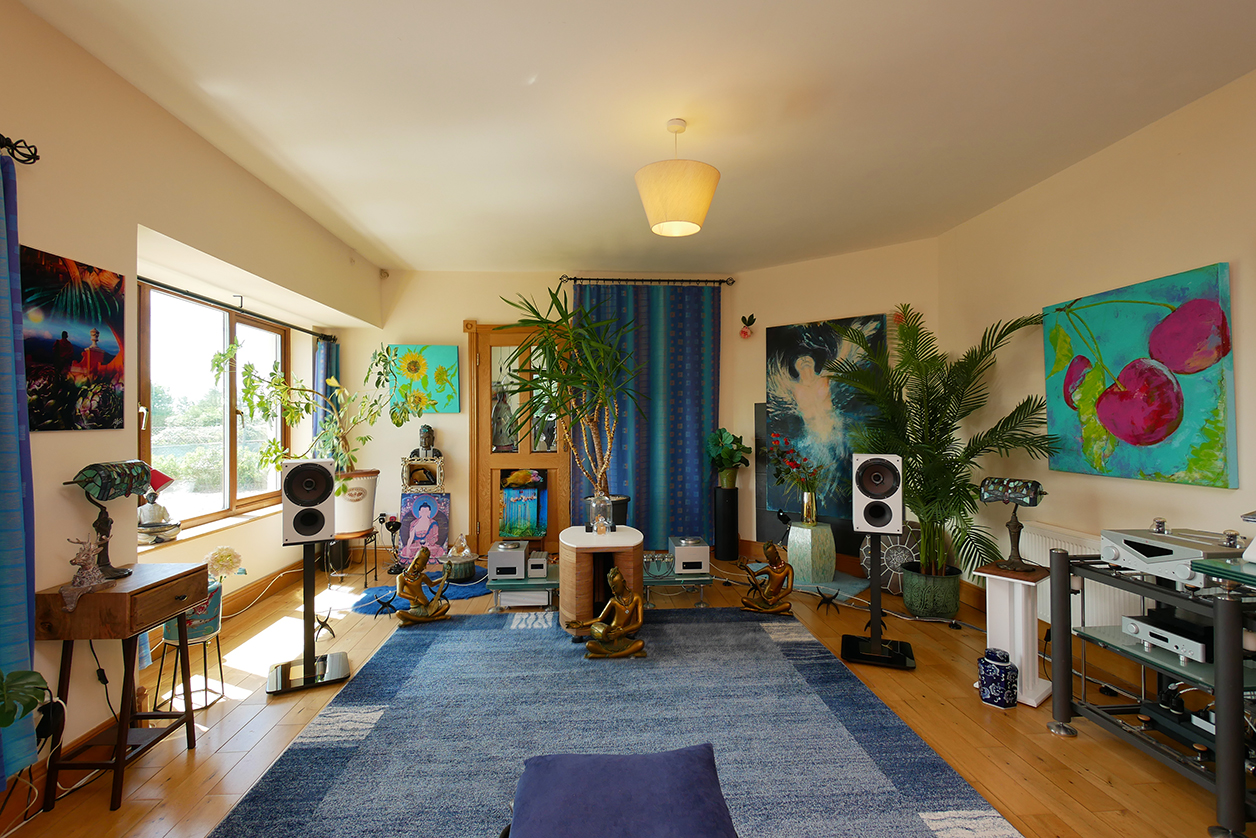
Because of their colour-intense midrange and generous staging, Method presented bold, robust and enormous. It refused to behave pinched like a generic compact. As though encountering a bit of turbo lag, for me this undeniable strength kicked in at slightly higher SPL than quoted 94dB sensitivity might predict. But once this 8-inch engine entered its torque zone, things snapped to big then kept getting bigger. That happiness to scale reflects stout pro-audio drivers. They're built for serious loudness composure, not audiophile Jazz treacle in a retirees' club. And in this execution they really do sound different than most boxes of equivalent dimensions fitted with regular consumer-audio or fussy audiophile drivers. It's not about ultimate detail parsing, separation, edge limning, airiness or gloss. It's about the motion in emotion, that energetic sense of propulsion, perkiness and punch. Those three horsemen of Utah–Peter, Paul and Patrick?–ride in on peppery dynamics and pouncing beats. That exhausted my arsenal of 'p'. "Fine" you think; "but what about bass in this bigger downstairs space? Did that need a sub?"