"You know of course that I'm low profile at the moment. But every now and then I still feel the need to do some R&D. Writing this email was actually triggered by your upcoming review on the new DMAX loudspeaker. It's a matter of coincidence that in recent months I was actively working on developing a coherent two-way speaker myself with the intent of giving those who find it interesting the chance to buy one without the usual profit motive. Strictly speaking, the furniture maker is paid for his work supplemented by components needed to finish the product. With coherent I mean specific properties we saw in the past with certain conventional speakers like Thiel and Vandersteen and digital variants like Kii and others which use DSP. It's of course all about their time-domain behaviour often accompanied by a mechanical tweeter offset so that housing reflections have negative effects. In addition there's the need to apply 1st-order filters. Another problem is human sensitivity in the middle frequencies where the transition from mid/woofer to tweeter is quite audible. That undermines the recorded spatiality. My experience is that despite DSP's ability to correct time-domain errors, it doesn't completely unfold recorded spatiality during playback. So I understand enthusiasts who choose so-called widebanders for their imaging and coherence.
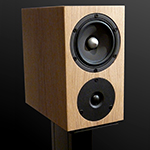
"Alas, I'm somewhat less satisfied when it comes to large widebanders because of their colourations while the problem of smaller types is their limited linear excursion. I therefore went looking for a fairly small mid/woofer having larger linear excursion coupled to good bandwidth without negative breakup effects. I wanted a driver with useful bandwidth towards 10kHz augmented by a small tweeter that reaches at least 30kHz whilst coming in at a high ~6-8kHz. Finally, the goal was to make the speaker suitable for small tube amps so that the impedance of such a speaker would be reasonably high. You can see that in the measurements. Unfortunately they're a bit noisy as I couldn't yet use an anechoic chamber. Just so, they already accurately reflect the time behaviour. A very stiff housing with dimensions of 14x24x24cm supports bandwidth of 60Hz-30kHz. The tweeter is at the bottom to get the right delay. As a result the tweeter and woofer reach the ear simultaneously. That said, a distance of ~2.5-3.5 meters and stand height of 60-70cm are key. Should the speaker sit higher, turn it upside down. The measurements show the impulse, step, frequency, phase and impedance plots. They show that an affordable coherent system is not limited to complex constructions or DSP. Although this is a passive design, it could just as easily become an active system without DSP. I can tell you that this approach is very addictive and augmentation by subwoofer of course possible. Initially the project was just for myself so I looked for a furniture maker's help. The one I found simply turned out to be a major professional interested in hifi. We already do this on a modest scale in the Netherlands with the possibility of expanding. But it was my R&D and this project's technical and audible results why I sent you this data. However, in consultation with him—he might want to upscale after all—we could actually ship you a set."

That was Cees Ruijtenberg, previously owner of Metrum Acoustics then Sonnet Digital and Acelec. Today all three brands operate under new management and one umbrella which sees Cees involved as occasional design consultant. With his Sonnet Pasithea DAC occupying pride of place in my primary system run amp-direct, his Model One speaker ruling my desktop, I have much appreciation for the man's engineering chops and Dutch frugality which prefers good simple design over bling complexity's extra costs. Having received this evidence of a creative mind still churning away, my immediate question was what to do about it. "It may be that the material I sent might stimulate consumer curiosity? My intention was simply to share the project's technical background. I obviously don't expect that an affordable speaker—~€2'500/pr or lower—will generate a lot of quick orders. Building that business could be slow. My Acelec Model One too started as a side project. While every reviewer who heard it was very positive, I know that in our current business the electronics still dominate speaker sales."

Breaking this down, we deal with an augmented widebander that runs an apparently conventional mid/woofer for broader bandwidth than usual. Now all of music's fundamentals absent the bottom 1½ octaves come off a single cone. The tweeter merely handles upper harmonics to avoid a handover in our ear's most sensitive range. This concept mirrors our Qualio IQ from the Polish widebander experts at Cube who are used to minting their very own drivers. The IQ instead operates a conventional if 1st-class SB Acoustics Satori 6-incher in dipole mode running out to beyond 10kHz to bring in a dipole Mundorf ATM above. It's also a kin to our Mon Mini and Zu Soul VI which limit their electrical signal interference to a +10kHz basic tweeter high-pass. Their 1½-way difference is using classic widebanders run wide open¹. The Cees variant applies the concept to a different type driver but for the same amp-direct unfiltered hookup. Obviously its raw acoustical roll-off on top must blend seamlessly enough with the electrically groomed roll-in of the tweeter to sum sufficiently linear. Identifying the right two drivers which do this tango without stepping on any toes was key. I imagine quite the driver reject pile in Cees' digs.
________________________________
¹ For another kin there's Totem's Element Fire v2. Its Stereophile review of measurements vs reviewer and poster comments makes for interesting reading. To see how Cees' own Acelec Model One behaves as a classic 2-way with progressive 6dB + 12dB filter slopes, click here. Our man is experienced working on either side of the crossover fence.
 This boat-hull build shows definite maker's skills.
About pursuing a formal review, "expressing your interest to my furniture maker, he isn't ready to go global. For the time being, he wants to serve domestic word-of-mouth clients to continue doing this on a small-scale custom basis." Easy does it. Keeping any enterprise correctly sized to where we run it rather than it us is key to proper quality of life.
 Acelec Model One.
Hence today's feature remains a think piece on the relative merits and demerits of low-passed vs unfiltered mid/woofers. But a few Dutchies resourceful enough to scare up the connection might just pursue actual ownership. If so, perhaps one of them will write in about their experience with this Cees cheese to tempt the rest of us even more?

Cees responds: "Thanks for posting my story. I also saw a letter to the editor in which the writer indicates that my story is not new which is correct in itself. However, not all of the models he mentioned are time-coherent which can be seen in their step response where tweeter and woofer can no longer be distinguished separately. The brands I mentioned are an exception. The Totem you mentioned is also an example of a tweeter coming first followed by a mid/woofer as shown in this sample graph. When I developed this speaker, I specifically investigated the behaviour of speakers at Stereophile and then did not find a sample that met the criterion. Given the measurements of the MM de Capo, it seems that in my case the crossover frequency is higher because the woofer has a smoother response."