
 "Soneto de Amor" opens Tempo Rubato by Mayte Martín. She is fluent in both Flamenco vocals and boleros, here celebrating the latter against string quartet, guitar and minimal percussion. It starts off all dainty and wispy; an accompaniment perhaps to a classy foodie party. But soon our cantaora shows off unexpected dynamic range. Even the strings lean in more. Suddenly our imaginary diners start to pay notice and forget about their gluttony nosh. Mahsa Vadat's "Bootarab" from her Enlighten the Night album on Kari Bremnes' Kirkelig Kulturverksted label is a similar test; and just as delightful. If we set our playback levels to what a fearless female singer would choose were she in our room, what happens when such voices peak? On smaller widebanders it routinely triggers their jagged zone smack in the upper presence region et voilà, things get a bit shouty. The Vox5 did not. Here the more efficient Hagen² atop its bass bin was more critical of ancillaries that would curtail such incidents. Hence Voxativ make tube amps. The sound|kaos needs no tubular ministrations.
End of? Not. There's one more; El Jefe.
 Do you have friends or offspring whom you'd like to get into the joys of classical music but have no clue where to begin only to turn them off forever? Earmark the name Joachim Horsley. This pianist is Jacques Loussier on steroids; after five espressos. For a quick dive, jump into "Bach's Cuban Concerto for Piano and Tres" from this Afro Bach album. It makes over Johann Sebastian's aloof cosmic-math vibe with hip-swaying Latin sex against big string ensemble, a full battery of Cuban percussion then dialogues with a solo tres guitar. Favour your chances on Beethoven, Mozart, Schubert, Rachmaninoff, Mahler or Shostakovich better? Fret not, Joachim reimagined them all, from "Mahler's Resurrection Rumba" to "Dmitri's San Millán" and "Amadeus Guanguancó". Whatever your pick, it'll be muy caliente; or zaftig if you do Yiddish. Regardless, anticipate high production values, super-muscular piano showmanship, crafty arrangements and Latin lust for life writ large. Resurrecting a concert grand between two speakers simply won't materialize fully if bass power, reach or air motion limit. This king of instruments—or queen if you crown the organ tops—stresses the full bandwidth more than any other. It's also physically bigger and notoriously heavy. Just ask piano movers. Suffice to say that the Vox5 does piano even at fully hamm(er)ed glory justice. It's where no monitor shy perhaps of a Virtual Cobra competes. It's not just about going low enough but displacing sufficient air to bring the absentee piano illusion home.
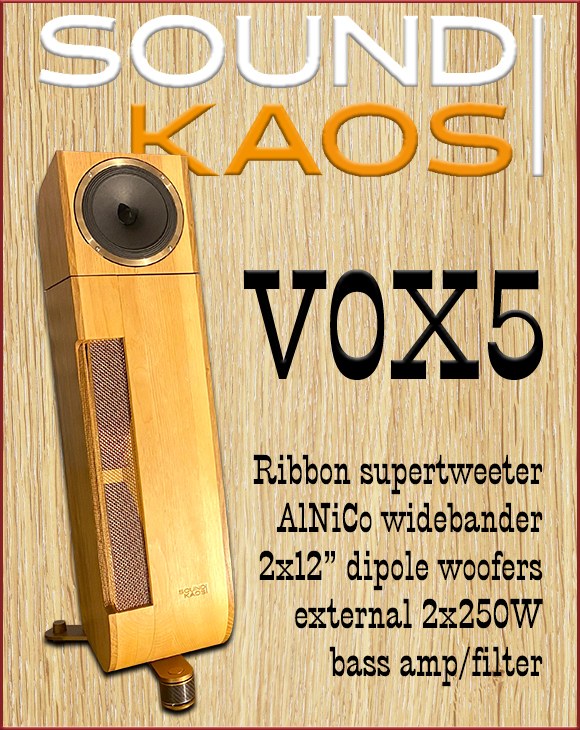
End of? Now it's time to bring this review home to its conclusion. If I built my case properly, the prosecution should admit defeat and go home. Seeing how Martin and I have form, I trust that production will tidy up certain finish issues which my final-preproduction units exhibited. He freely admitted them a priori but didn't want to delay this gig further. Warsaw contributor Dawid will get a final production pair. Having reviewed the sound|kaos Wave 40 and Liberation whilst owning the Vox3 and Gravitas D15, I have first-hand experience with the brand's finish standards. I trust them implicitly. That being the case plus the Vox5's soulmate status against my notions of a perfect speaker, my most sparingly administered award manifested itself. I just came along for the ride. Which leaves the concluding paragraph.










Fox5. The Vox5 is a very foxy customer; and fox in the hen house of ubiquity. Whom it's not for I laid out already. See ya drone operators and home-theatre pressure chasers. Whom does this mass exodus leave? Open-backed dynamic and ribbon headphone fans who wish to project their current 6"/15cm ear-to-ear internal soundstage between two ideally widely spaced walls whilst not changing their overall gestalt. It'll also appeal to those open-baffle fans who love the breed's freedom from boxiness but can't stomach the room-divider aesthetics of stacked 15" woofers on a plank, all nasty bits hung out to dry. Those two camps are virtually guaranteed to get the Vox5 even were budgets or cosmetic ideals to protest. Everyone else interested in a more complete audio education than familiarity with ported/sealed boxes really ought to sample the Vox5. How they'll react is unpredictable when the sensation of its LF stands the pressure-bass'd norm on its head. Just like vacuum tubes and e-stats are rites of passage—there are far more—so ought to be folded-dipole bass and filterless widebanders. Both are distinctive solutions for very specific problems. If you don't have these problems; if you're not sensitive to these aspects… then they'll obviously won't interest you. If you don't feel sick, why see a doctor?
What are these five problems?
♦ Time confusion in the critical 1-4kHz range.
♦ Multi-driver patchwork.
♦ Non-adjustable bass whose passive filters compromise woofer control.
♦ Pear-shaped textures that are well damped above the ~200Hz beltline but stop late to linger, bloom and boom below it.
♦ Timing blur from ringy bass that infects the vocal band to compromise its resolution.

The Vox5 addresses all five points in the most compact form factor. This includes the XO² filter/bass-amp box which couldn't be tidier. By solving them, it undermines the vexing room-response iffiness; and who doesn't love a sure thing? It won't drive, energize thus trigger an enclosed space like conventional speakers do. Its adaptive bass adds vital customization which passive speakers haughtily dismiss no matter their cost. That's it. That's the Vox5. I consider it a triumphant packing job; a timely standout in a sea of sameness; of home-friendly dimensions and look; and simply a far smarter way to do playback in rooms which are 'treated' only with furniture, curtains and carpets like civilians do it, not recording studios. What's the opposite of smart? Now canvas the total speaker sector. Do the math. Take your time. You'll find shockingly few examples that intelligently deal with room issues without resorting to DSP. That works too; in the amplitude not time domain. DSP will easily sync a multi-way speaker's wave launches. Once such nicely time-aligned sound hits the room, its LF still propagate in all directions. They still reflect off all boundaries and furnishings to arrive late and in the process, linger, drone, blur and fail to stop when they should. Here it's far cleverer to not radiate scattershot LF in the first place but instead shape directional bass. That's no myth. Not all bass is omni. Cardioid DSP speakers from Dutch & Dutch to Kii and Sigberg have already proven this very effectively very many years ago. Sans DSP, our options simply get fewer still. The Vox5 is one such rare exception; with RiPol¹-derivative bass.
Nothing new under the hifi sun? Not quite!
______________________
¹ For unrepentant fans of pressure bass, here's how to easily make a sound|kaos hybrid. On how to add RiPol bass to your existing speakers, go here.