Vox5's finely grained adjustability in active mode gives us control over not just our relative bass presence but its dose in the vital upper-bass/lower-mid transition. By slightly up/downshifting the filter frequency, we can add or subtract a bit of weight. This has more influence on our perception than a baby click or two on the dial might suggest. Being dual mono, we can even account for asymmetrical rooms. In what would otherwise be a standard 90° right front corner, my room has a diagonal fireplace hidden behind my wife's painting. With the Vox5's stereo subs, I noticed in the soundstage a slight left shift of the LF. My usual sub's central location never did that. Simply notching up the XO²'s right-channel bass gain by two notches re-centred it. This situational responsiveness of the XO² has my vote over the passive filter on sheer principle. Whilst by dumb luck the passive setting could bed in ideally—we'll still get to that—I shall always fancy having full control over so vital a thing even if it's only to respond to a short-lived mood, club/dub session or very low playback SPL which all might want a temporarily goosed bass response. Moving room or house also becomes a lot more attractive when our speaker can adapt over the long haul. It's why active adjustable bass has had my vote ever since I first split classic 2-channel playback into 2.1 threesomes. Except for my office desktop, my four other systems all use dedicated subwoofers, three of them with external active analog crossovers to also high-pass the mains for more accurate dovetailing. Before I began tweaking my final XO² settings, my default start with the bass attenuators at 12:00 and the low-pass at the recommended V5 was very close already. Whilst 200wpc bass drive—300W peak—doesn't read endowed when heavy-coned mega subs advertise 1'000 watts or more, I wished for naught even during massive attack bombast and still had beaucoup untapped gain on the XO². It explained Martin's declaration of having found nothing better to drive his woofer arrays. Would my ~€5K combo of spl Crossover MkII and Nord Acoustics nCore-500 monos amps press that point? We'll get to that momentarily. First a big shoutout to Martin's triple-wire suspension isolators. Whether we subscribe to the constrained-layer approach of Magico & Wilson; to Stack Audio's particle damping; to Carbide's elastomeric/roller-ball mix—subwoofer-capable loudspeakers demand that we attend to their floor isolation to negate vibrational transfer and resultant structural resonance. The Vox5 practices that observation rather than humouring us with the myth of the mechanical one-way diode called spike. That the Vibra 68 are much easier on parquet, tile, brick and stone flooring is a lovely side benefit. A parallel kudos goes to transistor-based R&D which didn't groom the Vox5 for vacuum tubes. All my listening took place in the solid-state domain, with the preamp a fully balanced autoformer passive.
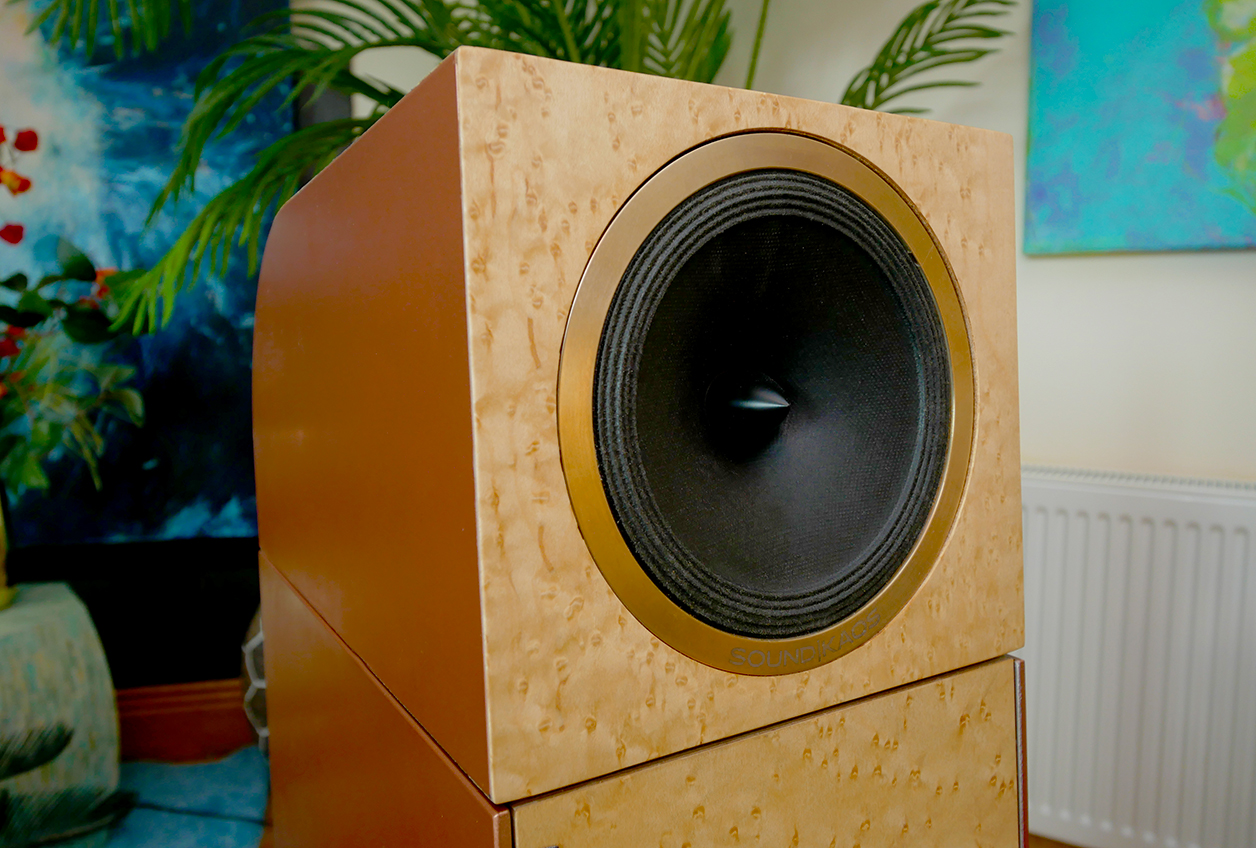
Enter the either/or myth. I'd wholeheartedly believed it. Going faster meant going lighter. That implied shedding weight when undue saturation and mass soon obscured and cast long shadows. Since the new millennium, observations to that effect had accompanied my reviewing career. Night and day. Summer and winter. ♂ and ♀. I'd accepted duality and made my path between its equally alluring extremes. After many years I ended up reasonably near the middle if arguably a bit closer to the polarity of adrenaline action. The Vox5 now showed how to add mass of richer sustains without getting congealed, syrupy or lazy. Flamenco guitar maestro Antonio Rey retained his transient fire and cleanly separated arpeggios. Accompanying cajon slaps cracked with real violence. What the Vox5 changed were tonal colour temperature and density. Those gained gravitas. Getting extra G from a light 6" diaphragm not 10.3" Eminence-based Zu cone which goes more opaque as it ascends frequencies is one of the Vox5's two super powers (folded open-baffle bass is the other). This AlNiCo-powered Armin Galm driver is a different customer. It's still of winged foot like Hermes so quick and astute yet packs the punch and follow-thru of a heavier slugger. Equally fortuitous is its rapid acoustic decline at ~150Hz. It allowed Martin to segue in the bodacious cone surface of twin well-damped 12ers in the power region without having to cut this very special widebander with a high-pass filter. Replacing the XO² with my usual three-box set had spl's high-pass inactive to send the Vox5 head sections an uncut full-range signal. The low-pass sat at 120Hz/2nd-order, power came from 700W/4Ω nCore. Whilst still tauter in the bottom and a bit more present at 25Hz, the overall difference was surprisingly minor. At half the layout and a more compact footprint, the XO² made a virtually open and shut case for itself. Might my solution's extra grunt make more headway in bigger rooms? I couldn't say. I don't have such rooms. As far as raw 25Hz output went, a quick fiddle with Audirvana's embedded EQ to lift 20Hz by 3dB took care of the XO² difference. Done.











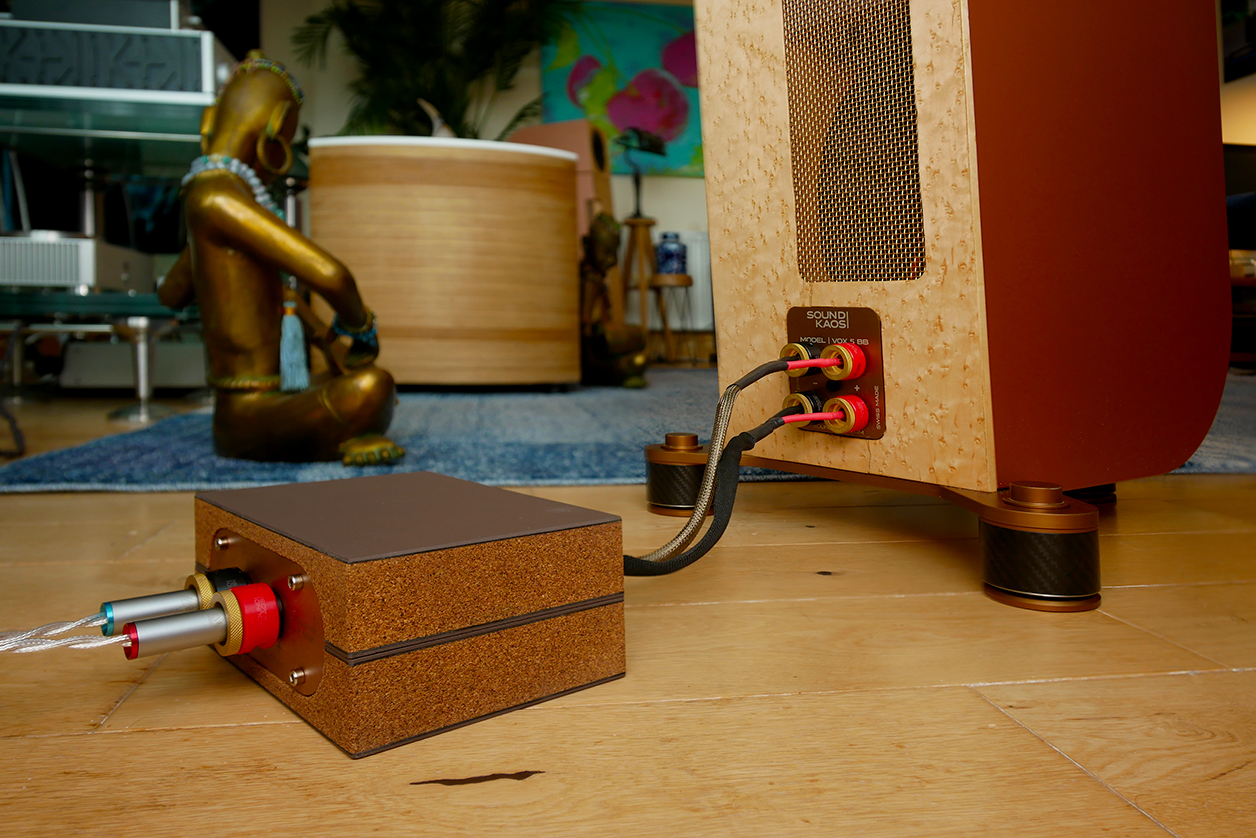
With 300/560wpc into 8/4Ω, my Dazzle integrated in power-amp mode to bypass the slower fattier preamp gain stage is an elegant muscle amp on premium lateral Exicon Mosfets. In passive mode those now drove the entirety of the Vox5. Martin's external filter in its natty layered cork/linoleum box conveniently adds pass-thru pigtails for the upper section. Hence a single wire run off our power amp suffices as shown next. In this room, the switch to the outboard filter made the overall presentation feel a bit less driven. It seemed more relaxed, loose and (dare I even say it?) passive. The low end was a bit softer and lardier. High-current class D with gauche SMPS direct-coupled to two parallel woofer voice coils had the upper hand over more powerful far posher linear-powered class AB facing passive filter parts. Sorry, Kinki Studio. Knowing the Vox5's active potential by direct contrast, I suspect that all buyers will want the XO²; and that Martin can spare himself the built-in passive option. This wasn't a function of bass output but control. Muscle mojo not might. The possibly best qualifier for the offset is virility. Active mode strutted 20-something testosterone. Passive mode was in its fifties to exhibit natural testosterone depletion. To hear Vox5 at its most youthful, go active. Beyond the most welcome personalization options of relative bass power, l/r bass balance and filter hinge, active drive benefits music's muscle tone and with it, energy transmission and optimal rhythmic tension. After Vox5 had already done a number on my long-held beliefs about how much embodiment is possible without falling prey to sticky gravitational drag, at least my other belief—about the superiority of active drive particularly in the LF—was vindicated. My self image (cough) was only half dinged. Didn't that imply it was still half perfect? I'll go with that. I'm a glass-half-full type. Cheers.
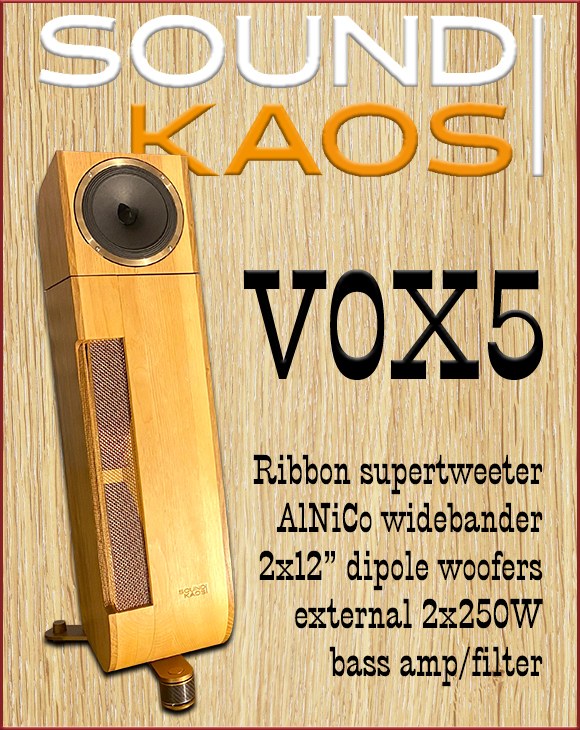
Let's wear out another belief. Sans whizzer, nobody not already familiar with this breed would credit a large paper-cone midrange with any HF to speak of. Though the true ribbon obviously fills in, knowing how it enters on a shallow slope at a high 8kHz then fires up not forward should conjure up visions of opacity, hoodedness and darkness. Already the 6-inch SB Acoustics Satori papyrus cone of my Qualio IQ knew otherwise. It too runs wide open to an octave above music's highest acoustic fundamental. Such behaviour is simply not what audiophile schooling teaches where proper tweeting belongs to dainty 1" domes. Suffice to say that my ears which call Mundorf's big dipole AMT their favourite tweeter followed by Raidho's monopole planarmagnetic, the Vox5's combo of unfiltered widebander + filtered ribbon telegraphed no lack. That's a bit of a mindbender but how the speaker's deep incarnation factor comes off without feeling slow, portly or benighted in the word's original meaning of being overtaken by darkness. Close-mic'd upper registers of violin and piano assure us of this in a hurry. In the next breath we appreciate why the Vox5 couldn't be the airiest of players. For that we'd want a frontal micro-mass driver operated across greater bandwidth than this Raal. Choices. Each one has consequences. Each one participates in any product that's populated with many different engineering decisions. The Vox5 performs as described precisely because of its specific choices. Change its tweeter system to some beryllium/diamond exotic and cause inevitable shifts elsewhere to dilute the present tuning, hence diminish what makes it special. Now we have the Vox5 basics. Specifics next.