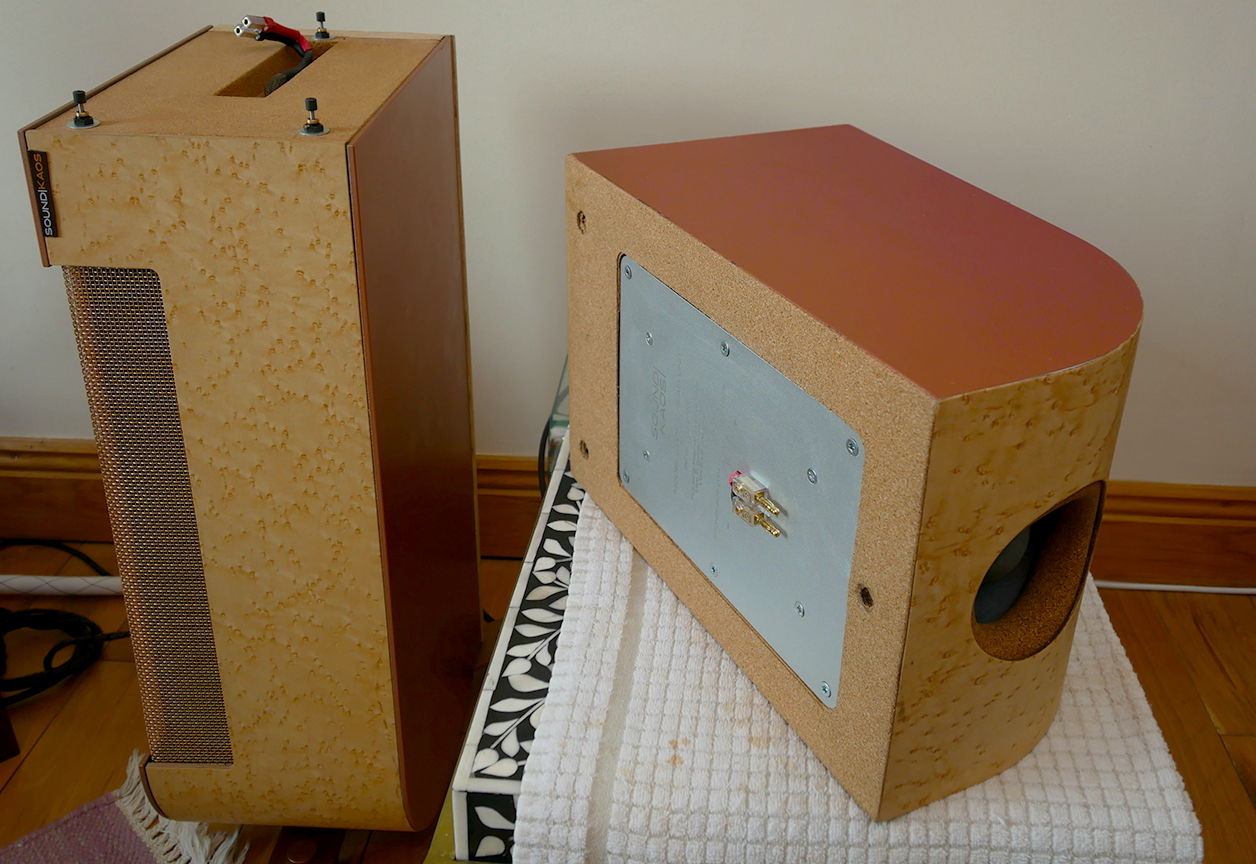
At the movies. Easing the downstairs shlep, I disconnected the heads. The bass bins were surprisingly heavy. With cork mostly air, the woofer magnets in particular had to be the culprit. Below we see the secret handshake of hidden horizontal bananas; and three micro shocks which decouple head from torso. My diagonal layout in this nearly square space minimizes room issues whilst the speakers park close to what here become two 'escaping' front walls. It's a very simple setup of region-free Oppo BluRay player and Gold Note IS-1000 SE integrated. Having already done the music biz, I now checked on speech intelligibility, retrieval of location atmosphere and what dipole bass did for (or against?) blockbuster bombast and mayhem. Starting with a clearly tarnished talkie/oldie on occasional rotation, the 1981-1991's series Bergerac set in the Channel Islands served up speaker pearls to production swine. Looking and sounding as dated as the original run time would suggest, this perished fare long past its sell-by date offered naught for the Vox5 to dig its teeth into. No silk purse from such pig entrails. Memo to Cap'n Obvious: garbage in, garbage out. I needed far more polished production values. For proper spice, Dune Prophecy to the rescue which first aired two years ago. Now I was cooking with gas. Given the earlier pages, it won't read surprising that dialogue clarity against background action was premium. Unless we cheat with subtitles, that's routinely a modern problem when actors mumble under their breath whilst the scene-setting noises and background music are too loud. Despite close wall proximity, layering too was good. Where particularly the HT crowd will disagree was the downstairs. Here's why. Unlike a live concert's reality check, for movies we lack any keep-it-honest measure. Who knows what a dinosaur roar is supposed to sound like; the black-hole implosion of an entire planet? Our cinematic version of the concert proof used to be the movie theatre with its THX-certified LF generators. Post Covid, certain blockbuster soundtracks like The Odyssey are again mastered for the big screen with its take-no-prisoners acoustic artillery. Such experiences become the blueprint for what explosions, train crashes and torpedo hits sound like when for most of us—thankfully!—all of it is pure speculation and make-belief in the first place. We lack exposure to the real thing. Whatever subsequent comparison we make at home, it's against a cinematic experience based on serious bass pressures at very high SPL. Movie houses don't run RiPol subs.
If we double-task our hifi for TV duty as John Darko does; or set up our video system as a standard hifi like I do—the bass difference to the movie theatre is a given. Our kind has no ambitions or pretensions at duplicating it. Home-theatre folks however do pursue a facsimile. For them, Ridthaler-inspired dipole bass just won't do. They'd merely clone Martin's Klangschloß visitor who dialled up XO² gain to max and still couldn't feel the bass. Whilst RiPol bass is most astutely heard, it's not felt as a pressure wave like omnipolar box bass that's played low and loud enough. Listeners prioritizing intelligibility perhaps even dialogue-driven films over spectacles will love the Vox5. Wannabe action heroes will call it weak sauce and move on. Polarities. They can be divisive.
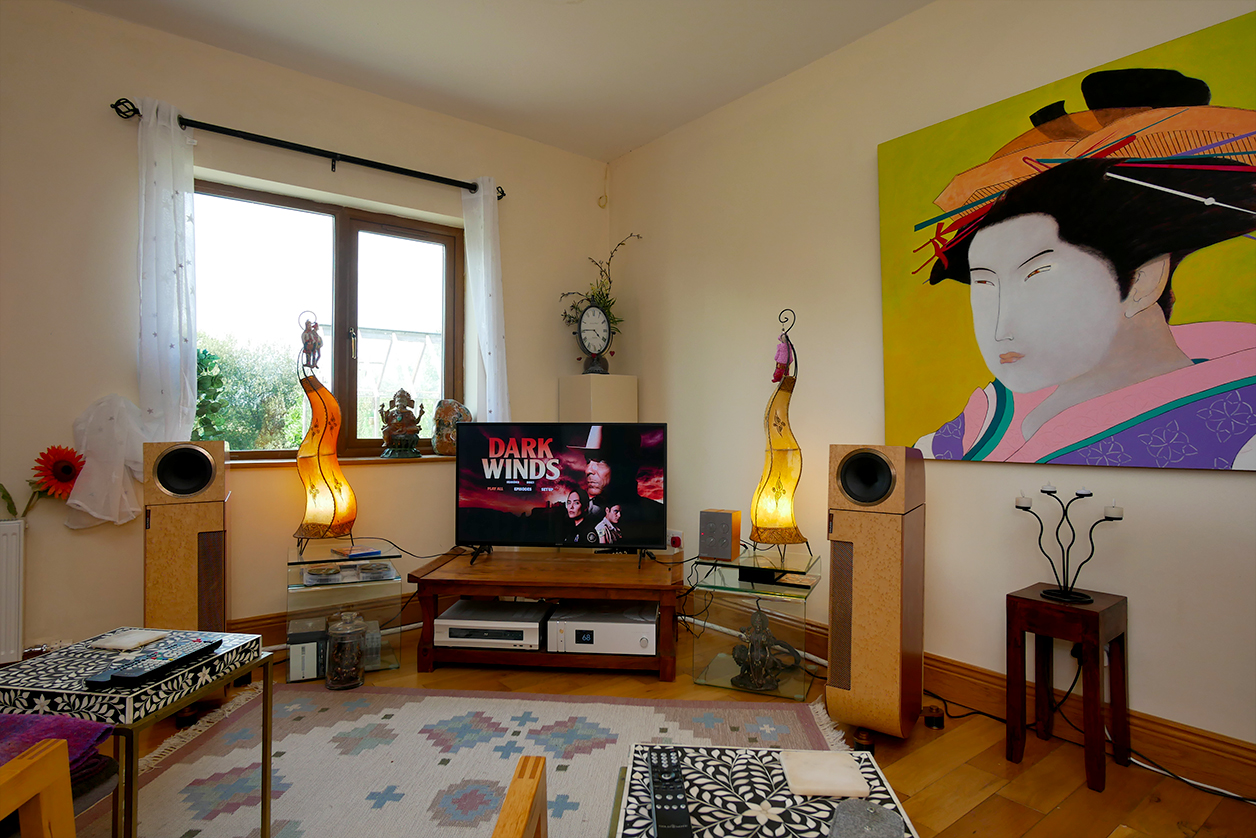
Having explored my three listening stations suitable for the Vox5, the final repertoire of this gig returned to where my audience of one had applauded the loudest. Enter actual music samples to wrap up this meandering tale with audible illustrations. It did require another temporarily headless shlep up the stairs but part of being a personally perfect speaker meant that I could on both size and weight. And to be sure, the choice of smaller system wasn't because the Vox5 couldn't fill the bigger room. Far from. It was because of its more lit-up amp profile; perhaps even sloping ceiling adding advantageous reflection angles to the ribbon tweeters. If I could combine the minor voluptuousness of downstairs with a more lit-up top end as my nearfield religion fancies it—why not? Grow old enough and not only will you know exactly what you like; you'll no longer apologize for it as though personal taste were up for debate. Of course a speaker designer too has her own taste and room/s. Unlike a buyer, he simply hopes to please a large audience. "With that extra low-end reach it's only natural that the Vox5 could strike some as a bit bottom up. I simply can't pinpoint whether it needs a bit of extra top-end sparkle. I got partial feedback over the weekend as a guy literally walked in off the street asking whether he could have a listen. He teaches industrial design at Zürich's ETH and was riding his bike past my house. His home reference is the Boenicke W8. When I switched from Vox5 to Vox3, he quickly asked to go back to the 5. He thought the 3 too bright." I'd personally never thought my Vox3 even remotely bright. In direct contrast to the Vox5 of course, it can't help but sound lighter. Comparisons. They can alter our perception. The underlying mechanism is often 'we don't know what we don't know until we do'. 'Until' is shorthand for a chance encounter that broadens our horizon and resets our value system. Suddenly what we thought fab is only meh. Could it be what birthed 'ignorance is bliss'?










 Before we face my final music, a last brief bit of biz. Awards. Their functions are a few. Recognition of excellence. Banging the drums in an increasingly noisy capitalist jungle. Alerting the scene: this is how you make a better mousetrap. Informing buyers: this deserves prime attention if you're shopping. Should a publication or writer keep bestowing awards to the same brands year after year, they lose credibility no matter how earnestly meant. Help and huzzah turn to hindrance. Having awarded the below Vox3, should my hands be firmly tied? If Alberich² eclipsed with an award, how could the Vox5 not just because it birthed second? Doesn't our speaker industry sorely need reminders on how to build better speakers that don't play Russian roulette with our actual in-room results? For every lonely Silent Pound, Treble Clef, Dutch & Dutch or Kii, regular ported and sealed boxes are same-old legion charted all the way up into the fiscal stratosphere. The next page will show how I answered these questions. Time for some tunes. Let's start with "Di'vaneh" from Jamshied Sharifi's One for its big and small drums, crisp bass line, synths, African vocals, soaring winds and generally cinematic soundtrack vibe which asks us to play it loud. So I did. Wowsers!
Again, it caused near disbelief that my narrow room could host such vigorous fare at these SPL with no inner-ear ringing from being locked in a disagreeable pressure chamber. Using my mind as attention laser, I could zero in on any musical thread, touch it loosely and not lose hold regardless of how low it reached or what happened simultaneously. This structural and textural apartheid which refused to bleed and clump fed my inner voyeur who enjoys parsing a composition as though it were an endlessly motif-multiplying Bach fugue. In the next moment I could turn off the laser and listen from the gut because that felt nourished by wet rootsy substance. Occasionally I even managed to occupy both belly and head; at once. Should I see my psychologist for multiple personality disorder? Jest aside, the Vox5 can appeal to both sonic inspectors and self-forgetful ravers. With its true full-bandwidth resolution, we can count the leaves high and low. With its bass arrays' air displacement, we can simply indulge in grooving and burn the notebook.

 Next up was "Noah's Dream" from Asita Hamidi's Blue Bazaar, a dense very dark dynamically compressed cut of electric upright, acoustic six-string bass guitar, layered bass synths, electric concert harp, Sujay Bobade's bansuri, alien voice effects, assorted hand drums, daendji and gu-cheng. The hand drums and clay pots in particular often exhibit such sharp cracks that the body/mind reacts like Chai Baba does with unfamiliar noises: on full survival alert ready to bolt should a sabretooth lurk beneath the bed. To come off to maximum adrenal releases, this crack currency depends on steep rise times followed by impeccable damping. With that in place it's hard not to flinch the first few times one hears this track on speakers as astute as the Vox5. Because the mastering engineer applied red-lined dynamic
  compression, our transducers must apply extra vivisectionist skills if we mean to wear the aural inspector's hat and separate out all these intersecting tendrils. The Vox5 was as capable as my best headphones.
Next up was "Mapushanelere Attım Postumu" by Turkey's acoustic Rubato project and their very first album Bir/One. It combines cello, bass clarinet, oud, cümbüş and octave-doubled male vocals for a mood very darkly hued. Thematically there's precious little going on. The simple narrow melody returns over and over like waves lapping the beach, varying only in which instrument, voice/s or combination plays it. Melodic or harmonic explication isn't this thing. The real attraction is timbral. This is a veritable baritone orgy of  saturated tone which the Vox3 renders less earthy and melancholy. With the Vox5 is was like eating 90% pure chocolate, walnut nougat or a Mixtec mole: rich, chewy and thickly layered.
For more tantalizing timbre tasting I cued up "Anomaly" from the eponymous breakout album by Jasdeep Singh Degun featuring solo sitar against a string ensemble with tablas. It's an elegiac asymmetrically metred tune that's unafraid about being gorgeous, period. If you're a super model, what to do? Haters unite. This one seamlessly switches between major/minor harmonies, an alien concept in classical Indian music which focuses on melody and rhythm, not chromatic chords. Massed strings alone are a perennial hifi challenge. Add the sitar's scintillating sympathetic strings and our flowing honey needs a spiky infusion of hot chili flakes. Those hot bits rose higher, brighter and more piquant than they had downstairs. Having heard plenty of live sitar during my San Raphael days in the Northern Bay area, that's just what I wanted. When captured as this recording did, those resonator drone strings should seem to refract sunlight and cut through surrounding thicket and sweetness.