As though to show off Olympian-level fitness for inventiveness, Martin then threw us a curveball. "Incapable of switching off my brain, by the end of last year I thought on how to combat the rising costs of CHF 3'000-4'000 per m³ of solid Maple or Walnut. I'd try compressed cork instead. I sourced a Portuguese supplier and some large blocks arrived in early February. Simon would machine them on his CNC. Having no idea whether this material would suit acoustically or machine properly, I didn't mention it sooner. The existing geometry of the midrange enclosure had sounded just a little lean and insufficiently warm in the lower midrange. So I created an internal 3D-printed twin tube for resonant and damped chambers. I had already modified an existing Spruce enclosure with the new tube. It was promising on sound and measurements but the real 'aha' came when I transferred the tube to the solid cork enclosure. We all know of small incremental improvements. This was far more drastic. Clarity and detail went through the roof and my main search for calmness finally ended. It feels as though what I've been listening to for the past few months was a ~20% reduction in distortion or noise. I suspect a combination of factors. 1/ according to research, due to its cell structure and flexibility, cork is a far superior absorber than solid wood. 2/ with the new inner tube I partially cover the widebander's back so reflections largely dissipate in the outer chamber. There are only three slots on the tube which allow some back pressure to escape into this volume. The main thrust escapes through the inner tube out the back. 3/ the driver no longer bolts to the front baffle. It now pulls into the baffle via two torqued steel wires which terminate at the rear. A lot of mechanical energy dissipates along these wires like my Vibra footer tech. Additionally the porous cork absorbs vibrations where it contacts the driver."
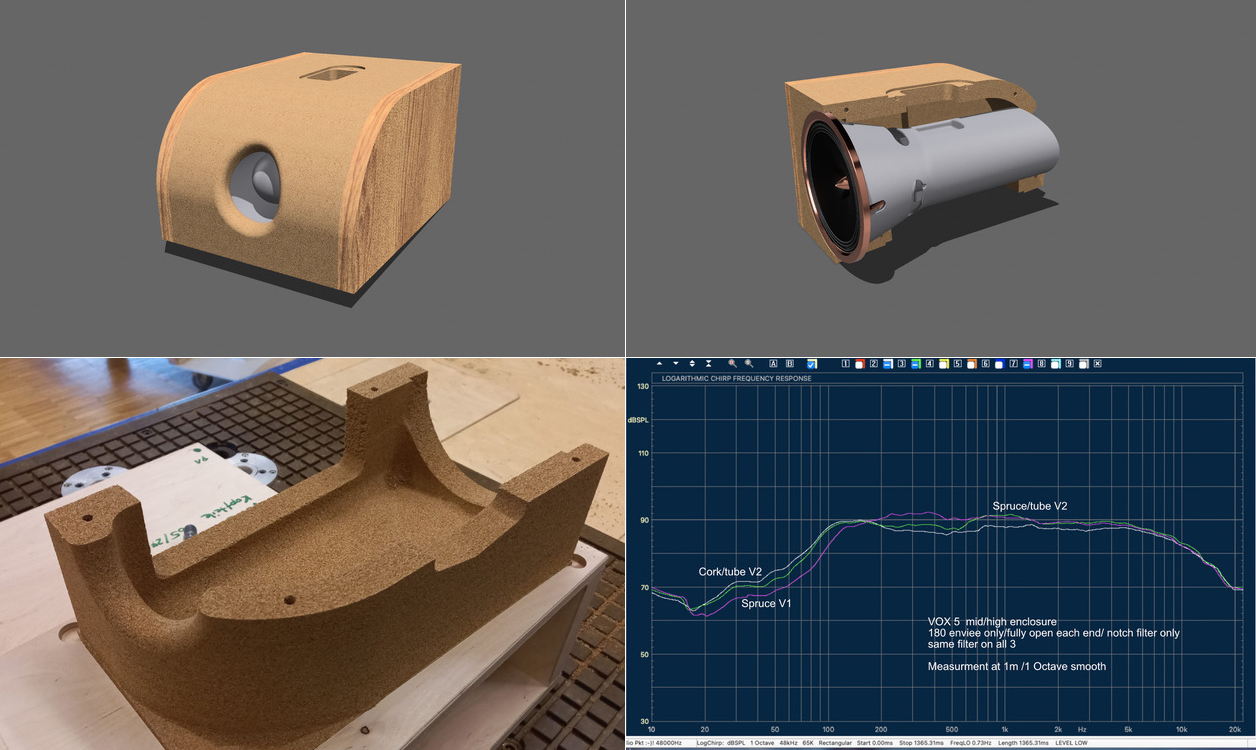
"The flipside is a lively enclosure that needs a bit of outer mass to calm down. It will have everyone resume the old argument about dead enclosures like the first time we showed the Wave 40 in Munich. A recent listener came up and said that he'd put his hand on the enclosure which felt very lively. I'd watched him for at least 20 minutes during the presentation which he seemed to enjoy. He confirmed that he had enjoyed it very much indeed. So where was the problem? Convention demands rigid enclosures he replied. Above are some renders and a photo of the new head unit plus a frequency plot. You can clearly see extension to below 100Hz from v1 to v2 and different behaviour between wood and cork from 250Hz-5kHz. I assume most of that difference to be noise since I measured at the same 1m distance and used an identical notch filter on all three versions. There's still a peak between 700Hz-2kHz which needs addressing. On weight I'm currently at 32kg/ea. which might change slightly depending on the dress panels. Width will increase to around 225-235mm." With my exposure to cork limited to the occasional wine bottle, I needed a brief primer to understand the different quality and thickness of Martin's new raw building block.












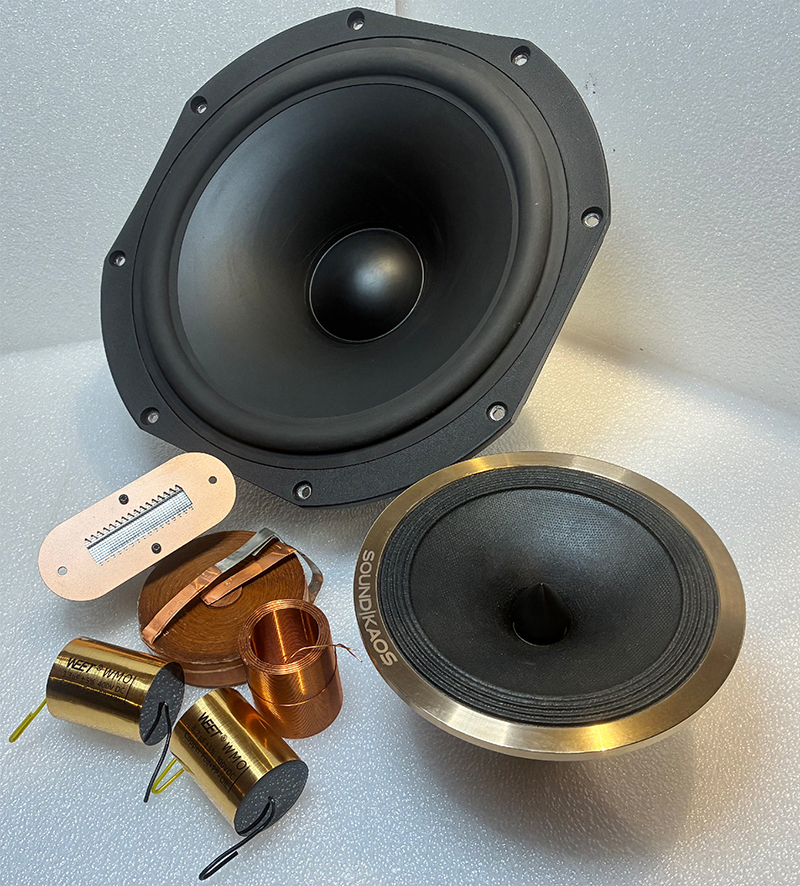 "Here are a few details I picked up on cork which derives from the bark of cork oak. When acoustic waves hit cork, the material absorbs, damps and scatters the energy. This occurs because cork's cellular honeycomb structure makes it a porous material of ~40'000'000 air-filled cells per inch³. When sound waves enter these pockets, their air compresses and expands, converting acoustic energy into harmless heat. Depending on thickness and installation, cork typically has a noise reduction coefficient aka NRC of 0.3-0.7 to absorb from 30-70% of the sound waves hitting it. Cork was first studied under the microscope in the 1660s. It was in fact one of the first materials which Robert Hooke, inventor of the microscope, studied. This is likely because for millennia cork bark already had been a well-known anomaly of the natural world due to its flexibility, light weight and regenerative ability. What Robert Hooke discovered helped explain the differences between cork bark and most other naturally occurring materials. Under a microscope, cork shows an irregular honeycomb structure quite different from the rectangular shape of most wood cells. This wavy structure allows cells to behave like corrugated cardboard, creating the flexibility cork is renowned for. Since these are closed cells, they do not absorb liquid. It explains why cork has been the preferred bottle closure material since ancient times. Notably only 15% of cork is solid. The remaining 85% is trapped air. This makes cork incredibly lightweight and buoyant. The trapped air means a density of 15% water, allowing cork to hold several times its own weight while staying afloat. In addition to being flexible and buoyant, cork's cellular structure exhibits remarkable thermal properties.
"This has created markets for cork insulation in weight-sensitive industries like shipbuilding, aerospace and commercial building applications. There is no other man-made or natural material which combines all of cork's properties. It is lightweight, rot resistant, compressible and recoverable, expandable, fire resistant in its natural state, impermeable, soft and buoyant. Because of this unparalleled combination of properties, raw cork has many applications. With its lightweight honeycomb structure and flexible membrane, cork is ideal for stoppers and floats, floor and wall coverings, gaskets, clothing and coasters. It is beneficial for buoys, floats, fishing rod handles, level gauges and an excellent filler including shoe insoles and soles.
"Cork can be pressure fitted against a bottle's wall and when released a hundred years later, bounce back to its original shape. That's perfect as a stopper but also for floor and wall tiles. Cork does not rot due to the suberin which makes it impermeable to gases and liquids. That's ideal for bottle stoppers, gasket sealers, joint fillers, floor underlayment and bulletin boards. Low conductivity from sealed air cells works on heat, vibrations and sound to make for one of the top insulators and acoustic capacities of all substances. The honeycomb structure gives cork a high friction coefficient to be very durable. It does not absorb dust and in its natural state is fire resistant so ideal for building products including floor and wall tiles, cork wallpaper, rolls and sheets. In technical terms cork is a porous absorber. It's most effective at reducing mid-to-high frequencies like voices, keyboard clicks or TV chatter. But cork doesn't block sound like a dense barrier. Instead it soaks up and diffuses some acoustic energy to reduce in-room—or in-speaker—reflections. When sound hits cork, part of it reflects but a significant portion gets diffused and trapped. It's what makes cork sound panels so effective at controlling reverb and improving room acoustics. In our sector the Sonus faber Concertino G4 cabinet already uses recycled cork innards."
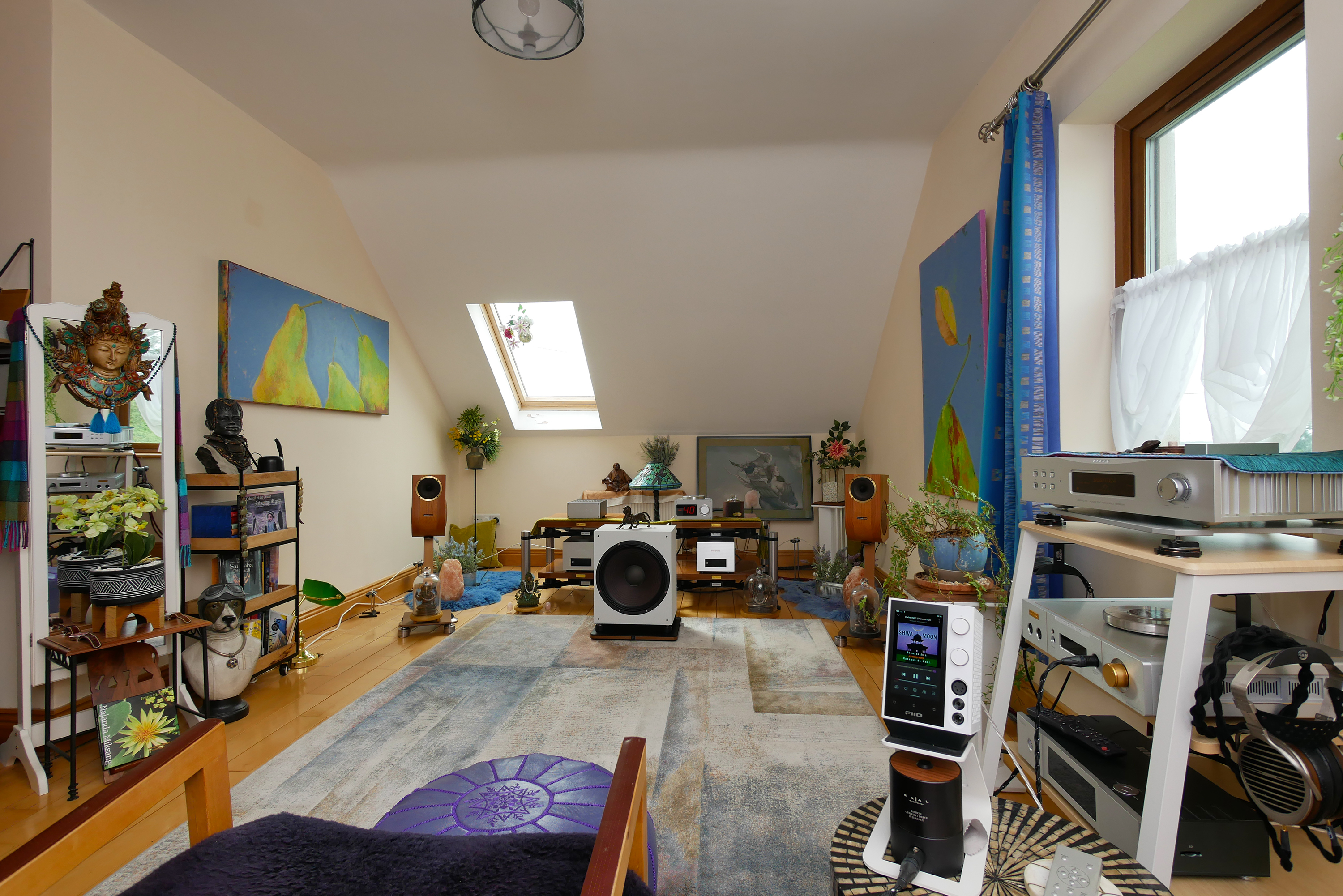 sound|kaos Vox 3awf and Zu Method sub on 40Hz/4th-order high/low pass to fill in the bottom octave. Source SD card transport, USB bridge, 1'024 DSD DAC via I²S. Volume control by balanced autoformers.
By mid June 2026, Martin was still undecided whether cork could at least partially migrate also into the bass cab where far higher mechanical energies put greater strain on the structure. For visual continuity, the wooden dress panels over the head unit's cork core would obviously continue all the way to the floor either way. The electrical connection between head unit and bass cab executes with bananas to be invisible once docked. Martin also still debated whether to offer a part-active and fully passive version or only the first. Thinking readers took knowing note of the widebander's change from loading by scoop port to twin-tube cartridge. It's a reflection on a common dipole observation. For all their admirable unstuffy openness and advantageous dispersion pattern, absence of box loading can render their power region leaner. Giving it some resistive loading counteracts dipole tendencies for lack of power-region weightiness. We also appreciate how the above amplitude-plot changes were purely down to enclosure material which modulated internal reflections and their effect on the measured frequency response. Against Martin's assessment of robust clarity and resolution gains from the cork cab, we suspect that cork's porous ability to absorb mid-to-high frequencies greatly undercuts internal rear-wave reflections which no longer radiate through the lightweight cone delayed in time and rotated in phase.