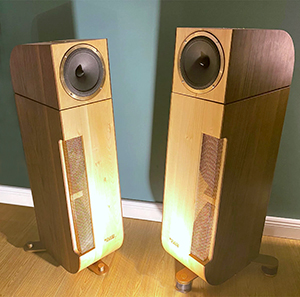
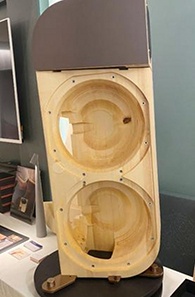
 Lazy readers wonder why I didn't whittle my narrative down to the final product to instead include abandoned R&D steps like the scoop and solid-wood build. It's to illustrate how Vox5 decisions weren't arrived at arbitrarily. This lengthy project underwent much iterative prototyping and a number of outright revisions. Whilst in solid tree the design was pretty much locked in before the turn of the year [left & right], Martin's cork adventure created more rounds of trials and challenges. It's how curiosity-led R&D spends ever more time and money. If I wanted to try my purely analog active spl Crossover MkII, Martin thought that with cork's effect on the response, spl's 120Hz/2nd-order low-pass option would probably match that of his own XO² very closely. With that I could even apply my usual 700w/4Ω NC-500 based Nord monos to his bass system. Importantly, the filter adjustments in his XO² too are pure analog-domain circuitry to involve no A/D conversion, DSP or digital latency. Again, the dipole bass array's ~250Hz self resonance which here isn't brute-force brick-walled wants a low pass setting whose frequency/slope combination keep it out of band.
In June I'd penned a follow-up feature to a podcast with Australia's Andrew Hutchinson before Dawid Grzyb and I aired the first episode of our new podcast. The gist of my feature was Andrew's Vienna HighEnd 2026 vexation at crowning his favourite sound of show a vintage whizzer-coned widebander with active drive and DSP correction. How did this gel with Vienna's mass sightings of diamond tweeters and hi-tech nano-coated composite membranes? I'd simply failed to learn specifics of Andrew's Vienna discovery. A month later, Martin had more. "Great stuff on your new 7th Moon podcast with Dawid. Also saw your podcast with Andrew and your piece Nothing new under the hifi sun. I'd already found FS Musical Systems on the web. Their widebander looked familiar. So I asked Armin. It is indeed his 21cm Envieé. So nothing new as you say; apart from price. They want €89'000/pr just for the DSP-corrected monitors."
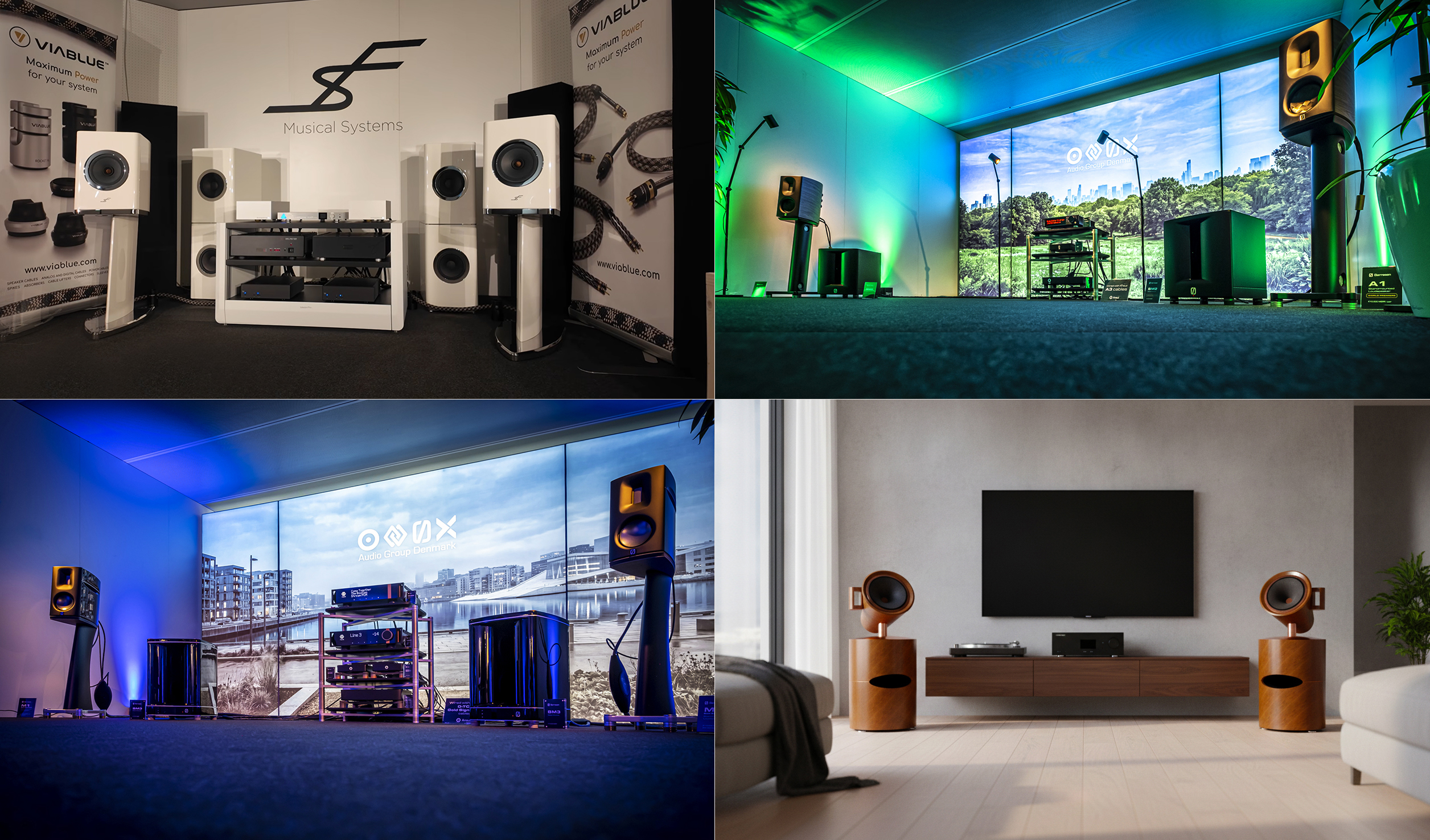 Upper left from Andrew's show report. Click image to launch then select time code 23:00 for the FS segment.
No wonder Andrew had enjoyed an 8" Envieé. Not having heard it, I can't comment on its implementation. I simply much prefer Martin's pricing for a true full-range solution without big external stacked woofers. So we can even include the sticker in his think-different tune. The same sentiment would have accompanied another exciting Vienna 2026 demo [above, upper right] captured by Warsaw contributor Dawid: Børresen's exhibit with €16K/ea. 4×8" gloss-lacquer RiPol subs and €100K/pr 5¼" 2-way monitors. Closer to Vox5 terrain would have been the simpler Børresen room [lower left] of ~€10K/pr 5¼" 2-way monitors and €8K/ea. 2×10" RiPol subs. The Vox5's possibly vital contribution to this micro niche is equivalent functionality in two not four enclosures. Depending on real estate and décor demands, many shoppers could have a strong preference for fewer enclosures. "Doing the bass bin in cork did sound tidier just like the mid enclosure but caused its own 49% material waste after machining so required additional work. It's not what I had originally envisaged but sonic benefits must take priority of course. I'll update you with some photos later this week." At this rate the Vox5 was bound for County Cork across the river from where I live. From a John Darko news post on the new Sonus faber¹ Olympica range: "… The Olympica III and Olympica V add cork damping to the mid-high chamber which the company says trims resonances still further." Pop that cork? For an insider's exposé on the challenges of regular non-folded dipole bass which we know the Vox5 deals with differently, read this. Asking Martin about SB Acoustics' new Neo woofers referenced in the link, "spot on. SB have responded to rising OB demands. Such drivers all have much higher Qts² than conventional PA drivers and obviously a low resonant frequency as an absolute must when dipole mode gives you no loading other than folded RiPol/H-frame topologies. The original Audio Technology woofers too were designed for high Qts at obviously higher price points. I experimented with the standard 15" SB woofers in my bigger Gravitas sub and their LF output was nowhere near as good as my AT units. The 12" SB version in the Vox5 is a specialized OB unit with a 0.66 Qts. The 15" and 18" Neo version have even higher Qts² of 0.8 and 0.9 respectively."
________________________
¹ From Google AI: "The Sonus faber Suprema uses recycled cork to mould a truncated oval acoustic chamber behind its mid/high driver array. Cork was selected because it is a sustainable natural material easily shaped into complex organic geometries while offering exceptional acoustic damping. The irregular internal walls absorb and scatter rearward sound waves from the drivers, preventing reflections inside the enclosure.This minimizes the pneumatic resistance and backward pressure placed on the midrange cone and silk-dome tweeters. It also reduces distortion caused by natural harmonics and acoustic build-up, elevating the overall resolution and clarity of the mid frequencies.
² Qts or total Q factor measures the combined mechanical/electrical damping at the resonant frequency and expresses how well a driver controls its cone motion. Qts combines the Thiele-Small parameters Qms (mechanical damping) and Qes (electrical damping). Qts below 0.4 reflects a strong self-damped motor system ideally suited for ported or horn-loaded enclosures. Qts from 0.4-0.7 is the most common range typically ideal for sealed alignments. Qts above 0.7 indicates low damping so freer cone movement best for open baffles.








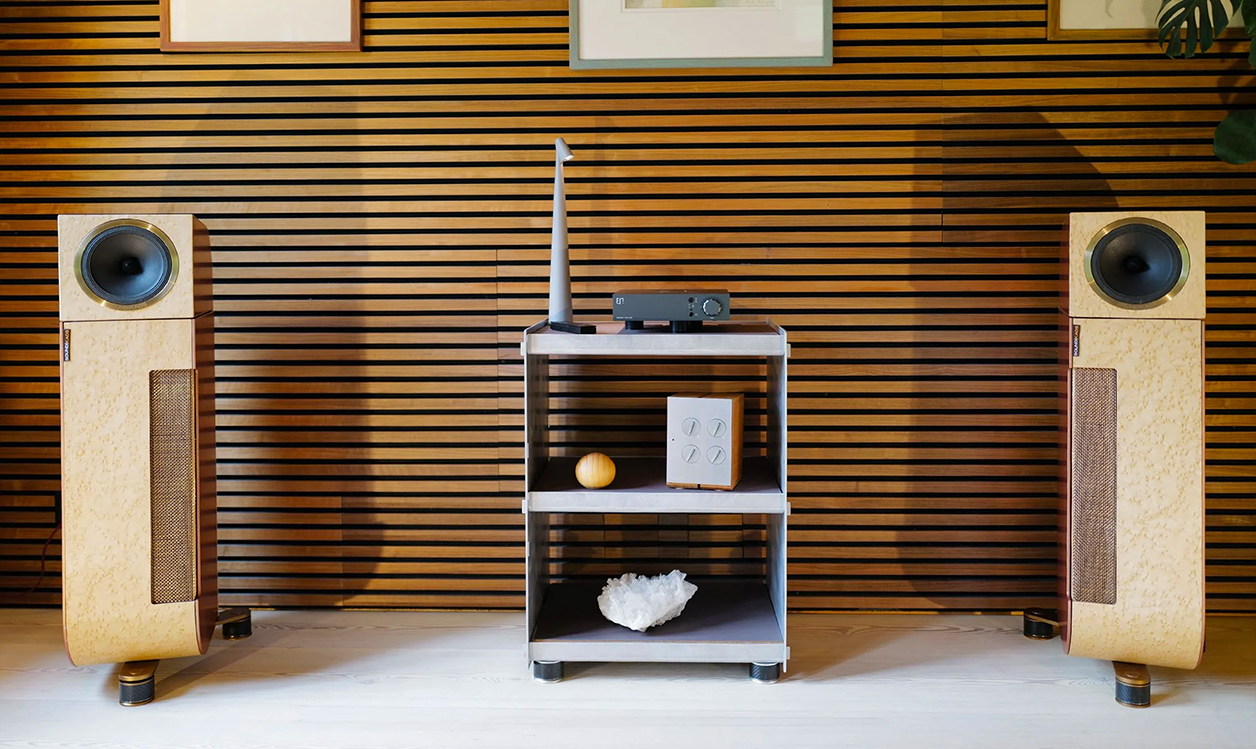
Where pencil-bound folk like yours truly would shoddily doodle on a napkin, a designer versed in 3D graphics can quickly visualize a concept in software. Martin's doodle [above lower right] illustrates what results when a classic twin-woofer RiPol array rotates 90°. Now woofer Ø enforces cabinet width and a face-on pair of 15" woofers loaded through a horizontal slot plus basket clearance and cabinet wall thickness mandate at minimum width of half a metre. By turning its woofers sideways then stacking one atop the other, the Vox5 achieves equivalent functionality in a much slimmer form factor that's easier on smaller narrower rooms. Just because it's possible to envision even manufacture a particular design, will it be a good idea in practice? Today's speaker sector has many an example where my eyes think that the doodle should have been torn up, the fancy 3D sim purged. But I won't mention names. Beauty and its opposite are in the eyes of the beholder: "Just before packing I took a photo. Décor of this pair is a bird's eye maple veneer with bronze side panels. I'm told it looks a little retro. Must be getting old. I was going to do a cherry veneer and started the XO² in that then saw that I had insufficient stock for the speakers to need a different finish. The slot covers have reverted to my signature bronze mesh for being more brand consistent. Now I must say that this first pair's cosmetics are not completely final yet. These 5mm bronze-anodized aluminium side panels won't feature in the final version to return to my established all-wood look. The thinking behind the alloy panels was as much damping as possible."
 Woofers in is the intended orientation to exploit the built-in directionality pattern.
 "But it turns out that the cork bass bin is far less lively than the midrange enclosure. As an open system, the air pressure from the woofers freely escapes front and back. For the top enclosure though I'll still go with solid-wood sides thicker than 5mm. In your shipment I included a pair of my optional external passive LF filters so you can experiment with both passive and active bass plus your own spl/amp combo. Because of the copious use of cork in the head unit, my three Vibra 30 isolators between it and the bass bin no longer fit to become three miniature shock absorbers instead. I'm not quite sure what damps more, those or the cork. Having both doubles up. The marked gain settings on the XO² are of course simply starting points. The voltage gain and power rating of a client's main amp and their desired in-room bass response could easily shift them." This game was finally at hand, both feet free to tap. Where far bigger very upscale speaker houses like Sweden's Mårten rely on IsoAcoustics, the Vox5 goes exclusive even on the resonance-attenuation front, with Martin's Vibra 68 isolators perfectly integrated into the tripod outriggers. Add the 3D-printed airflow cartridge for the whizzer-less Enviée with its custom bell-bronze basket and AlNiCo motor; the large-surface use of solid cork; the option of active or passive drive plus outboard crossover for the former; folded-baffle dual-woofer dipole bass; elite Raal ribbon – and this is an unusually condensed approach to full-range speaker design. Minus a source, the above setup chez Gateley runs his 25wpc Enleum variable-gain amplifier with the XO². That's a very tidy footprint for twin subs, a pair of 1½-way monitors, outboard analog xover, 200wpc bass amp and stereo main amp with remote volume.
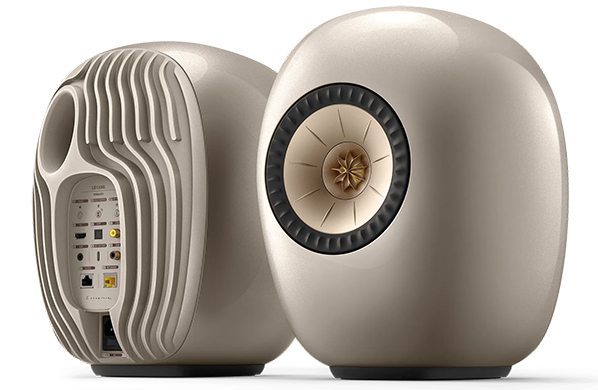
It's also a radically different concept than KEF's LS Luxe which bowed days before my Vox5's loaner arrival. The British 6½" coaxial 2-way is a DSP active with motional feedback which, to compete, still needs two companion KC62 subs plus stands. What warrants its brief mention here is coexistence with the Vox5. Both were brand new for Q3 2026. One appeals to an ultra-modern networking audience, the other to shoppers in the classic separates mould who still share the former's less-is-more mentality for size and complexity then desire a premium build. One group goes hardwired wood, cork and bell bronze down the purist analogue lane, the other wireless injection-moulded glass-fibre reinforced polymer and complex DSP. Two concurrent market entries, two very different executions and targets, both equally far off Box Central. One simply had a bag of published reviews and press mentions coinciding with its launch date, a benefit of being mainstream with a very large commercial footprint and marketing budget. Radically fewer will have noticed the launch of the corky Swiss. To chip away at such obscurity, Dawid Grzyb was booked for an independent 2nd opinion. Which finally gets us at mine. Off paper so in the room and hot-seat sweet spot, is the Vox5 a perfect speaker?