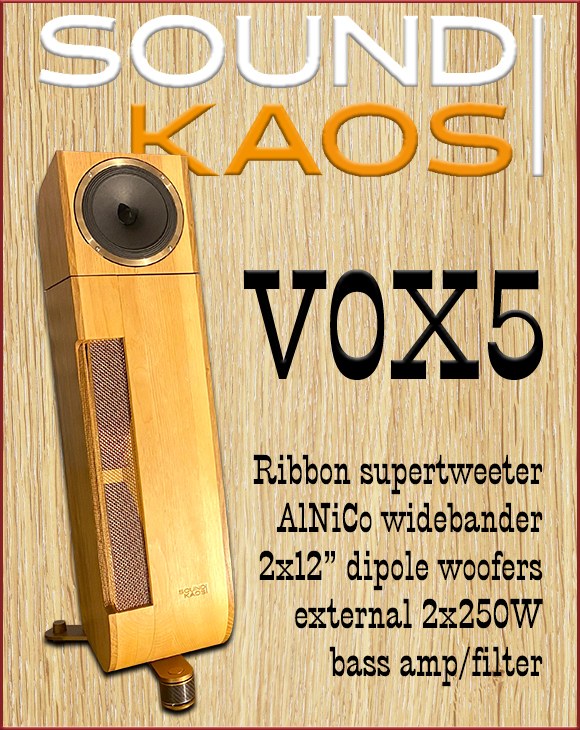
It's more Cap'n Obvious boilerplate but a 150-8'000Hz point source like the Vox5 is bound to soundstage with the best. This doesn't diminish the achievement, only explains why it shouldn't surprise. Where left/right spread is greatly influenced by physical speaker setup and sufficient sidewall clearance, depth layering is where unified dispersion and absence of phase shift go farther. More voluptuous tunings like the Vox5 will often undermine soundstage separation because images have a tendency to bleed into each other; or worse, clump like wet cat litter. Its extreme is the aforementioned wall of sound. The Vox5 completely avoids it. This quality belongs into the very same drawer as refusing to go dark. A parallel clumping aspect homogenizes textures. Percussive events sound rounder than they should. Often the cause is timing blur. Avoiding it is another classic widebander forté. Peppery fast-rising instantly stopping events have plenty of textural distance from sounds which rise more lazily then linger. Staccato and legato sit at opposite ends of a long table not on adjacent chairs. This becomes most relevant when they occur simultaneously. Just as great dynamic range and a high signal-to-noise ratio are most desirable, so is textural differentiation. Or call it the bandwidth of feel. Hard and soft sounds deserve to retain maximal distinctiveness. They shouldn't get pasteurized. A richer fuller bass-anchored reading like the Vox5's will naturally tend toward more subjective softness than a leaner, whitish and prickly presentation. Yet when pitch-shifting hail-on-a-flexing-tin-roof African talking drums kicked in; when the wicked trills of multiple darbukas flickered like mad; when the metallic fire of plucked oud sparkled; when twangy Manouche guitar runs defied human speed limits… those sounds rose above their surroundings like flares do in the night. This was another aspect of refusing to go dark. For all its tonal voluptuousness, the Vox5 can do hard, brassy and plucky when called upon. It's not been neutered at the altar of prettiness as so many warm cosy tunings seem to me.
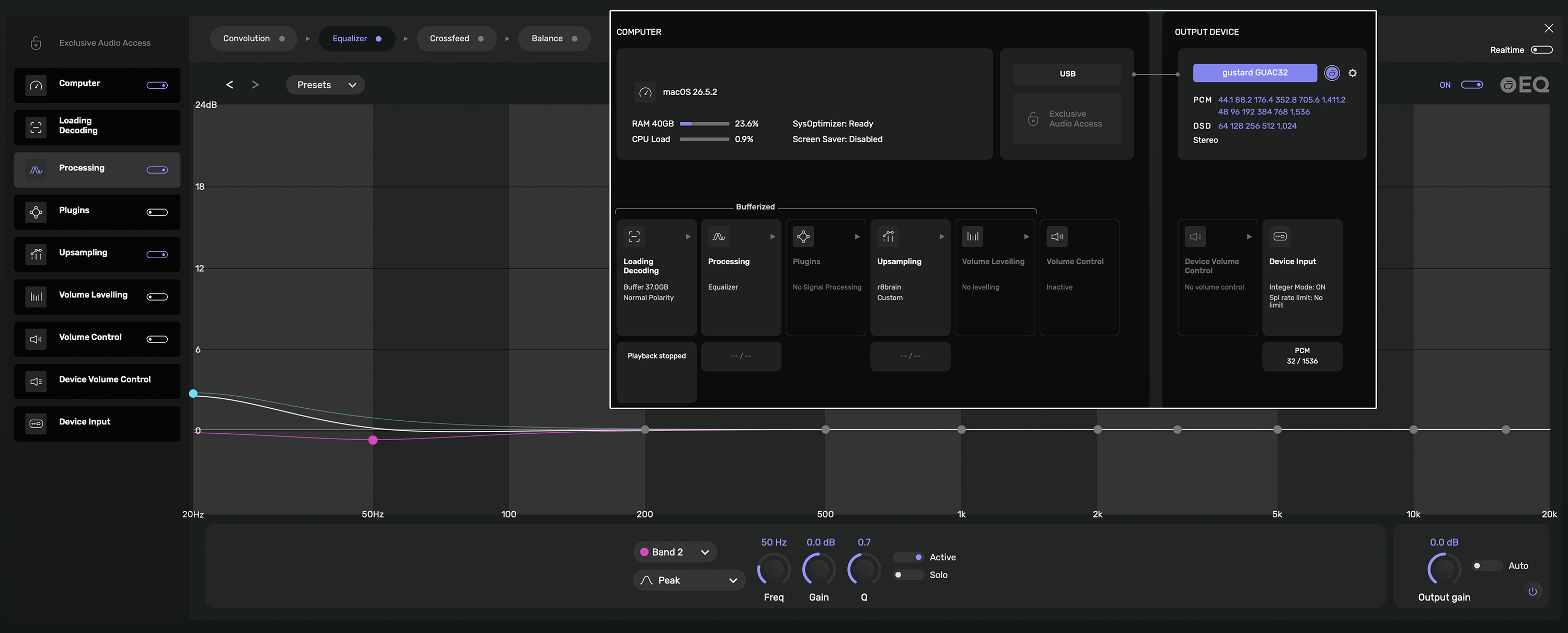 A small 50Hz response kink in Audirvana's EQ raised 20Hz by 3dB.
Hifi lingo differentiates between 'I'm there' and 'they're here'. In one case we feel transported to another place. In the second the performers seem to be in our place. The first prioritizes the presence of space. This could be an actual recording venue or multi-tracked artifice augmented by electronic reverb. This overlay—of an acoustic space over our room's own acoustic—relies on the audibility of the most minute of recorded decays. With them our ear/brain remaps space as the emptiness in which these sounds were first captured. Much of it happens in the treble; and at very subdued levels. Here elevated airiness is a virtual prerequisite. Where fire, earth, water and air were the Ancient Greeks' four earthly elements though the Taoists added metal, space or akasha has always been of the beyond. A focus on space then becomes a kind of audio spiritualism. As suggested in my intro, that's the way of Qualio's IQ. The second perspective prioritizes performer presences which seemingly teleport into our crib from the past. It's about flesh on the bones. It's unrepentant audio materialism. It's also the path of the Vox5; and for me was a novel way to playback without an internal reflex of wanting back on more familiar ground. Another quality that merits address even though it should have been implicit in what came before is consistency of intelligibility from the upper midrange down into the lowest bass. There's no difference of in-sight. It's not the water effect where the ocean floor retreats from visibility as we depart from the shallow shore. Our ears enjoy the same keenness at 30Hz as they do at 1kHz. The enabler is drastically reduced room talk with its time-delayed blur. To remain with our watery image, room talk from omnidirectional reflections stirs up silt from the bottom which then floats upwards to obscure our view of even shallower depths i.e. higher frequencies. Cancel this muddy flotsam and not only does the midband remain pristine. So does the foundation it sits upon. It's one construct, not a multi-tiered affair with windows of increasing opacity as we move downward. If our roving ear were evil Sauron's eye high up in the tower of Barad-dûr, we'd encounter no obstructions.










Listeners imprinted by ubiquitous pressure bass will predictably over-dial the XO² attenuators in a Quixotic attempt to compensate for the Vox5's refusal to pressurize. In the words of RiPol inventor Axel Ridthaler, this type bass system works as velocity converter not pressure generator. It's an opposing principle. Should our ear/brain fail to switch over and in the process break addiction to pressurized bass which demands a confined space to build up—it won't come off outdoors either but sealed headphones certainly work—you and the Vox5 will never come to grips. Or as Martin put it about battles he faces, "all punters who were brought up on drone bass don't know better and many won't recognise superior clarity and stoppage when they hear it. At my Klangschloß demo one guy kept turning up XO² gain to full power until another listener politely suggested that it sounded 'a wee bit' heavy-handed. When I dialled it back to correct, I got a big smile." I wasn't kidding when I earlier called this approach and in-room behaviour fundamentally other. It could potentially require longer exposure before our grey matter resets. Or it might never. It's like losing the taste for junk food. Sugar, salt and fat are addictive. Fast-food joints and potato-chip makers around the world exploit it. If we abstain long enough to break the cycle, such empty calories lose their right to be called food. They're fillers; budget stop gaps but no long-term strategy for health. At this stage of my audio journey, I couldn't return to McDonald's bass. The break of abstinence has been sufficiently lengthy. My ear/brain has rewired itself. Raal's original SR-1a open-baffle ribbon headphone with zero energy storage and unfettered full-bandwidth speed first showed me this alternate reality. The past five years of reshaping my speaker systems according to the ribbons' precedent were my detox regime. I'm phrasing for emphasis to restress a vital point. We must either be already disenchanted with pressurized room-ricocheting drone bass; or sufficiently curious to explore an alternative and give it enough time to demonstrate itself. Will everyone then come around? Do we adore death and taxes? Is RiPol bass our industry's staple where demand sets supply? Just because I switched over as have Børresen, sound|kaos, Voxativ and precious few other speaker makers doesn't imply that you should. Just don't pursue the Vox5 until you've actually heard it. It's too divergent from the norm. There's no predicting how you'd respond. Try it first. On outdated beliefs, I'll reiterate that the XO²'s compact class D drive of high current, low Ω and quick recovery— on control, damping and muscle!—outed my purist amp of higher output, dual-mono toroidal power supply and fully discrete ultra-bandwidth class AB as the inferior choice. If purists insist on Martin's passive filters to harness their own posh non-D amps, I'm certain he'll happily supply them. That I consider this leaving more than crumbs under the table shouldn't bother them in the least. Horses for courses and passive filter parts between amp and paralleled woofer voice coils for purists. This Vox5 option accommodates both preferences.
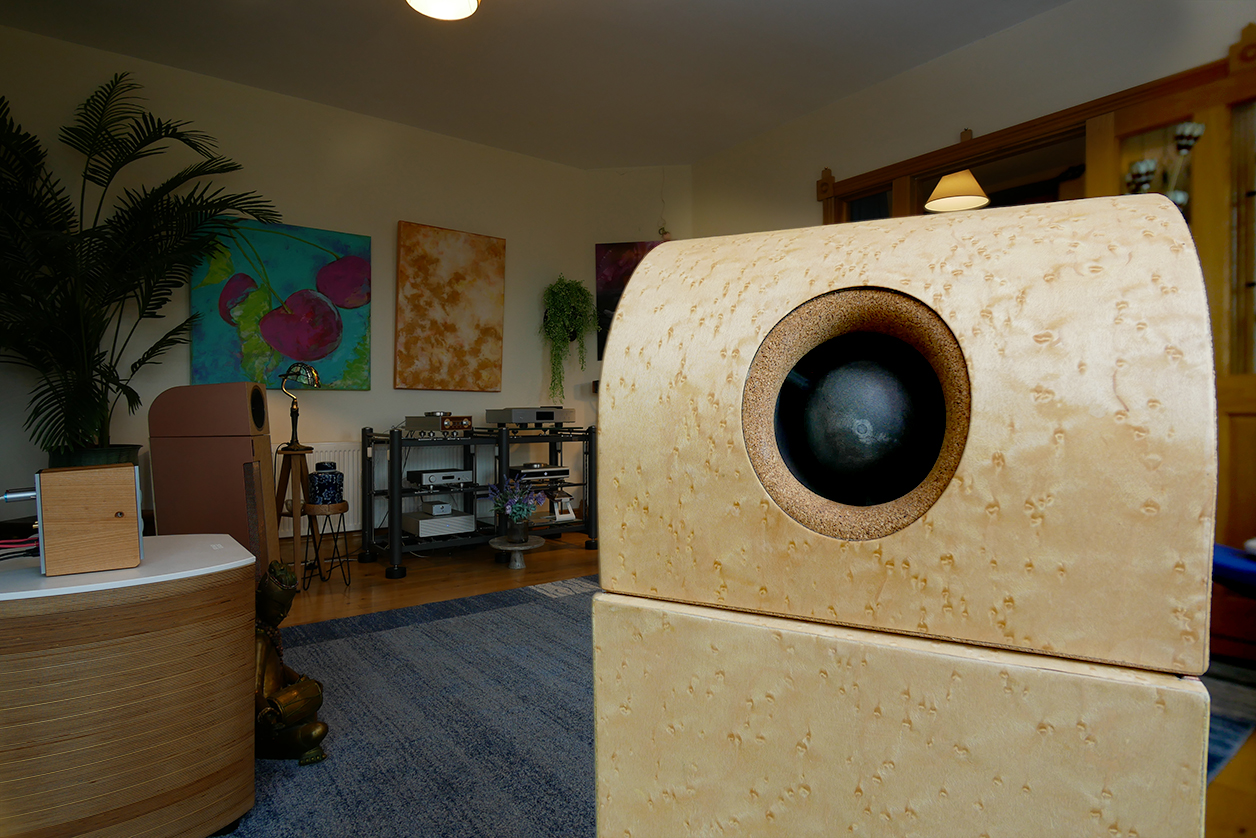 The rear of the finned 3D back-flow cartridge.
Voxativ's Alberich² had been a hifi whisperer par excellence. This was likely due to unusually high efficiency. Our sound|kaos appreciates higher input voltages before it fully comes off the leash. Because of its notch-filter linearization, this widebander remains composed as we get noisy. Where many smaller widebanders turn piqued then peaky, this Enviée doesn't fray at the seams. It's thus tailor-made for folks who listen louder. On said score and popular bass-heavy music, the Vox5 is shockingly mainstream for an otherwise exotic even esoteric niche product. Here it even packs a third super power—that of friendly neighbourhood noise-pollution filter. Common LF bleed-thru of pressurized bass migrating through floors and walls to annoy the habitants of adjacent rooms even apartments is demonstrably less. Far more bass stays confined to the room than usual. I confirmed this in both my office directly across the hallway from the music room; and my open kitchen which shares a wall with it. Not only does the Vox invite higher SPL with unusually clean low bass. It won't punish co-dwellers and neighbours like structurally-coupled pressure bass does. All around this isn't your granddad's Telefunken radio widebander from the 1930s though according to Armin Galm, it was inspired by one. His version is thoroughly modern and in Martin's implementation, practical in more ways than one. To be redundant, let's list them again: being unusually compact for its bandwidth; uncommonly room agnostic in the LF; copacetic with powerful solid-state amps to require no special high-impedance low-power SETs; subwoofer bass in full stereo which remains far more in the room than the usual leakers; active bass-drive option with dual-mono output/filter adjustments. That's quite the scorecard of good will. If this starts to sound more like a love letter than review, my lead-in of a perfect speaker might have predicted it. Whilst it began as a question with a likely but not guaranteed answer, the actual experience settled it. To complete the gambit, we must condition my three little words. Replace 'a' with 'my'. The sound|kaos Vox5 is a perfect speaker—for me. In that it's just not perfectly exclusive or loyally monogamous. I felt the same about Alberich². Both share the same general concept then diverge in execution and sonic profile. That results in two equally compelling if different personalities. My ears call both of them soulmates. My interior decorator prefers the veneered over the piano-lacquered look; the more integrated docking without big spiked gap. My inner practicality prefers the Vox5's less critical nature over ancillaries and its low terminals making for shorter neater wiring. My inner purist prefers the externalized XO² for not sharing a cab with high-output woofers. My inner bass hound leashed to ambient and organic techno welcomes the doubled LF cone surface of the Swiss. That's quite the scorecard of personal likes. How would those hold up in my smaller far narrower room? As it turned out, this tale still had another level.