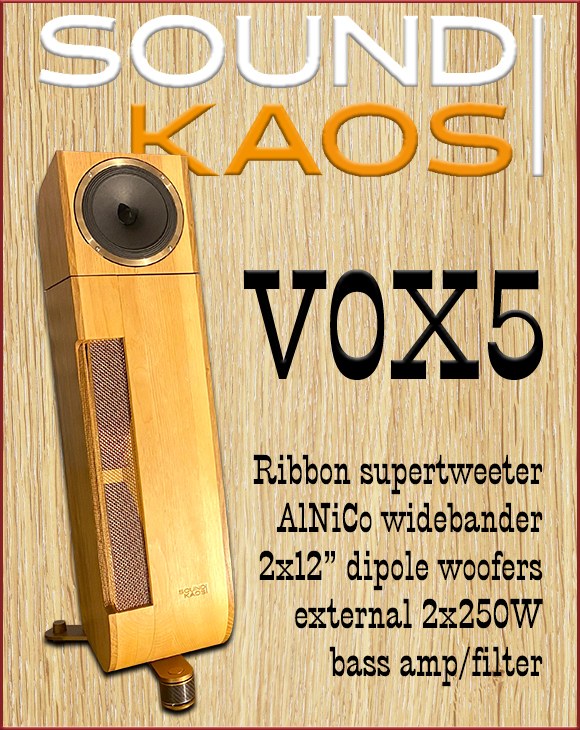
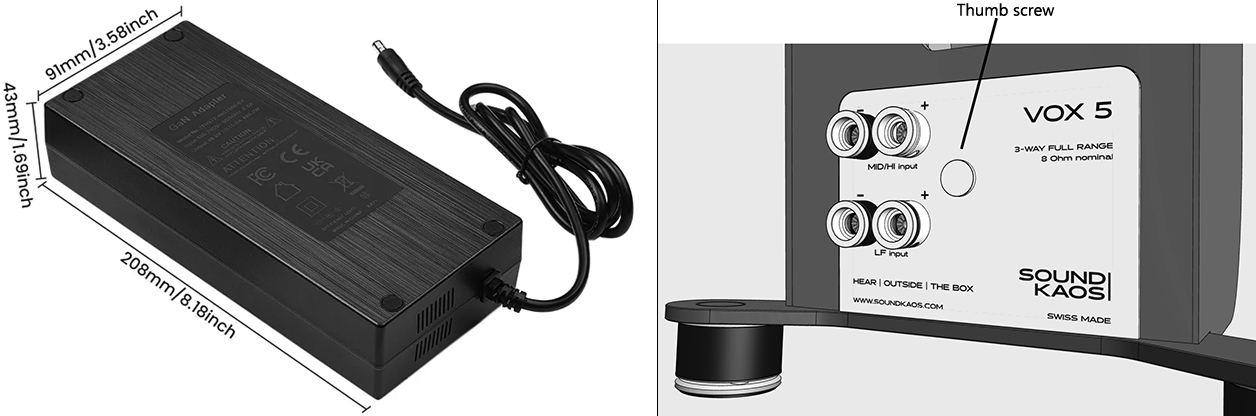
Sweat the details. As a true creative, Martin couldn't rest until he managed to incorporate his passive bass-filter low-pass option inside the speaker for final production. To avoid a selector switch in the signal path, this requires that the user undo the terminal plate via the indicated thumb screw, then swap the internal wiring from the passive to the active filter header. In passive mode, we bypass the LF inputs which are now disconnected. Our main amp drives the Vox5 as a full-range speaker with a standard single-wire cable to the mid/hi input terminals. In active mode our main amp drives the mid/hi inputs internally disconnected from the woofers. In this bi-amp scenario, the main amp could be of the low(er)-power persuasion, potentially even tubes since now the XO² drives the speakers' LF input with a separate cable run. My review sample didn't yet have this thumb-screw feature to reseat some wires. My passive filter was still external.
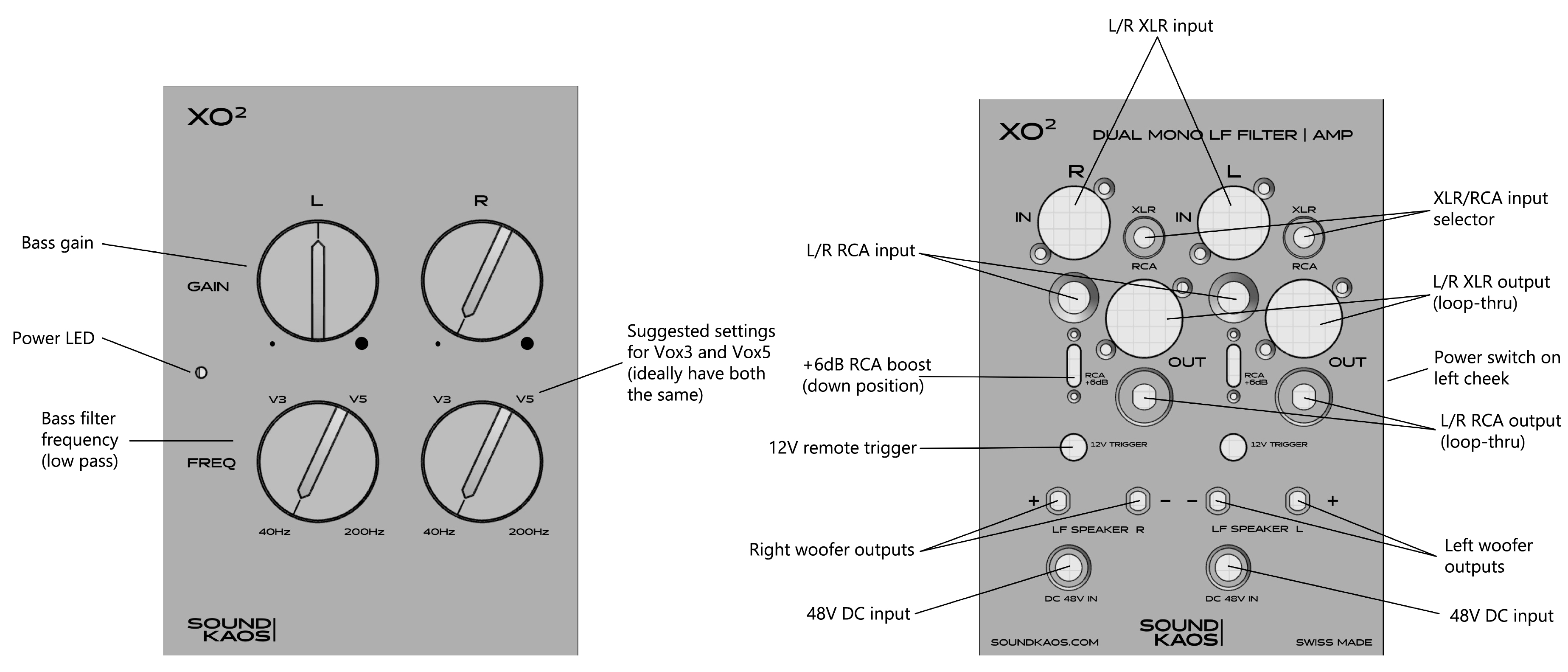
Below we see the various functions of the XO² filter/bass-amp box. It's all perfectly self-explanatory. The power toggle on the left cheek is easily reached even when installed in a rack close to a wall. We can enter the XO² XLR or RCA. In the latter case we have a +6dB option to raise the incoming voltage to XLR level. Should our preamp or variable source lack twin outputs, the XO² has convenient loop-thru outputs on both RCA and XLR from which to feed our main amp. Be aware though that if you enter XLR, you must also loop out via XLR. Ditto for RCA. Here we must stay in our lane and can't mix the i/o. But looping could be handy even if we have dual pre-outs to work with. Say our layout puts the source gear on the sidewall, the amplifier/s between the speakers. In my case this entails a 6-metre interconnect. Rather than now needing two long such pairs, my second interconnect from the XO² to my amplifier could be far shorter. Splendid. With its internal class D modules powered by two big external 48V/5A switching bricks, the dual-mono XO² takes two power cords. Its woofer outputs only take 4mm so our bass speaker cable must terminate in bananas at least on the send end. Meanwhile the Vox5's custom LF terminals take bananas or spades. C'est ça.
Passive or active bass? Martin definitely recommends active for >30m² rooms where the extra gain range of the XO² will compensate for the output loss of dipole radiation. That loss is exactly what we want to improve our time domain via reduced in-room reflections. As cubic volumes grow, we simply need means to adjust our playback volume above and below the woofer filter frequency independently. Bigger rooms will want relatively more bass than main gain. Passive drive can't account for that. Decreasing our bass efficiency as rooms grow in size is simply the price we pay to benefit from dipole bass dispersion. It's where active drive enters. That goes beyond just dedicating yeoman muscle to big woofers. We also want a separate bass attenuator fronted by extra voltage/current gain to balance out our overall amplitude response in the seat and maximize woofer control at higher excursions. Active bass might even be preferable in smaller rooms because dedicated woofer attenuators can dial down the relative LF presence so the tonal balance doesn't get too bottom heavy. Passive bass isn't adjustable.









Other than speakers, what's on your pallet? 2 x 2.5m banana/banana woofer cables. 1 x XO². 6 x loose Vibra 68 wire-suspension footers with matching cap nuts. 2 x power bricks with figure-8 power cords. Finally, 2 x passive outboard filters which final production installs inside the speakers. Three small shock-absorber shafts hold each docked widebander cube in place whilst horizontally mounted bananas connect to short cabled receivers then tuck into a recess atop the bass bin.
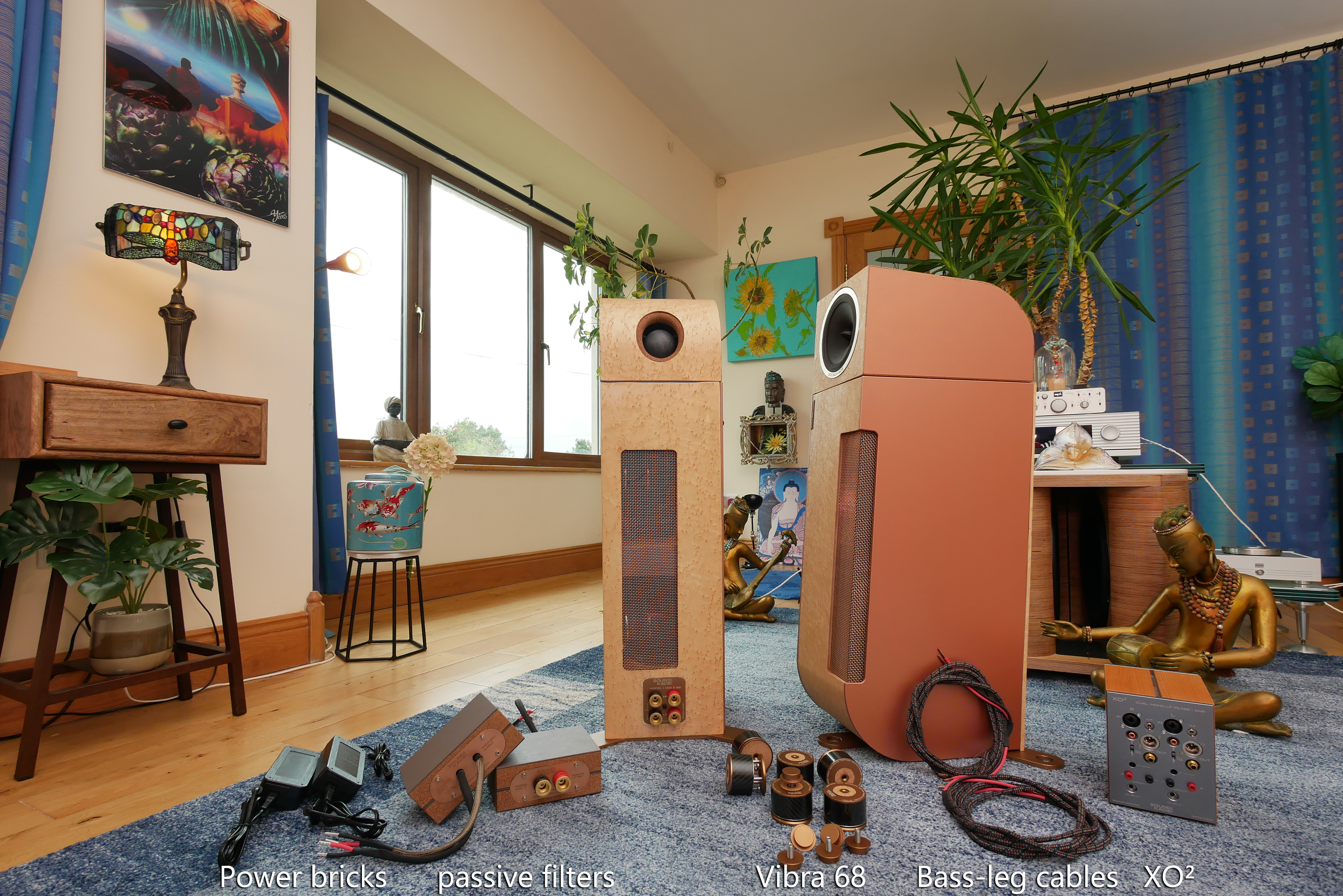
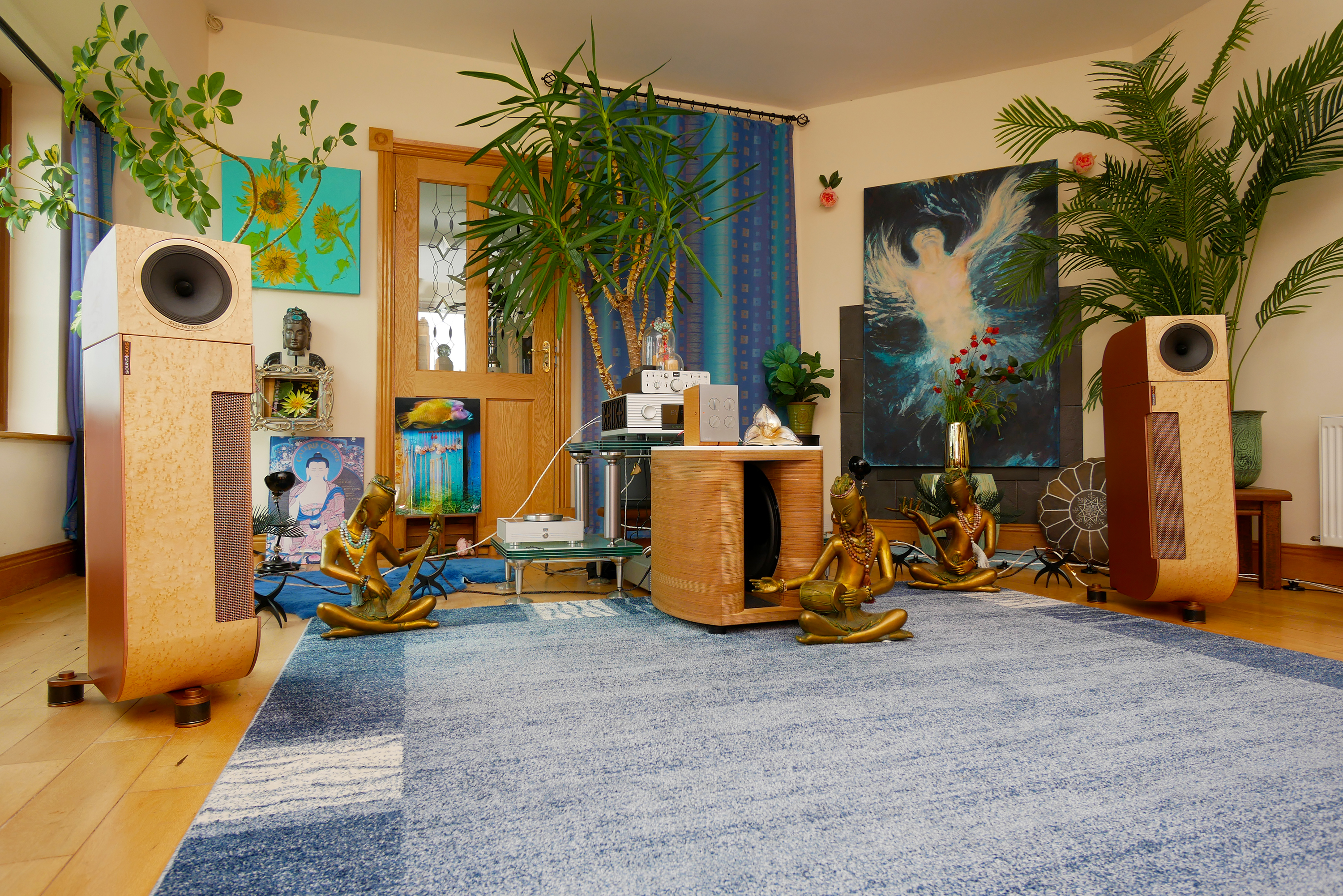
Here is the finalized setup in my main system…