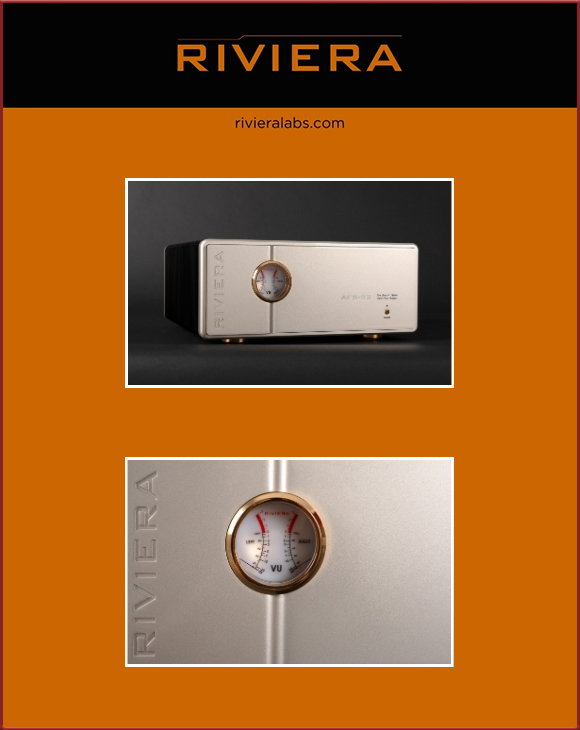
I'd never yet heard Ridthaler-inspired dipole bass in my smaller room. Martin's twin 15" sub of the main system is too heavy for me to heave up the stairs. Instead here Zu's single 15" sealed Method sub does the honours. At 4m narrow, this room's lateral mode sits at 85.75Hz. I thus enter this conventionally omni-radiating sub at 40Hz/4th-order an octave below. It avoids having big cone surface ride a standing wave which even bass-shy music would constantly trigger. It'd get supremely annoying hence impossible to ignore. It's why we so often hear how big speakers overload a smaller space. It's the punishment of pressurized bass causing ear fatigue; and copious room gain unbalancing the amplitude response when passive LF offer no trim. The sound gets too dark and ringy whilst the pressure build-up in the front corners overdamps the treble for more murkiness. It's hard to overstate my sensory disconnect of high-SPL low bass suddenly manifesting in that smaller room with zero issues; like somehow stuffing a grown man into baby clothes and having them fit. Wtf? But there was more. I well know that Ivan Liu's EX-M7 monos tune for a Goldmund/Spectral-inspired profile that's very lit up and direct. It's why I got them in the first place. They're my nearfield directness poison. It's a voicing the Kinki Studio boss warmed up with his flagship Dazzle integrated to chase greater mass appeal. Downstairs I counter-steer by defeating the extra gain of his active preamp stage. Yet it remains a more gravitational fleshy tuning. That ideally interleaves with my airier Qualio IQ—the joys of separates ownership. The upstairs preamp fronting the 2.5MHz direct-coupled monos is another autoformer passive, this by Manchester's Pál Nagy of Lifesaver Audio icOn fame, not Arek Kallas of Spain's Hattor boutique. The Vox5 instantly parlayed this set's more illuminated treble energies without sacrificing any materialism or embodiment factor. Now the sound's upper third was far closer to my usual IQ parameters whilst the lower two thirds transferred from the downstairs showing. The Vox5's treble system was even more capable than described. This next-level reveal of even higher resolution was utterly unexpected. Surveying the sloping ceiling which reaches full height right above the speakers, I wondered. Did the ribbon reflections now aim more output at my ears whilst they dissipate more against the flat ceiling of the lower room's bigger cubic volume? When you're dealt four aces, you don't ask how or why. You go all in, play your hand then cash out. Genuine shock and awe in a jaded reviewer's life? Rarely do they still occur. This showing simply was such a one. Seven moons in conjunction? Yes, I now do have a 7th for the occasional extracurricular activities.
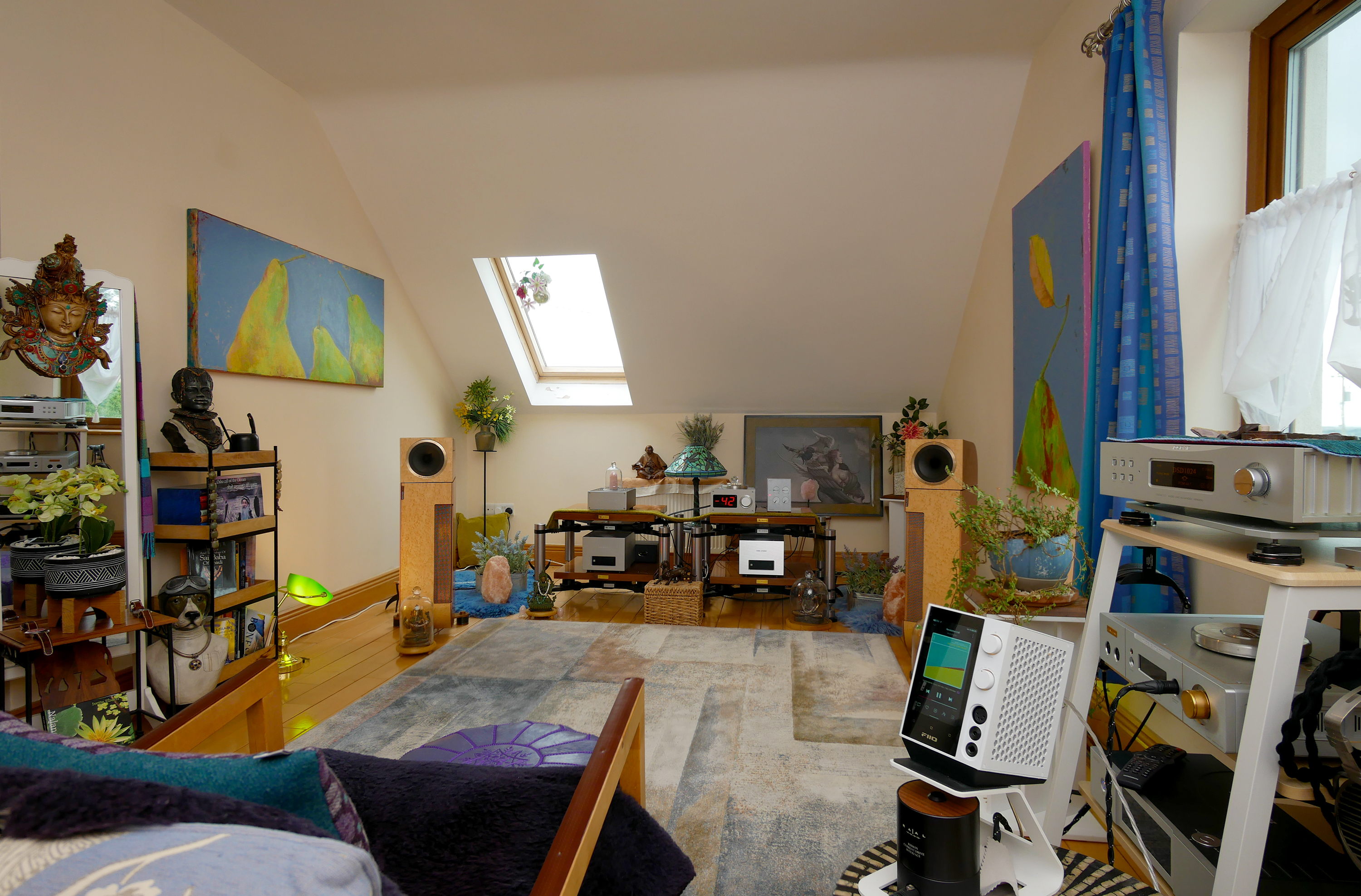
Back in the world of cold hard reason where shock and awe are emotional write-offs, the Ridthaler principle proved its room-agnostic mettle with a real vengeance. As shown, this includes happiness at close sidewall proximity. Dipole's classic figure-8 pattern disappears those walls in its nulls. With the Vox5's directional radiation axis rotated inward, this reflective vanishing compounds. The result is superb separation across the bandwidth because bass bloat and mud are on permanent vacation. To personalize a special aspect, enter Chai Baba, my Bengal lounge leopard. At night he walks and kneads all over me whilst I pet him before he finally curls up between my legs or in an armpit. If he's been on a nocturnal prowl and comes in late, his insistent meows wake me up. He then wants repeat verbal invites before jumping into bed and starting the pawing then clockwise routine in nearly a trance. I'm thus most familiar with the peculiar lightness of padded cat paws. The agility and lightness of the Vox5's in-room bass feel reminded me of Chai. It's worlds apart from the elephantine stomps of box-loaded pressure bass. Hence that's really the decisive aspect buyers from that part of town must embrace. If you want a baby elephant to stomp across your rib cage or feel punched by a pro boxer, RiPol bass simply won't suit. Like a slinky feline, it's far more stealthy.










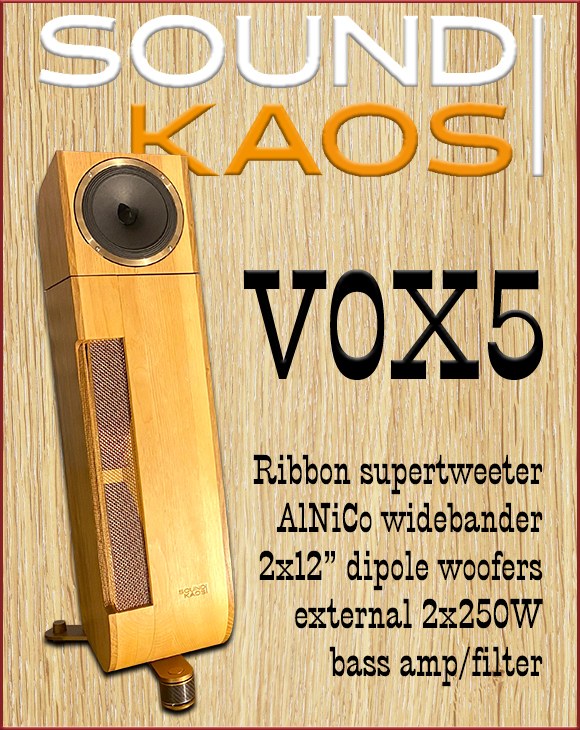
This page's key takeaway is that the Vox5's full-range potential scales beautifully down into smaller spaces which won't overload even a bit. That scaling in the opposite direction should have limits is implicit. As cubic volumes increase, so must bass surface to still move proportional air. It's the primary difference of all flagship speakers. They beef up their LF artillery to accommodate the ball rooms of McMansions. Meanwhile denizens of the real world make do with compact 2-way monitors. It's the only sort that'll work in their smaller rooms. Unproblematic 30Hz bass is the forbidden fruit of dreams soon forgotten. With the Vox5, bass quality is divorced from SPL. Whilst loudness increases or decreases, there's no change in pressure since pressure isn't how this works. Neither the room nor the woofer enclosure fight back. Why struggle if you can chill? Easy does it. Now truly big sound will fit into smaller spaces. Even established designers have been known to look at Ridthaler-inspired speakers and not grasp their MO. One slot in the front plus one or two in the rear don't look the least bit exotic. The hidden woofers are standard dynamics though groomed for open-baffle use. Why would such a basic geometry behave so different? Read the original Axel Ridthaler patent and graphs to understand it. Denmark's Treble Clef were inspired by it and have been granted their own patent. This likely offers more reading for the technically inclined. For our civilian purposes, it's perhaps more instructive to think of the Vox5's bass as that of a frame drum like an Irish bodhrán or Middle-Eastern bendir and tar; and conventional bass as a kettle drum or timpani where the stretched skin's rear wave compresses the air captured in the hemispherical copper bowl to energize the kettle and rear-load the skin with high pressure. One is a dipole, the other a box. Both work; just differently. Enough now on the lower octaves. After all, the centre piece of the Vox5 is its widebander.
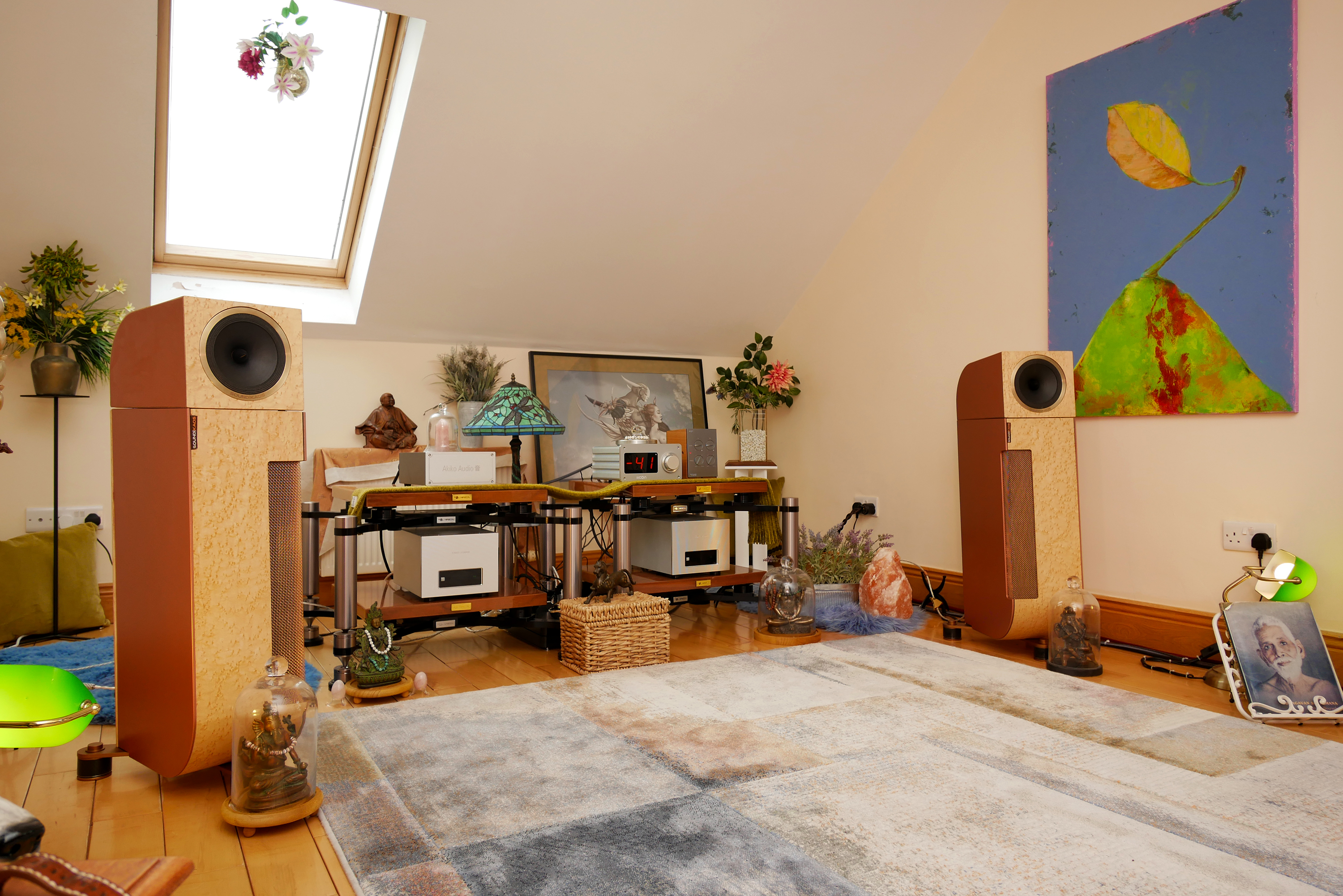
Norbert Lindemann of the eponymous German brand and Seo Junhyeok of Korea's Mon Acoustics successfully implement MarkAudio's spider-less 4" metallic widebanders in compact ported 2-ways with ~15KHz brilliance assist via small AMT. I reviewed both, acquired the SuperMon Mini and run it in the second upstairs rig. It high-passes at 120Hz/4th-order to dovetail with a twin 9½" force-cancelling Dynaudio sub. As you'd expect, such compact drivers are all about blazing reflexes, presence-region suchness, illuminated transparency and radiating ever closer to the mythical point not area source. We'd obviously not anticipate the impact, shove and weight of a 10.3" Zu cone; nor that the far bigger driver's resolution could match theirs higher up. In fact, my Mon is most like the original winged open-baffle Raal ribbon. It simply projects their headfi panorama outside the bony cave. It's a quick, lit-up lucid sound that's comparatively lean, light and whitish. A core question with widebanders is their Ø and moving mass. Those values set bandwidth and how much treble vs bass they'll do. Too small and they need woofer or gargantuan rear-horn assist. Too big and they need whizzer or separate tweeter help. Most commercial single-driver efforts agree on 8-10" as their golden mean. The Vox5 goes smaller but stops well shy of my more extreme but limited 4-incher. Then it's not groomed for bass in the first place. Its cone needn't be LF-appropriately heavy, its suspension components not long throw. It optimizes the vocal band then surprises with its lower-treble chops. The equivalent Enviée of my Vox3a is smaller. That moves the needle away from the Vox5's beguiling tonal substance. All of it is a precarious balancing act between interconnected values of detail magnification, heft, colour intensity and dynamic vigour. Push any one of them and, like nip 'n' tuck plastic surgery, it'll displace at least one other. Amazingly, this bigger driver's expected advantages of image mass and timbre saturation coexist with resolving powers that eclipse the Vox3a monitor. That really shouldn't be but is—probably a net effect of the driver itself, its solid cork encasement and the 3D-printed twin-chamber cartridge guiding the rear emissions. Speed and adrenaline versus comfort and curves. It informs cars and speaker tunings alike. With the seamless continuation of its open bass system, the Vox5 widebander seems to maximize the incarnation factor that's practically achievable without compromising in-sight and clarity which lighter less embodied tunings are capable of¹. In my experience, that's a most unlikely point of balance to secure within a web of sonic counter polarities which all vie to partake in the sweet spot. Speaking of which, I had another one of those to explore in my downstairs 2.1 TV system. But first, a mini history lesson.
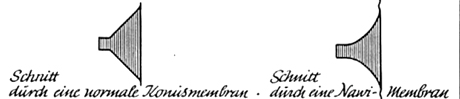 "Nawi membranes aren't English. Proper German pronounces them 'nawi' not 'newi'. The term abbreviates non-windable. Telefunken were first to develop such membranes. You might remember terrible geometry lessons which showed how certain body surfaces can be made from drawing paper. The cone is an easy example. Cut it open and it can be unrolled again into a flat plane. Do that to a sphere and its surface will never flatten out but stay curved. Hence in the early days of paper-based speaker membranes, cones were the only possible shape. Only when the casting of paper came were shapes possible that couldn't be flattened out. Their curved geometries eliminated the sub-octave oscillations of cone diaphragms." It's from an old German paper Martin forwarded to document Armin Galm's Telefunken connection.
¹ We started with this 160mm membrane allied first to the 50mm AlNiCo motor of the Vox3's 100m cone. This final version of the Vox5 widebander harvests the 75mm motor of Armin's larger 210mm driver so really is a super-charged 160mm version currently exclusive to us. That's where its extra power and projection originate."