
Country of Origin

Reviewer: Srajan Ebaen
Financial interests: click here
 Main system: Sources: Retina 5K 27" iMac (i5, 256GB SSD, 40GB RAM, Tahoe 26), 4TB external SSD with Thunderbolt 3, Audirvana Studio, Qobuz Sublime, Gustard U26 USB bridge, LHY Audio SW-8 & SW-6 switch, Sonnet Pasithea; Preamp: Hattor Audio ARP-S; Active filter: spl Audio Crossover MkII; Power amplifiers: Vinshine/Kinki Dazzle & Audiophonics NCx500 on subwoofer; Loudspeakers: Qualio IQ [on loan]; Subwoofer: sound|kaos D15; Cables: Exact Express Flame, Furutech; Power delivery: 2 x Kinki/Vinshine Tai Hang on amps and source stack, Furutech DPS-4.1 between wall and conditioners; Equipment rack: Artesanía Audio Exoteryc double-wide 3-tier with optional glass shelves, Exoteryc amp stands; Sundry accessories: Acoustic System resonators, AudioQuest FogLifters; Room: 6 x 8m with open door behind listening seat; Room treatment: 2 x PSI Audio AVAA C214 active bass traps
1st upstairs speaker system: Source: Shanling EM7 into Soundaware D300Ref SD transport to Cen.Grand DSDAC 1.0 Deluxe with POW; Preamp/filter: Lifesaver Audio iCon 4SE & Gradient Box 2; Amplifier: Kinki Studio EX-B7 monos; Loudspeakers: sound|kaos Vox3awf; Subwoofer: sound|kaos D12 on twin Nord Acoustic NC500 monos; Cable loom: Exact Express Earth; Power delivery: Vibex Granada/Alhambra, Akiko Audio Corelli Corundum & Castello Solo; Equipment rack: Hifistay Mythology Transform X-Frame [on extended loan]; Sundry accessories: Furutech cable lifts, Furutech NFC Clear Lines; Room: ~3.5 x 8m
1st upstairs headfi system: DAC: Cen.Grand DSDAC 1.0 Deluxe with POW; Headamp: Cen.Grand Silver Fox; Headphones: Raal 1995 Magna, HifiMan Susvara
Desktop system: Source: HP Z2 workstation Win11/64; USB isolator: LHY UIP; LAN distributors: LHY AS6 Pro & SW6-SFP; Ethernet reclocker: Stack SmoothLAN; DACs: Gustard R26II & Audalytic DR70; Preamp: Topping A900; Speaker amps: Topping B200 monos; Headphone amp: Enleum AMP-23R; Loudspeakers: Virtual Hifi Viper; Headphones: Final D-8000, aune SR7000, FiiO FT7, HifiMan Susvara Unveiled
2nd upstairs headfi system: Shanling EM5; Headphones: Meze 109 Pro, Fiio FT3, HifiMan HE1000 Unveiled
2nd upstairs speaker system: Source: smsl PL200T CD transport; DAC: Shanling EM7 w. 1TB microSD; Crossover: Lifesaver Audio Gradient Box II; Amplifiers: LAIV Crescendo Chorus monos; Loudspeakers: MonAcoustic SuperMon Mini with Dynaudio S18 subwoofer
2-channel video system: Source: Oppo BDP-105; All-in-One: Gold Note IS-1000 Deluxe; Loudspeakers: ModalAkustik MusikBoxx; Subwoofer: 2 x Zu Mission; Power delivery: Furutech eTP-8, Room: ~6x4m
Review component retail: €5'350 in stacked Ply as shown, €5'900 with mono XO¹, €6'260 with dual-mono XO²
 |
 |
 |
 |
 |
 |
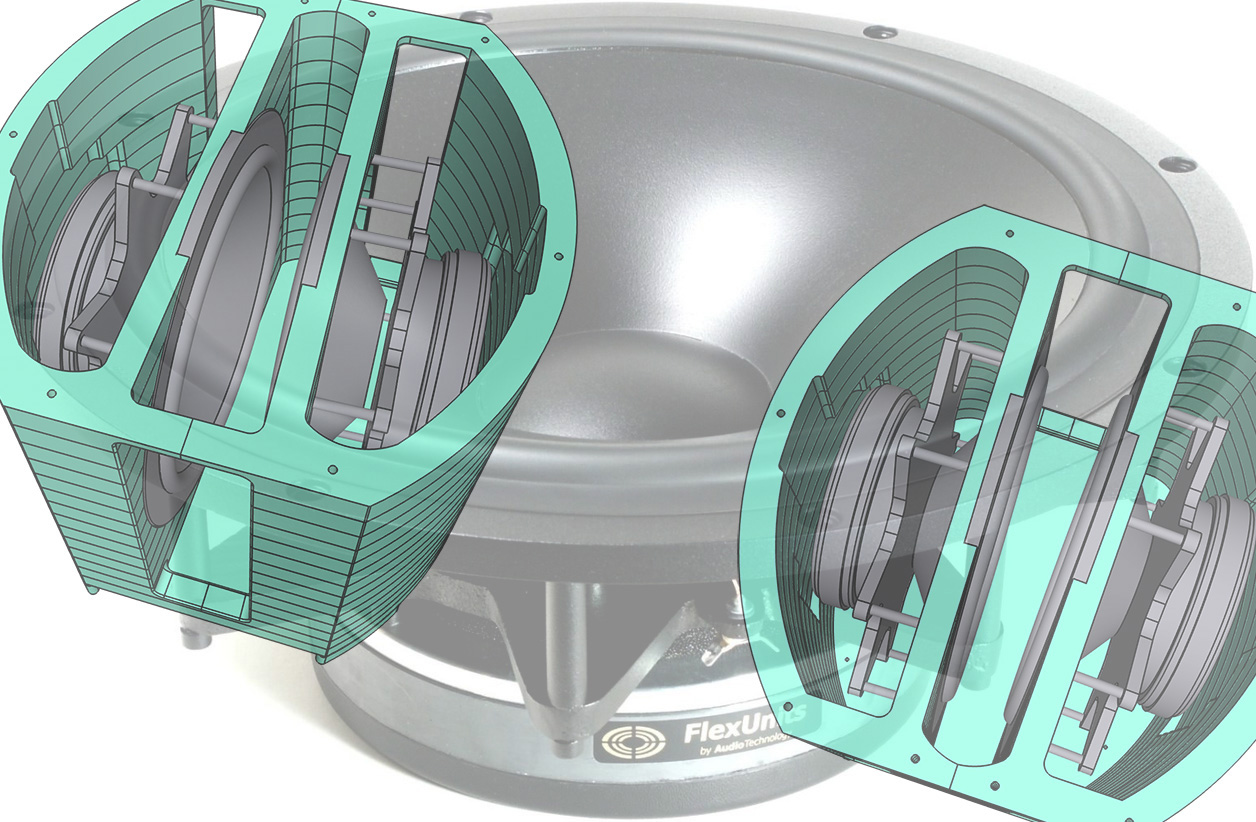
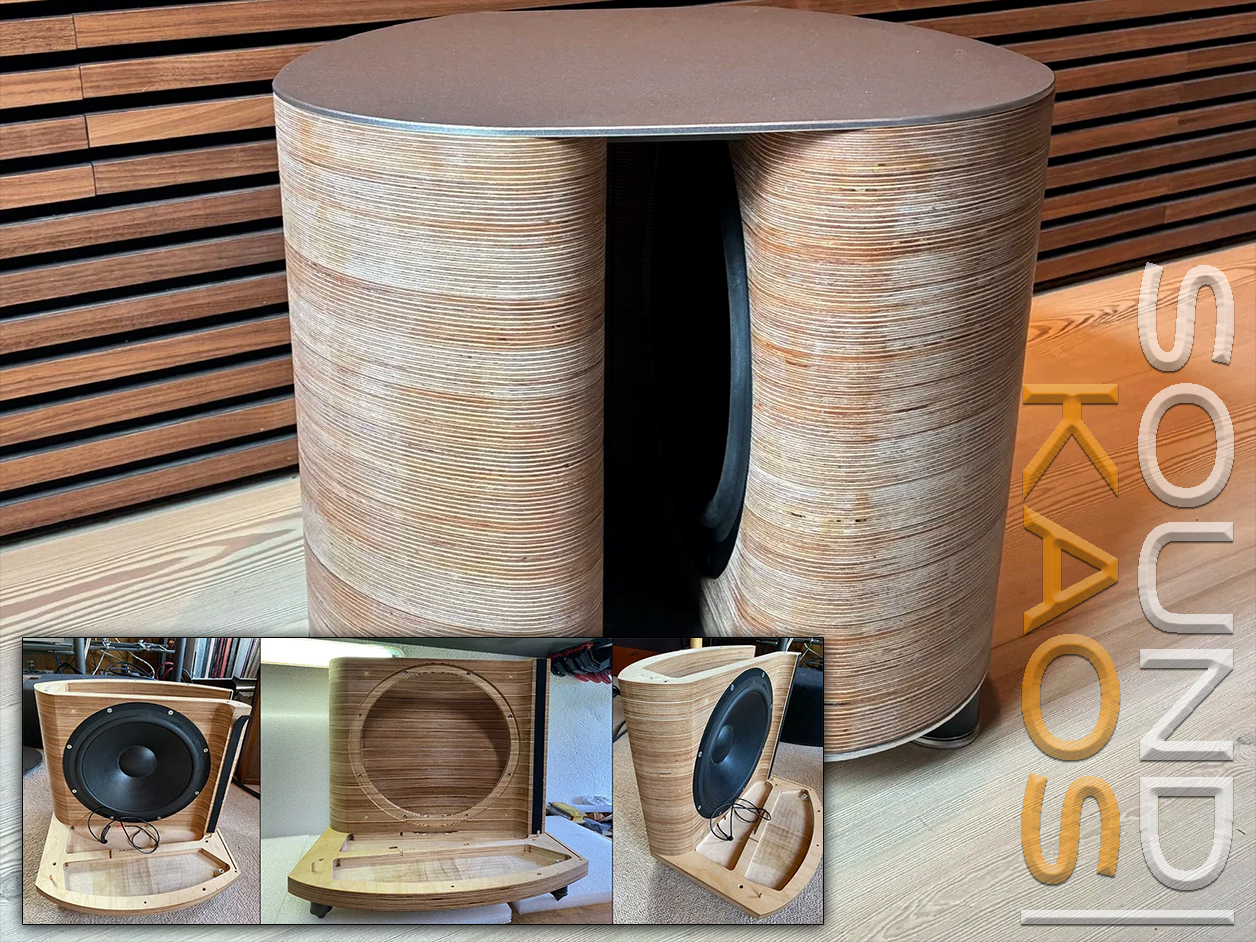 The insert shows the very similar construction of my D15 just with a wooden plinth.
Truth and dare. Tell the truth. Face the consequences. Skip 'or'. Except nothing is heroic today. No speaking truth to power to risk incarceration or worse; just a lustful consequence of having experienced the Vox5. This had been most memorable. Saying so in the award-ending review told nothing but the truth—about how <150Hz folded-dipole bass could generate low loud bass of feline agility without riding the room modes of my 4m narrow space or pressurizing it. I could finally do bombast at happy hour without causing my room to revolt. After years of owning the bigger D15 RiPol sound|kaos sub in my main system, I understood the MO. I'd simply never had it on my upper floor. That 2×15" sub weighs more than I can stairlift. With the Vox5 loaners earmarked for a Swiss reunion with their maker, the dream was soon to expire. Enter desire to replicate it with something I already had: these companion Vox3awf monitors. Rather than continue to run them wide open augmented by a sealed Zu Method sub for some 1st-octave assist at 40Hz/4th–order, I'd high-pass them at 120Hz. Martin Gateley's smaller 2×12" D12 would now treat the lower 2½ octaves to far more directional far less room-interactive dispersion. With his XO² filter/amp's dual-mono outputs, I ordered my D12 with four banana inputs not two. Each woofer would see its own 200W mono amp. Martin could finish my XO² in Cherry to match the Vox3. The sub's stacked Ply build would duplicate that of my bigger downstairs version. Instead of white Corian end plates, this D12 would have the alternate silver aluminium plates shown above.











Fuzzy still on RiPol/folded-dipole¹ bass? See the drawing. Two face-on woofers apply maximum stoppage on each other being wired in push/push. Their combined front wave exits through the front slot aimed at our seat. The equally quickly stopped back waves exit through the rear slots. At the wavelengths involved, anti-phase energy wraps around the box to cancel at the sides in classic figure-8 dipole style. This eliminates sidewall reflections and their lateral standing wave. Unlike panel dipoles whose front/rear cone surfaces face our room for zero loading, this folded-baffle geometry first patented by Axel Ridthaler—hence RiPol for Ridthaler dipole—slot-loads its woofers. This has two benefits. One, it lowers their resonant frequency by up to an octave vs. the same driver in a classic ported box. Two, if the involved math follows the Ridthaler formula, the rear emission is of lower amplitude than the front. The upshot is directionally shaped bass. It no longer radiates scattershot in all directions like 3D bass snooker. More aims at us, less is lost to the room. Demonstrably fewer LF reflections clean up the time domain. That causes less bass smear from loitering, droning and triggered room resonances. Bass notes stop when they should. They no longer suffer hangover. Much haphazard room bounce which takes longer to arrive at our ears cuts. That turns temporal blur to focus, cellulite to firmness, mud to clarity. More clarity isn't just good for bass. It invariably improves the midrange too where now there's less resonant overlay from below.
____________________
¹ As shown in the Vox5 and previously Voxativ Alberich², this type bass system also works with a single woofer; or multiple woofers stacked vertically. Such arrays obviously get a single rear slot not two.
Another benefit—or demerit depending on preference—is RiPol's MO of velocity converter. Standard box bass of the sealed/ported variety generates pressure. If played low and loud enough for a given room size, we feel this pressure. Longer exposure to pressure creates fatigue like sealed headfi does when played too long. It loads down our ear drums. With a RiPol sub, we hear far cleaner bass of superior stoppage and linearity—but don't feel it. This type bass won't create the pressure sensation that 99.9% of listeners call normal because they use omni-radiating box bass in untreated rooms. The road tax for folded-dipole propagation is diminished room gain as the reflective product of omni bass. This lowers bass efficiency to need more cone surface than a sealed/ported sub to generate equivalent loudness and reach. No free dinner. Just so, RiPol bass eliminates pressurized LF. That creates a textural feel far closer to midrange and treble. It's reminiscent of open-backed headphones free from typical room issues. Whatever remaining chamber resonances they suffer shrink the pathways of bouncing reflections down to millimetres or centimetres. Standard speakers and subs deal in multiple metres. That implies greater delays for far more serious time confusion. The truth of my dare is major hots for RiPol bass. Today's silly dare meant naught but settling an invoice. I can't credibly champion this niche solution of better bass for untreated rooms then continue with standard omni subs. At least two of my systems would now walk the talk. As such my 5-year makeover of various 2-channel speaker systems into 2.1 equivalents with actively high-passed mains neared completion. What this latest acquisition enabled is massive attack–type fare in a modestly dimensioned space without bodily discomfort or acoustic mud; somewhat like fitting the proverbial square peg into a round hole. I knew the result because I'd already had the Vox5 in this very room. The only difference has the sub apply half the cone surface to dial up XO² bass gain a click or three in compensation; and RiPol cover in mono not stereo. Since that's exactly how I already run my main system, I knew what to expect.
What's a dare without any risk? A sure thing.
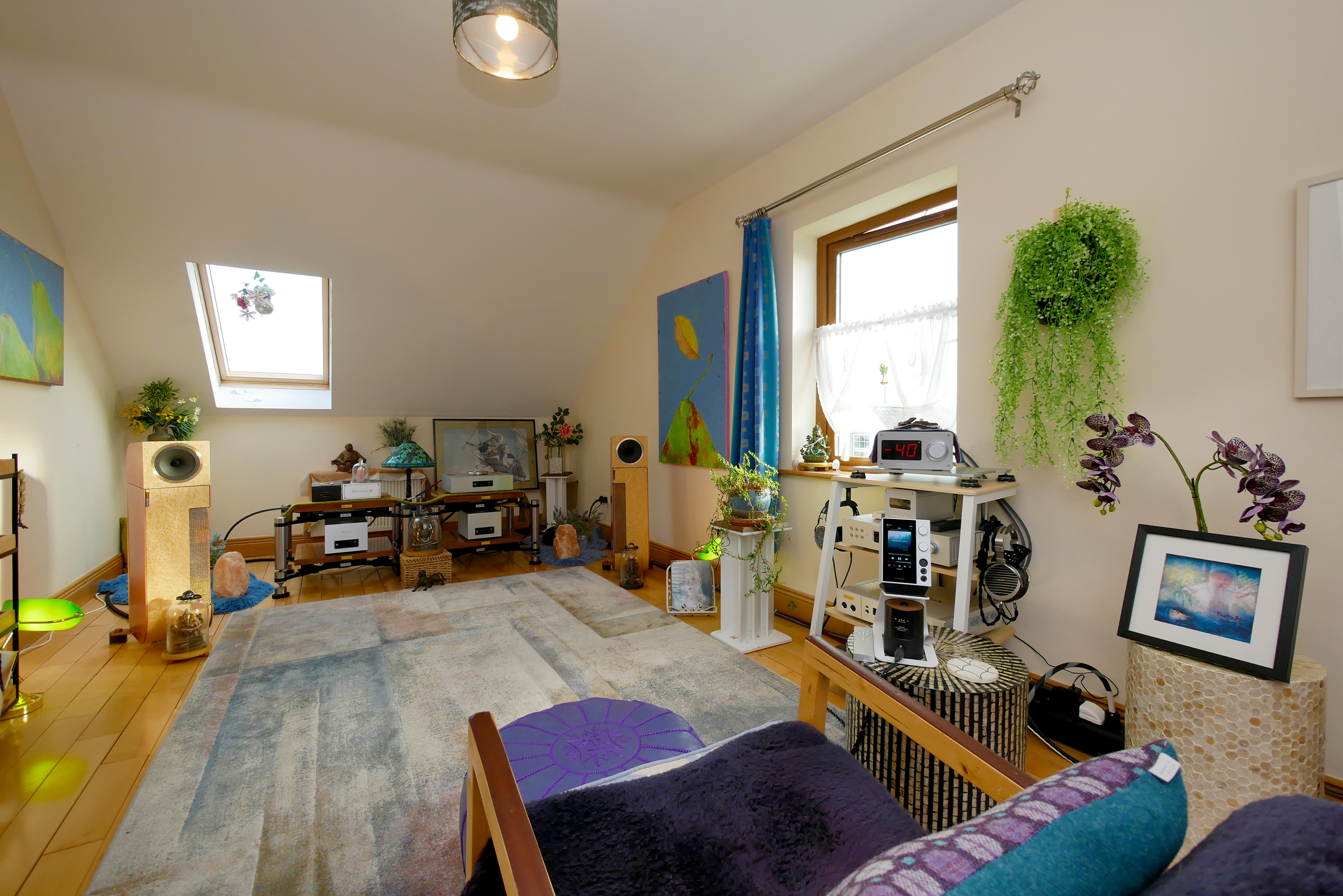 An alternate scenario with a Kinki Studio EX-M7 stereo amp dedicated to bass duties whilst a Lifesaver Gradient Box II analog crossover handled the frequency division of low and high pass.