Little Prince Di's coronation. Thought this tale winding down? Climax time. I'm not winding you up; seriously. Of my three systems, this was the personal N°1—Final D8000 planar headfi escaped from the skull cave's puny 13½" width to a seven times broader panorama of matching minutiae. It was lucid mode wedded to chunky tonality and exceptional resolving powers. Getting such rich beefy down-to-20Hz sound at such closeness felt frankly outrageous. Little speakers of nearfield coherence can't usually do that. Getting premium 10" woofers of first-class stopping power and zero latency into the act was obviously key. It's what I've done all along with my slightly smaller Dynaudio sub. And I did reap this level of detail and bandwidth before; but not its physicality. Here the M1 trinity turned an unholy page; a deeper dive into materialism where classic widebanders tend to capitulate sooner. Cornering skills vs creature comforts. It's one of hifi's mutually thieving battles. Rather than load up both scales evenly, the balance tips. One aspect gains prominence. The other becomes its shadow delegate. Res chasers sacrifice body. Booty worshippers lose reflexes. In this 2.1 nearfield geometry, the balance not only held. It carried quantities. Percussive immediacy and image pop were loaded. So was sonic substance slash density. In the driver's seat tucked petite €1K/ea. class D monos. At today's €14K ask for the combined Dutch goods, those mini amps were more fish food—chicken feed?—than royalty. Yet the result was this gig's crowning moment. To enter this game entails no scalped tickets. Having arrived at my Big Leagues final with bonsai ancillaries, some specifics. Direct-driving these woofer voice coils to eliminate the larger inductors and capacitors of a passive filter crafted true low-frequency articulation at already low volumes. With that band's audibility and exactitude on par with the higher ranges, stereotypical 'little speaker' sound applied its Hulk transform. As activator, pick rage over the usual equivocations of "quite impressive; for a (cough) small speaker"; or excitement over pleasing my appreciative audience of one. The only smaller things were subjective stage distance—rather than over yonder, the music was right in front of me like a kid's nose pressed against a bakery window—; a stage narrower than especially my downstairs system; and SPL less enthusiastic than those more easily triggered by farther sitting distances. Whilst those aspects naturally reduced, the flavour intensity of a big speaker did not. That was the delightful dichotomy at play. Call it 3-course satisfaction from a smaller single plate.
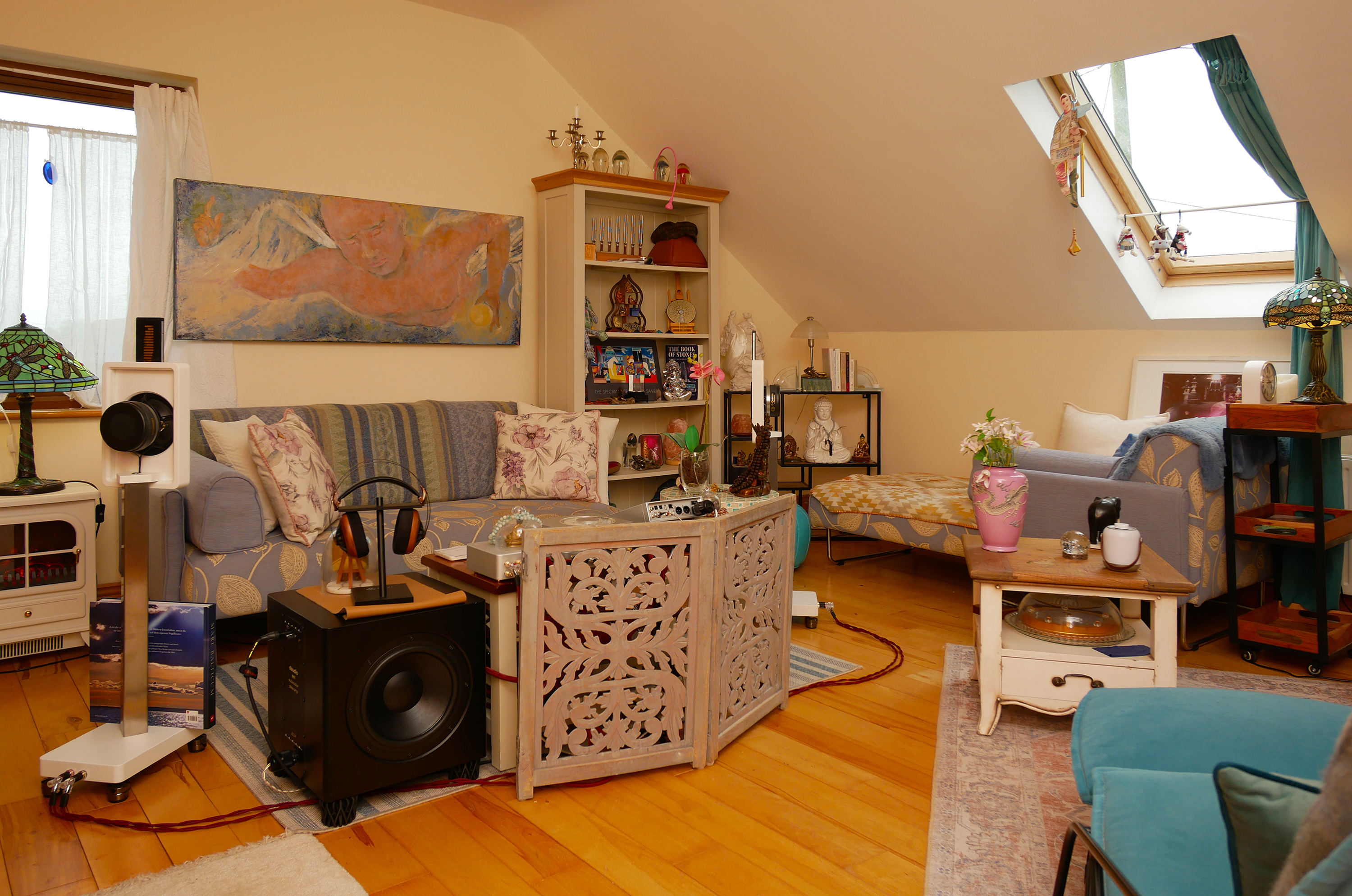
If you're tired of reading on gear for magnates and moguls, industrialists and tycoons, Daudio's M1 threesome should rekindle relevance. It still costs a pretty penny. Uncompromised performance audio of premium parts usually does. This simply fits regular even small rooms. That's today's difference and haymaker. In certain circumstances, it can even cover two spaces simultaneously as shown much earlier. Like in my above setup, sitting close is no issue. In fact, it minimizes the heavier atmospherics of a wideband dipole's energization of the total room. The same is true for reversing this setup. Swap couch with screen. Face Ivette's painting of Archangel Michael, with monitors and sub against the same wall. Now music radiates in virtual half space what with very little space behind M1. We'd merely restrict soundstage depth like is true for actual inwall speakers. Attentive listeners could enjoy rotating the sub so one woofer aims directly at them as I did here. It could also make the attenuator and power mains easier to access. Meanwhile attentive decorators could enjoy the subdued branding. As one circles this proposition like a punter does a new car, one begins to appreciate its numerous smarts. With the turnkey ease this embeds, I can't see prospective distributors having issues understanding this system; or demonstrating then selling it successfully. Admittedly the big dipoles are another matter; and Daudio no one-model brand. But as I thought going in, M1 could just be the breed's most persuasive ambassador.
When we call a chap a prince, it's often because he did us a solid. It's more reason I call M1 little Prince Di. He really does dipoles on a whole a very solid favour.











Sexy and smart. As my photos showed, M1 makes little décor demands. As my narrative shared, its 2.1 execution is textbook. It duplicates what I learnt over the years to a 't'. In three different rooms, integration was perfect and instant. Unlike most all competitors who even offer optional subwoofers to augment their small speakers' natural roll-off with adjustable filter and phase controls, Daudio make theirs mandatory. It's how they can guarantee a seamless dovetail joint with just one potentiometer; naught else. It's how their 6" midrange categorically unloads the 2½ octaves that are the most excursion-critical distortion generators. It thus plays cleaner and with more authority and gumption than preconceptions would believe. Sexy and smart. It needn't be the scary combination machos fear. In fact, this particular one could become quite the domestic peacemaker. It can play subdued or stentorian without occupying big real estate. Woofers aimed sideways, the sub in black or white looks like a standard piece of furniture. Its top could display decorative items, hold a big plant, lamp or show off a few coffee-table books. Eyes would be none the wiser that it's a serious LF weapon. Even the plinth-mounted cable entries clean up the usual snake infestation to please an interior decorator. Were I a dealer canvassing weekly hifi news for unique problem solvers, I'd want to check out the M1 speaker system. So it's seemly that my final page featured a deliberately compact layout. Smaller spaces are where today's Dutchies can make the biggest difference. If from just reading you could know how big and complete these behave, you'd stop dreaming of that posh dedicated sound room and find bliss in a smaller shared-use space; now and not a mythical tomorrow which may never come. See these at the foot of a double bed. If that sat in open space which had the sleeping area continue into a living zone or home office, the same speaker pair would make identical sound in the other direction, zero adjustments involved. What other compact speaker does that? What other 2.1 system does that and takes the usual guesswork out of its subwoofer integration which even reviewers claim is a black art? If you still believe that, order this sub in white. On that jesting note—white not black magic—time for a smart and sexy conclusion.
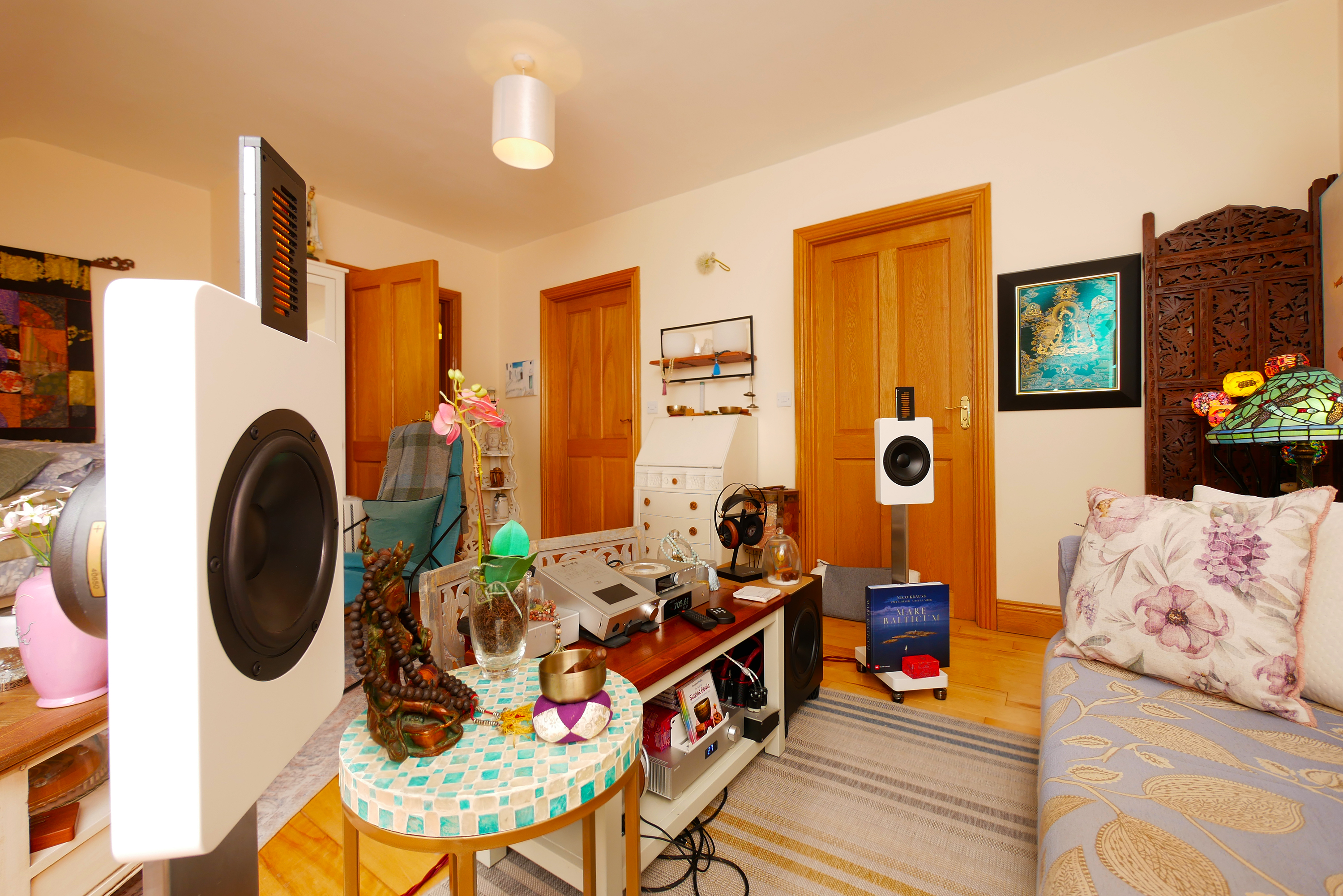
First, a quickie rewind on my triple room takes. Most writers collect all their listening impressions first before penning a review from hindsight's higher vantage point. I write as I go. It preserves my takes unedited by subsequent findings. It also maintains apparently conflicting observations in their original rawness when things behave different from room to room. As a dipole which emits sound in both directions—here from sub 100Hz to beyond our upper limits of hearing—room interaction follows setup. Two factors are at play. The farther from the front wall we situate a dipole, the longer its rear reflections take to reach us. Shortening those pathways minimizes their time delay. Simultaneously, longer pathways cause greater amplitude loss. Whilst delays increase, signal strength decreases. Also, the closer we sit to the speaker, the sooner its reflections can reach us. My 3rd setup had me very proximate plus super close to the rear wall whilst rear emissions travelled far. This had me hear the most direct sound and the least reflections. My 2nd setup had the speakers nearly 3m off the front wall, my seat +3m from the speakers. Front-wall reflections travelled +9m to maximize delays for that classic 'deep-venue' feel. My 1st setup split the difference. As someone who fancies headfi's no-room immediacy and loves when speakers come reasonably close, my descending sequence of preference was least to most 'reverb'. Predominant direct sound maximized separation and stoppages. Predominant reflections prioritized softness, elasticity and tonal voluptuousness. Front-wall/speaker and speaker/seat distance fixes where on that axis we end up. It's true for all speakers but dipoles add greater weight to these decisions. To optimize my downstairs for dipoles of broader bandwidth than my current IQ, I'd want to rejig its layout. It'd mean moving indoor trees that sat in their current spots for five years. Had I just one room, that'd be mandatory to do fair reviews. I then couldn't have immovable plants. But with five rooms—today we'll stick to three—generating extra data points is rather more useful than multiple matching results.