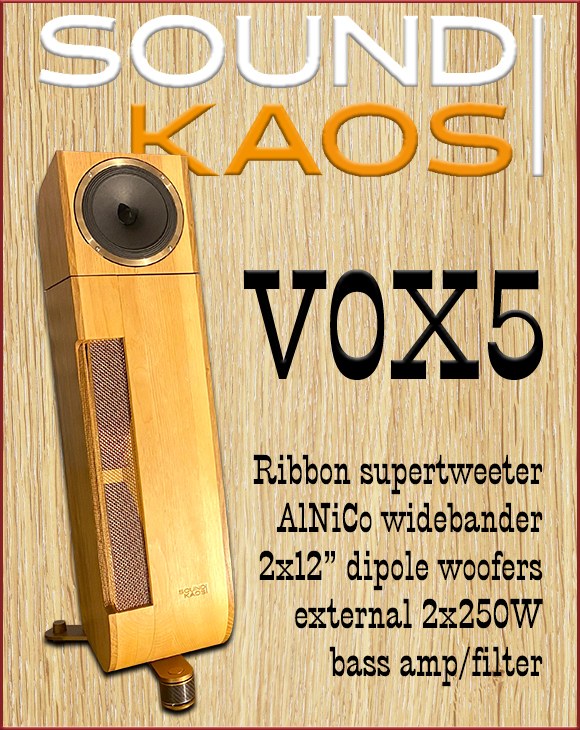
'D' for divergent. Box speakers occupy 99.78% of audio's commercial real estate. Amongst that lot, ported bass occupies its own 85%. That carves a deep sonic imprint on the general populace. Familiarity equals correctness. Remove box talk, port bloat and attendant time blur. What differs from the norm has its work cut out. We must first forget our sonic reference to open up to a different gestalt. Once the old is forgotten even just temporarily; once the new becomes temporary status quo—returning to the old could well seem old. Passé. But if dipole dispersion were the silver bullet, we'd all listen to it. That we're not becomes the counter argument for most dissenters. That full-range dipoles look like room so opinion dividers is one reason. Big dipoles needn't be ideal wall huggers either. That can conflict with minimum-space décors. There are reasons why dipoles don't dominate. As sound-first pilgrims, are these legit reasons though? Shrinkage and sleek dress code of the M1 concept could just pull the rug out from under dissention. Then it's down to pure sonics. Now 'D' could stand for: Daudio M1. Dipoles. Domesticated.
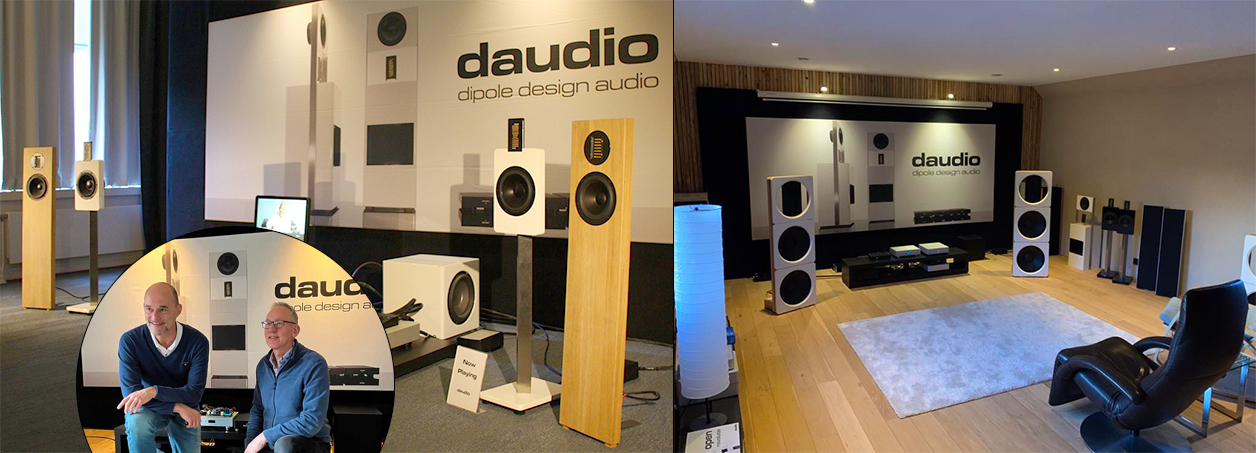
Above right a reminder what ~30Hz bandwidth from a full-range dipole entails with Daudio's dual 15" MOB; how petite M1 is by contrast. Its sub hits 20Hz yet the threesome is less imposing. What we lose is room tuning from figure-8 cancellation down into the 1st octave. The M1 sub radiates omni like all other box bass. It interacts with all boundaries. Whilst we get more bandwidth and loudness, we lose dipole's reduction of late-arriving room gain for superior timing. Something for naught isn't in the cards. If it were, Daudio wouldn't need bigger models. Versus dipole brands Clayton Shaw, Diesis, Emerald Physic, Kyron, sound|kaos and Spatial, none offer anything as petite. M1 might just be the host with the most for lowering the barrier of OB entry. It could be the breed's most convincing ambassador. It just must make the rounds beyond Holland's dikes. "We supply M1 with passive tweeter/mid filter and active analog high-pass (ASP for analog signal processor) with dipole EQ. We can supply DSP—usually a Lyngdorf 3400 so the client has a compact system—but our ASP reaches a higher level and adding a nice DAC makes more sense. The small black box at the end of M1's speaker cable is its passive 2-way filter. It can also build into the stand's plinth which then grows from 18mm to 40mm high to house the caps and coils. The sub has its own built-in low pass driven by the ASP's mono line-out. We can visit domestic clients, measure and build active room-correction notch filters into their ASP. International customers will do their own room correction in Roon or HQPlayer-type DSP as we do at shows for real-time flexibility. Our filter slopes arrive at a 4th-order acoustic function. The standard M1 baffle is painted HDF though can be made from other materials by request. Likewise for the sub. We've already done solid oak. The bass amp is an NC252MP [400-watt/4Ω mono – Ed.]. Digital latency is zero because our filter is analog." Removing LF from even presenting at a midrange's voice coil reduces its excursion demands by a factor of four for each octave eliminated; and lowers coil-temp increases which otherwise lead to raised resistance and reduced dynamic linearity. Classic 3-ways execute their midrange high pass passively. The M1 modular 3-way's goes active for superior phase behaviour and non-reactance; compensates for an OB's 1st-order acoustic roll-off; and activates its bass system with a purist analogue low pass. Whilst it might look like just another sat/sub proposition, a closer look reveals decisive differences.












For what came before, a 2019 Dutch review described the earlier DSP/amp as a beautifully bevelled bead-blasted solid aluminium housing with recessed rear connections and oval blue display containing 100wpc Hypex Ncore for the tweeter, 125wpc for the mids and 250wpc for the sub, with XLR analog inputs, AES/EBU, coax, Toslink and USB plus SpeakOn outputs for monitors and sub. "The M1 managed to achieve fundamentally different replay from many speakers I hosted over the years. Whilst it sounded free and balanced, many others did, too. What differed was the degree of freedom. Thanks to the open baffle, the M1 created 3D holography with calm coherence and brilliant integration that sounded as good at pianissimo as it did at fortissimo. The stereo image was beautifully wide, its boundaries neatly extending past the monitors with beautifully layered depth of field. On dynamic expression, the M1 played not as exuberant as certain expressive box or horn speakers but certainly not as timid as certain electrostats or low-efficiency types to give very little to criticize. It is great that this small system can play so very grand and mature and even managed to fill the enormous ballroom of the Audio Show Alkmaar 2019 with remarkable ease." Playing verbal sleuth, 'degree of freedom' could 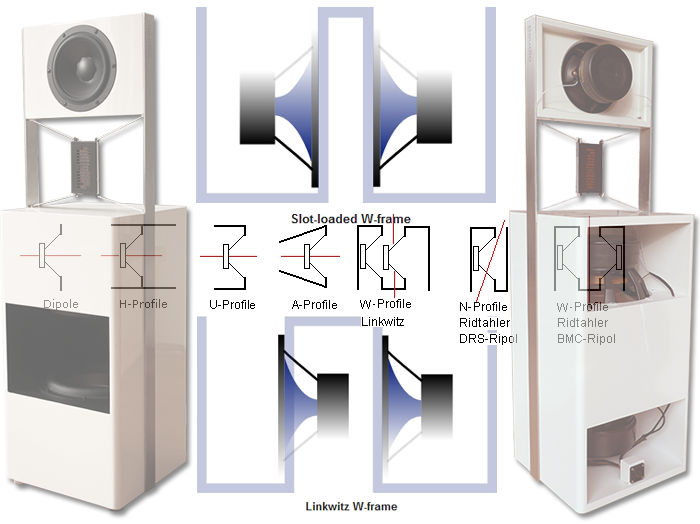 well point at unfamiliar recognition of absentee box talk. Noticing it is easy. Describing it to someone who never experienced it is far from. A typical detour into familiar terrain articulates a dipole's benefits on soundstage precision and image localization as the most common noticing points. My experience says that there's more to it though freedom is a great if vague start.
"We abandoned the fully active version written up in that review some time ago. Limiting the M1 to Ncore wasn't the best way forward. Many clients already have tube or solid-state amps though a few do use our Purifi-based P1000 amplifier option. Because the sub remains active, you only provide your power amp of choice to the monitors."
Here's HifiPig in their 2025 Dutch show report: "They were playing the MOB3 when we went in. These are bigger than the MOB2.5 we recently reviewed and gave our Editor's Choice award to. It was a good few years that I first heard this brand's speakers. I loved them then and my mind hasn't changed one bit. There is something very natural-sounding about these that even in this less-than-ideal environment seemed to get a really organic sound… We then had a listen to the smaller M1 stand mounters which are also OB but much smaller and supported by a Daudio sub… You'd not guess you were listening to such small speakers and I confess to being a tad sceptical before they started playing tunes. That scepticism lasted about two bars into the music. Worth noting, though they aren't on the website, the electronics in the room were also by the company."
In June 2026 when I wrote the above, Daudio still had work to do on documentation and English pages. But Hans explained why their global roll-out is slow. Their domestic sales approach is hands-on. That extra service isn't readily cloned internationally unless value-added dealers get involved; or clients take on their own setup. For a pictorial walk down Dipole Avenue with its various folded offshoots, at right you can see some shapes super-imposed on the W1. By May 5th, "we received all parts and built the ASP analogue active filter with volume control. There is still space for analogue room-correction filters. For domestic clients we normally take the necessary measurements to customize such filters. We are still debating how to do this globally but it is certainly possible. For now the review set of M1 with AT subwoofer is ready to ship."
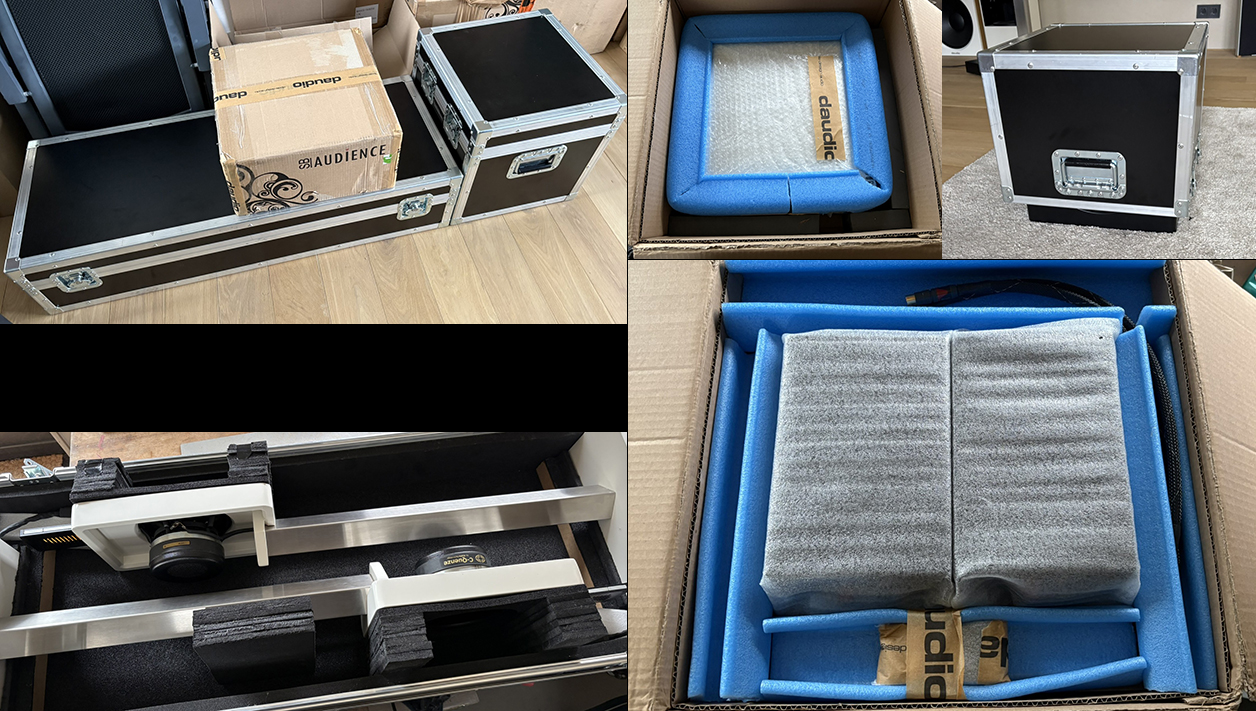
"The monitors are in the long flight case. The square flight case contains the subwoofer, the cardboard box the ASP, remote control, a pair of our Airtube RCA interconnects with silver/gold conductors, a subwoofer XLR cable, the 2-way crossovers for the monitors and Sonic Design damping feet for the sub and monitors. We are currently working with a packing specialist to develop a more compact shipping box for the M1. Then the client will need to assemble a few parts but it would ship worldwide far more easily. Since that packing is not done yet, I shipped these M1 in our original flight case, no assembly required. The ASP'S MC input has 60dB/1kHz gain and a 100Ω input impedance. The DAC/AUX inputs are identical. A small screw next to the phono stage can earth the turntable. The chassis is grounded for this." When both flight cases arrived with their innards severely damaged despite the outer cases being in good nick, my narrative suspended until custom packaging fit for international transport was available. That took a good four months during which the original samples restored. "I picked up custom protective foam and everything fit perfectly. Now the maker of the transport crates will build matching hardware." The new foam cradles and wooden crates certainly looked the biz. On final packaging, Daudio were open for global commerce.
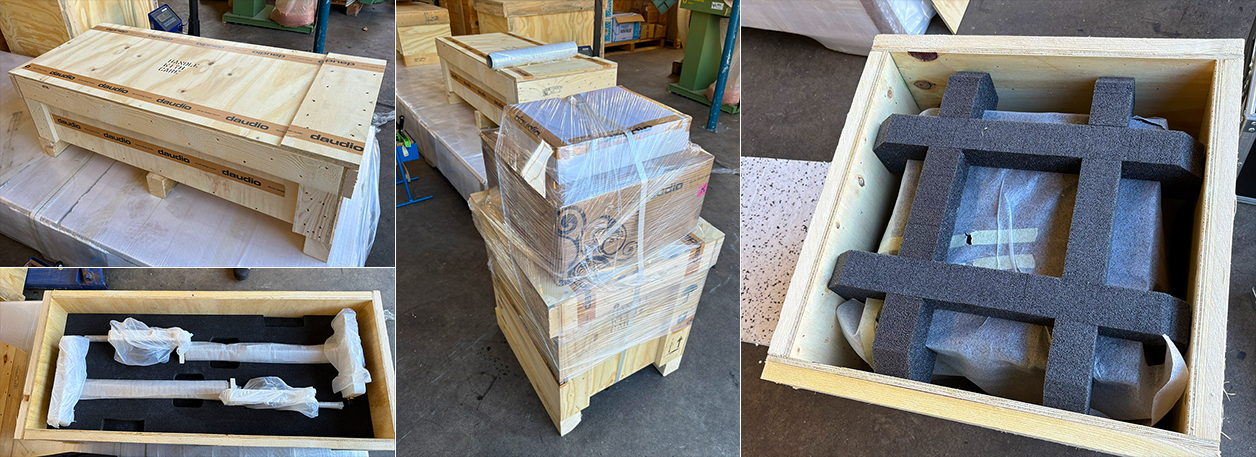
"This M1 is in matte white with taller plinth embedding the passive filter. This is currently our best-selling version. Most clients dislike the look of a separate filter box placed behind the speaker. This M1 has threaded M6 receivers for the included IsoAcoustics Gaia III. The sub is not yet fitted with threaded inserts. Those will come with the next batch. It's why I sent along Sonic Design damping feet which provide excellent decoupling though the IsoAcoustics look better if at a higher price. If you have other decouplers, you can of course try them. Set the ASP's switch to mono for this single subwoofer. This version takes an RCA signal from your DAC then outputs balanced to the monitor amp and sub. On a single sub, its central volume setting is usually the perfect starting place." A day prior to when my Dutch shipment was to land, a big lift-gate lorry collected a pallet with weather-wrapped Virtual Hifi 2×15" 3-way open baffles called Supernova to return to Poland. I'd smoothly transition from a classic big open baffle to Daudio's 2.1 hybrid. Other than overall shrinkage, another Dutch advantage would be its separate bass loudness control where the passive Pole's was fixed. To alter it had me 'write' EQ compensation in Audirvana Studio. It worked like a charm but not everyone has such means. With today's 3-piece system, that's no issue. Also, a few days prior to arrival I learnt of new Belgian brand Bombard. Their maiden model is a twin-woofer dipole on a carbonized Oaken baffle with cast-brass horn-loaded compression tweeter, class D active drive and DSP. Meanwhile Silent Pound from Lithuania announced Parallax, their new flagship embedding a quad of 15" woofers per channel in a stacked folded-dipole configuration. This wider speaker breed was stretching its legs.