'D' for Denmark. Hamlet's country may enjoy the highest density of hifi makers in the world. Like Dynaudio and ScanSpeak—and formerly Dansk brands Peerless and Viva now part of Taiwan's Tymphany Group—AudioTechnology of Stilling design and produce drivers. This brand is most responsive to OEM requests. It enables speaker designers to alter performance parameters to their specs. This family business is run by Ejvind and Per Skaaning. Ejvind had previously founded ScanSpeak and Dynaudio to be Danish hifi royalty. AT drivers are used by Goldmund, Peak Consult, Verity; in my RiPol subwoofer as twin 15-inchers; as a twin 10" upgrade option for today's subwoofer; as M1's custom midrange. For transducer envy, Daudio have us royally covered. Why customize a driver for dipole use? Its return stroke doesn't see compressed air in a box act as spring. Stiffening surround and spider compensates. To personalize, I run my below Qualio IQ fronted by a 100Hz/4th-order high pass. It exploits the semi-cardioid dispersion of the RiPol sub to cover bandwidth beyond 35/70Hz room modes. It's how a directional sub plus two ultra-compact active PSI Audio bass traps become effective room tuning. I even plug the IQ's port. My floorstander might as well be smaller. I look at beefy bass bins I don't really use. M1 would strip back these visuals to actual needs then hot-rod the smaller AMT. Doing it all in white would be my albino cherry. As a lightweight compact, M1 would also easily hoof upstairs. There I respectfully decline to heave the IQ.
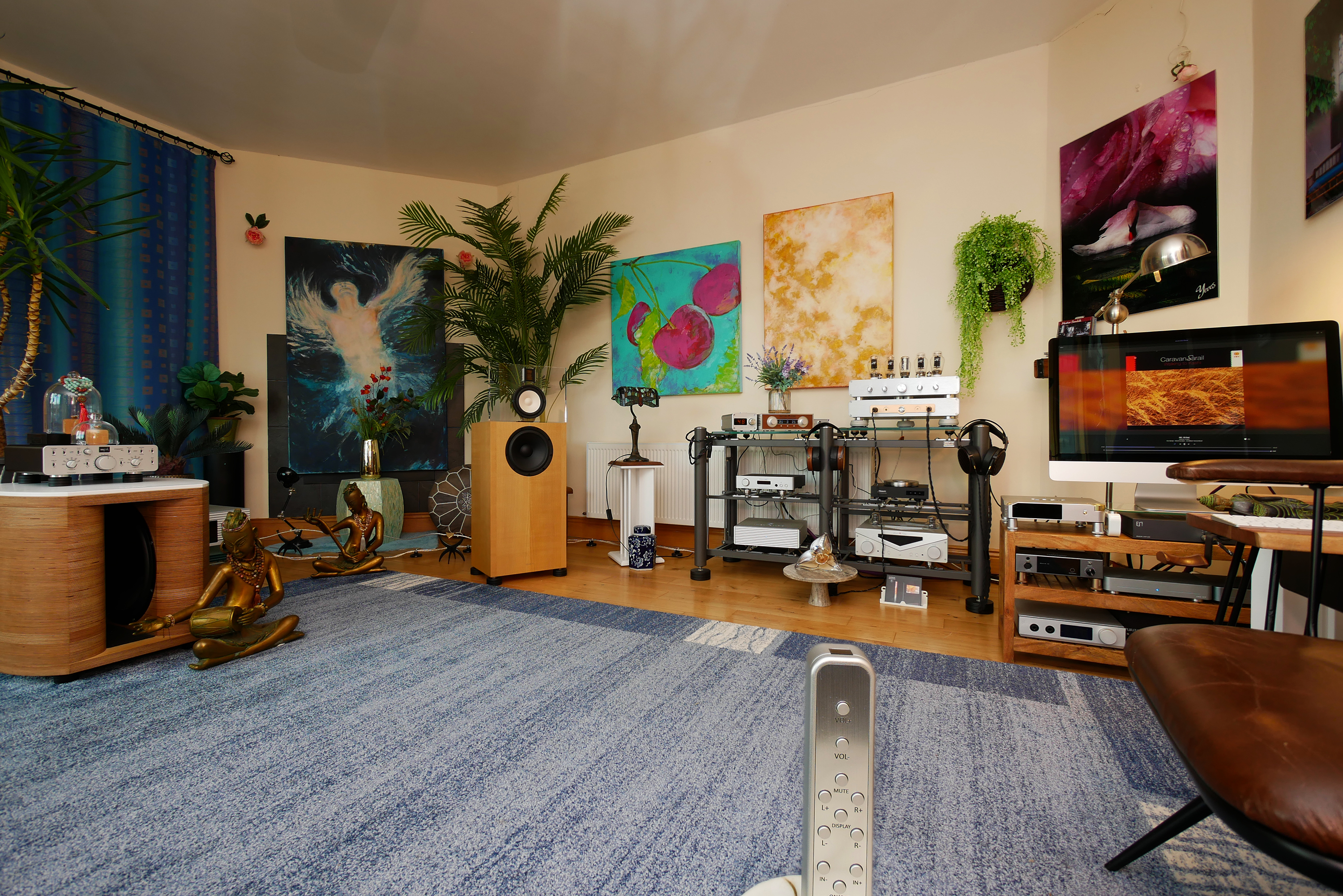
One of the upper systems used to combine these ModalAkustik MusikBoxx monitors with a 15" sealed Zu sub whilst a Pál Nagy active analogue crossover split 70Hz hi/lo-pass paths.
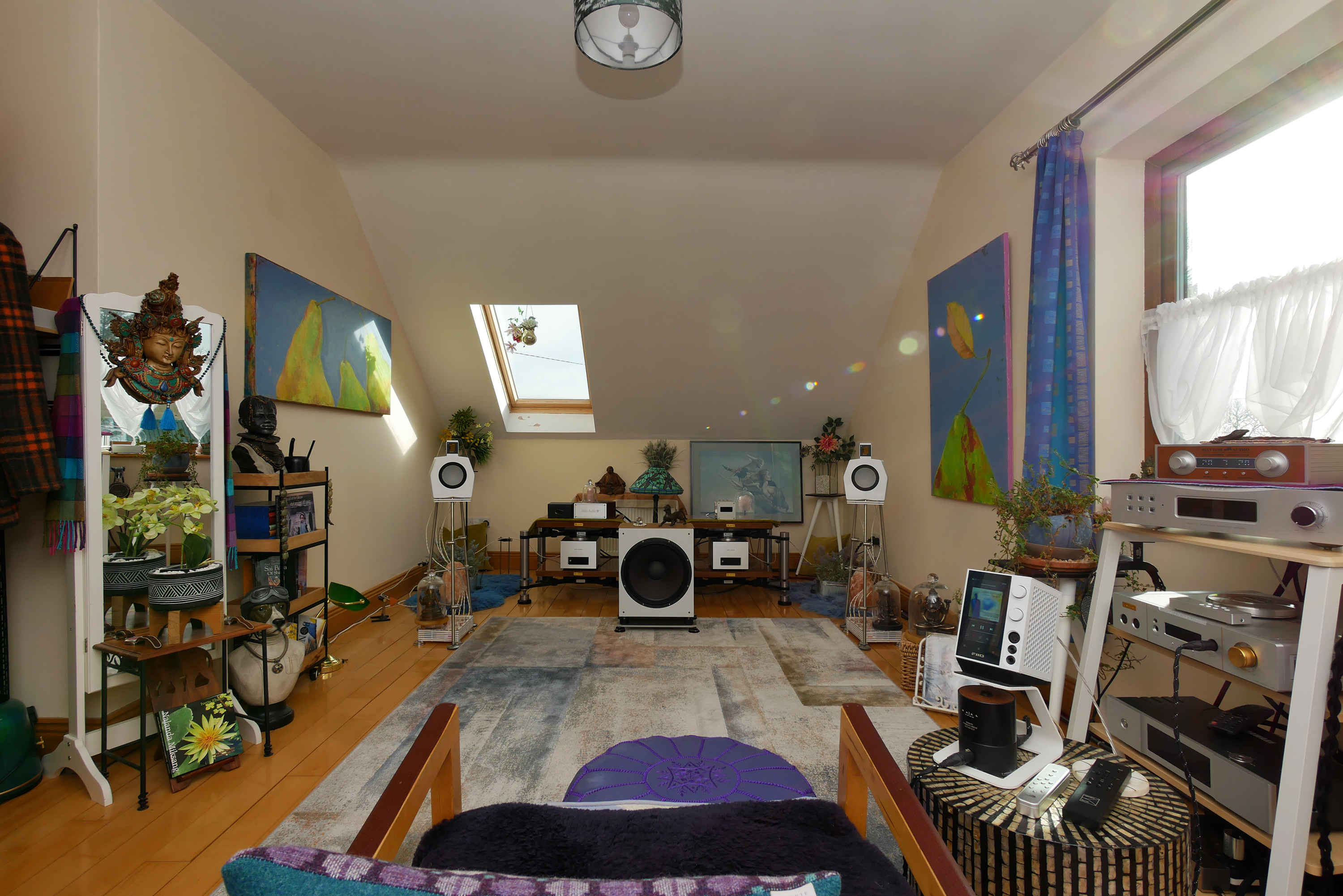
Before you think this the end of my Mundorf dipole dalliances…










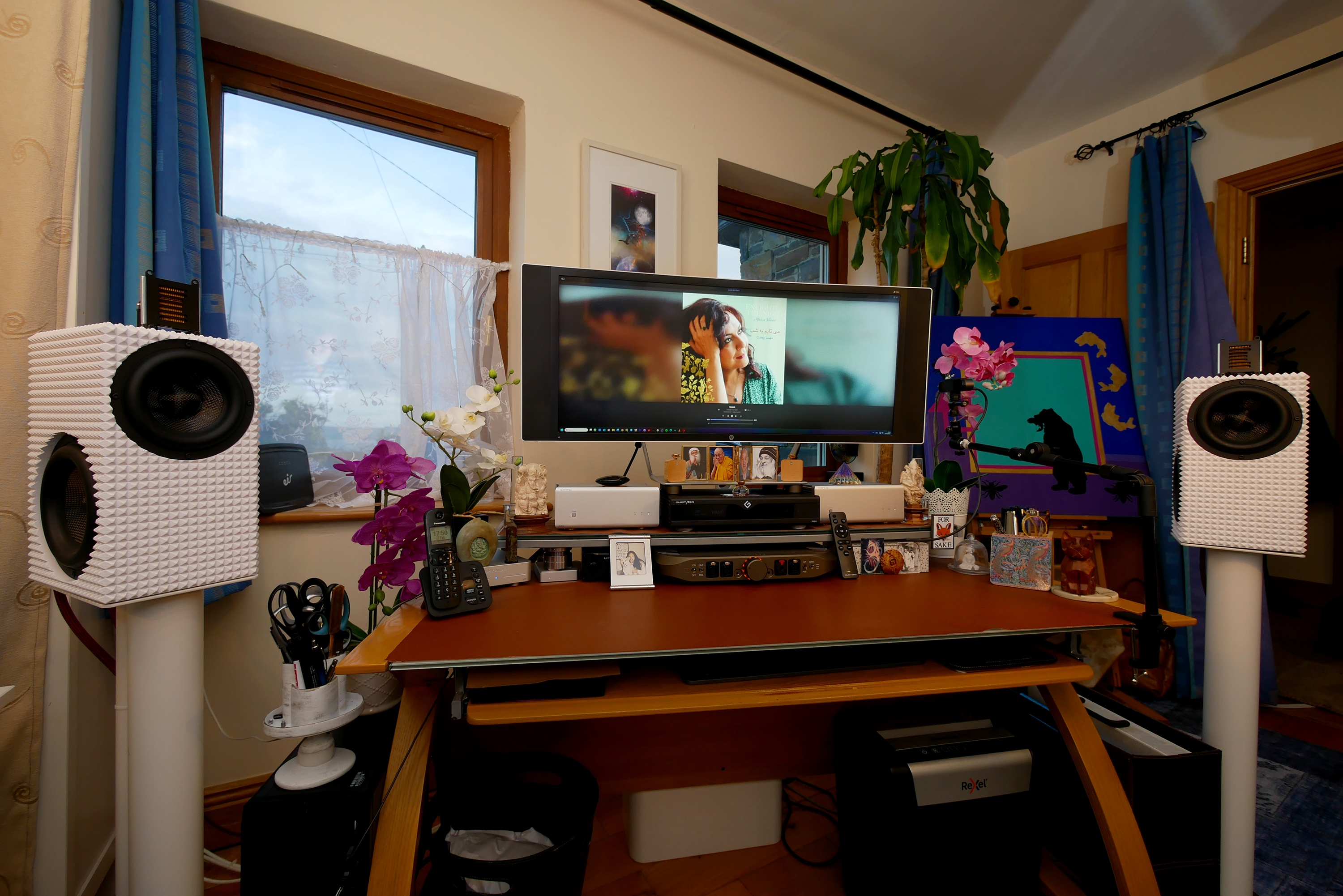
… there's my stable office system…
… and this temporary variant:
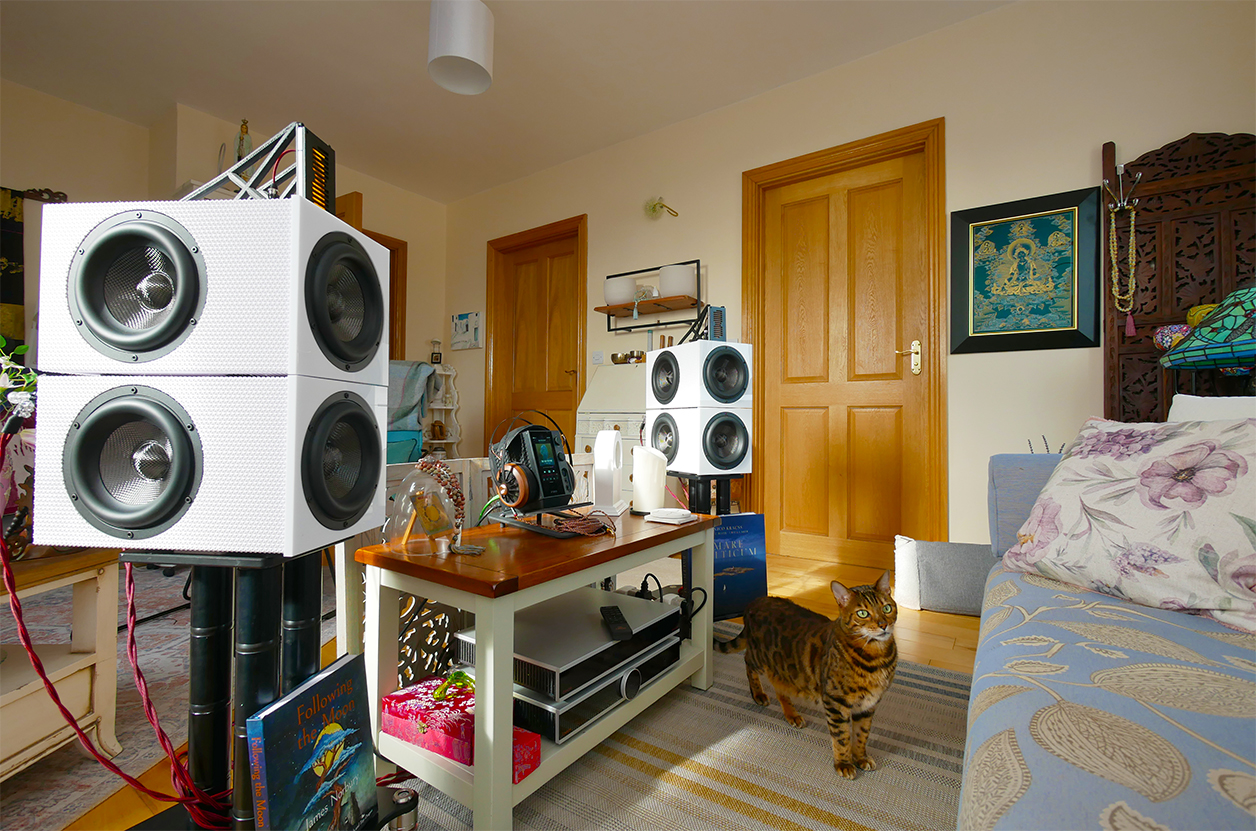
 Predicting that M1 would fit right in was fait accompli. Hazy I still was on its building block. Hi-tech synthetic stone à la Corian, HiMacs, Krion? Daudio's site didn't say. Ditto sub electronics, connectivity, adjustments and power. I didn't need these details. Prospective punters will. So I asked. Relative to letting all nasty bits spill out—a common complaint by dipole detractors about nekkid baskets, magnets and wiring—M1 plays it clean as starched white table cloth. Black-out driver treatment meets single short straight wire lead as any box speaker shows with attached speaker cables. The rest conceals. Not even a pesky puritan should object. Over 35 years, musicians Hans and business partner Jeroen have sweated details that grant an interesting idea a 'D' for domestic docility not defiance. Enter more obviousness.
The modular M1 3-way won't work sans sub. No open-backed compact driver makes real bass. This one doesn't have to. It can stay small and quick to meet a blazingly fast very dynamic tweeter. For more on why this dipole stops at 120Hz then goes sealed-box active, here's Grzegorz Rulka on his Virtual Hifi Supernova: "I already tested Dayton's 18" woofers. They require active drive of at least 1KW. This delayed me for a long time because I want my project to be passive. Physics are heartless. Without baffle, a nude high-stroke 15" woofer starts its 6dB roll-off at ~600Hz so it's down ~25dB/30Hz. I'd need eight per side to compensate. Serialized drivers never work well. Now quad amping and high excursions enter the picture or there's no real bass. There is real bass from Dayton's 18-inchers; but only with 1'200-watt ICEpower drive on each; twin woofers per side; and still only for reasonable not very high SPL. I tried it all. There's either a huge utility bill and complex design; or some kind of folded baffle."
Knowing the same Physics, Daudio picked a hybrid approach.