Degrees of freedom. It's what the earlier review quote said. I too encountered higher freedom in M1's soundstaging and its widebander-adjacent suchness. To me, the latter's origin was the time domain, its communicator musical energy. Was it Naim who coined PRaT for pace, rhythm and timing? It hints at a playing-the-tunes feel. In the pocket. It triggers tapping feet, bopping heads and snapping fingers. Such physical reactions suggest a transfer, stimulant or infectant. Something prompts an audience to not sit still like stone idols frozen in time. Whilst listening, I tend to refrain from physical twitching. But I'm still sensitive to whether a self-communicating quality presents or not. The sort I felt with the M1 was a subtle quickening. It very easefully cut to the heart of the matter as a sudden absence of energetic drag that waded through water or shifty sand. It's a lack of buffering which the music must no longer clear before it jumps from speakers to ears. It's less confusion, hesitation or reluctance. But it differs from my take on Naim's term. It applies to all music, even spacy styles with no groove to lock onto. This freedom isn't about reactive physical ticks. It isn't manic or forced. It simply causes keened attention. It crystallizes perception. Fewer subliminal detours. I assign this to the time domain and the tonal beginnings we call transients or leading edges. When they take the shortest most direct route, cobwebs clear. The result is pristine, clarified, instant and self-evident. If music were a sculptor and our attention its clay, this widebander-adjacent quality is a fine point that leaves deep unmistakable marks for most easeful legibility and comprehension. Whilst audio discourse litters with musical meaning, open windows and artistic intentions, I dislike these expressions. Nobody but the performers and studio engineers knew their own intentions. As a former musician, I'd even say that in a flow state, there is no individualized intention. There's only an expanded hive mind perfectly sync'd to the newness of the moment. But it's certainly true that our right system speaks to us. We comprehend, see or feel something about our tunes which lesser systems won't parlay. Such insights are intensely personal. They have zero overlap with a composer's or performer's intentions. "What's your abstract painting about?" "You tell me. What do you see?" In that individualized sense which fluctuates from listening session to session, musical meaning is real. We just can't claim that it's what the performers intended. It's our find; of that moment. The next could and should be very different.
I thought of it all as upshots of reduced time confusion. Some designers pursue it with minimum-phase 1st-order filters. Others use physical gears to time-align drivers with a given listening position. Widebanders shun a crossover altogether; or move theirs beyond all acoustic fundamentals, say to 8kHz or higher. Yet other designers and their clients pay less or no attention to time coherence and driver alignment. They call it immaterial. Clearly we don't all listen to or for the same things. Daudio's M1 seems tailormade for people triggered by capacious well-sorted soundstages populated by very precisely focused images. M1 should also speak to people who are sensitive to music's energetic aspects. There are fewer hurdles to clear before we connect with our tunes. It's very simple, uncomplicated and non-esoteric. Attempting to explain and differentiate this effect is not—particularly when the box-less nature of it remains alien to all who never heard a dipole. For those familiar with classic true widebanders, M1's immediacy was less tensioned and more relaxed. It didn't ratchet up microdynamic jump factor the same. It also lacked the slightly manic drive of Naim's PRaT. It's back at easefulness from greater temporal clarity. When scenery stops to flicker and blur, we comprehend it without effort. Here the enabler isn't no crossover or a basic 6dB/octave type. It's lack of box talk and its shadows of energy storage and time delays. That now captured the conceptual aspects as I understand them to clear us for listening comments.











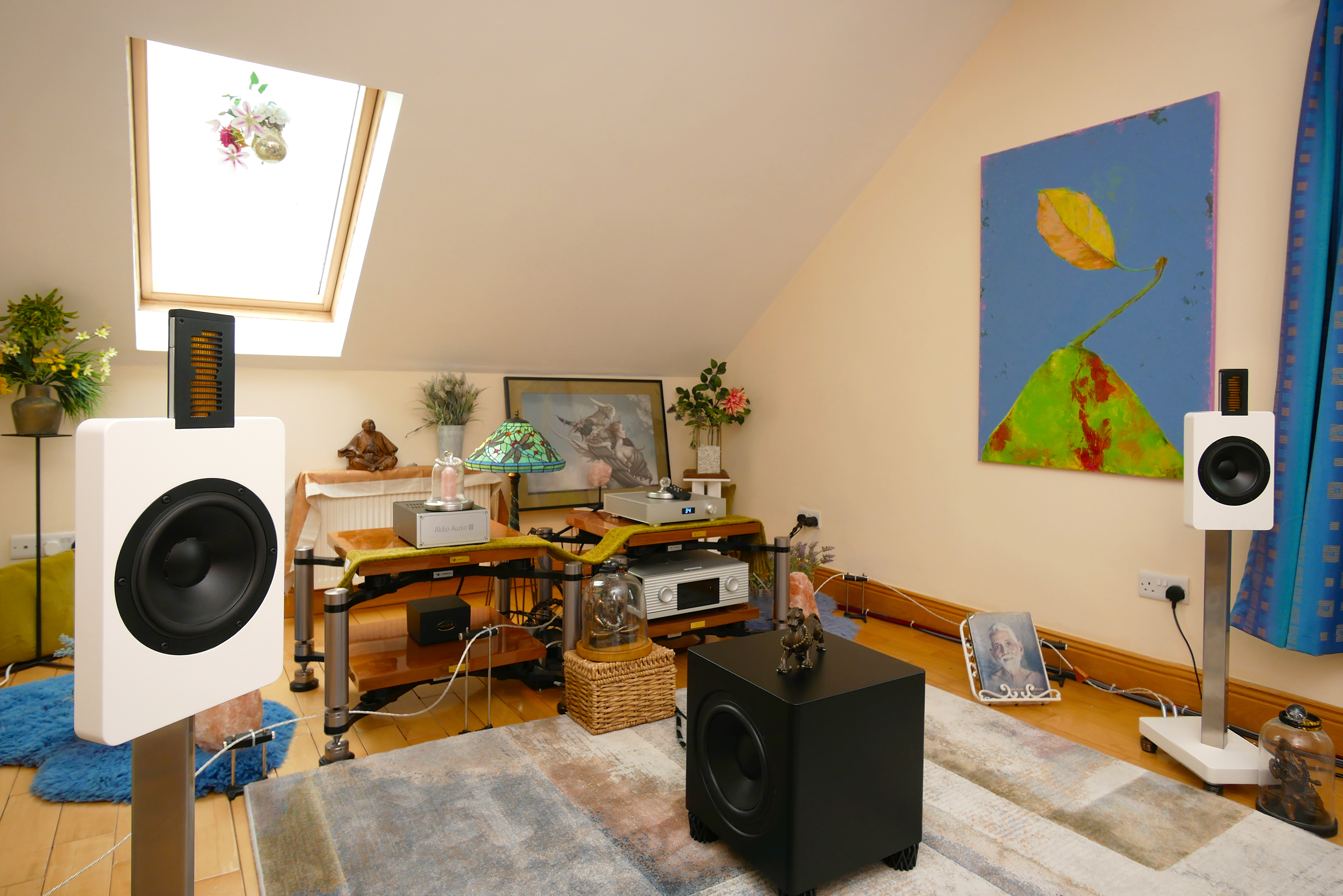
It'd be silly to invoke dipole sounds as having proper backsides and their direct-radiating competitions' butts serving time in boxy cells. Yet there's something to letting the mid and high frequencies escape box jail to trigger our room's ambient field like the low frequencies do which, even were their driver/s hidden inside a bandpass box to exit through a slot, still propagate freely in all directions. The easiest way to see the effect is a spare singer/songwriter tune whose recording engineer injected reverb around/behind guitar and vocals. What would otherwise feel stark and bare-boned gains spatial context and richer tone. I already covered M1's spatiality. Now comes its tonal quality. It's informed by more in-room reflections than the upwardly narrowing off-axis-attenuating dispersion of box speakers. Where the effect of four open-backed 15ers in my recent Supernova encounter was ultra physical at anything but background SPL, M1's was more subtle. Don't think reverb-laden dizziness; just slightly wetter textures. It's how even highly damped transistors acquire a faint tube tint. The back end of decay land is more developed than clipped trimmed hedges. It creates microscopic tone motion beyond the bigger far more overt motions of melody and rhythm. It injects traces of tonal elasticity or elegance. Even otherwise dry overdamped electronics aren't immune. That's fortuitous when such amplifiers can counteract a dipole's lesser innate stopping powers from lack of proximity loading. Another M1 aspect is its power region of the upper bass. It falls smack into the ±120Hz transitional zone between this smaller frontal midrange and its bigger lateral woofer companion. The combo creates acute alacrity and articulation in trade for bigger artillery's raw shockwave impact. As someone who always prioritizes bass diction and enunciation over shove and massive violence—well-chosen civilized speech not braggadocious jive—I really enjoyed this aspect. But it's fair to point out that a 2.1 Zu Method setup crossed the same way would register different thus speak to its own audience. The American set's vocabulary is more street, the Dutchies' more conservatory. The next close-up shows how Daudio terminate the midrange magnet with a leatherette rim and acoustic foam. More of that foam wedges as a sliver right behind the cone. The tweeter umbilical runs invisibly inside the upper baffle then routes cleanly around one side of the midrange before being captured in the joint run that passes through the stand's upright—a tidy execution of what can be a sore point with bare-assed speakers.
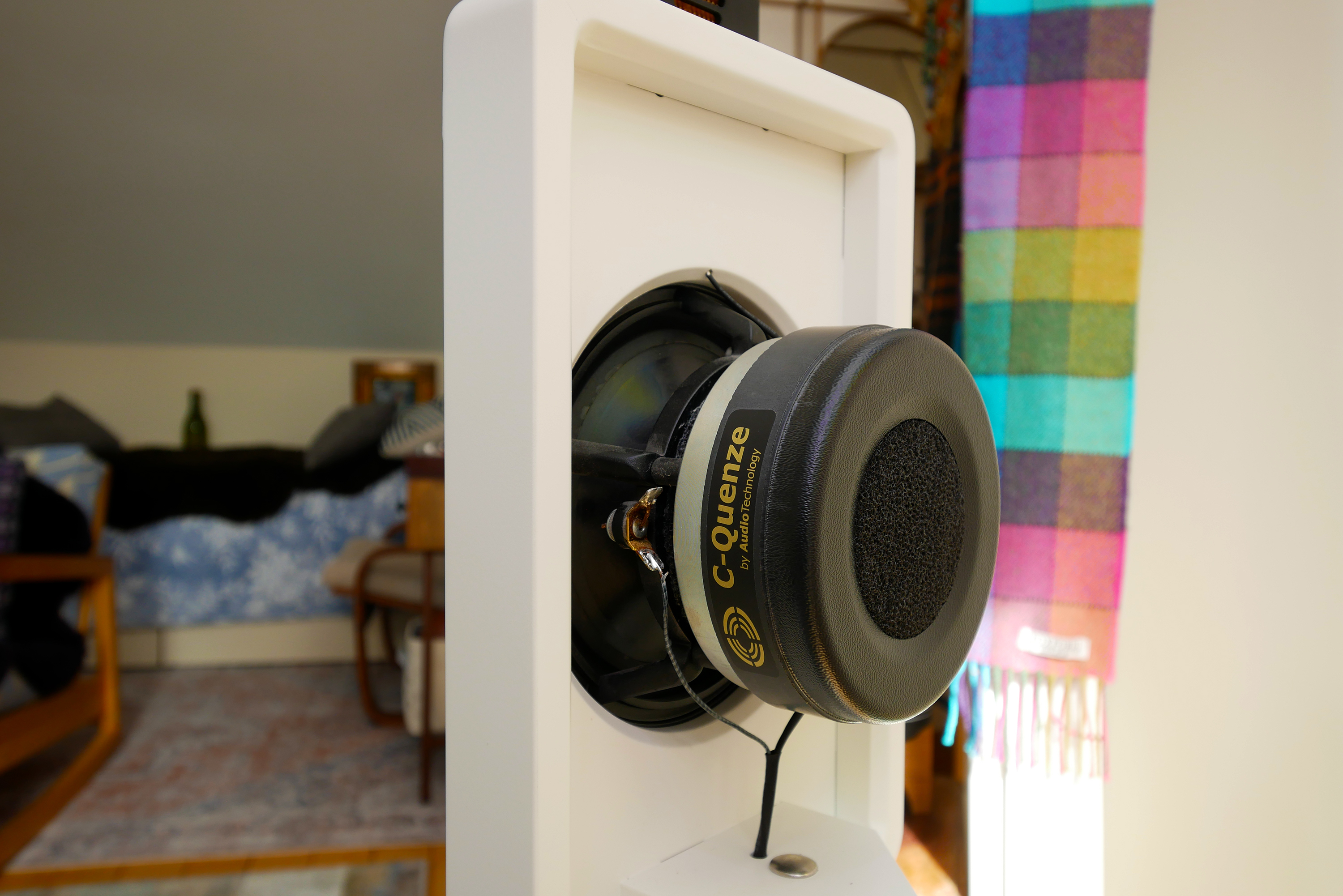
M1's clarity-over-mass bass balance—some of it tweakable by sub attenuator—contributes to its resolved intelligible style paralleling attractive spatially enfolded tone textures. It's the antithesis of speed-über-alles tunings that bake in leanness and overemphasize sonic beginnings to diminish bloom then foreshorten trails. M1's bloom doesn't rise like bigger more dynamically blustery drivers. That keeps its fast visual attributes uncongested by undue mass and potential darkness; not that the air squeeze of the AMT's grand surface would allow it. In my smaller room, I didn't hear the tweeter's contributions as standing out. They ideally dovetailed to complete the picture without any selfie antics. Would all of it stay or shift once moved into my main system? As it happened, it mostly just scaled up.