In some ways this was a Dansk battle between AT and SB: two 6" dipoles, one run to 120Hz handing over to 10"; the other playing ~400Hz baton switch to 9½" then 100Hz to 15". In the power region of music's engine room, Daudio's open-backed smaller driver didn't have the same crack or impact as my bigger box-loaded Satori blending very gradually with a studly 15" AT RiPol. That was 'p' for phtt and Physics. The Dutchmen's choice took the lead in midrange materialism. My papyrus cone from SB Acoustics plays it a bit leaner and more atmospheric. The mineral-filled polypropylene AT cone added substance; not what you'd expect from a speaker so much smaller. Where the eyes may lie, the ears know the truth. There was more. With these Goldmund-tuned Kinki EX-B7 monos whose high-zoot integrated version upstairs voices deliberately warmer, extra heft in the vocal range displayed harmonic fruitiness. It's what I call the enzymes, vitamins and fruit acids of recorded odd-order harmonics which give certain instruments their tart, spicy or pungent hues. It's not all honey, silk and lower even-order harmonics. Given chewier character, the AT/Mundorf combo was surprisingly capable of tracking such tone modulations. Whilst twin 10" woofers in a sealed box reached very low, they couldn't move the same air as my usual twin 15" specimens from the same supplier. No surprise there but it was creditable how on output linearity and reach, this sub kept pace with the rest's adaptation to larger cubic volumes. There's a well-justified belief that, grandiose image casting notwithstanding, such conditions put small speakers in their place. Don't bring a pocket knife to a rapier duel. On that score M1 seems half a small speaker; a snail that lost its shell. For it, logic predicts an even taller fall from grace once facing greater space. M1 put categorical paid to that notion. Sure, its game of scaling will hit limits. My largest room simply didn't meet them; nor did apparently the exhibit the HifiPig writers visited. Hearing it for myself was unexpected. It spoke highly to this driver's quality when run in dipole mode; and the efficacy of Daudio's analog open-baffle compensation.
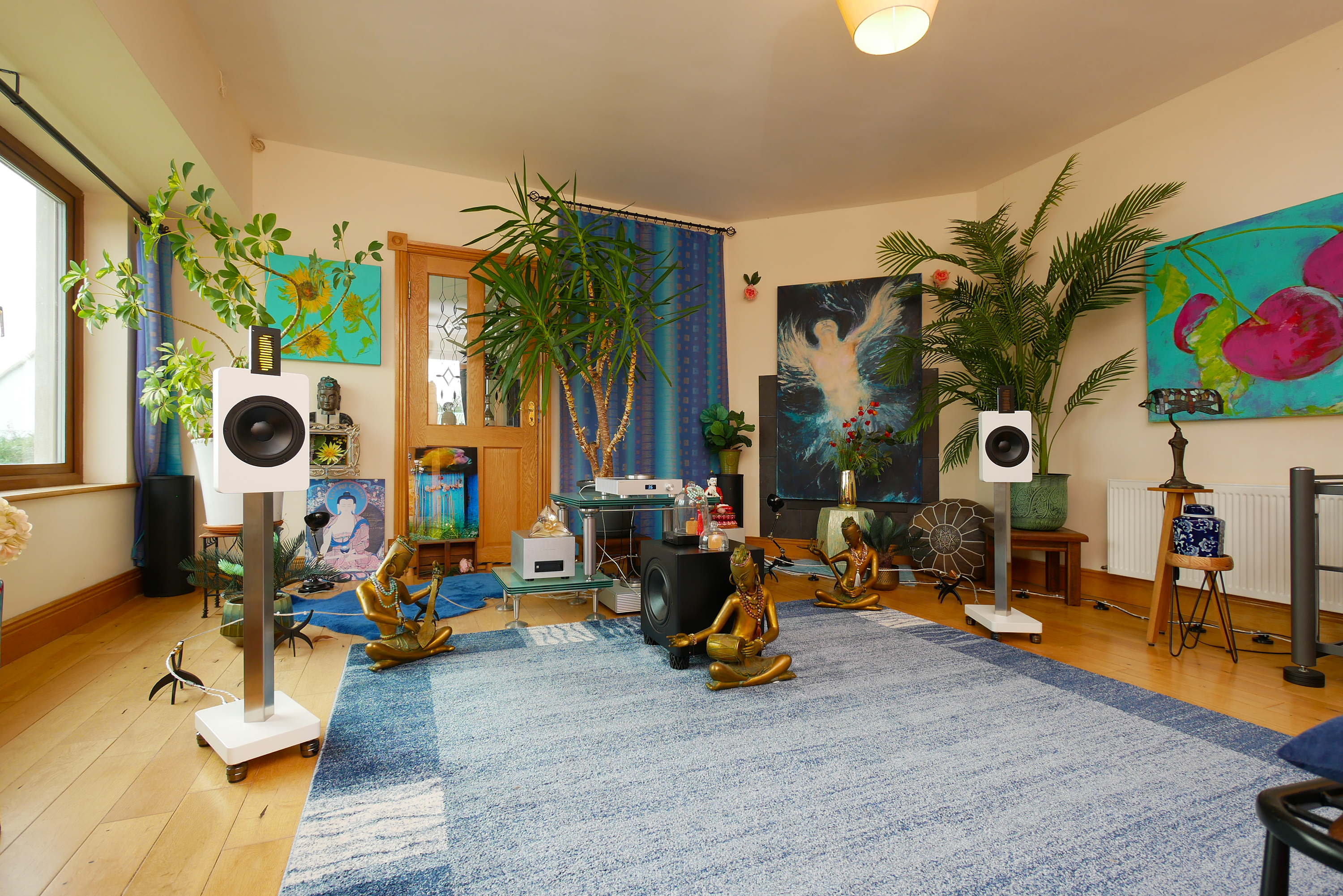
To be sure, this tonal aspect was separate from and other than a dipole's fine reverb flavour which I'm most familiar with from my usual Qualio IQ. This was probably a function of a given diaphragm's makeup. Carbon-fibre sounds different than Titanium-coated aluminium, Japanese washi paper or various plastics. Suffice to say that tone/timbre lovers who dream of Harbeth or Spendor could find M1 quite surprising. Likewise for deeper pockets considering Storgaard & Vestskov. Those Danes admittedly go farther on cosmetic detailing and finishing which bills directly to our credit card. Daudio strike me as performance-first folks. That's precisely what the M1 system sells; and very intelligently. It's not about the final word on cosmetic pizzazz and all that Jazz. But it does look straight at the informed less-is-more crowd which appreciates compact monitors of elite transducers and filter parts; a preamp doubling as phono stage and active crossover¹; an active sub with elite woofers and guaranteed integration whose lone variable is where to set its pot (start at 12:00); and a purist analogue signal path for zero latency from digital signal processing. It's also as close as a 2.1 system can get to shake 'n' stir.
___________________
¹ "Having the ASP handle the sub filter is a Dutch option when we can examine the sub of the future owner. Sometimes they already own a good sub. Then we measure that and put a crossover into the ASP to generate the overall acoustical LR4 120Hz low pass. Your ASP only does the high pass. The low pass integrates into our plate amp for max S/N ratio." About the volume control creating a switching transient each time one crosses 33 from either direction, "correct, all switches operate together at that value. It's audible but can't cause any damage."










All gain, zero pain? Wouldn't that be fiction? If you prioritize a damped dry sound of extreme contrast, you might call M1's extra reflective energies noise because they are not the silence or sonic absence of your usual backdrop. By running its 6-incher in dipole mode across two more octaves than my IQ, I was keenly aware of that extra behind-the-speakers presence—constant fish food raining in slow motion through backlit aquarium water. That action was the road toll of the heavier embodiment factor. I paid in softened contrast coin. My musical action sat in thicker atmosphere. It's the same for balcony seats. They capture far more venue signature than does close stage proximity. Even if concert tickets were free, most listeners would still pick according to their favoured mix of direct vs reflected sound. If you're a front-row guy or gal, free-space dipoles won't be your thing. This statement is as true as the particular directness already described. They coexist. One happens to the direct emissions. The other becomes the surrounding milieu or climate. My smaller room and closer sitting distance shortened reflective pathways. This downplayed the fish food. My larger room and placement far from the front wall lengthened them. Setup tunes this spatial humidity. Placement is thus an important consideration just as it is for all speakers. My biases preferred the upstairs balance. Whenever we have options, we're expected to favour one. What my time downstairs clarified was the M1's ability to fill a larger space like a far bigger speaker. Message received; loud and clear. How about the other way—scaling down? For that I went back up the stairs to the inverted nearfield system with its lilac minis and force-cancelling Dynaudio sub. Out with the old, in with the new. Here speaker drive is by LAiV's 120W GaNFet monos. The layout places the speakers about twice as far as they are from the couch, with wide open space behind them. Such front-row listening means predominantly direct sound. Distance loss pads down eventual reflections. Hello nearfield. Sources here are a Shanling EM5 1TB microSD transport; or smsl CD transport with I²S output. Either way, the DAC is an original LAiV Harmony.
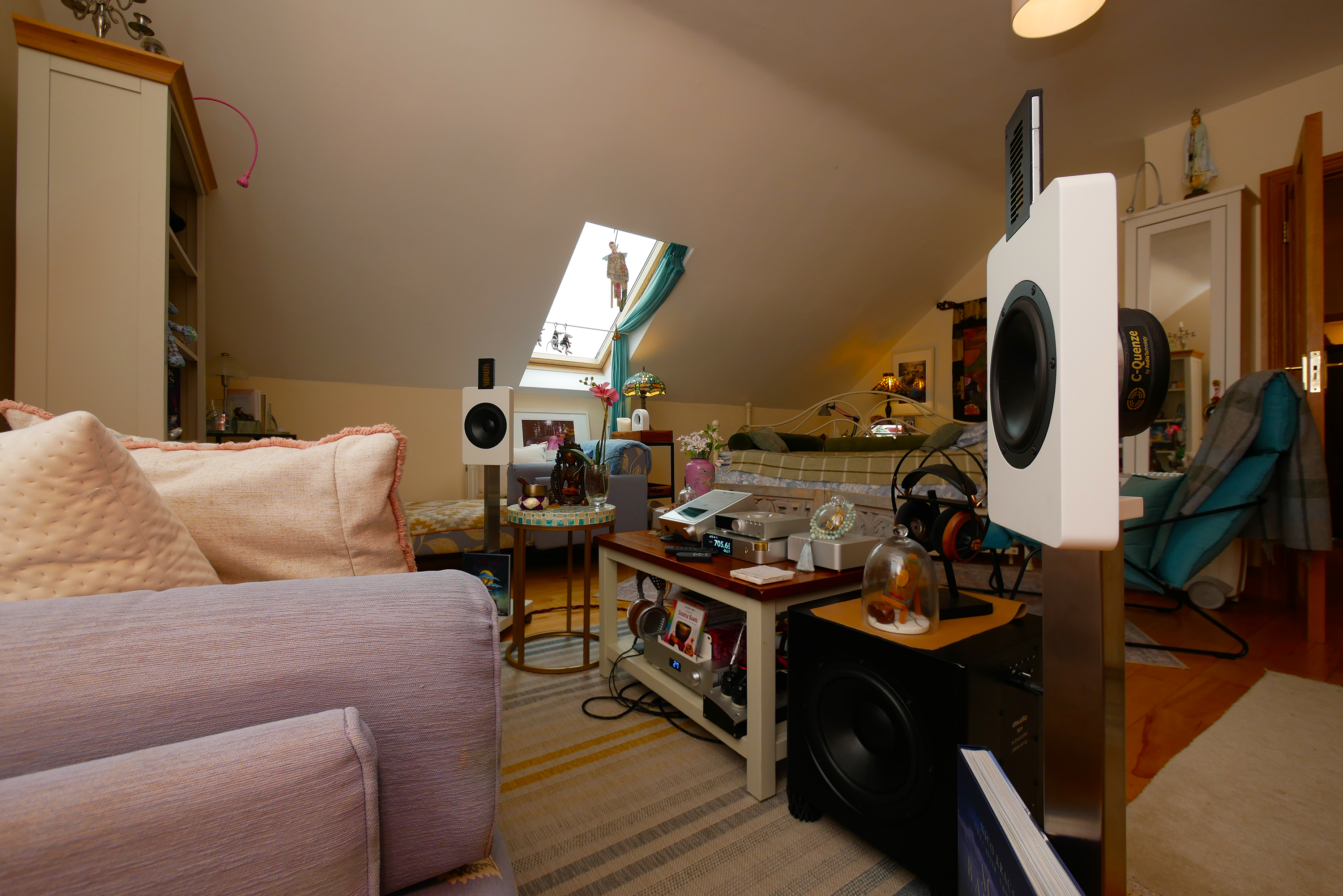
This proximity highlighted the widebander-adjacent qualities. It also put the aquarium fish on hunger strike. I didn't hear a stimulated ambient field. No humid atmospherics. That's why one goes for a nearfield layout in the first place of course. It's the 1st-row VIP perspective. It creates maximally direct sound, maximal intimacy with the onstage action. On this occasion it also meant sound on the far side of the room which was virtually identical. It just missed the last bit of HF focus because that side saw my steep toe-in as toe-out. But it was an altogether rare occasion for a delightful fringe benefit for my 'hifi niche within a room' approach. The striped throw rug which contains this 2.1 hardware on its lowboy is 1.2x2m. The speakers park on either end. For serious listening, I sit on the couch. For only slightly more casual listening, with M1 I could sit on the other side of the carved screen and enjoy virtually the same quality. The next page shows it from that angle.