
 Little Prince Di. He goes where none dared to venture before. To make it true, just qualify 'none' with 'no full-range dipoles'. Being diminutive is this enabler, the upshot rather princely. King 'n' kaiser titles remain reserved for big open baffles that work as true dipoles to at least 30Hz. But the real scholar and gentleman of their bunch is M1. As the previous page made crystal, this room would never welcome the Polish Supernova; or Daudio's own twin 15" models. What's more, their fixed passive bass would be a total crapshoot for a smaller room's in-seat bass balance. It might work; or with no means to soften LF, misfire royally. In my 'free' not wall-hugger setup as Hans portrayed its average buyer, M1 staged through the roof, here an upper floor's kinked front wall that turns into an actual roof. Not only was depth outstanding. So was extra specificity of left/right image placement. Subliminal origin cues—that sounds spilled forth from these two electroacoustic contrivances; or rather, three—were absentee like a perfect landlord who lives abroad. Directness was nearly as keen as my unfiltered spiderless 4" isobaric Alpair widebanders also 4th-order/120Hz Linkwitz-Riley high-passed just down the hallway.
Key to it was the Dansk midrange's innate physicality not charging any reverse tax on alacrity and reflexes. On percussive perspicuity's prickly pepper; on Joël Grare's alien clavicloche, a chromatic assemblage of precision-tuned Swiss brass cowbells—the M1 displayed startling rises. Their suchness felt denuded of common cotton-taffy hesitation. I heard it like widebander-ish speed just with extra tone weight. As widely spaced as my room allowed, toed in face on and sitting quite close, sub equidistant for time alignment, imaging so fundamentally decorrelated from actual drivers was truly special. Think of Tesco's 'free from' aisle. It sells foods without common artificial ingredients, preservatives, colourants, gluten, lactose, peanuts and other things people may be allergic to. M1's soundstaging was free from the hifi colourants and artificial flavours of box talk and its thru-cone time smear. Their absence has more of a sensory impact than we realize whilst, fish in water like, we only listen to box speakers and never come up for air. Unfiltered widebanders add a box but eliminate a crossover. The benefits of higher energetic charge seem similar. To learn what stacking those benefits does would require an unfiltered open-baffle widebander for freedom from box and crossover. Today we only get one of the two. Today also isn't about needing high Ω transformer-coupled valve amps which classic widebanders à la AER, Lowther, Rethm and Voxativ can prefer; nor about outer limits on bandwidth. I ran 300 watts of lateral Exicon Mosfets with 2.5MHz reach for sterling results whilst a class D-powered active sub held up one end of the bargain, a 64.64cm² tweeter the other. For contrast, a 1-inch dome tweeter has a surface area of 5cm².
The effects of super and ambient tweeters on perceived airiness and spatiality are well established. Unlike the 1-inch rear-firing dome we might get with Boenicke, M1 gives us an über-ambient tweeter with the backside of its folded AMT. That adds itself to the free-from spaciousness of this baby dipole. It combines exemplary localization focus with finely aerated atmospherics. It's the perfect tool for these jobs. The counterweight of ideally damped low bass prevents bleaching whereby treble-led whitishness would wash out colour intensity. None of that factors. The two scales of this bandwidth are weighted equally. Ditto textures. Without the air motions of twin open-backed 15" woofers per side generating profound physicality which at higher SPL could turn oppressive and do so even sooner in a more compact space, M1's smaller artillery doesn't get materially massive. Its soundstaging does yet incarnation factor remains normal. Sonic materialism doesn't occupy an unnatural footprint; nor does the 6" AT midrange pretend at being a 10.3" Zu Eminence affair. Also, M1 is an early riser on the SPL scale. Its resolution and clarity wake up at low levels. It makes for a good hifi whisperer that needn't talk loud to hold our attention. That is vital for any transducer aiming at smaller spaces where high SPL are rare exceptions. M1 complied ideally with the demands of shoehorning dipole performance into a narrower space whilst offering bass obviously superior to a small Magnepan.








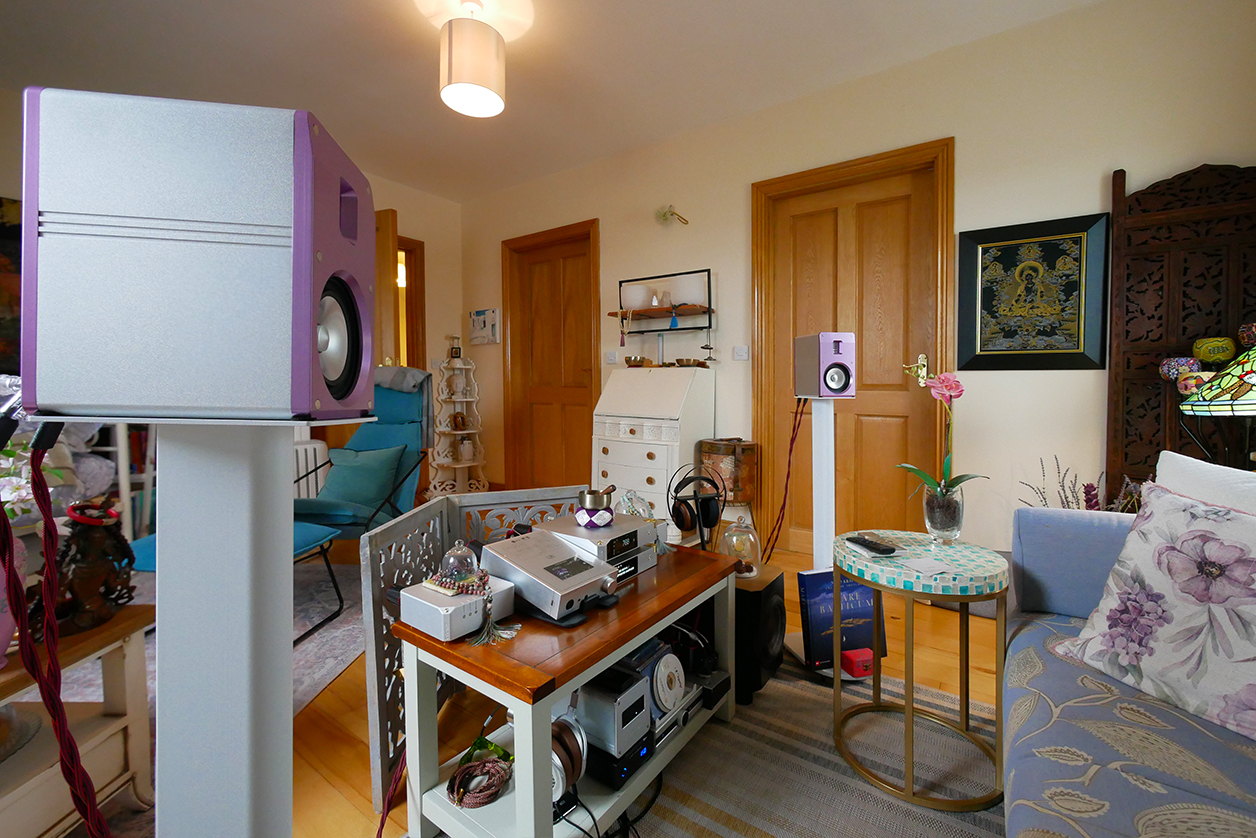
M1's separation and insight levels are such that within seconds of a new track in an adventurous playlist, we know it to be more or less clearly recorded than the last. This isn't about discriminating good from bad recordings. No ghosting the latter. It merely recognizes a track's pixel count. "Okay, here the system can't do what it just did since this recording doesn't present equal opportunities". With M1, the gradations of opportunities were more numerous and communicated rapidly. This was a kissing cousin to hearing more difference between recordings, just not limited to different venues. This assessment encompassed more. It reflected the speaker's magnifying powers. In an amplifier we call it gain factor. 'x' input voltage becomes 'y' output voltage. The conversion is the multiplier of 'x'. M1's high-gain multiplication talents focus on directness. However much a recording contains, M1 applies a loupe to it. That's its multiplier action. It won't condemn or belittle a muffled congested recording. It merely signals within a few bars to expect less; and why. Call it a benign form of hi-rez. Like classic low-mass paper widebanders, it celebrates immediacy. Unlike many of their speed-first kind, it complements it with more intrinsic body. That seems a joint function of this AT driver and LF augmentation by force-cancelling sub. The active high pass doesn't burden this 6er with reactive energy-absorbing phase-shifting filter parts. Yet it still strips off higher excursions, time lag and thermal voice-coil stress of LF. Meanwhile not breaching its squiggly zone—the region where unfiltered widebanders misbehave in some way—avoids the glassy, glary or subliminally strident immediacy tariff. Then the AMT goes places off-limits to whizzers. So M1 much reminded me of the above lilac MonAcoustic SuperMon Mini, a genuine widebander augmented at 15kHz with a mini AMT. It's why despite not operating the same, I call M1 widebander adjacent. Given far less critical ancillary needs then bandwidth advantages perfectly copasetic with club, dub and EDM, it's welcome news to fans of the single-driver genre who'd otherwise not clock M1 as one of their own. Whilst little, M1 really is a prince! Would his blue blood dilute in a bigger room? Before answering that and more, let's revisit the likely mechanism which earned M1 its adjacent badge. A classic widebander eliminates time confusion and energy losses from a passive filter. A dipole eliminates time confusion from internal cabinet reflections and energy losses from compressed air that opposes half the driver's motion. These are two different actions. Yet at the ear they seem to net the same gains of greater directness. They aim at the same thing from two directions. At least so it seems to me; a recognition that took two dozen years to dawn.
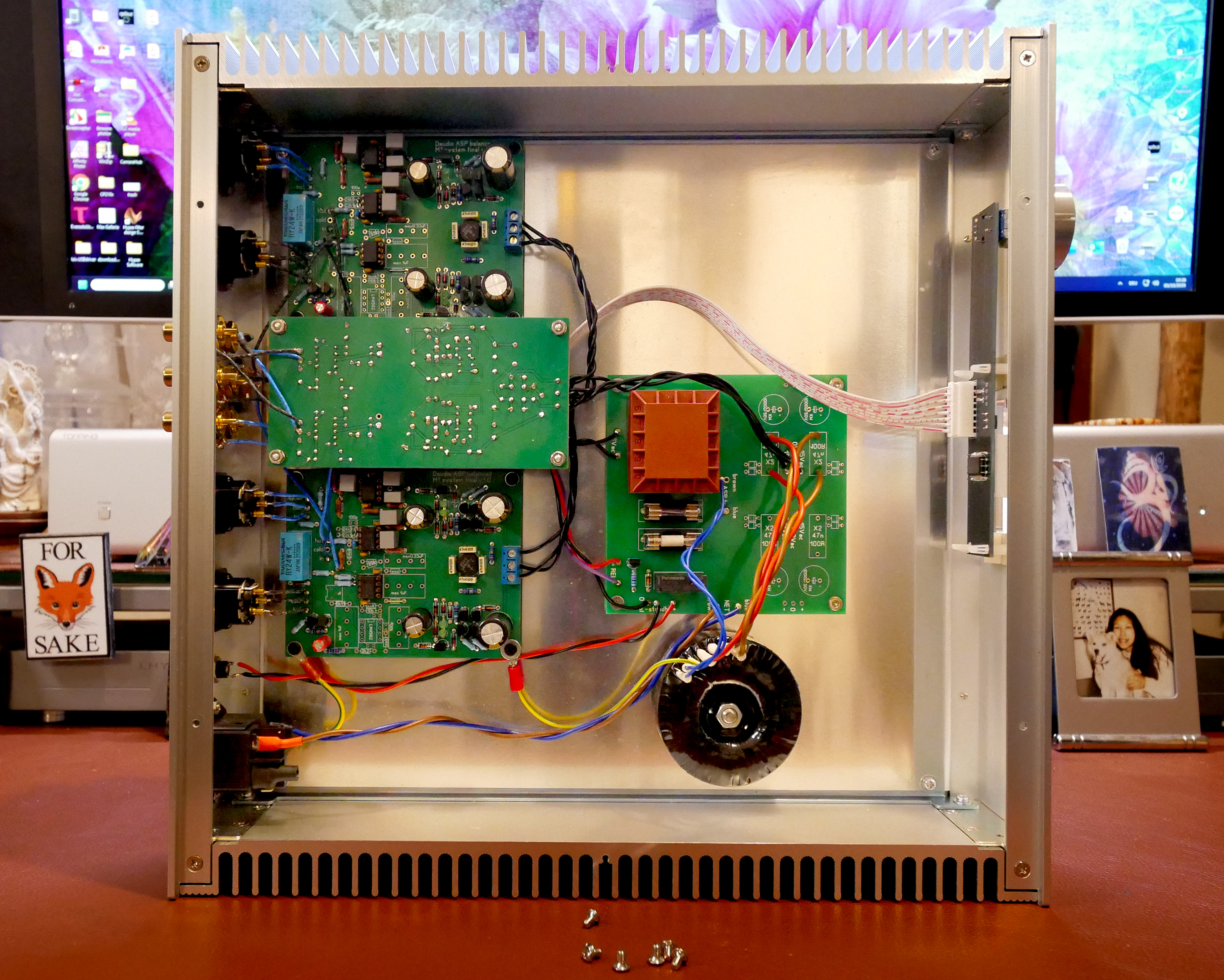
 When I reviewed Voxativ's Alberich² as the Hagen² monitor atop its active RiPol bass module, I explored the add-on benefits of actively high-passing the 5" unfiltered widebander with my spl Crossover MkII. It's since led Voxativ to author the passive inline €4.9K Aries high-pass filter. With all Dutchies believed to be born thrifty, Daudio's ASP handles that job in the active domain. And it's not optional. If you buy M1 which is a 3-piece system joined at the hip, perfect driver unloading and subwoofer integration include from the start. With its master volume, input switching and phono option, Daudio's ASP replaces a conventional preamp to accomplish rather more than just high-passing the mains or low-passing the sub in the analog domain for zero latency.
It's this systemic no-nonsense approach which really sets apart today's proposition.
Purists must pray hard that their far more capacious rear-horn widebanders stand any competitive chance on bass reach, output and damping against these Dutchies. Full-range dipole lovers with smaller rooms knew it to be game over just looking at M1. Whilst some will argue against the visual addition of a 3rd item in the LF cube, I find the same catalogue's MOB rather more imposing to execute this 2.1 option all day every day. And once more, passive drive lacks M1's independent adjustment of bass amplitude which I find non-negotiable.
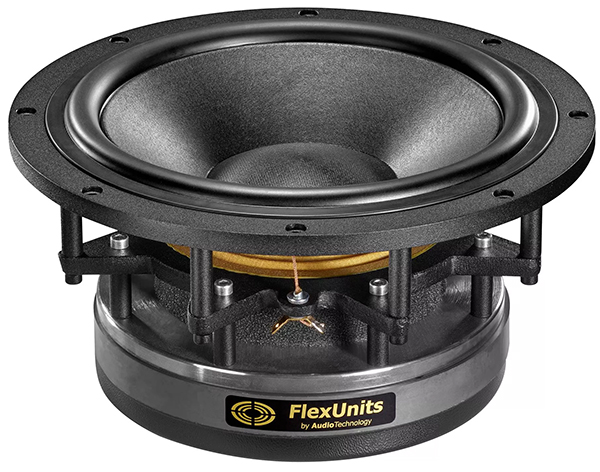
As I see it, M1's fight IQ—its fight is our acoustic in-room reality—is higher than seeming purist solutions which don't really solve core issues, just pray for a fortuitous match. Doesn't a sure thing beat a maybe all day, every day? And what's impure about active analogue crossovers¹ and a 64-step Tentlabs analog volume control all housed in an external chassis with distance-legible numerical readout so not inside a subwoofer's high-pressure box? Ditto woofers of AT FlexUnit pedigree.
___________________________
¹ Executing a 4th-order Linkwitz-Riley low pass at 120Hz passively would, for an 8Ω woofer, take a 6.5mH and 19.5mH inductor plus 60.5µF and 181µF caps. Such passive coils require thick heavy copper wiring for low DC resistance to get bulky and costly. Depending on gauge, AI claims that the bigger inductor as a wire version could require copper spanning "tens to hundreds of meters" depending on bobbin diameter and wire gauge. An electronic filter is not only tidier but far less invasive and free from phase shift.