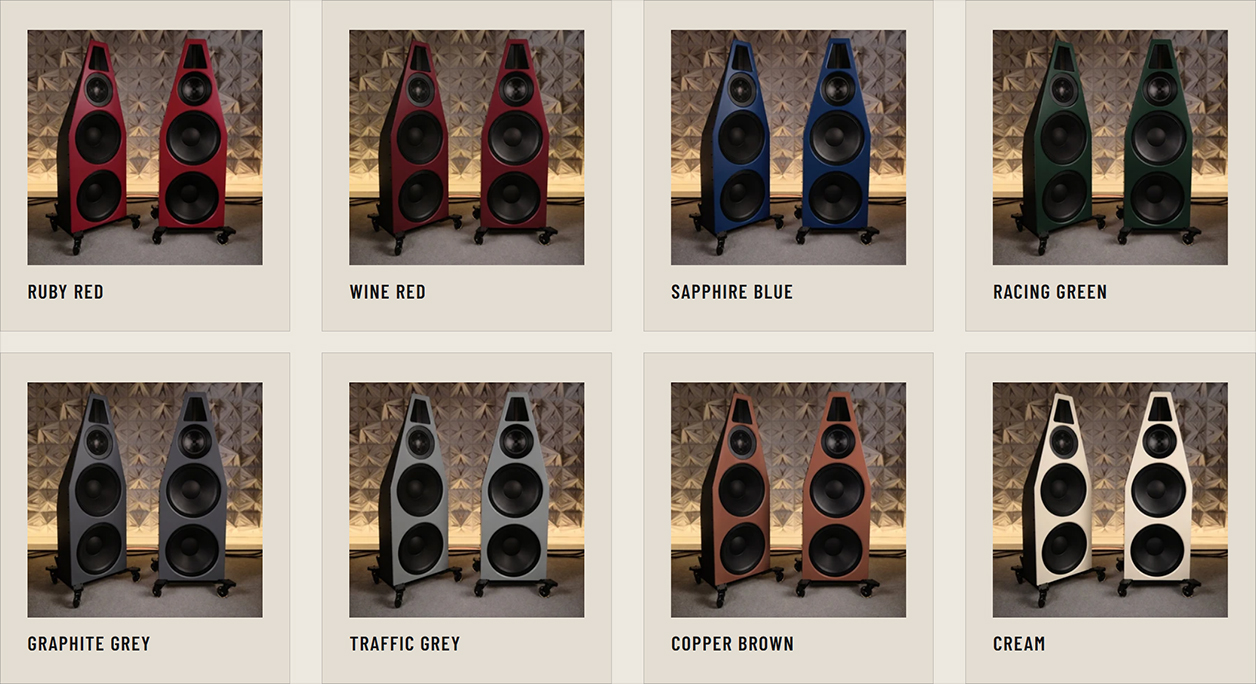
As a math pygmy, already log functions jam me up. Just so, these ears insisted on some logarithmic action relative to dynamic cresting. Usually I move my passive-magnetic attenuator a click at a time and loudness increases nice and steady. With Supernova, clicks past background SPL caused greater jumps; a bit like my 230hp/2.5l small Volvo's overdrive turbo. On paper, dynamic willingness for a speaker concept like this is perfectly predictable. It's anticlimactic. But remote in hand for theory in action, anti became ante. It also meant a narrower range than normal. Perceived sonic mass scaled to boisterous then bombastic rather more rapidly not just for a track's median level but more urgently, its embedded peaks. We might call this the antidote to density's lethargic shadow. In combat sports, the flyweight division routinely packs the most intense action where heavyweights lumber and exhaust far quicker. Supernova clearly is a sonic heavyweight of one-punch knockout powers. Yet its dynamic impulsiveness and cardio fitness ensure flyweight reflexes particularly when our amplification's multiplication factor and headroom taunt them. This too challenges attention deficits. If we aren't in a mood to be dynamically manhandled, we must either turn the volume down, cue up more sedate fare or pick a less aspirated sonic conveyance. This is no polite Yugo puttering around on a lawnmower or tractor engine. We're back at Grzegorz's hotrodded Ram truck where review isn't synonymous with test but testosterone. Obviously dynamic contrast isn't synonymous with steady-state loudness. It's about the difference delta or sound-pressure gradients between quietest and loudest sounds regardless of volume setting. In the normal course of home playback, dynamic linearity isn't; linear that is. If the signal records a x 30 voltage increase across an orchestral crescendo, mid and high frequencies may scale up appropriately but the bass hang up at x 12. So-called dynamic compression also ties to thermal build-up when hot voice coils increase their resistance to actively oppose the signal. It's what causes many systems to get brighter during long sessions. Their tweeter/midrange drivers continue to track recorded signal dynamics. Ever hotter woofers start to lag which tilts up the sonic balance and has the tweeters lead. With no air to trap, no heat to build up in pockets, Supernova's dipole nature plus raw driver pedigree promise atypically high dynamic linearity. Particularly the uncommon bass dynamics emphasize in-room presence and liveliness. Big things are out and about. Two Wildebeests lock horns. Two massive grizzlies wrestle over who takes all the females. Here Greg's aural appetites go full pork. Big dynamic cresting. Big stage casting. Big tone density. Big bass. Those are the four horsemen of Supernova. The underlying aesthetic is more the sound-reinforced amplified concert than unplugged acoustic presentations. It's an extreme proposal with an equally extreme purchase guarantee. It ships worldwide with all freight included; and a 30-day trial privilege, return shipping on Virtual. To eliminate sure-fire misfits, Greg personally consults on a prospective client's ancillaries, room and setup specifics. As much as possible from afar, it previews that Supernova really is the best fit from his portfolio. Given his no-strings satisfaction assurance, it'd be self-defeatist for Grzegorz to ship out a pair destined for inappropriate rooms or setups. It's very much in his own interest to squash disappointment margins. That's different from dealing with pushy salesmen on a payroll who get paid regardless. Here one deals with the very chap who owns the business, designed the speaker then builds each pair himself.
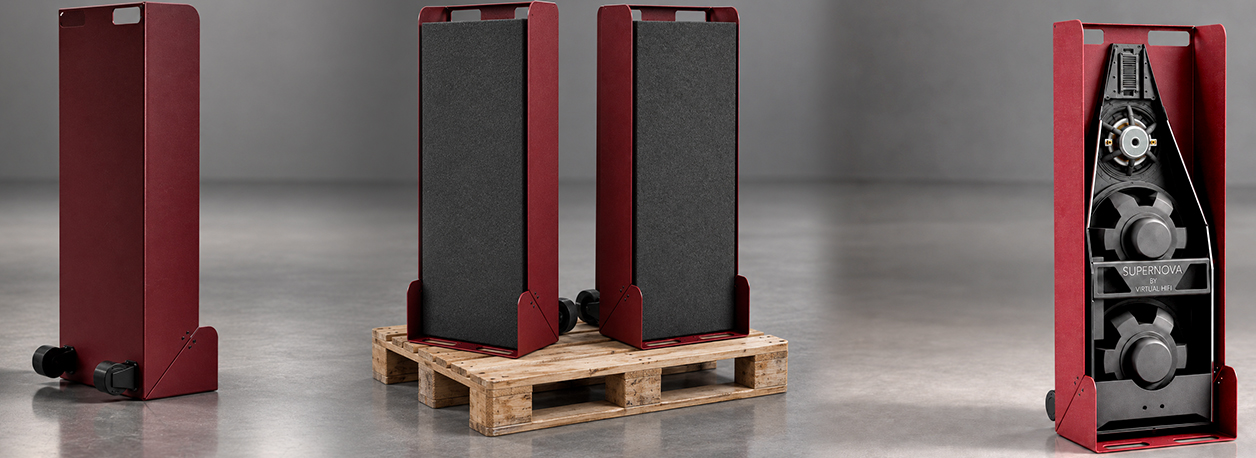
In the preview I quoted about TeXtreme® from earlier, Mads Buchardt calls this exact 7½" midrange more resolved than the 6½" cellulose-based Purifi driver he uses in an alternate 2-way monitor. Whilst Purifi's extreme excursion tailored for a low F3 reaches farther down with more loudness—Buchardt publish 30Hz versus 38Hz—according to Mads, SB's bigger harder cone leads on vocal veracity. With Kinki in the post-EQ driver's seat, I could sympathize with his opinion whilst inspecting lighter acoustic chamber music which lives on inside-out finesse not Muscle Beach physiques. Though piano and cello with Vassilis Tsabropolous and Anja Lechner respectively [Melos, EMI] had fleshy bodies and gravitas, their reading didn't turn dark or opaque. The piano's peculiar overtone shimmer captured on this recording shone through despite the speaker's bodybuilding regime. Just as I wrote the last sentence, Greg's email with the final packaging renders pinged my inbox. "This transport cart will be made of 3mm high-strength steel. The integrated wheels allow it to tilt and move by holding the upper handles to roll into position easily. The speakers will cover in polyethylene foam for more protection and arrive on a pallet. One detail compared to your samples will change. To make both cart and shipping box smaller, plinths and footers will supply separately. This only means that the client will need to fasten the base to Supernova with four screws during setup. The transport cart is designed so one person can move each speaker from the pallet directly into the listening room provided there are no flights of stairs to negotiate. For carrying the speakers up or downstairs, the cart is designed for two persons: one grabs the upper handles, the other can comfortably grip the handles built into the lower cart section." Flagship speakers and stairs tend to be at loggerheads but compared to most, shallow Supernova is a far easier proposition.







Giving twin very capable 15" air pumps reign over the upper bass is a main feature and mechanism of Supernova's chunky materialism. It also helps create those extreme black values of its colour palette. Regardless of how much, little or no mid/lower bass a recording contains, upper bass and its transition into the lower midrange is virtually always present. Yet how many of us hear it come off this kind of cone cannonade? Its effect is similar to how an acoustic gig differs from an amplified take with the same musicians. Should your allegiances lie firmly with the former aesthetic, you need to adjust or disagree with Supernova's sonorous needle which injects into Camille Thomas' cello on Aznavouriana some double-bass hormones for just one example. Having attended the music conservatory of Hannover on the classical clarinet, this aspect was how Greg and I disagreed in the end. I already knew of his gravitational gusto from my desktop Viper. That compact monitor I strategically energize and quicken with Topping triplets of active preamp and high-feedback class AB monos. As his catalogue's de facto Anaconda or Python, Supernova scales up that gestalt with real rigor. On assorted electronica, trance and live albums, I felt completely in sync. On the kind of unplugged chamber music I grew up on and played, I wanted to but couldn't shrink the effect once its novelty wore off. It's baked in with these very design choices. Even my Goldmund-esque Kinki EX-B7 monos couldn't unbake it. I'm obviously not one of the lads at the track or a Ram TRX truck dreamer. My conservatory conditioning and the twelve years preceding it are firmly baked in, too.
Supernova won't apologize for being extreme. That's its whole appeal and project brief. Remember how going in, Greg meant to prove that passive dipole bass will compete with the very best sealed or ported arrays? In actuality, that point is no longer even in contention. My in-room amplitude balance wanted digital-domain cutbacks. That was child's play in Audirvana's precision EQ. If you possess no equivalent means, your room, ears and setup must share Greg's bass enthusiasm; or closer wall placement create fortuitous cancellation to cut output as he suggests. Could a multi-tap low-pass inductor add a few stepped adjustments for more flexibility? To be sure, that comment pertains to LF amplitude only. Where avoidance of room modes and hot spots were concerned, dipole dispersion's promise was in full effect. It really showed ported even sealed omni bass a very tall set of heels. That devil does wear Prada. Returning to Birkenstocks afterwards has no appeal. Now you have the picture as I heard it. What remains is a clever conclusion. Just then Dirty Harry appeared on my mind. "You gotta ask yourself one question. Do I feel clever? Well, do you, punk?" When faced with a loaded 700 horse-power Magnum TRX that may or may not contain one final bullet, one does want to be certain.