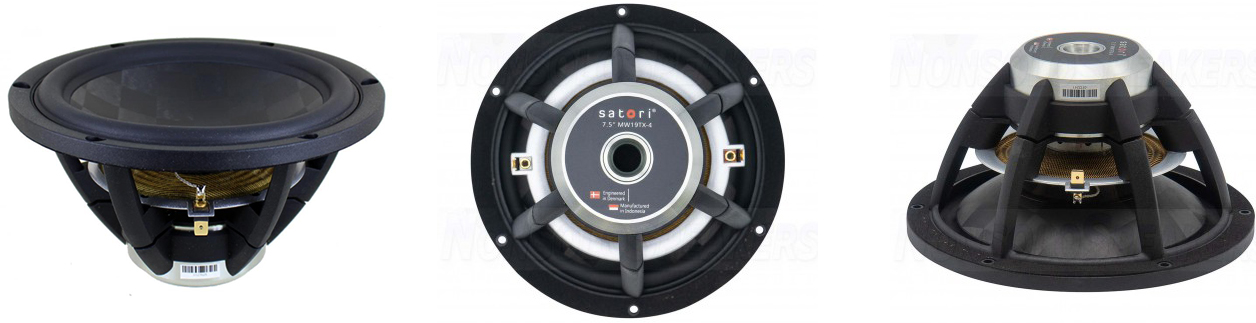
Whilst waiting on my door bell, my preview on a new Buchardt speaker had this: "Our new 7½" mid/woofer uses the renowned TeXtreme® material from Sweden's Oxeon AB. It differs from regular carbon-fibre cones due to an advanced manufacturing process which creates a thin-ply diaphragm of spread-tow fibres for exceptional stiffness, minimal mass and precise resonance control. These cones have extremely good properties for audio applications and are considered among the best hard woofer material. Although very expensive, you can clearly hear what this material brings to the table." From Oxeon's site: "Our patented spread-tow thin-ply construction aligns fibres with extreme precision, significantly reducing crimp and fibre waviness for thinner laminates of superior mechanical performance and higher fibre volume fractions. Less resin requirements minimize weight and enhance strength, stiffness and impact tolerance. The result: ultra-light, structurally efficient composite parts optimized for the most demanding applications." The material shows up in sports so bicycles, rackets, hockey sticks, skies, kayaks, helmets, surf boards and golf clubs; in aerospace i.e. planes and drones; in nautical, automotive, medical, wind turbines and underground pipe seals. It's an example for how our high-performance hifi hinterlands appropriate inventions from far larger industries. Today's operative words are thinner, lighter and stiffer. Kudos to SB Acoustics for exploiting this hi-tech composite for OEM drivers. "FedEx picked up your samples. They have wheels installed, making them as easy to move as 56kg can be for one person. Since I used this pair to experiment with and refine my assembly process, they are not cosmetically perfect. In particular one of the front panels has a superglue stain. Also, the packaging is not what our regular customers will receive. I recently ordered new hybrid metal case/trolley containers for improved transit safety and ease of handling but didn't want to delay another month by waiting for the packaging to arrive." Greg's palletized 128x78x164cm shipment announced itself at 157kg. "Let me know if you have any questions." I had just one; and not about a pallet twice my body weight; nor how ants can carry from 10-50 times their own weight. Are there any ant reviewers? Next life.
"You already explained the 6dB/oct. acoustic roll-off of nude woofers and open baffles in general. We know about classic compensation which creates inverse attenuation above the baffle step to linearize the overall response. You already said that Supernova uses zero baffle-step compensation. How do you manage? You have short side rails. Those add some woofer loading. But surely it's not enough to counter their acoustic 1st-order roll-off? According to basic AI math, the -3dB baffle step of Supernova should be ~276Hz. Everything below ought to attenuate evenly to be quite down at 25Hz. Yet in your room you claim a +3dB lift at 20Hz. My techno-peasant brain can't see how." It's one of my favourite job perks. I get to query people who know more than I. It adds knowledge to our hobby's collective data pool. Granted, many designers remain taciturn. All the more reason to practice curiosity when designers welcome it. It quite naturally has one come back for more. After all—hint, wink, cough!—nobody enjoys pulling teeth.










"Perhaps I did oversimplify things a bit. When I said no baffle-step compensation, I meant no separate compensation circuit or active bass EQ. What I left out is that the woofer filter itself does much of this balancing. Left alone, the raw response naturally has considerably more output in the upper bass than bottom. So I set the low pass sufficiently low to reduce the level of the stronger upper bass towards the deep-bass output. Then I match midrange and tweeter to that. My low-pass crossover has two jobs: hand over to the midrange; shape the bass response. These functions needn't be two separate circuits. Then there's the interaction between filter and woofers. Their electrical behaviour changes with frequency particularly around self resonance. Depending on tuning, that interaction can either produce a lift or cut. So the actual result is no textbook filter placed across an otherwise unchanged response. It's why I tune drivers and crossover in the finished structure—together. Another big part of the recipe is the raw woofers. I tried so many 15-inch woofers over the years that I lost track. With all others, I couldn't get this combination of reach, weight and output. Supernova in its current form wouldn't exist without these drivers. That includes earlier woofers purpose-designed for open baffles. Their specs looked promising but in my prototypes didn't give the LF behaviour and excursion I needed. That didn't make them bad. They just weren't right for my application. For a hard comparison, SB Audience specify a 25Hz free-air resonance and 16mm Xmax for my Nero-15OBN450D versus 34Hz and ~11mm for an earlier Bianco-15OB350. Nero gives me a lower natural resonance and more cone travel to work with.
"Neither number on its own guarantees deep bass. Reproducing the lowest tones with an open baffle simply demands a lot of stroke. That extra travel obviously doesn't remove dipole cancellation. It just creates more headroom once the response is balanced. In my experiments, these particular woofers delivered the combination I had been seeking. The side rails contribute but aren't performing miracles. Siegfried Linkwitz modelled U-frames and showed how rear loading changes both amplitude and timing of the sound coming off the back. That affects how it combines with the front. He also warned specifically that an oversimplified mathematical U-frame model can give us the wrong answers. The familiar width-based baffle-step calculation does roughly net your 276Hz figure for a conventional box speaker. But a box speaker's transition and an open baffle's continuing front/back cancellation behave different. I'd not treat 276Hz as a precise corner for finished Supernova; or replace it with another 'exact' number by adding my wing dimensions. Next comes the room. When I move my microphone, the 20-30Hz response changes. At the positions I checked, 30Hz stays roughly level with the midrange, −3dB typically falls between ~20–25Hz. These are results in my room, not a free-space spec. The overall bass lift and exact 20Hz level are separate things. My mention of a gentle bass lift shouldn't be misread as guaranteeing +3dB/20Hz in all rooms. Also, this shouldn't imply that Supernova somehow ended up with low sensitivity. My current estimate is ~90dB at 2.83V/1m/4Ω. That's an estimate based on comparisons not yet a final calibrated sensitivity measurement. I'm simply not chasing 95–96dB headlines. Leaving more upper-bass output in place would not automatically give me matching output in the lowest octave. My priority is the final speaker's balance, not how loud the raw woofer plays before I shape its response. Sensitivity alone also doesn't predict which amplifier suits. Electrical load and needed headroom at the listening position matter, too. I didn't design Supernova for 8wpc 300B SET but monster amps weren't the goal either. I designed for a good amplifier that's comfortable driving 4Ω loads with enough headroom for your room and desired SPL. Proper bass depth, useful sensitivity and sensible amplification were the combo I chased. So the explanation isn't that my short wings somehow cancel the laws of physics. It's these particular drivers, geometry and crossover working in conjunction plus the room which contribute to the final measured result. What I should have said is that while I don't use a separate BSC circuit¹, I definitely do exploit deliberate response shaping in my low-pass filter."
___________________________
¹ "A basic BSC network is an inductor and resistor wired in parallel with each other then in series with the woofer. The inductor controls the transition frequency. At higher frequencies, the inductor blocks the signal and forces it to pass through the parallel resistor. At lower frequencies the inductor allows the signal to cleanly bypass the resistor. The resistor determines how much HF attenuation occurs, typically shelving down the upper frequencies by ~6dB to match the lower LF output caused by the baffle-step transition. By turning down the louder high frequencies, the circuit flattens out the overall response tilt. Many modern designers choose to instead integrate these values directly into the main crossover rather than use a standalone BSC filter."