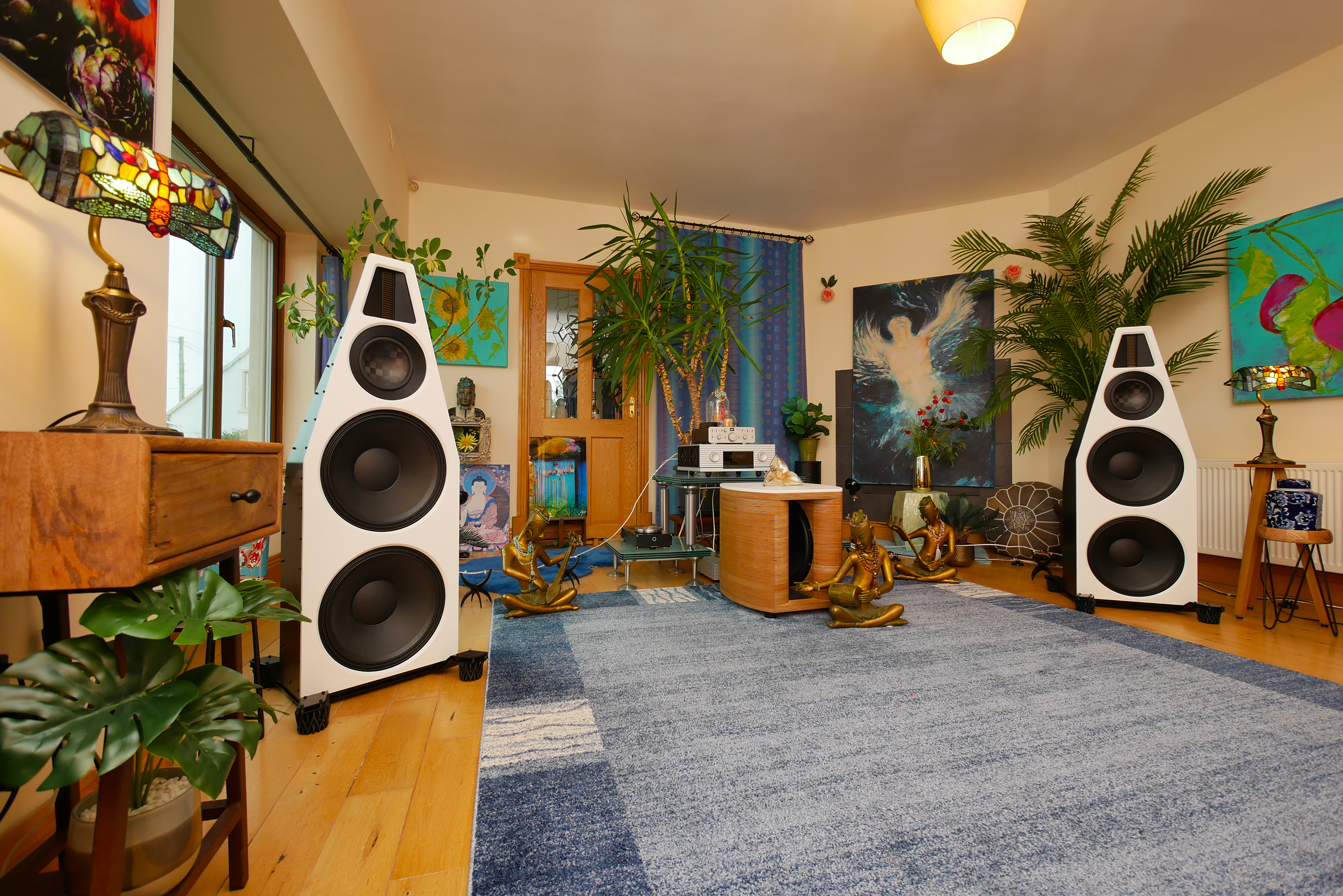
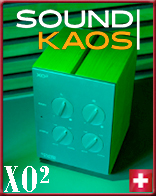
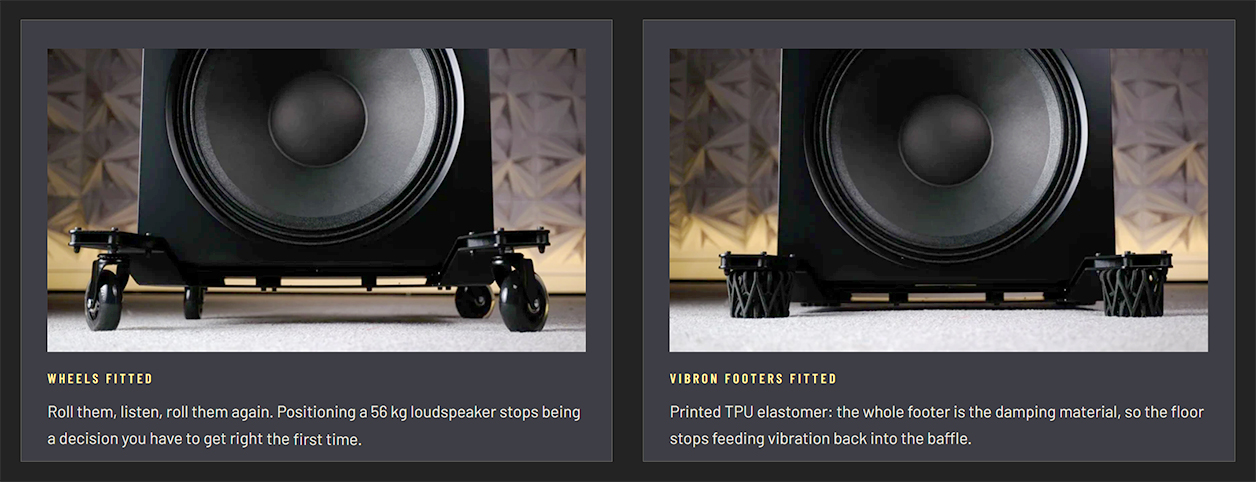
Though far from demure with such butch bass battalions, the baffle outlines suggesting narrow four-storey apartment buildings with very steep tall roofs had white Supernova look less squat than expected. Swapping the lifesaver wheels for the 3D-printed decoupling footers was easy. With plenty of metal to grip, so was manoeuvring into final place. Here's my setup, with a 300wpc class AB Kinki Dazzle in the driver's seat—quite temporarily as it transpired. To explain why, consider brothers Ri and Di. In a RiPol for Ridthaler dipole, the open baffle folds. That enforces strategic very advantageous driver loading. As shown in my stacked-Ply sound|kaos sub between the speakers, two 15" woofers face each other in close proximity. As one moves forward, it opposes its mate which also moves forward. The same happens to the rear waves slot-vented out the back. They meet the immediate barrier of the open enclosure's sidewalls. This boundary proximity creates high self damping like a down-firing woofer hits the floor. In a classic non-folded dipole like Greg's, there's no loading other than the air's acoustic impedance. If one arrives from hyper-articulated superbly damped RiPol bass, looser dipole bass must compensate its lack of loading with firmer amplifier damping—particularly with bazookas like these. In Virtual Hifi's studio, that harsh taskmaster is a Gryphon Diablo 333. With multiple Gryphon reviews under my own belt, I know their amplifiers to be exceptional for bass grip and dynamics. Clearly Greg's amplifier of choice is no coincidence.
 On the same score my Dazzle is very good but no iron-fisted Shaolin sifu packing extreme negative feedback grip for minuscule output Ω and max current flow. After two days of drying out any transit moisture, first Supernova auditions said so unmistakably. Bass reach/amplitude beyond classic subwoofers didn't stop as sudden as my RiPol conditioning wanted.
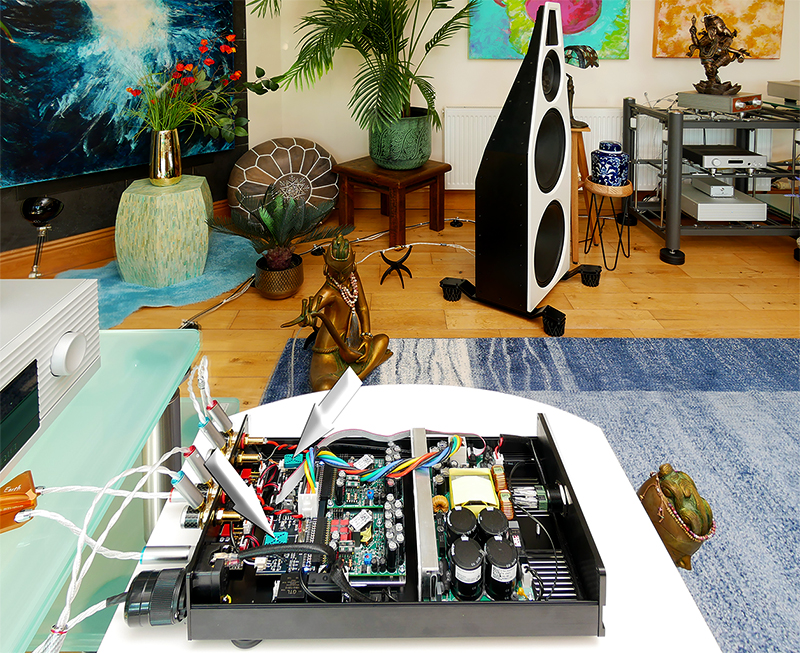
Synchronicity then had a high-damping French ampidote: the NCx500 from Audiophonics, a narrow-chested version of Greg's wider-chassis NCore specimen. It's what I bought quite recently to drive my sub via one 700w/4Ω channel per woofer. In full-range not low-pass <100Hz mode, its stock input buffer opamp is simply too chalky for my liking.
Thankfully I'd already rolled Greg's parallel 'super' opamps. I knew that for 20Hz-20kHz cover, I most fancy his blue bits. In those went. Over the course of three quick tracks, the NCx500 now sidelined my ten times costlier Dazzle. The bloody cheek of it!
♦ Humvee.
♦ Sierra Nevada Rubicon trail.
♦ Proper tyres.
♦ Right tools for the job.
♦ End of.
If you know, certain things are rather basic. We must just own a well-stocked toolchest to pick from. Once kitted out correctly, my listening comments could commence. Here's the super-basic thing: If you don't love bass, you won't like Supernova! End of. If there's even a speck of bass dust you never saw before, Supernova will find and present it clear and loud like a mega magnet hunting iron shavings six feet under. The phrasing is dramatic; its implication serious.
In my room set up well clear of the front wall, Greg's bass lift was in full attendance. Whilst my RiPol sub is good to ~25Hz, my active crossover's bass attenuator sets its output lower. Supernova's passive fixed <50Hz output was clearly higher. Talk about a 100X magnifying glass on sub bass. It'll have you fully meet bits previously faint, barely suggested or outright missed. As someone with one 2.2 and three 2.1 systems, these statements aren't specious. Framed in common terms, Supernova is a (way from the) bottom-up proposition for maximum density and black-value saturation. As a heroic air mover, it's also very dynamic so enthusiastically responsive to mayhem throttle positions.








If you're on a mono diet of string quartets and singer/songwriter fare, Supernova is a Humvee in crawling traffic—headed to the local Tesco lot across polished blacktop. It undeniably works. It might even have you the talk of the village; or its babe magnet. It's also fragrantly gratuitous because it won't tap the speaker's real potential. But add even a regular smattering of electronica or Hans Zimmer soundtracks and you'll have traction, justification and raison d'être. Greg's 90dB sensitivity estimate strikes me as factual. Hence my somewhat brutish Humvee image falters. Supernova doesn't need to play loud to show up. It's good at low volumes where extremist bass excavation skills become superlative because we very clearly hear things that the Fletcher-Munson curve usually skips over. Embodiment hangs together like an endlessly fading singing bowl. By the same token, aeronauts into overt treble brilliance and lucid-mode midrange rapport will prefer a less bass-first tuning of lower density and chunkiness. It's the old transparency trouble. To see through things wants less not more thickness. Diminished too far, fleshiness turns ghostly. Only psychics can still appreciate that. But there's certainly a viable range on our incarnation dial across which individual tastes pursue sundry settings. If its end stops are Zorba the Greek's materialism on the left and Gautama the Buddha's transcendence on the right, Supernova just then struck me as full-on left—without a single vacuum tube in its path but instead a quad-autoformer passive preamp and generic if hi-spec class D power amp.
This motto is 'transducers first, all else second'. Supernova dictates our climate, feel or performance style. Preceding electronics will nip'n'tuck as they always do but more than most, what squarely puts us in today's lane is this speaker and its design choices. As Greg would say, it's a 700hp Ram TRX truck, not an electric Porsche Cayenne. That 6.2-litre V8 pickup too is fast. It's just intended for different terrain and experiences. That shouldn't surprise. Already looking at Supernova's artillery predicted as much. Just so, confirmatory assurance was key. Likewise for dipole dispersion's far reduced room reactivity. Once in the rigid grasp of <0.002Ω output impedance, Supernova behaved ideally non-lumpy. It avoided typical room-mode hot spots just as the concept promised. Personally I'd simply reduce amplitude across the bottom 2½ octaves. Some of this will be tuneable with lesser front-wall distance. My room's layout is simply a bit rigid about where speakers end up. Before we break down sonic wholeness into attributes to discuss, let's acknowledge that with some attention and perception finesse, we should be able to assign any hifi system a word which shoehorns its persona. For my Supernova-anchored system, biggitude sneakily combines big+attitude. That fits well. It's not just about scale, mass and presence. It's also about the slightly megalomaniacal attitude which groomed and packaged these qualities at such quota. If you want petite, dainty or pipe'n'slippers gentility, look elsewhere. Once you prime the pump beyond background levels, this very quickly becomes lads doing laps at the track stuff. If that's just not what you do—or too rarely to count—don't get a big-bore eight-cylinder Hemi truck. Get Greg's Viper monitor. Already his Cobra two-way with its six passive radiators per side is slightly high on nitrous oxide and goes shockingly low but on raw air displacement can't tie Supernova's shoelaces. As such this line-up ramps up from M to L to XXXL with quite the gap between N°2 and 3.