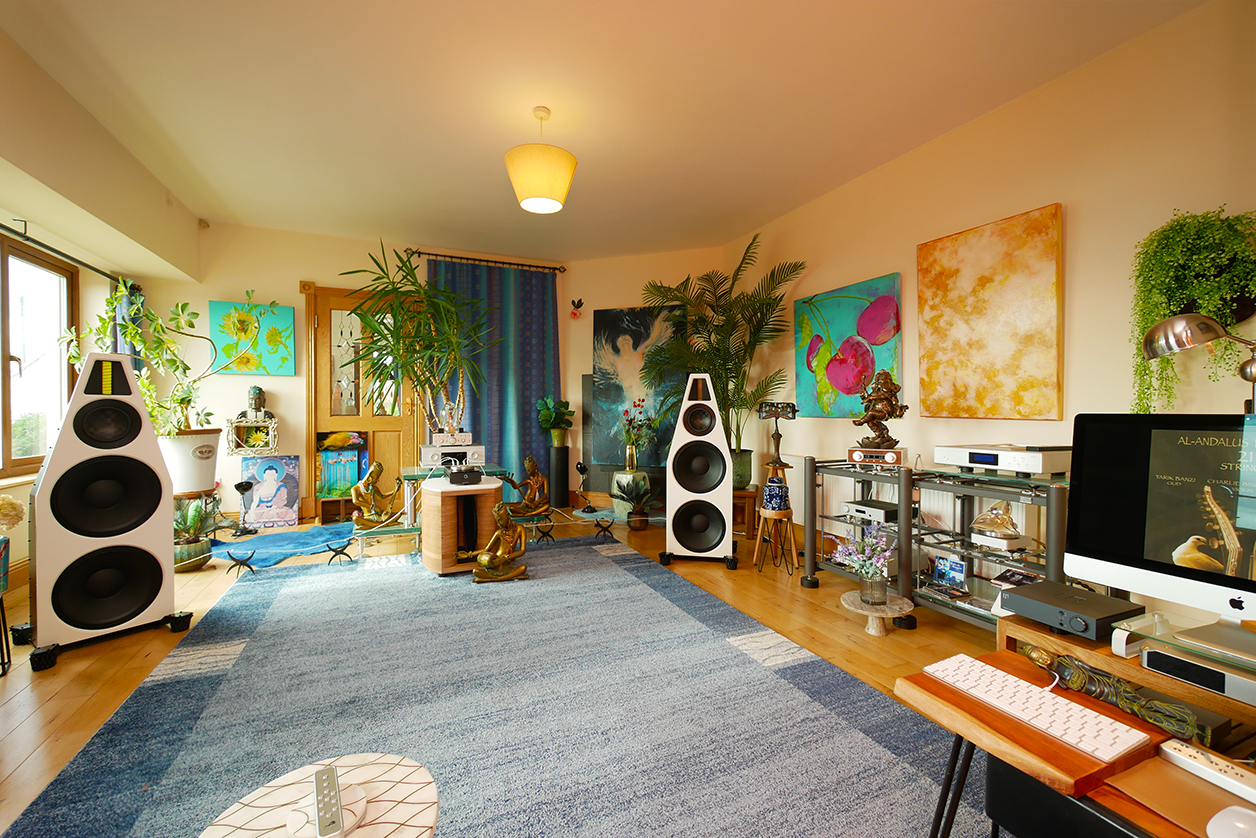
Physicality. Cubits of energized N²/O² molecules i.e. moving air register very different than good-to-25Hz headfi. Heavy air motion triggers a corresponding body/mind emotion. This needn't be anything sentimental, goosebumpy or teary. At minimum there's some bodily acknowledgement of sonic materialism which co-inhabits our listening space. It differs from mental appreciation. With abstractions we can readily multi-task. Our imagination can fill in or go on auto pilot like a daydream. A more physical reaction occupies a rather larger footprint of attentive energies. If in a given moment we don't welcome it—we may not be in the mood for company or suffer attention deficit—it can feel oppressive. It makes be-here-now demands. Our nervous system knows. We share space with something very present that's far from immobile or still. With Supernova that's key. At any levels above mildly conversational, its company turns demanding high-maintenance partner. That is particularly so because of these LF. Even subliminal sub bass ratchets up our perception's sense of realism and scale. All subwoofer users know this. Even where objective with/out differences are minor because a given track contains no or little apparent bass, the subjective offset is routinely bigger. Our hearing is far more easily fooled into accepting invisible presences when the 20-40Hz band is fully loaded. Firing up Supernova gets profoundly more physical than any 7" 2-way could dream of regardless of F3. Many claim how that's exactly what they want from their hifi. I suspect that when confronted by Supernova, a lot of them could flinch then admit that this level of physicality is just a bit much. That's no critique—just knowing the rules of more extreme intimacy. Cue the basement adventures of Paul Giamatti as Unites States Attorney Chuck Rhodes in the TV hit series Billions.
How about being on top? In a dynamic 7-inch monitor with 1" dome tweeter, the ratio of cone-to-dome area is ~39. Supernova's 136cm² tweeter halves this ratio. Its twin woofers' surface is ~17 times larger than the folded AMT's. From this we expect a bizarre selfie were we to replace our example 2-way's soft dome with Mundorf's SE dipole. Hello tweeter-on-cocaine extravaganza. Neither would Supernova come off with a 1" dome. It'd be tweeter-on-morphine fog. We're back at the right tool for correct amplitude and dynamic-contrast balance. I remember earlier quite forward AMT-based Mark&Daniel monitors. They weren't bright from treble too hot. They were forward from tweeters more dynamically twitchy than their mid/woofers. Supernova's gravitational counter balance prevents exhibitionist HF antics. I had no upper-harmonic emphasis on transients, zing or sizzle in cymbal rises and trails, wince on straining power vocals, glare on scratching fiddles. There was no treble-related spectacle in fact; just a properly adjudicated mesh which dovetailed LF exuberance with correct HF skills to prevent overshadowing. Whilst Greg is on open record that Supernova in this shape became possible only because of SB Audience's new Nero woofers, Mundorf's secret flagship tweeter surely was another discovery that prevented having to parallel smaller AMT. Whilst my upstairs 2.5MHz direct-coupled Kinki Studio EX-B7 monos would illuminate and aerate rather more than the NCx500, my choice just then was between ultimate treble titillation versus best bass control. Given an already rising LF response, I prioritized that where shadows trigger me more than lack of ultimate treble sheen. Grzegorz: "This particular NCx500 implementation actually sounds quite warm and dark compared to my Diablo 333. With the Gryphon, my room gets noticeably more upper-mid and treble presence, openness and resolution though I used both amps to tune the speaker." The ideal Supernova amp should combine ultra-low Ω and current drive for best dipole control with high resolution and excellent treble elucidation. If you get your warmth kicks from an elevated bass response not timing blur or tailored harmonic distortion, you won't want a warm amp. Supernova's innate tuning already covers your bases. Given ~90dB voltage sensitivity, hulking power should be no requirement unless your SPL live really palatially and the sub-bass portion of your menu loads up.







For a 2nd take on Mundorf's uncrowned jewel, I swapped in a standby 250wpc Kinki stereo amp whose specs otherwise mirror its mono mates. I then wrote an EQ curve in Audirvana Studio which evenly attenuated <65Hz to be 4dB down at 20Hz. Whilst bass textures weren't quite as grippy as what the D-class champ enforced, in combination with more realistic in-room amplitude I now preferred the remainder of the spectrum. I'd unwittingly injected lightness and filigree into my proceedings. I'd upshifted the perceived centre of gravity closer to normal. It gave textures a minor air-bubble infusion; a dash of soufflé if such a thing existed. To overwrite, Godzilla had left the premises. Ideally I'd have a mongrel of NCx500 for the lower half, Kinki's ultra bandwidth without coupling caps for the upper. I just can't afford a $24'990 Diablo 333 so slummed it with a $2'798 Kinki EX-M7 and free Audirvana cheat. Though Yogi Berra said that the future ain't what it used to be, my present was rather close. Having exhausted my possible hardware pairings and arrived at a favourite, all subsequent comments chauffeured with Kinki's EX-M7. Why not start there to delete preceding detours? For a more complete picture. Embedded triangulations suggest what an ideal Supernova amp might be. A Bryston³ should suit, too. Some pairings are bliss on first try. Others demand more before exchanging wows. On which, percussive events of all sorts—clicks, cracks, snaps, zings, hits, finger tremolos, pounding mallets, clicking sticks—could startle. Typical time smear from thru-cone rear reflections which trail their direct emissions by nano delay was gone. Yet rather than feel brittle, here very substantial moving mass backed all attacks. We get the leading-edge snap followed by physical heft. A large kick drum renders like a 66cm-diameter affair of proper whomp. Likewise for massive-attack Latin piano. It stomps fully grown not miniaturized. It's how speed and density coexist. The speed of the rising edge comes first. Bloom's density follows. Because bloom lasts longer and comes second, our attention fixates on it especially with Supernova. It's tunings of overcooked transients that lack backing which register as speedy. They feel caffeinated possibly haggard. Supernova doesn't. That it really lacks no speed when properly driven is especially crystal on drums and percussion. They are the opposite of sluggish. In trademarked Zu lingo, this Virtual open baffle has big-boy pop, crackle and shove.
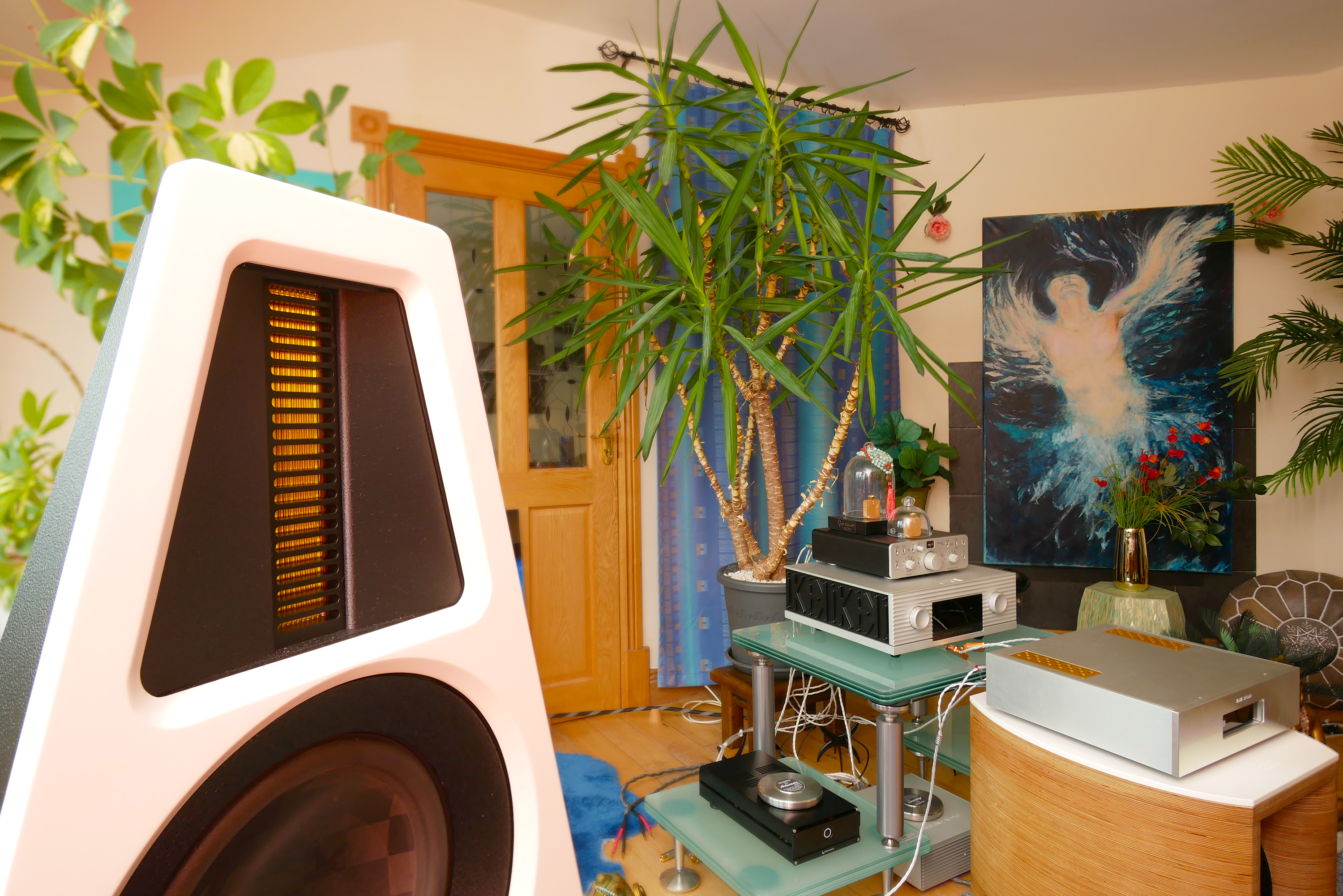
After more minor liposuction in Audirvana's digital-domain EQ to slightly lighten my 70-100Hz response, I considered myself in the sweet spot for all comers, be they coquettish female vocals, Baroque period ensembles, fleet-fingered Jazz Manouche guitar trios, solo Bach piano plus all the big stuff. No matter the selection, complexion was flush, muscle tone enhanced. Forget pale, bookish, famished. With now subjectively linear amplitude if still of unusual reach, that quality seemed down to driver and filter-parts pedigree; plus sheer bi-directional moving mass. What big-name €20K speaker leverages equivalent weaponry? At €38.5K/pr, Wilson's entry-level floorstander Sabrina V nearly doubles the ask yet only gets us a 1" silk-dome tweeter, 7" cellulose midrange and 8" paper-pulp woofer. As an elite box, it goes heroic on an inert enclosure and premium on automotive paint but clearly has a different focus and audience. With Supernova, 'where's the meat?' is neither an ingredients nor sonic question. Its unapologetically carnivorous aesthetic is ballsy, vibrant, rich, propulsive, super robust and capable of astonishing scale. Because of its dipole blind spots which can't see sidewalls, Supernova's grandeur shoehorns into regular living rooms where ambitious twinned 5¼" woofers of forced port loading can already overload and ring. Been there, done that; more than once. On paper even to the eye that doesn't seem right. But such are the two worlds of port-boosted omni box bass, figure-8 dipole bass and their disparate behaviour in enclosed spaces. One looks compact so ideal but could easily be too much. One looks grotesque but beds in far better. It's definitely a hear-before-belief thing. As set by its fixed passive crossover, Supernova's in-room amplitude response across my bottom ~2½ octaves was too high. This produced no ringing or boom, just a dub tuning. For Cobra, Greg has different tweeter padding resistors which we access with different sockets for the tweeter umbilical. Would an equivalent multi-value bass adjustment be feasible for Supernova should one not have my Audirvana-style digital EQ plugin?