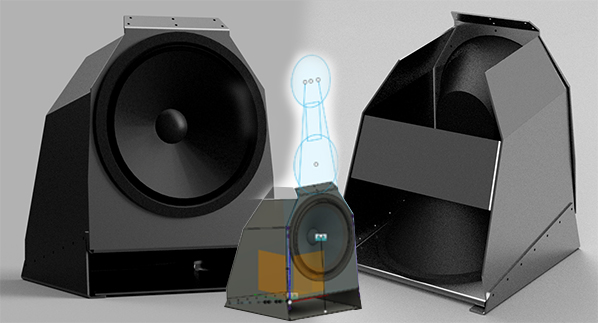
 "I already tested Dayton's 18" woofers. They require active drive of at least 1KW. That delayed my dipole project for a long time because I want it to be passive¹ and a statement. I just came up with something in 5mm steel and bent top so I can have the upper frame bent as well to time align the drivers. This would run dual 18". Now I must see whether my steel people can make the prototype."
I emailed Greg the last image of the prior page. "I've not heard the flower-quad woofers but the red frames multiple times at Munich. Last year they showed a far bigger version. Still no bass. I already tried nude woofers. They don't work for me. I know that for many their kick-drum render is good enough. I understand and with it can enjoy specific music. But since I also love electronica and concerts, I expect more. I mean to embarrass all standard sub designs by how clean, big and immersive OB bass can be. So having no baffle won't ever work for me. Physics are heartless. Without baffle, a 15" starts its 6dB/oct. roll-off at already ~600Hz. That has it down ~25dB/30Hz. I'd need eight per side to compensate. Since series-connected drivers never work well, quad amping and high excursions would enter the picture or there's no real bass. There is real bass from Dayton's 18-inchers but only with 1'200-watt ICEpower on each and one of the below clamshell pairs per side; for reasonable SPL only. I tried it all. There's either a huge utility bill and complex design; or some kind of folded baffle."
_____________________
¹ The late Siegfried Linkwitz spent years working out permutations of open-baffle speakers and for his reference designs insisted on active equalized drive. By wanting passive drive, Greg rather complicated his Basilik project's pursuit of in-room reference performance.
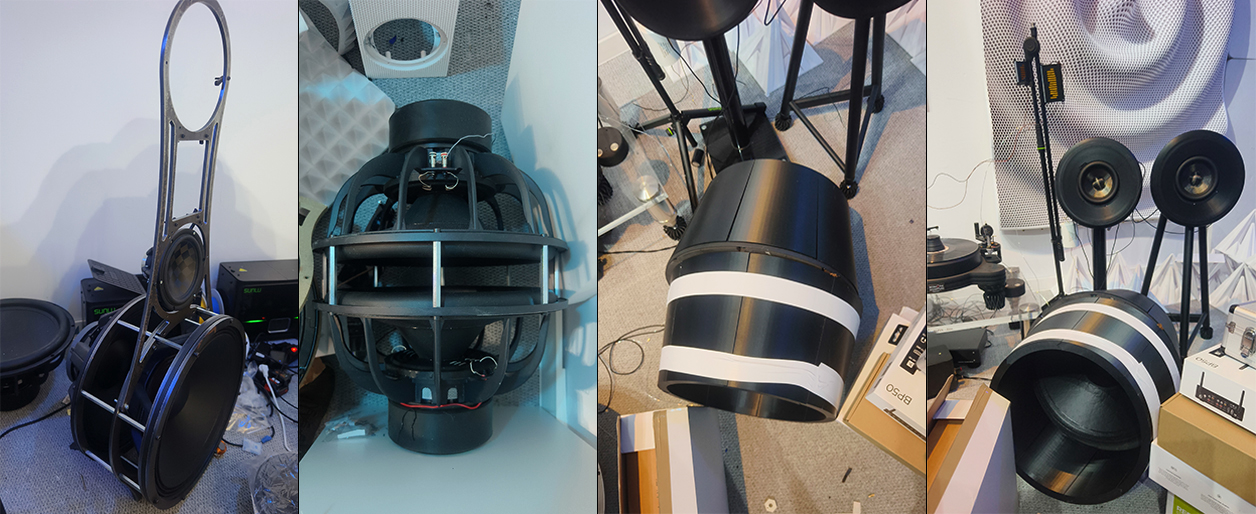
"Kyron's Gaia still needs their own active sub to achieve reference performance. Now what's the point of six nude woofers per channel? I want Basilisk to be an absolute reference regardless of price. So it must be complete in all aspects; for my own enjoyment too. My steel workshop server just accepted my files. Maybe they'll be able to do that. 40kg is not that much. If it works out sonically, one could crash a car into Basilisk if it were somehow bolted to the floor. My current housings for the 18" woofers are 20mm 3D printed. While 3D printing might be a challenge for an 18" sealed cabinet due to the forces involved, it remains valid for open-baffle designs. However, printing such large structures isn't something I want to pursue if there's a better alternative. I'm going to try working in steel first. If successful, it will simplify things significantly by having a reliable metal workshop handle the heavy fabrication. It'll make my assembly of the speakers much easier."









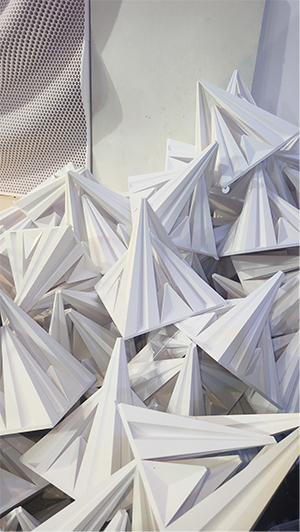 When I checked in with Grzegorz 45 days later, "my son was hospitalized and I had to pause work for the duration. All seems good now. For over two months now, I've run my 3D printers non-stop to complete new acoustic panels for my studio's front wall. These are crazy 3D hollow pyramids capable of diffusing 350Hz – 20kHz. I need about 100 more panels to cover the entire wall."
Crazy ideas are a dime a dozen doodled onto beer-stained paper napkins in pubs all over the world. Crazy ideas actually materialized with personal ingenuity are another matter altogether. Talk is cheap. By extension, those who can, do. Those who can't become teachers. Those who can't teach become critics; what our space calls reviewers. Here our helpless kind has endless questions. "For the acoustic panels there are modelling tools used in architectural acoustics which can simulate how surfaces scatter sound. Programs like Ease, Odeon or Comsol can give you a pretty good idea of how different geometries behave and what frequencies they might influence. So they definitely help reduce the amount of blind prototyping. But in reality it's never a pure software exercise. Once geometry becomes strongly three-dimensional and multi-scale, simulations quickly get very complex and computation heavy. At that point I still rely on a lot of prototypes and listening. The nice thing with 3D printing is that I can change the geometry in CAD and have a physical prototype the next day. The iteration cycle is very fast compared to traditional manufacturing.
"The underlying physics are fairly straightforward. The maximum depth of a structure gives you a rough idea where diffusion begins because it creates different reflective path lengths. With a depth of about 24cm, the lower limit of meaningful diffusion starts at ~350Hz. Above that the surface increasingly breaks up reflections instead of behaving like a simple flat reflector. What makes this particular panel interesting is that the geometry behaves like several diffusers combined into one structure. Because of the cavities between layers and recessed shapes inside each arm, you effectively get multiple scales working at once. The overall panel depth handles the lower part of the diffusion range. The midrange is influenced by the larger structural features while the higher frequencies scatter by the narrowing arms which taper from roughly 80mm down to about 3mm. On top of that there's additional multidimensional diffraction from the alternating arrangement of the arms which rotate 90° relative to each other.
"The empty space between arms forms a small internal cavity where reflections bounce before leaving the structure again. Together with the grooves in the arms this creates many different scattering paths. Instead of behaving like a single periodic diffuser, it produces a much more complex distribution of reflections across the mid/high frequencies. Another important point is that shapes like these are really only practical because of 3D printing. Many of my designs rely on internal cavities, undercuts and layered structures which would be very difficult or extremely expensive to produce with traditional CNC machining or woodwork. With additive manufacturing these kinds of geometries become easy to build and even easier to experiment with. And to be honest, there also was a more visual motivation behind it. I simply like geometric patterns. With these 3D panels and some ambient light, the shadows cast become a kind of wall theatre. The whole surface starts to look almost like those crystalline landscapes on Superman's home planet—like a wall made of Kryptonite crystals. That interplay between acoustics and light was very much part of the idea. So in the end it's really a mix of basic acoustic theory, some modelling where it makes sense, a lot of rapid prototyping and a bit of design curiosity. The ability to print new geometries overnight makes exploring these ideas much more practical than it used to be."