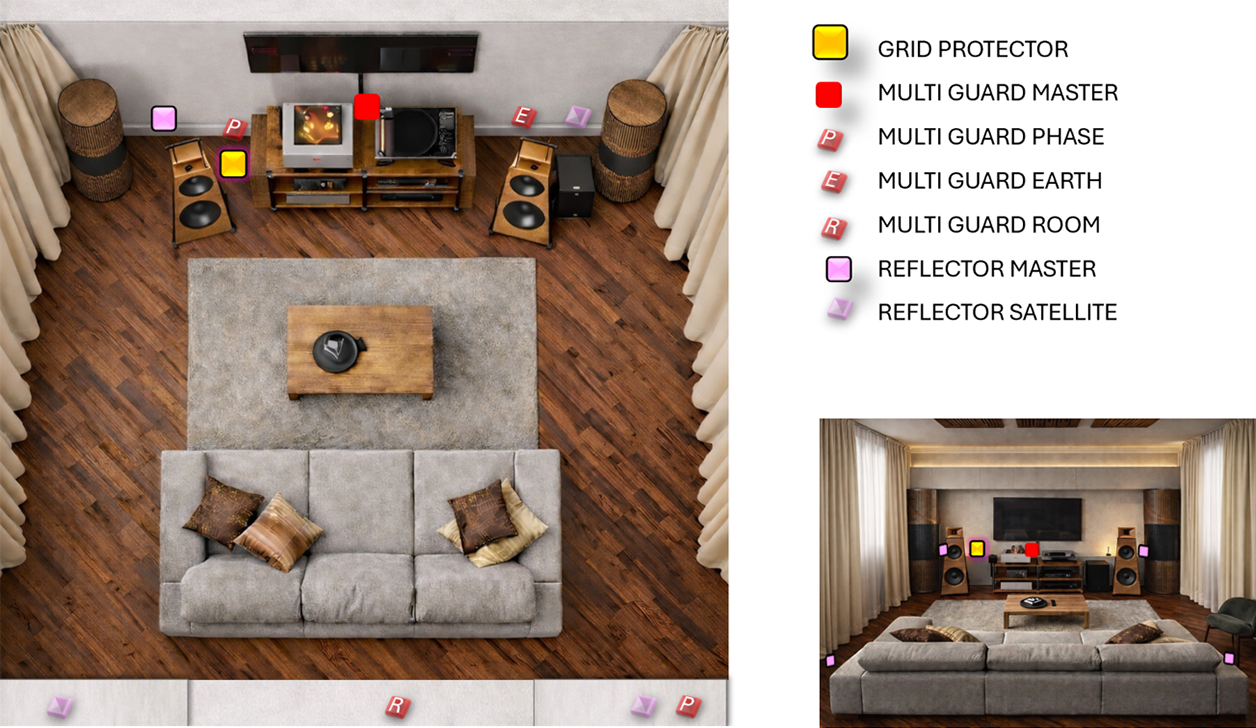
Up to that point I had all protector switches at 0. Schnerzinger provide no hints about what switches 1 and 2 do. Neither do they recommend any setting, implying that the best configuration is case-dependent. In my system and room, the most successful configuration was with both switches at 'I'. This restored the slightly darker more organic depiction of high-frequency content without sacrificing openness, impulse speed and detail retrieval. In fact the resolving capabilities of my system were never this acute yet wrapped in a noble gentleness that made it feel inevitable. Now I had my curiosity satisfied: four reflectors surpassed the EMI + 4 x piccolo in my room. Yet given the steep €19'800 of the reflector quad, I wanted to check what a twin reflector kit would bring to the table. That price is almost the same as the EMI + piccolo combo. I went back and forth multiple times but remained undecided between the slightly smoother larger-sounding EMI + piccolo and the more transparent, clear and fresh dual reflectors. As a final cost-no-object combination, I added the EMI protector to the 4 reflectors and was still able to hear an improvement although very subtle this time, mainly by way of a further increase in the buoyancy of sonic images and persistence of low-level harmonics trails.
I typically try to include review comparisons to provide some context and avoid hyperbolic absolutism but with these Schnerzinger products I had no prior experience of direct competition—if it even exists. The closest I had was the broad family of power filtering and interference absorption. I am a believer in tuning kit and tried and owned a number including power conditioners, mineral-based noise absorbers, ground boxes and galvanic isolators. What I tried operated passively whereas the Schnerzinger kit applies active counter-phase cancellation. Every tweak I experienced provided audible effects, sometimes for the better. Yet none achieved the before/after delta and most importantly type of impact Schnerzinger had. For example, elsewhere a smoother sound might have come at the expense of attack sharpness of treble brilliance whilst soundstage expansion might have been trailed by a loss of focus or image ballooning. With Schnerzinger there was no alteration of tonal balance or reshaping of the character of my system, no trade-off. This tech seemed to work outside the audible band yet made everything audible easier to perceive as real, thus becoming more inviting and emotionally engaging.









With the full set of Schnerzinger installed and configured, I experienced sound as a sacred and joyous celebration within a temple of silence and peace. It was easier to see how I felt during listening than to rationalize what happened to the music to allow me that state. There was a similarity with the calmness we experience during snowfall. This is a scientifically backed phenomenon whereby falling snow and cold dense air absorb sound, creating a sonic cocoon that reduces noise by up to 60%. This acts like a natural 'pause' command, damping vibrations and fostering deep tranquility, psychological relaxation and a sense of stillness. In my case the cocoon acted as a deeply black canvas of silence from which every speck of sonic information emerged with that gentle non-mediated vividness we associate with reality. The relationship between silence and sound is far more than binary polarity. One provides context for the other. There are inexplicable but easily perceived cases of osmosis between the two that create seemingly impossible hybrids such as silences charged with sonic expectancy; or sounds meant to evoke silence. The great Arthur Schnabel's famous quote provides a glimpse of this: "The notes I handle no better than many pianists. But the pauses between the notes—ah, that is where the art resides!"
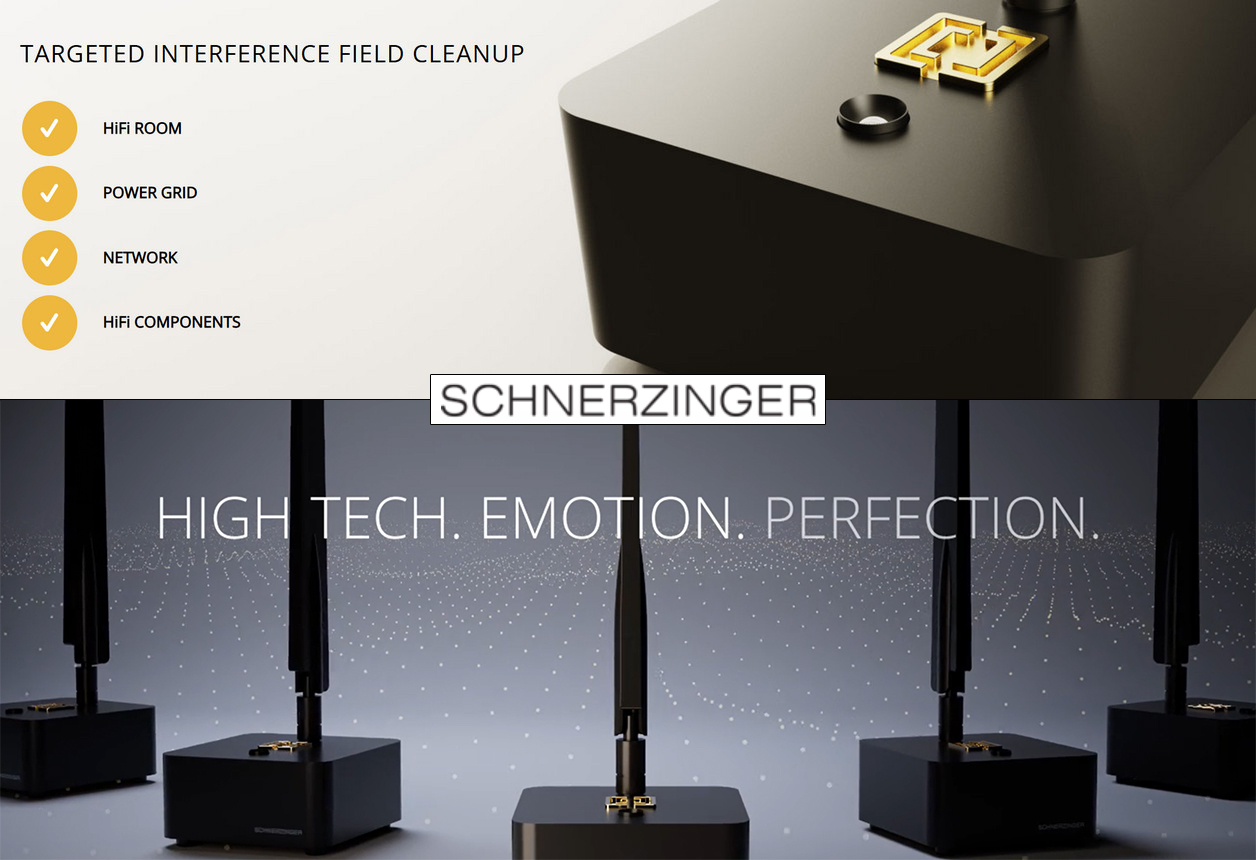
In my system, Schnerzinger expanded not only my music's physical reach to levels where I couldn't sense its spatial boundaries and temporal eclipse but understood its meaning and ultimately my psychological attitude towards it. Scherzinger Interference Control products are not for those wanting a quick fix or a set'n'forget solution. Especially when installed on the scale of the complete ecosystem, their high price puts them in a category of investment that mandates justification within already very high-end setups. In this context they provide a type of upgrade which is holistic and transcends the incremental upticks or lateral shifts that often come with component changes. For me the route is set, a new journey starts here and I encourage other sound travellers to embark on the same adventure.

Publisher's comment: Knowing of my personal interest in this tech, Simone shared the following: "This stuff had a profound impact on my system. The grid protector is a keeper for sure. As for EMI + piccolo vs 4 reflectors, my results purely on price/performance favour the first option. Grid + EMI + reflector is even better but as a one-time investment very steep. Whilst audible, for my pockets the multi guard benefits were too subtle. The highest bang for the buck could be the combo of grid + EMI which is closer to set'n'forget whilst the grid + piccolo combo favours tinkerers because it allows more granular fine tuning. This stuff does things for my playback which no other component changes I experienced thus far could do. It goes beyond improving the technicalities of the performance by creating the most favourable conditions wherein music flourishes naturally."