For decades, established methods like mains filters, power conditioners and battery-based power supply concepts have been used to reduce electrical interference in audio technology. These approaches are largely based on passive and active topologies that utilize energy-storing components such as capacitors, inductors or electrochemical storage devices. While such components effectively reduce conducted interference, they inevitably alter the dynamic behaviour of the connected power supplies. Periodic energy storage and release cycles lead to frequency-dependent impedance characteristics, phase shifts and delayed current delivery. These effects are particularly relevant for load-dependent transient current demands. In practice, this results in limitations of impulse reproduction, reduced transparency of the power supply during rapid load changes and restricted effective high-frequency bandwidth. Developers often accept these effects knowingly because bandwidth limitations simultaneously suppress high-frequency interference and increase EMC stability. Subjectively the resulting playback behaviour may be perceived as quieter or calmer. Technically however, this calming effect is accompanied by partial attenuation of fine temporal and spectral signal components, significantly limiting the transmission potential of high-quality audio components.
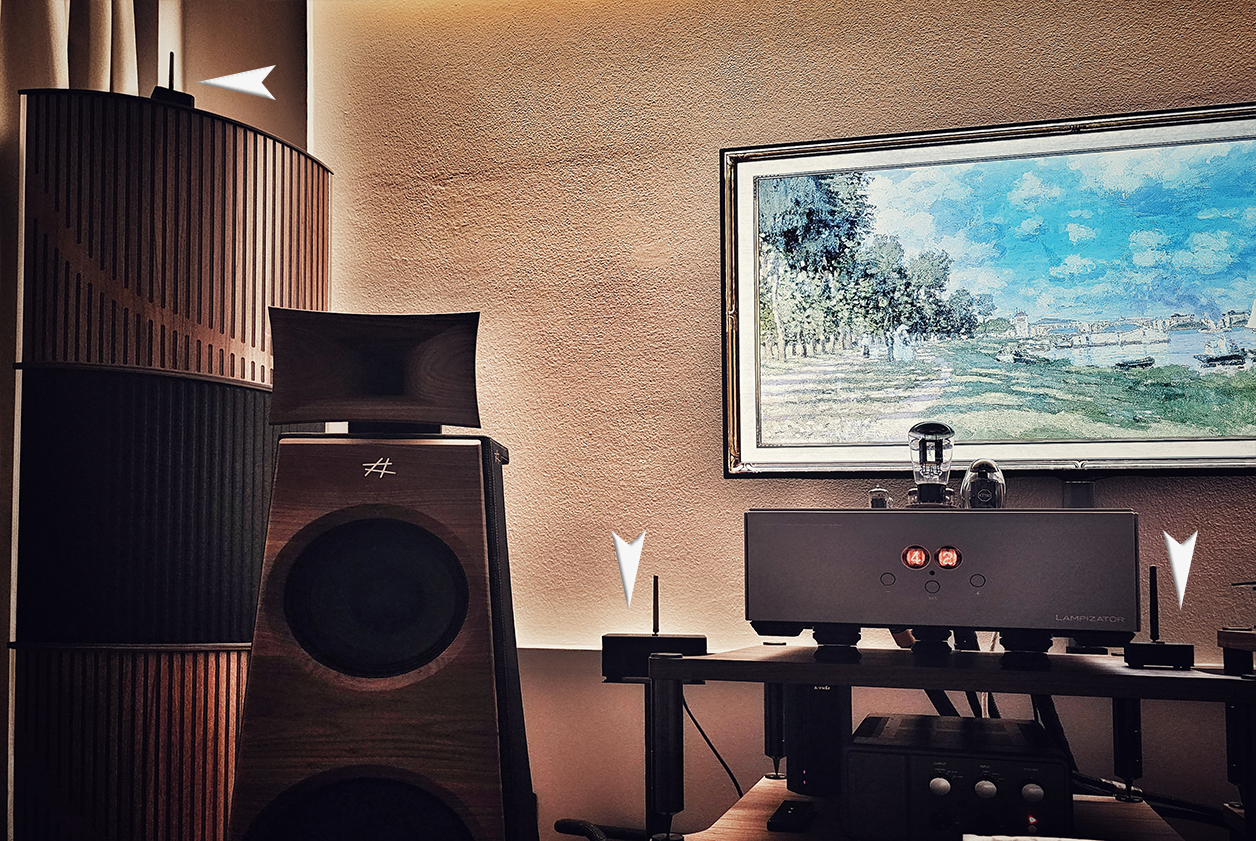
The latest generation Schnerzinger giga cancelling Plus+ is the result of years of experimental and theoretical development in the field of electromagnetic interference control. The system addresses an exceptionally wide frequency spectrum from low-frequency mains disturbances up to the three-digit Gigahertz range, thus capturing high-frequency emissions such as those found in radio, radar and highly integrated digital technologies. Unlike established suppression methods, giga cancelling Plus+ completely avoids the use of energy-storing components such as capacitors, accumulators or conventional frequency-selective filters. This eliminates system-related effects such as delays, phase distortions, bandwidth-dependent impedance changes and limited current delivery capability which are unavoidable in conventional filter concepts. Interference reduction is achieved through active interference cancellation. The combination of high temporal resolution and exceptionally wide effective bandwidth fundamentally distinguishes giga cancelling Plus+ from conventional RF suppression systems and enables effective reduction of electromagnetic interference without limiting the dynamic or spectral transmission behaviour of audio systems. All Schnerzinger giga cancelling protectors operate on the principle of controlled electromagnetic interference and consist of two functional units within a device. The receiving unit detects electromagnetic interference fields in the near and transitional field of the listening environment. Depending on the device, both conducted and radiated interference components are captured. The control unit processes the detected interference signals and generates a corresponding counter signal. Through precisely defined phase and amplitude offsets, this creates local interference effects, partially cancelling or significantly reducing selected interference components. The effect is frequency and location dependent and focuses on the immediate electromagnetic environment of sensitive audio components. The goal is not the complete elimination of electromagnetic fields but the reduction of interference-relevant signal components to a technically uncritical level. The functionality of radio-controlled and wireless systems remains unaffected. The giga cancelling technology operates without high-energy or externally powered transmitters or additional external high-frequency sources. There is no increase in electromagnetic field exposure in the room. From an EMC perspective, it is an adaptive modification of existing interference fields, not an additional emission source. Giga cancelling does not improve the audio signal itself but rather the electromagnetic conditions under which audio components operate. The perceived improvements in silence, precision, dynamics and resolution are the direct result of a physically more stable electrical environment without the typical side effects of conventional interference suppression methods.








Based on the product literature, the use of the 12V power supply for 15 minutes per annum is needed to keep the functionality of the various protectors at their max. I also read it is not a charge since there are no batteries inside. How do we define this maintenance activity? As a clean-up or reset?
To maintain full performance, we recommend performing a reset via a system restart once a year. Further details can be found in the operating instructions of the respective devices.
To use the various protectors above '0', I must use the SMPS. In my system I easily spot the negative effect of connected SMPS even though I have a dedicated hifi line kept free from switching power. When I tried the grid, piccolo and guard masters at levels above 0, I could detect a certain increase of HF grain as one of the signature indicators of SMPS noise. Would it make sense to use linear power supplies or battery chargers instead to provide power to the protectors?
In rare cases where the full performance level is required in combination with the connected power supply, the use of high-quality linear power supplies or battery-based supplies may be beneficial.
Is the LED brightness just visual user feedback to know whether the protectors are set at 0, I or II; or do they contribute with their own emitted energy to the desired cancellation effect?
When the LED is illuminated, it serves to convert the increased absorption of interference radiation into heat.
Can we specify the approximate bandwidth of the grid protector, EMI protector, piccolo protector and multi guards respectively?
Depending on model, the operating range extends from low-frequency interference to high-frequency disturbances in the radar range.
Are there recommendations as to musical genres, ensemble composition, single instruments to better highlight and appreciate the effect of the protectors?
Essentially, the existing baseline of a recording—its transparency, three-dimensionality etc.—determines the effect's magnitude. Naturally there are genres in which excellent recordings are more common but fundamentally the effect is not genre-dependent. It should also be noted that perception is often influenced not by the effect's absolute magnitude but by reaching a certain level. Thus, a familiar recording of lower quality can be elevated to a level where for the first time it transcends a merely technical-sounding reproduction and becomes fascinatingly authentic even if it does not represent the highest achievable level.
What do you see as the most important outcome of your products on a listener's enjoyment of music?
The aim is for the music, in spontaneous experience, to move beyond the level of technically good hifi and analytical listening and convey a captivating realism that leads to a largely emotional perception.