As I wanted to assess the supposedly cumulative effect of the various Schnerzinger kit on hand, I followed this approach:
Given the variables at play, I had to be patient and systematic but fortunately discovered that this was worthwhile and almost enjoyable. Luckily I found that the third step was irrelevant in the majority of cases as except for when combining the EMI protector and piccolo protector, I did not want to change a product configuration after adding a new one. After reaching the full-fledged 1st-gen giga cancelling configuration, I wanted to check the comparative sonic outcome of having only the piccolo or EMI protector in play as they allegedly address similar interference. Then I moved to the next-gen giga cancelling PLUS+ with the reflector. The last step of my test was to remove the protectors and multi guards and listen for changes. As anticipated, both EMI and grid protector produce a buffering effect, therefore I waited until the next day before evaluating the change.
The first stage of my Schnerzinger tour de force was the grid protector. Initially I did not follow the manual recommendation and instead of starting at the lowest setting, plugged in the SMPS and set all switches to max. The result was quite spectacular, almost shocking had I not previously experienced the same when attending the show demos. The music seemed to manifest in a bigger venue, transcending the physical space of my room. Instruments depicted more like autonomous sonic entities detached from loudspeaker localization then enveloped in a harmonically rich aura which provided a sense of dimensionality and tactility not experienced before. Next came a feeling of relaxation of the musical discourse as though a previously unnoticed tension eased. The music seemed to slow down not as a reduction of rhythmic drive or taking longer but instead as if an increased sense of naturalness enabled a more synced-up connection, making it far easier to feel immersed. I felt a bit like the DC Comics character Barry Allen aka Flash who sees things around him in super-slow motion thanks to his hyper-accelerated sensitivity. Details and nuances came at me with an inviting gentle clarity. Attacks were starker not in aggressive fashion but with effortlessness. Guitar plucks, drum kicks or even the subtle atmospheric texture effects of high-hats were astonishingly real and natural.
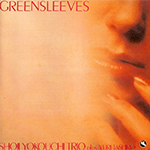
 "Willow Weep for Me", the opening track of Greensleves, a 1978 Three Blind Mice recording featuring the Shoji Yokouchi Trio plus Yuri Tashiro, is one of my trusted tracks for soundstage reconstruction, transient response, bass control and midrange naturalness. With the grid protector in place, it was clear from the opening guitar strums that the realism of the presentation was elevated thanks to more vivid presence, attack clarity and buoyancy of sustain in the decays. When the Hammond B3 organ enters to fill the room with its deep timbre, I sensed it with my whole body yet room pressurization remained under control and the tonal balance of the track intact to feel exciting yet not suffocating or overwhelming.
It took a few days to familiarize myself with the new level my system had reached with the grid protector in play. After my brain adapted, I started to experiment with the various settings, going backwards with respect to the recommended practice. When changing the 'bandwidth' and 'clocking' settings, I observed a slight change in focus, height localization and to a lesser extent, treble energy. Bandwidth at 'I' and clocking at 0 were my final choices. The most impactful change was going back to 0 on the 'power' switch where absence of listening fatigue but instead calmness, control and dynamic resolution were at their best. I am not sure this had to do with getting rid of a SMPS on my power grid but that was my final configuration.
The combination of intelligibility, articulation, drive and organicity plus music's in-room presence all were a clear step above what I achieved without the grid protector. The amount of improvement was similar to a component upgrade but even more compelling qualitatively as it acted holistically with no trade-offs and especially addressed two aspects I'm very sensitive to: spatial presentation and timbre textures. I moved the grid protector around the room but detected no significant modifications to the sound. As a side note, with the grid protector in my chain, the mechanical buzz of a linear power supply reduced to inaudibility at the listening position which did not stop me from replacing the unit with a dead silent one. After experiencing the overall musical uplift from the grid protector, I moved to the multi guards with a mix of excitement over further improvements; and scepticism about how that would even be possible.










 The multi guards were the logical next step since they are intended as ideal complement to clean up the power line. By following the manual indications, I plugged the 'phase' into my Faber's Power La Potenza power distributor to which the main components of my system connect; and 'earth' and 'room' into a wall socket not on my dedicated hifi line so rear wall. In all cases I paid attention to connect the devices in correct electrical polarity with the help of my multimeter. The master located behind the rack at the centre of the front wall about 0.8m off the floor. Given that my room has two side walls with no AC outlets, I couldn't follow the recommendation to treat all walls. Given my experience with the grid protector, this time I obeyed the manual with the master not on the SMPS so 0 position. While less dramatic than with the grid protector, the effect was easily recognizable and mostly along the same lines. The feeling of effortlessness and physical presence strengthened as did the refinement of midrange and treble towards more textured liquidity. Male vocals especially seemed more incarnated and connected to the singer's body instead of feeling like ghost images projecting from an open mouth into the room. Tracks such as "L'Ami Baudichon, madame" with the Cut Circle vocal ensemble, a risqué intermission Josquin introduced in his Missa L'ami Baudichon, became more like a tactile hologram of full-height vocalists triggering next-level realism which in turn resolved into a stronger emotional connection.
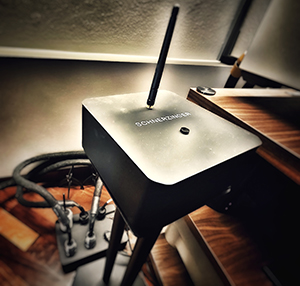
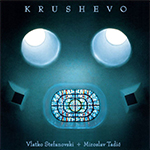 By powering the master, higher power levels produced a certain increase of soundstage size and airiness both related to a perceived increase of energy in the treble yet I preferred the smoother more organic presentation of the default 0 setting. Unrelated to sound, a welcome side effect of adding multi guards and grid protector to my system was an increase of contrast, vibrancy and stability of my LED TV's imaging, something I hadn't realized I should expect. With AC-related interference kept at bay by the little armada of Schnerzinger sentinels, I turned my attention towards those malicious, invisible yet audible HF gremlins. Here I started with the big gun, the EMI protector which at the centre of my system would cover my listening area given its 3m operational range. First connection was with no supplementary 12V power so the zero setting. The immediate and thrilling effect was that I could no longer clearly tell the sonic boundaries of my room especially in the height and lateral directions. This applied not only to obviously grand compositions such as big orchestral or aptly processed electronica but small-scale ensembles. The main image, be it voice or instrument, maintained its proportions, localization and delineation but the aura of overtones, the echoes of energetic pulsations in the recording venues became a more integral and tacit part of the experience. The increase of contrast was apparent especially with intricate passages like in Krushevo, a minimalist MA Recording where guitarists Vladko Stefanoski and Miroslav Tladić play inside the stony Makedonium Monument. Their interplay, phrasing and fast fingers were easier to follow, always sculpturally layered yet integrated with the large reverberant venue. The illusion of immersive participation in the event was stronger than ever. I also appreciated that these aspects were in full display already at lower volumes and my natural tendency to listen at lower SPL than usual became routine during my time with the Schnerzinger kit as though the dynamic range of recordings expanded by a few dB. On the other hand, when I wanted to push the system to eviction levels I could tolerate them more easily and the composure and breadth of the presentation did not suffer. For the EMI protector too my preference was the default 0 setting and after trying several positions, I ended up with the box placed in the middle of the rack about 80cm off the ground.