
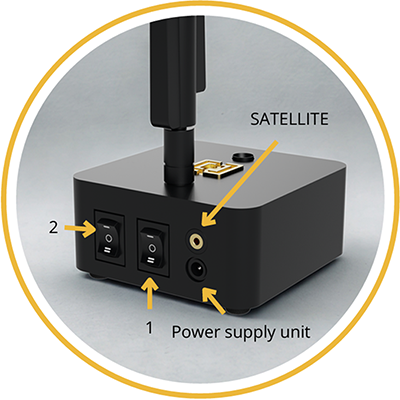
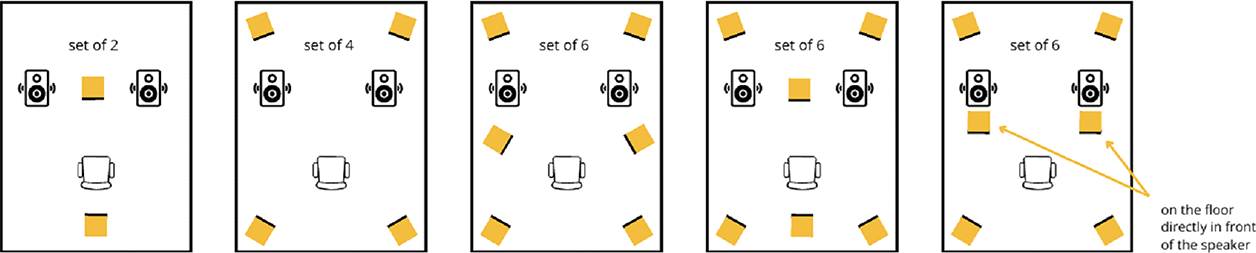
 The manual suggests to first identify which switch 1 setting is best, then leave it unchanged when moving to switch 2 which reduces the number of permutations to 5. The reflector is operated without the supplied 12V SMPS which only serves to perform the annual adjustment where we connect the master to the power supply and a satellite via a dedicated DC cable for about 20 minutes. During this operation, all switches must be placed to position II.
Schnerzinger are notoriously secretive about how their equipment functions. However, Dirk Klocke and team were kind enough to reply to some questions, thus shedding some diffuse light on the background of their technology, development process and intents.
Can you provide some background on your technical development, inspiration and company history?
Since 1989, Dirk Klocke has been intensely engaged in available cable design technologies largely unused by the audio sector as well as high-frequency interference suppression long before the company was founded. This early involvement led not only to solid familiarity with conventional interference suppression technologies but starting in 1993, also a deep understanding of so-called information technologies at a time when these were known only to a small circle of scientists and not applied to audio until years later.
These technologies still form an essential foundation of currently competing products. Dirk Klocke recognized the potential of advancements achievable with these technologies early on but also their associated compromises. Schnerzinger's fundamental goal is the greatest possible absence of compromise in product development. For this reason, despite their innovative potential in the audio sector at the time, these technologies were initially considered unsuitable for Schnerzinger. Only after an intensive development phase of the giga cancelling products did they achieve a level of quality that met internal standards and justified market entry. The perfectionism underlying this approach is rooted in Dirk Klocke's exceptionally high sonic standards shaped both by familiarity with reference systems and authentic live listening experiences. On the other hand, this perfectionism primarily reflects an extraordinary level of time and methodological effort. All development steps are accompanied by extremely intensive listening sessions. These serve not only to maximize positive sonic effects but above all to consistently eliminate subtle negative influences that might otherwise go unnoticed due to obvious improvements elsewhere. The particular quality of this approach becomes especially clear against the background of the high sensitivity to side effects of many hifi components. Despite initially perceptible improvements, these side effects can, beyond a certain level of development of the entire playback chain, limit or even prevent further exploitation of sonic potentials.










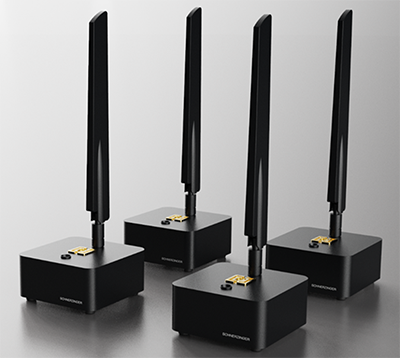 What are the steps of design and validation of new Schnerzinger products re: measurements and involved methodology, equipment and testing? Is there any publicly available research study I could refer to as background to better understand and position your technology?
In addition to exceptionally intense listening tests, the development of Schnerzinger products involves the use of high-frequency measuring instruments capable of three-digit GHz ranges, laser interferometric spectrometers and more, made possible in part through special relationships with other scientific institutions and industries. Schnerzinger have access to background technologies and measurement equipment originating from scientific environments that, for various reasons, are not typically available to the audio industry. Many of the underlying technologies in Schnerzinger products originate from external sometimes highly sensitive industrial sectors. To avoid jeopardizing our partnerships—and because, after extensive consultation, we decided against patents due to the requirement for full disclosure of our technology—we currently do not disclose the research background of these technologies. This decision is made in full awareness that such information could be highly effective for marketing purposes. Due to the superiority of our products and the corresponding interest from competitors in their underlying principles, we also use a special potting compound that cannot be X-rayed. Furthermore, it only becomes liquid again at temperatures at which the circuit board and its topology would already be destroyed. We do not rule out the possibility of being more open with this technological information at a later stage once competing products have begun to approach our current technology and we have advanced to the next technological level.
As I understand it, the operating principle of most products I have for review is based on cancelling disturbances by emitting counter-phase signals. Since every room/house is different, do you use a technology for first detecting specific disturbances at play and then cancel them; or do the various protectors work with fixed energy spectra that can then be adjusted until they match a given pollution as closely as possible?
Electrical interference fields represent a significant influence on the function and performance of audio systems. In modern installations, low-frequency mains disturbances (50/100Hz and their harmonics) interact simultaneously with high-frequency interference from digital circuits, switching power supplies, RF communication and electromagnetic emissions from nearby devices. These interference sources couple capacitively, inductively and conductively into power supplies and signal-carrying components. The resulting effects are measurable: increased noise levels, modulation of supply voltages, degraded jitter characteristics in clock-sensitive circuits and reduced signal-to-noise margins in analogue signal processing. Because audio devices draw their required current from the power supply, disturbances in the mains directly affect their useful signal. The quality of the electrical power grid directly impacts the transmission behaviour of the entire system. Reducing electromagnetic interference therefore leads to more stable operating conditions, lower intermodulation and improved working conditions for critical circuit areas. Schnerzinger giga cancelling addresses this issue by specifically reducing external and internal interference fields. The goal is to minimize unwanted electromagnetic interactions and thereby improve the electrical conditions under which audio devices operate. The sonic effect is not an isolated phenomenon but the result of a physically improved system environment.