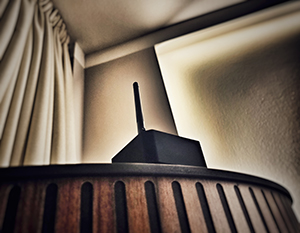
 My last step with the original giga cancelling techn was the addition of piccolo protectors. Having a master and three satellites, I already knew that I'd spend some time on positioning. When I started with the master in the middle of the front wall, one satellite behind me close to the rear wall and the other two behind the speakers aligned along the front wall ~75cm off the floor, I detected a further improvement of the perception of the space within which the music recreated.
 The reason was a depth-of-field increase which allowed for a better sense of soundstage proportions which I had previously expanded in width and height. Depth too increased but not to the same extent, making up for a bit of fish-eye portrayal. With the piccolos I could achieve an almost binocular see-through with recordings whose sonic landscape was aptly captured. An example is El Misteri d'Elx, a mystery play in 2 parts for the Feast of the Assumption: Fanfara, by Harmonie Universelle II, an Alia Vox compilation of mostly Renaissance and Baroque music featuring Jordi Savall with various ensembles. It includes some ominous and terrifying thunder strikes that with the piccolos kept their colossal appearance combined with the eerie feeling that the sound was coming from well beyond the front wall. Most importantly, the effect was not achieved with cheap trickery of generic inflation often heard in big systems where a uniform upscale factor applies to all images, rendering particularly vocals unnaturally enormous.
 Another presentational shift with the piccolo was that the lingering of decay trails seemed longer. This however was not associated with a lack of precision so muddiness or slowness. Rather, it was a product of very low-level information being more accessible and textured. Piano, percussion or instruments inherently rich in complex overtone structures like the oud or idiophones like cymbals and xylophone acquired an additional layer of richness and realism. Musical flow too was smoother as in a picture with more colour depth where the nuances in levels are otherwise too small to evaporate into thin air. Image separation was more pronounced, something made spectacularly apparent in a track like "El Cuarto de Tula" from the Buena Vista Social Club's eponymous album. Here a small multitude of singers and instruments including Cuban maracas, bongos and cowbell play a fast-paced Son descarga style, featuring a syncopated piano montuno and bass tumbao. I find this polyrhythmic track almost hypnotic and with the piccolos at my service, I could not stop moving my foot and head following the groove and the appearance of the various musicians within the room.
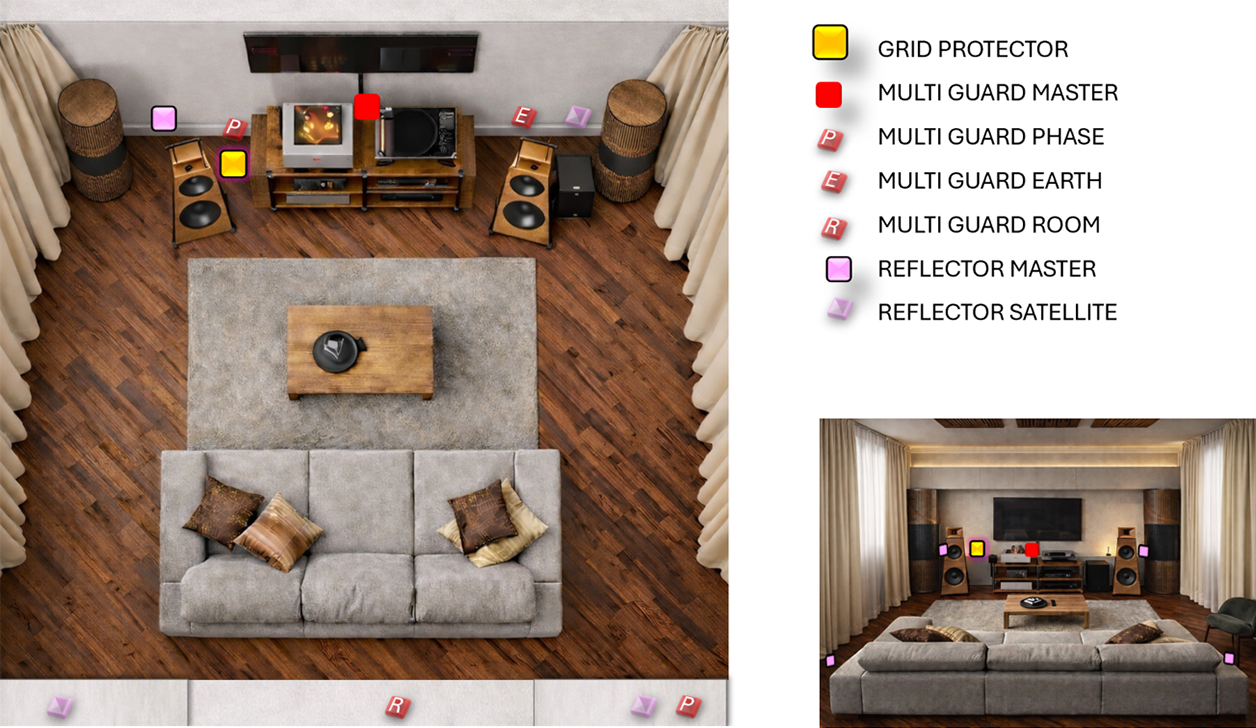
 After checking again that the piccolo master worked best at default 0 power—a seeming constant in my system at this point—I started experimenting with alternative positioning of the satellites. I left the master and rear satellite fixed then moved the remaining two around the room's three axes so on the floor, on 75cm tall speaker stands and atop my Vicoustic VicTotems corner traps. The beauty of the piccolos was that throughout they kept doing what they were doing, acting like fine-tuning musical lenses. After I realized how to manage their placement, I could even change location depending on what I was listening to. A piano recording miked too close to result in an exaggerated perspective was put into more realistically focused proportions by moving the satellites directly behind the speakers or even on their top while some asphyxiated orchestral recordings could breathe better with the satellites widely spaced to either side of the speakers so close to the side walls. In all cases, the speakers' disappearing act stayed intact and stronger than in the non-treated version of my system. At this point of my journey, I had deployed the full arsenal of 1st-gen giga tech at my disposal and enjoyed the system as such for a few weeks. I honestly hadn't the slightest desire to change anything, never mind remove a single item.











 Then review duties called to begin reality checks. Sometimes though not always, I'm more sensitive to changes when I remove not add items. The first thing I tried to remove was the EMI protector also because I had the feeling that the piccolos and EMI protector caused similar changes. The experiment confirmed that. Although I sensed a slight loss of the imperial feeling of calmness and relaxation, it took me only a day or two to miss the EMI protector less than feared. The next step was removing the piccolo protector. That was an easy no-no. Contrary to the EMI protector, the effect of taking out the piccolos was instantaneous and it took me only a few songs to realize that the relative constriction, loss of resolution and air stole too much from my enjoyment of music which had become essential by then. My conclusion was that having at least one of the two, the piccolo or EMI protector, had become essential. Removing the multi guard caused a slight loss of focus and depth and the solidity of musical objects was not as obvious. Although the change for the worse was more audible than expected, I would not call it a major setback.
Next I unplugged the grid protector, removed its antenna, placed it in another room on its side and waited a day. When I resumed, I thought that I had one of those days where my mood is not right and everything I listen to seems dull. Then I thought that I should wait for the system to warm up even more. Whilst I recognized the sound of my system, there was an inexplicable feeling of greyness that prevented me from engaging the immersive mode I'm addicted to. The music was more clearly confined between the speakers, more mechanically attached to them whilst a creeping tension emerged especially in the upper midrange after longer sessions. These traits were nothing I associated with my setup before Schnerzinger but now I could not un-hear them. Reinstating the grid protector restored the loss and it was with a sigh of relief mixed with resignation that I realized that a new member of my system had squarely settled in. I was ready for the last step, the reflector as my first proponent of the giga cancelling Plus+ tech Schnerzinger are so proud of. Already the packaging of the product showed much higher care for the presentation of the kit. My intent was to compare the reflector to the EMI + piccolo protectors. After removing the EMI the day prior, when I replaced the 4 piccolos with the 4 protectors, I did a one-to-one switch, hence placed 3 protectors along the front wall and one behind me.
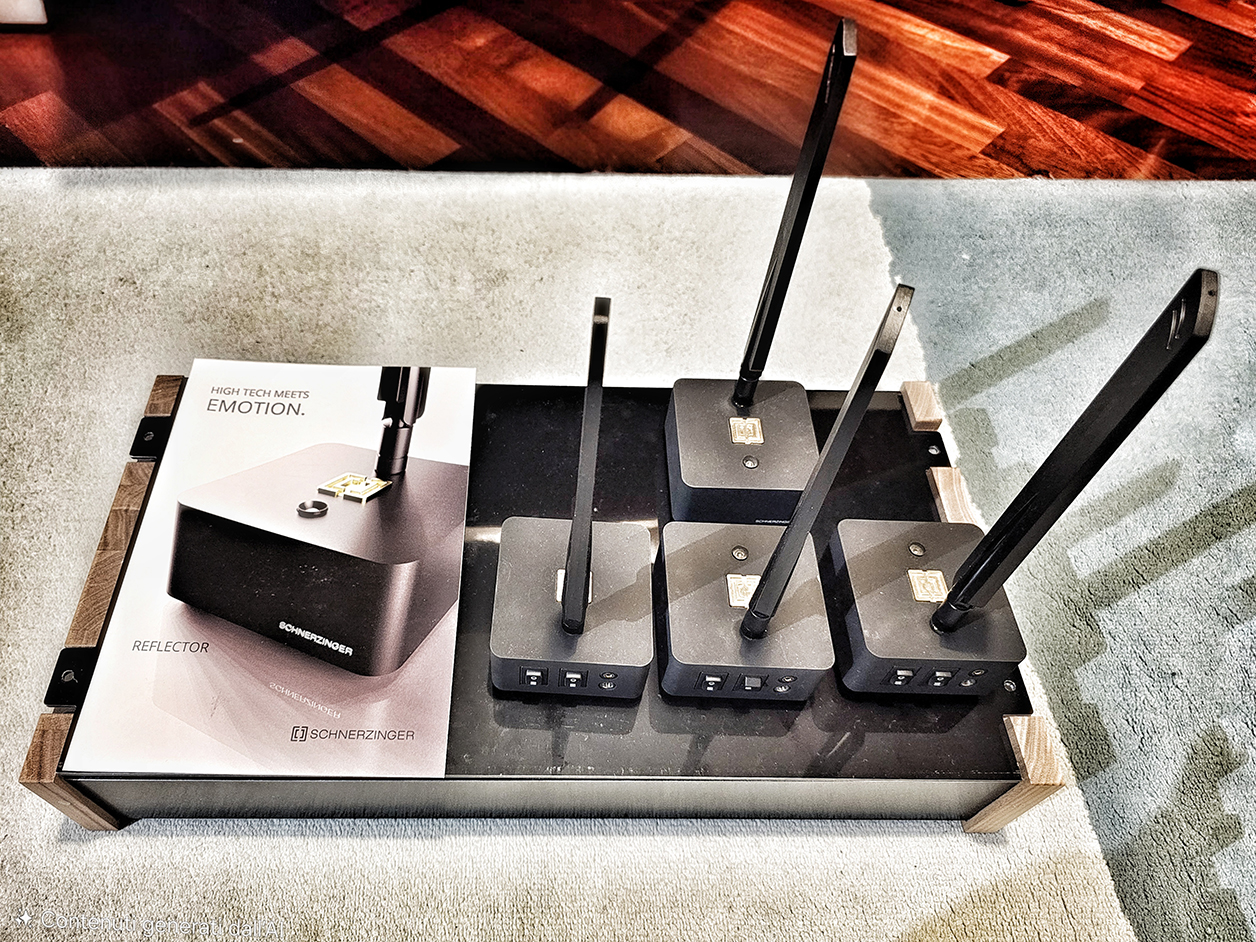
What I heard now was the most impactful change of all experiments I'd done by then. Three things captured my attention. I had a definite impression of higher SPL yet after checking both amp and DAC, of course nothing had changed. I was almost overwhelmed by the amount of musical information I was exposed to; and images were larger. Overall I was feeling a stronger sense of energy being projected into the room, with unprecedented clarity throughout the spectrum and especially in the extremes. Transients became lightning quick, giving an exciting edge to the experience. Another effect of the protectors was a solidification of the centre image which acquired a focus and stability that seemed to defy volume changes for textural complexity like a stoic beacon in coastal bedrock.  An album like Tarentule–Tarantelle by Gregorio Paniagua with the Atrium Musicæ de Madrid became a sonic feast under these conditions, a pyrotechnical display of holographic capabilities and transient outbursts inside a large transparently resonant space. I could not hold back a smile while shaking my head in mild disbelief. On the other hand, I had lost that feeling of serenity and effortlessness of the EMI + piccolo. Listening was more exciting but a subtle increase in fatigue which I normally associate with abundant HF seemed to creep in. Also, despite the larger size of musical objects, the overall envelope which enfolded the music had slightly shrunk. So I re-read the manual and realized that my positioning choice was not recommend. With the reflector so contrary to the piccolo and multi guard, the master does not need to stay at the centre of the setup. So I moved to the baseline placement advice for a 4 x kit, with the reflectors close to the four corners of my room pointing towards me. This was my first attempt among numerous iterations. It showed me that the reflectors are very sensitive to position, even more so than the piccolos. The result was an increase of expansiveness that went beyond the best I achieved with the EMI + piccolo. Now my side and front walls became a mere visual distraction compared to the perceived limitless size of the projected soundstage. Instrumental proportion and separation within that soundstage too were the best I had in my system thus far.