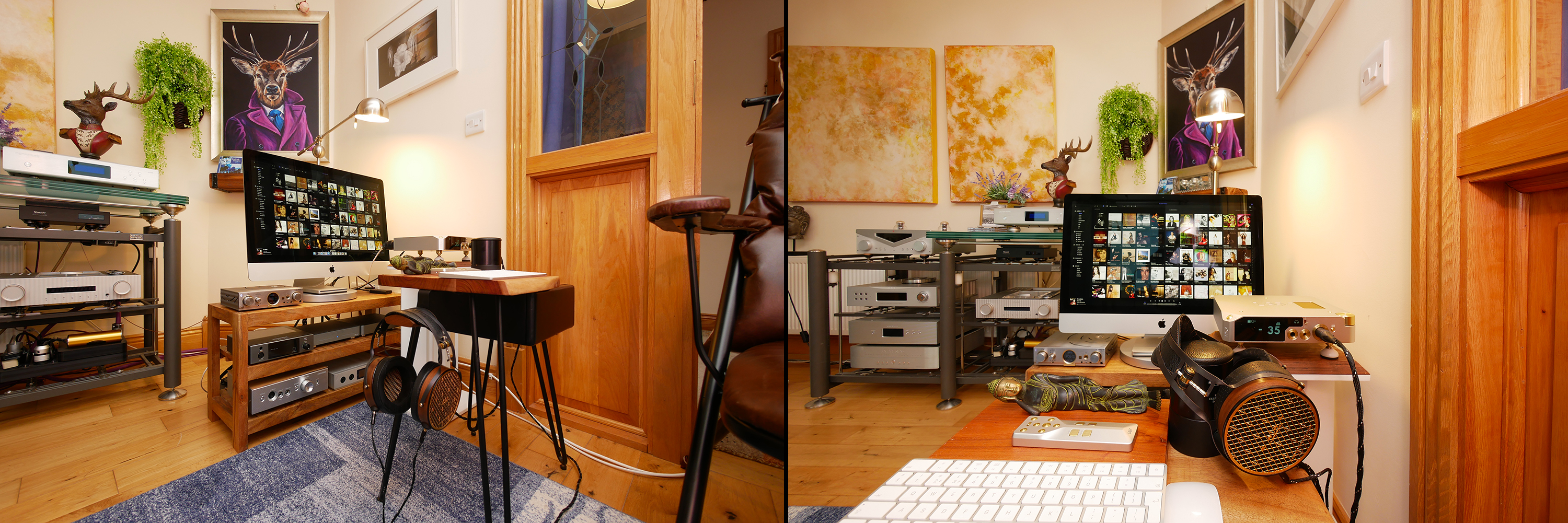
When posters challenged Cameron Oatley on his max voltage given the figures then published by Laiv referencing a 4V input from their own DAC, he revealed this: "Yes, I messaged them about the specs since the whole reason for the redevelopment of the amp—it originally was going to be a very different design—was primarily for the higher voltage and power. I imagine it's just those specs being what you get with a normal 4V DAC but suggested that they add the actual max value too." Perhaps chasing beast-mode power for one or two rare loads explains the HP²A's divergence from the Harmony tuning? To me it felt as though the designers had changed their minds on the original Laiv-for-live sound. To avoid assumptions, I asked Weng Fei-Hoh. To dig deeper into his HP²A, I now set it up around my best transducer, Raal 1995's triple-ribbon Immanis with 32Ω transformer-based impedance adapter barrel. The iFi iDSD Pro Signature DAC fed from a Singxer SU-6 USB bridge sat in 12V fixed output mode and comparator amps were Kinki's THR-1 and Soundaware's P1x. My music iMac runs Audirvana Studio in 4 x upsampling mode and cloud files through my Qobuz Sublime subscription come off the router via CAT8 cable then encounter two slaved LHY network distributor for reclocking and noise stripping. My obvious first contrast amp was the Kinki when it too runs on lateral Exicon Mosfets. In matters of amp tastes, I'm quite the one-trick pony. Be it my Kinki monos and stereo amps, the Kinki and Enleum headfi amps, my earlier LinnenberG Liszt monos or Goldmund/Job 225 amp, they all champion/ed these output transistors. Likewise for Nagra's Classic Amp I reviewed, loved and could have grown old with hadn't I been set already. But there's obviously more to it than identifying and worshipping particular parts. Implementations differ. They turn the sonic steering wheel.
First, Weng's reply to wrap up the redo: "I'd like to clarify the development and design goals of the HP²A in light of Cameron Oatley's involvement and the changes made during the process. Originally, our focus for the HP²A was to create a world-class preamp with a headphone amplifier, targeting a 70/30 split between preamp and headphone functionality. This design included a precision-matched discrete resistor ladder for volume control and a discrete Class A buffer for the preamp while the headphone section utilized two TPA6120 chips for true balanced operation. Cameron's insights from GoldenSound proved invaluable during further development. He identified a gap in the headphone amplifier market and suggested that the HP²A be enhanced for higher power and voltage-swing capabilities, specifically to support demanding loads like Susvara, Tungsten etc. As a result we decided to elevate the design to a more balanced 100/100 focus on both preamp and headphone functionalities. I also had the pleasure of collaborating with Raal to showcase our Harmony DAC at CANJam Singapore 2024. The response from the headphone industry was remarkable, reinforcing our belief that the HP²A should excel as both a preamp and headphone amp to enhance our commitment to a 100/100 focus. The core preamp design remains unchanged but we significantly enhanced the headphone amp section. This required extensive engineering including multi-layer PCB and careful arrangement of components to fit within the chassis while maintaining performance. In terms of voicing, when used as a preamp, the HP²A retains the signature sound of the Harmony series. However in headphone mode, it delivers a vivid organic tonality without sacrificing detail. Our goal was to avoid the fatigue that often comes with forward aggressive sound signatures. Instead we aimed for an engaging rich full-bodied presentation." This confirms my prior take on a changed voicing exactly. As someone who loves the Harmony tuning to buy one and who expected its more intense and energetic nearfield voice transferred to the HP²A, the altered tuning had me surprised. This obviously is no reflection on quality or tier, just a shift of profile and how that plays to personal preference.









With ace percussionist Steve Shehan flying sorties into torrid time keeping, the THR-1 played it more 'laiv' than the Laiv. Think of the tacit slap of open fingers peppering taut drum skins for cracking rhythmic morse code. They generate flinching rawness, upper-harmonic spray and microdynamic spikes all of which the HP²A rendered more tame. Granted, Raal 1995's triple ribbons in very open chambers are masters of dynamic acceleration and treble zingers. Whilst drilling down into differences, using one's sharpest tools simply digs deepest. And on subjective speed, transient fidelity and reflexes, the Laiv was second to the Kinki. I suspect that its multi-paralleled outputs and lower S/NR were at least co-responsible. This follows the observation that in a given catalogue of amplifiers, the model of the lowest power often has the best resolution, clarity and reflexes. We already know how the HP²A was deliberately regroomed to manhandle a few outliers of extreme drive demands by growing extra muscle. If those headphones are what you own, that's what you want. If you own more normal loads, you won't flex that extra muscle but still notice its presence as minor lushness and warmth. And many listeners adore those traits. In fairness, we're talking about fine degrees and applying extreme detail magnification with a very expensive flagship ribbon headphone. Just so, the 'smaller' Kinki amplifier with the same but half as many output devices played up the old adage that where it's superfluous, more power can feel thicker, slower and a bit lazier.
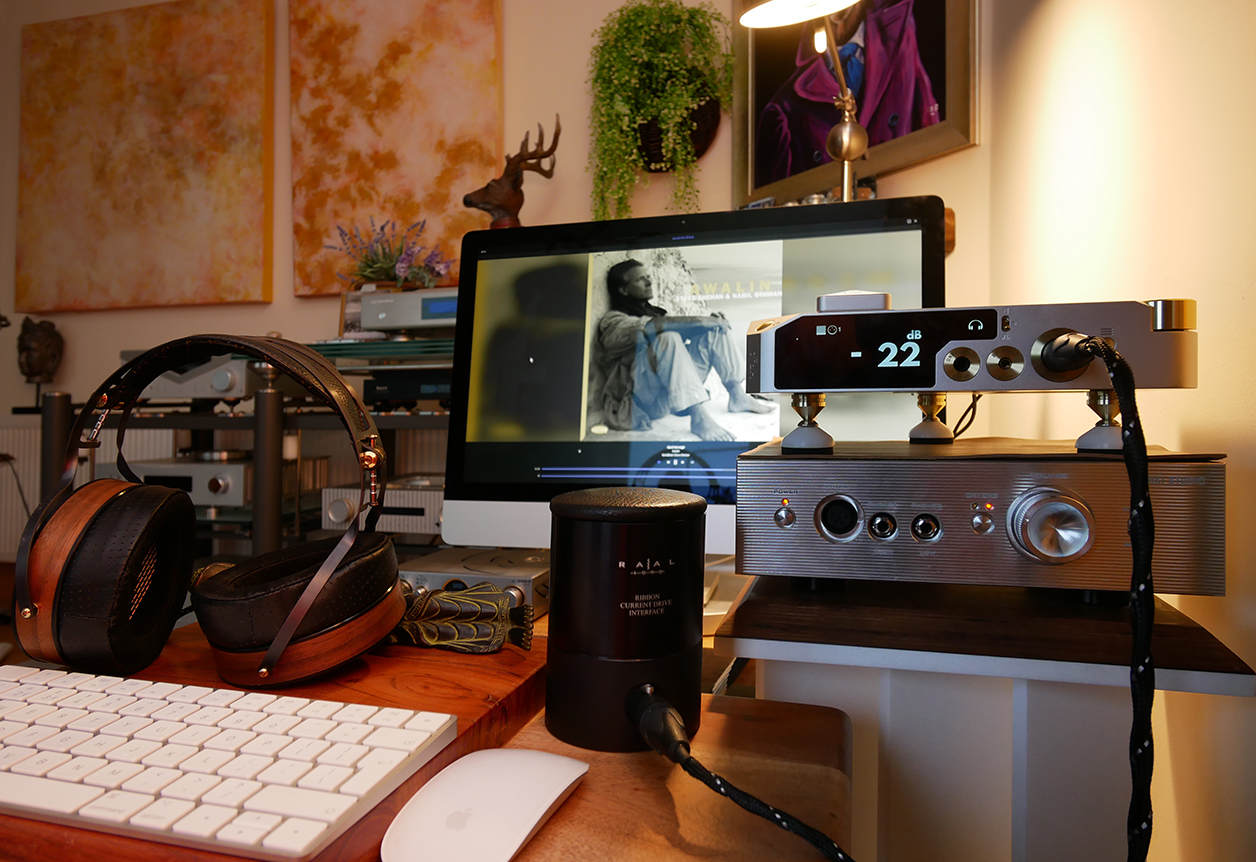
Before that's misunderstood as a rule etched in stone, take the small €2K Soundaware P1x. It also delivers 12wpc albeit of pure class A into 32Ω, 3 watts into 300Ω and packs higher voltage gain than the HP²A. Cue up "Sobranía" from the Rafael Cortés album Espada de Fuego. That title translates as Fire Sword. Combine his impeccable finger technique with close microphone placement and think of the proverbial hail on a tin roof. This is extreme string-based transient precision. Once again, the 'high-bias' class A/B Laiv drew attacks with a softer thicker tip than the presumably warmer class A amp. The obvious upshot is that implementation or execution trumps parts choices and circuit types. Laiv chased a more organic presentation and richer tonality. Anyone finding Rafael Cortés too hot and steely will applaud them for it. Over the HP²A, we're taking a step back from his Flamenco guitar's artillery range of picado string arpeggios. We soften their blitz exactly like moving away from a stage by a few rows will do. In this instance it also means a lower dose of upper harmonics which can inject bluish undertones from odd-order overtone intervals. None of it is meant to belabour a point other than properly reset expectations when one comes from the Harmony DAC. That handles these aspects slightly different. By temperament, the second Laiv doesn't lean forward the same so feels more relaxed. Which gets to my next question. Would I also concur with Weng's assessment that in preamp mode, the HP²A reverts back to Harmony's tuning?