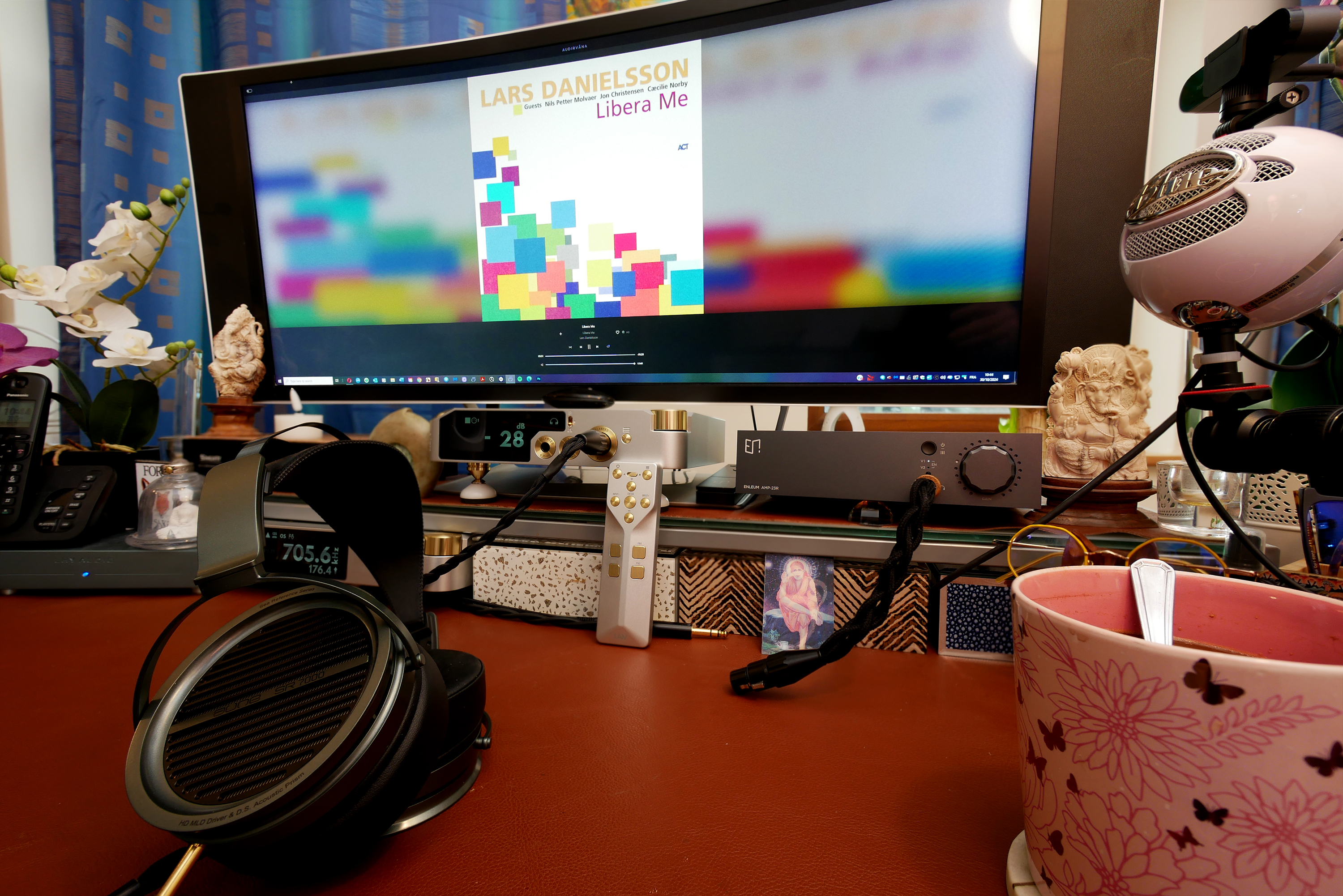
Onto sonics against my Enleum whose single-ended nature tapped the Harmony DAC's RCA outputs to be live simultaneously. A Medicine ¼"-to-XLR4 pigtail in the Enleum prevented its rotary from defaulting to zero which it does when unplugging a headphone. Now I could swap headphones at will, with both amps under signal and volumes matched. Plug 'n' play. Now I spotted a post from Cameron Oatley of GoldenSound, a YouTube reviewer who consulted on ferrum's special edition Wandla; Warwick Acoustics; and Laiv's Harmony and HP²A. "One of the things I told Laiv was that there's a bit of a gap in the market for high-voltage output amplifiers particularly important for a few specific headphones like the ModHouse Tungsten which needs far more voltage than other headphones. Due to how their voltage rails set up, almost all headphone amps can do either 10V or 20V out at maximum (±10%) regardless of their 32Ω power spec. The Holo Bliss, ferrum Oor, MassKobo 465 etc are all 20V for instance. But for some listeners particularly if they listen loud or to bass-heavy tracks, headphones like Tungsten may indeed need more… Here I measured 60V or over 12 watts not into 32 but 300Ω! The HP²A has an extremely high voltage output capability uniquely suitable to these headphones though it's important to note that its gain fixes at 12dB. This means that with a normal 4V DAC, you'll get to just under 20V similar to other amps. But when paired with high-output DACs like ferrum's Wandla, Rockna's Wavedream, RME's ADI-2 etc., you can get up to 60V out."
The very first thing owners of the Harmony DAC will probably notice is how it's voiced different than the HP²A. Of course the DAC's outputs are high-feedback opamps to buffer its R2R ladders. The HP²A's outputs are discrete. The DAC packs a 3rd-harmonic dominant type signature because regardless of whether that reflects actual measurements, it has that flavour. It gives brilliant separation and the type clarity I call lit up all over to distinguish from just a lit-up treble which would be a narrow-band emphasis. The DAC's broad-band personality is the type transient-taut energy one gets close to a live stage but not in the far seats. The HP²A is tuned mellower and richer; what we would call closer to 2nd-harmonic dominant. That makes it a bit denser and more relaxed. Sheer horsepower transfers those qualities to the bass such as to give up no control or definition. There's no below-the-belt collagen injection. This general personality is merely weighted more on the bloom/sustain of tone than its leading edge. Without in any way adding etch, the AMP-23R had a bit more attack assertiveness and resolution.









Perhaps think of a low-distortion pentode versus the HP²A's equivalent triode. Neither lays it on thick but a core hue remains. So the Enleum felt more direct, the Laiv more distanced. The majority action of playing the gap of difference was tone colour; how upper harmonics presented. It wasn't about tonal balance so frequency response; not that you'd expect that from top-class transistorized amplifiers. It wasn't really about subjective damping either. The Enleum simply packs higher voltage gain. -15B on Susvara over the Laiv meant 11:30 o'clock on the AMP-23R's rotary which sets the gain of its discrete current-mode IC. That left a lot more untapped headroom even though Laiv run twice the number of Exicon Mosfets. Enleum's hi-gain mode simply applies steeper amplification factor. Users will view it as the more powerful amplifier. Whilst it's a very able-bodied speaker amp of 25/40wpc into 8/4Ω plus a peak headfi proposition, the AMP-23R demands a whopping €6'250. The only comparable double-duty amps of its solid-state calibre I'm familiar with are Dragan Domanovich's SAEQ Hyperion Ge and Armageddon. They cost equivalent or higher coin. That Laiv can chuck speaker mode, maintain pedigree on headphones then slash the ask by more than 50% is impressive. The SAEQ twins also don't have its display or remote whilst the Enleum still subtracts the display. The HP²A is more full-featured.
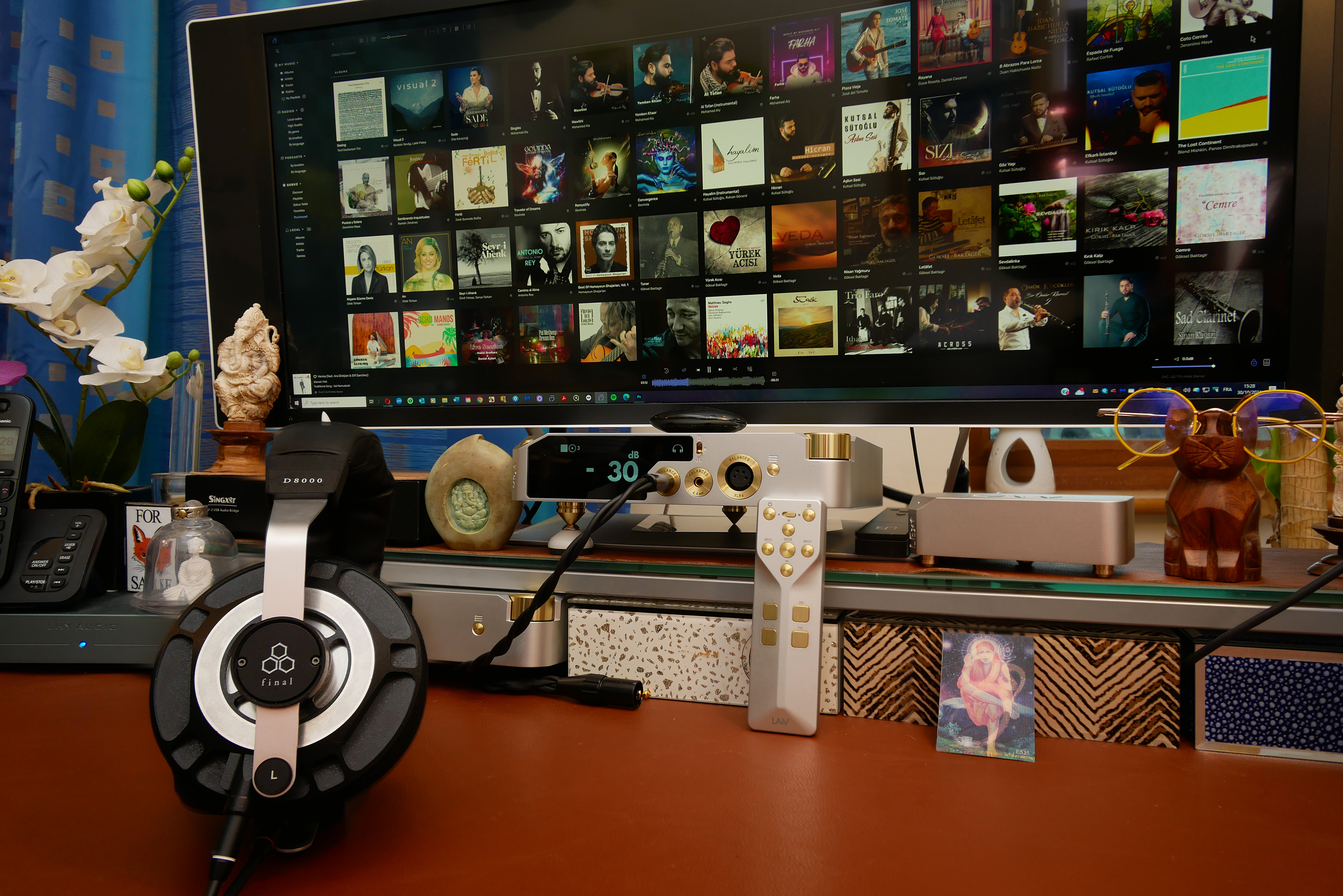 LExt IN2 connected, input 3 RCA selected and displayed as such by the HP²A's display. The power LED of LExt glows white.
Comparing LExt's RCA feed to the HP²A's direct XLR, there was no gain difference as promised. RCA textures were simply marginally softer or plump. That gave the direct connection a small edge on outline grip. Call it one of 121 shades of gray so nothing of consequence. Just follow the hookup instructions by first pulling the HP²A power cord before you leash up the outboard box. Being light, small and on three not four footers, LExt easily capsizes with just the weight of its umbilical. Routing the cables strategically will square out its stance. Whilst we could geek out and parse more minute differences between AMP-23R and HP²A, most if not all of it would be specific to my setup. That includes cables, USB bridge, reclocker, front end, Audirvana Studio settings and power delivery. For first impression, the above suffices.
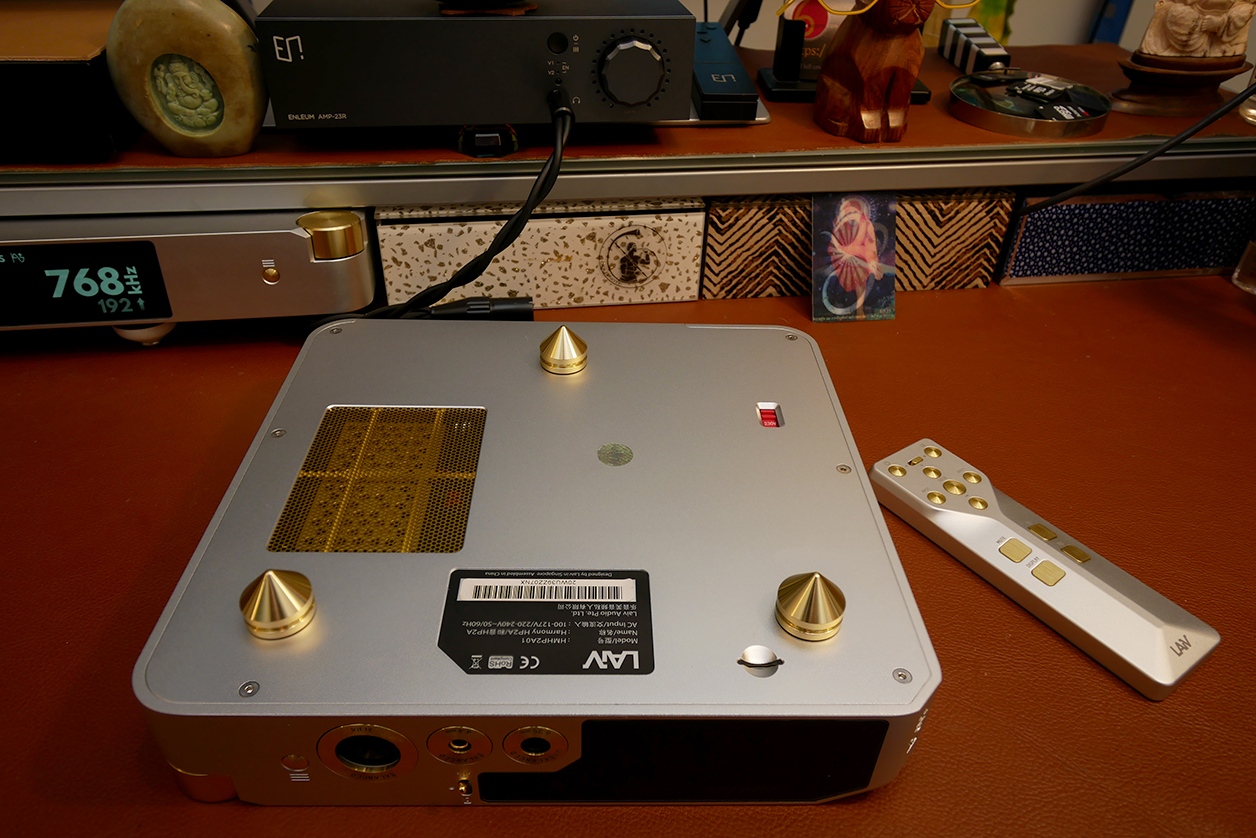
As we leave my desktop, a parting belly-up glance at the HP²A to show its triple footers, down-facing heatsink window, 115/230 red voltage selector, serial number decal and micro SD slot.