Hermann the German. Impassionate. Cerebral. Precise. My inner critic found one thing very hard to grasp. To convey its seriousness and actuality, he now replaces my internal creative. My Kinki amps spec out at -3dB/2.5MHz. That exceeds classic Spectral turf. Having fallen hard for Ivan Liu's sound—at pricing I could hack where similar Goldmund remains unattainable—I've come to believe that its illuminated airy quicksilvery qualities must link to avoiding phase shift, exploiting high slew rates and shunning signal-path capacitors. My first proof that modern class D which previously always came second on treble can equal those qualities were Alberto Guerra's GaNFet Vivace monos. Whilst not identical, they were undeniably and fully on par with my Kinki EX-B7 monos. They just cost wildly more. That returned them. Not so the Chorus twins. Why revisits my initial 10-second take. It resurfaced big upstairs during my first nightly Nadabrahma session with them. This Osho version of a Tibetan meditation sets to a Deuter soundtrack filled with singing bowls, gongs, cymbals and other oscillating metal objects which the German composer/artist now living in Santa Fe could scare up on Poona's MG Road in the mid 70s then record to cassette. With the Choruses, I now made out harmonic and ephemeral lower-treble elements which previously didn't factor here. Think of overlapping very long-trailing HF sounds like muslin sheets hanging off cloth lines, one behind the other. A light breeze creates rippling harmonic pattern in the gauzy fabric whilst you see through its layered stack. These patterns cause short-lived micro effects between each other. I knew of their existence from other systems but currently don't use them for this meditation. I'd come to accept that Martin Gateley's widebander plus upfiring ribbon simply lack complete resolution in the ~3-6Hz region. Fine. Now the Choruses disabused me of this notion; loudly. Even finer. In fact, their render of this intimately familiar track was the most detailed and insightful I'd yet heard on any hardware. Italicize away. The biggest stumper was the difference delta over my own stereo amp. With this 30-min. track essentially containing naught below 100Hz, LAiV's bass chops didn't tap. This session focused solely on the other frequency extreme where even dry impartial Hermann proved susceptible to shock. Unlike the creative writer, it had him lost for words; a sad state of affairs in a review meant to be read. Can you appreciate my difficulties at conveying this unexpected quality without seeming gushy and exaggerated? It goes to the heart of why I preferred the Chorus monos to the Harmony GaNM. I needed no actual side-by-side op. I just looked at my inner Gollum gauge. The more class A-flavoured GaNM hadn't pegged it. The Chorus reminiscent of high-bandwidth DC-coupled class AB said, I wantz it. Basic yet effective. The next day I returned to bass-heavy fare and found that with Choruses as drivers—one seat per cheek?—I could turn the sub off. It still did the occasional extra but was no longer needed to signal completion. Now it was a luxury or indulgence, no longer necessity. And to integrate properly, I'd still have to turn it down.
 When a component beats what we have, getting excited is virtual fait accompli. When it matches what we already find excellent, we don't consider it the same find though someone without our reference would. When it matches ours but costs decisively less, we might not feel emotionally exuberant but our rationality can muster its own take. The biggest emotional reaction comes when a component beats what we have and costs less. Even calm collected Hermann could see that to start negotiations with my inner accountant. My interior decorator celebrated his own glee of cute and pretty. Go ahead, pronounce my psych eval. Before you count split personalities, let Hermann finish his account. To be sure, the very informative lit-up tuning of Chorus won't please our pipe 'n' slippers crowd.
Take this publicity image for Sogn Murders, a new Scandi Noir crime series for TV based on the 15 novels by Jørgen Jæger and starring Kristofer Hivju of Game of Thrones and Eili Harbœ of Thelma. "The lead character, Norwegian police investigator Ole Vik, is a dedicated audiophile. Hence production company Nordisk Film sought to find a brand that shared his purist analogue mindset." As the press release tells us, Audio Note UK became it. Bushy beard. Tubes. Vinyl. Corner-loaded broad-shouldered speakers. Brainy crimes. What kind of music will Ole Vik cue up? Typical audiophile fare? More adventurous stuff? What Audio Note models will his system consist of? Whatever the Scandi production decides, it won't be a WiFi streamer with class D amplification. Whatever music they acquire licensing rights for, it won't sound like Chorus does on my speakers.








For a nudge not rolling-stone push in Ole Vik's direction, LAiV's bigger monos would suit better. But vinyl + valve electronics + Snell-based boxes will still aim elsewhere than does today's unapologetically modern sound. If you find Raal's TruRibbon headphones too illuminated, direct and data intense, Chorus should strike you likewise unless it's mated to deliberately chocolatey speakers. Going from stereo to mono is a narrow preview of such weddings by shifting a bit deeper into tone density's bloom to detune the leading edge and with it, the snappy timing and energetic rhythmic tension. If you're a farfield fan where sound is reverberant and rich, Chorus definitely wants thicker slower time-confused multi-way speakers. If you're a front-row freak on adrenaline, Chorus on simpler 2-ways is just the ticket. Such polarized qualification pleases Hermann since it avoids blanket runaway hype. The very mix of qualities exciting to me because they're not middle of the road are bound to miss with listeners prioritizing other qualities. It's basic stuff but true nonetheless so important to reiterate against a looming award. To my ears, the Crescendo Chorus picks up the baton of the original Harmony DAC thus skips over other LAiV models which slightly softened the first model's energy profile. This fully resurrects the brand name's meaning of 'live' sound when, as it was for me during my formative years, this corresponds to being on stage.
There will be speakers and scenarios where even high voltage gain into 160wpc/4Ω max runs out of steam. My ears, hardware and room simply couldn't mock that up. There will be speakers and tastes where the Chorus tuning fails. I've covered those. No prior experience with modern class D or this brand might take stock of the size, price and MO and discount the lot just because. Ditto racism of 'lifestyle' kit. For any aging community like audiophilia raised on Stereophile and The Abso!ute Sound, the past is a powerful force. It's why today's bridgeable micro amp could most appeal to the younger generation already in sync with the Crescendo range's proposition of well-groomed bonsai audio. Fossils like Hermann the German must first clap on ears to wake up to this new reality of class D not only having arrived but not needing to cost bags like Merrill and AGD to compete head on with examples of linear gain circuits executed to a high level. Denying this just fumbles the bag.
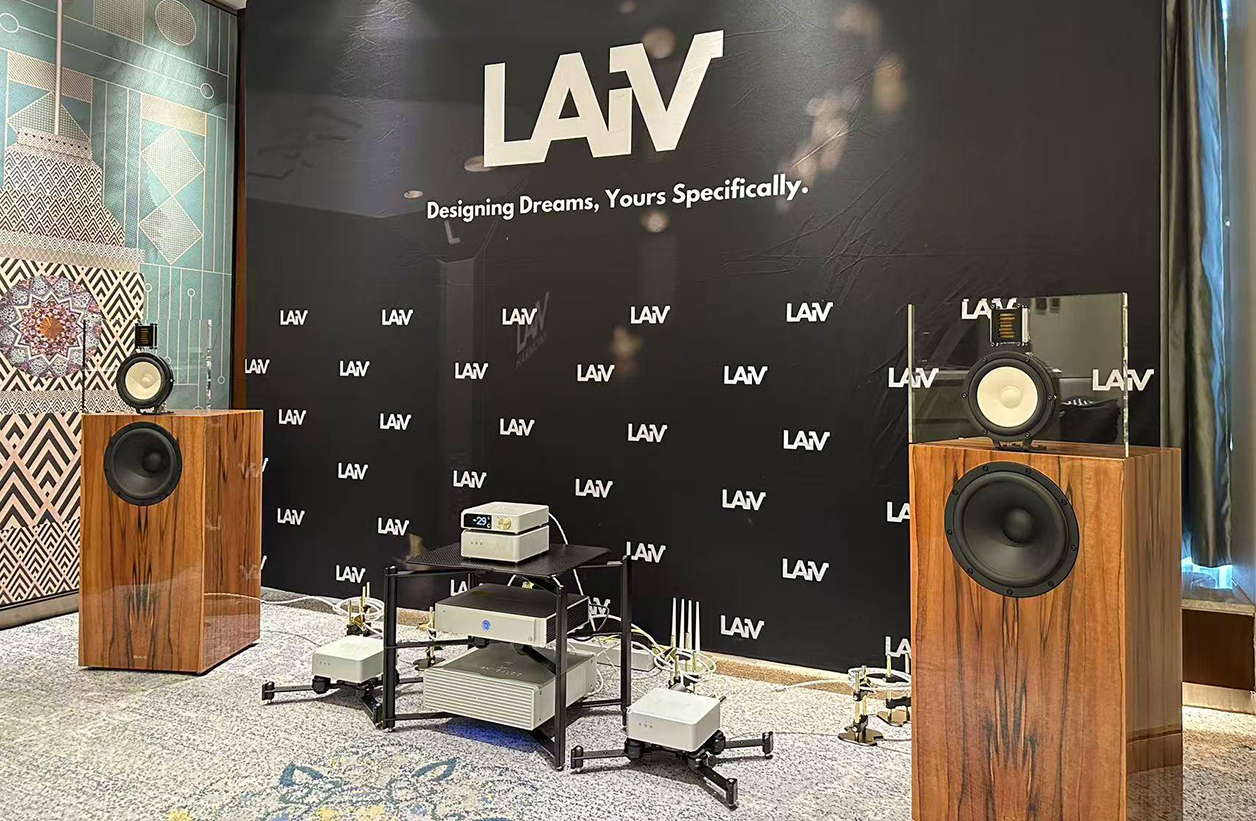 LAiV's Singapore 2026 show system. I used the same power conditioner, cables, amps and speakers. Only my front end differed.