 To play a Capt'n Obvious card, securing the power density of balanced/bridged Chorus in so compact a chassis virtually demands switch-mode power to kiss off a linear power transformer and its attendant filtering requirements. Whilst SMPS can combine with class AB or A circuits—Aavik and LinnenberG are two such class A promoters I know of—such output devices will still run hotter. That wants more dissipation surface so bigger heavier enclosures. Chorus goes all in on combining a fast-switching supply shielded with Mu-metal with fast-switching outputs that needn't concern themselves with 50/60Hz line noise and its harmonics. Class D dissenters tend to overlook this. Such amps often run quieter than their linear brethren for a lower noise floor so higher resolution because switching noise at ~100kHz or higher filters out easier than 50/60Hz hum. Proper switching power supplies also tend to recover more quickly and excel at high current delivery. It's why many linear brands in the very high end these days run SMPS. Think Constellation, Soulution and Vinnie Rossi for just three. To rub further salt into this wound of legacy hifi, when tube gal EveAnna still ran Manley, she had Bruno Putzeys design her an SMPS for her most noise-critical tube phono stage. Nagra exploit them as well. So do class AB Chord transistors. In short, LAiV's Chorus is fully au courant.
 Where it goes extra centimetres is the milled-from-solid case work, industrial design and finishing. Packaging those at today's tariff, in US currency, virtually demands Chinese manufacture. What $1'250/ea. in US production buys us looks like Orchard Audio's Starkrimson 25 Mono Premium; more modest. And it doesn't start as a stereo amp for lesser needs or as a stepping stone for an eventual upgrade. Sitting in my rural office on Ireland's rainy west coast, it's how my remote viewing of the first published Chorus photos and specs framed the brand's latest entry against comprehensive prior exposure to their catalogue. For more I had to wait on their product pages to update and my sample/s to dispatch. Would the latter necessitate reframing? Adding up Verse and Chorus begs $1'888; for discrete R2R+DSD+I²S, remote control, balanced preamplitude, headfi and speaker-drive across just two stackable small boxes.
Bonsai audio seemed in rude health I thought. This triggered The Adventures of Buckaroo Bonsai, a 1984 film centred "on the efforts of polymath Dr. Buckaroo Banzai, a physicist, neurosurgeon, test pilot and rock star to save the world". Polymath feels rather applicable to the short Crescendo stack. With it, LAiV give us two upgrade paths just within this range: the stereo⇒mono thing plus replacing Verse's wall wart with the Beat linear power supply of maximally 50µV of ripple. Once we look at the Harmony range, another obvious upgrade beckons with the $894 µDDC. That inserts between streaming source and DAC then taps the latter via I²S over HDMI. It's why the Beat LPS has 15V and 5V outputs. The former supplies Verse, the latter the µDDC. Like Apple, LAiV have their infrastructure well sorted.
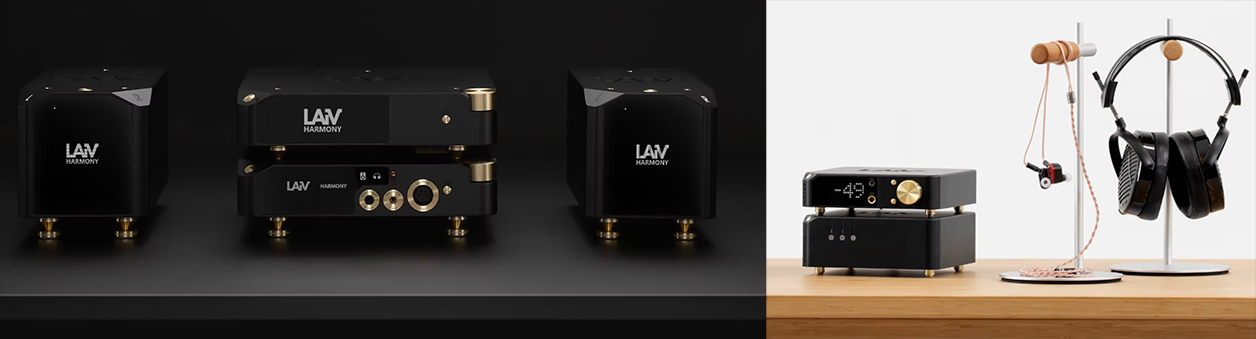 Downsizing the LAiV way from four already smaller to two still smaller boxes.
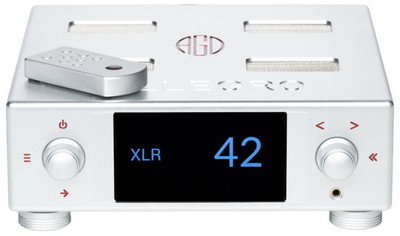
Just then a parallel news announcement dropped for Alberto Guerra's AGD Allegro, the above 200wpc/4Ω GaNFet integrated with remote, discrete R2R DAC, MM/MC and balanced headfi. Whilst it integrates the lot into one chassis whose build quality matches LAiV's, US manufacture presents different economics. It demands $14'999 which in his Axpona 2026 report for The Abso!ute Sound, Robert Harley called "surprisingly low". Point made. And, whilst integration cuts down on box clutter, it implies that if you don't do vinyl, you still pay for a phono stage you'll never use. That's unless the AGD is a fully modular build. The press release and lack of rear-panel images didn't yet detail that. No matter, LAiV's cost advantage remains. Minus AGD's phonostage, a LAiV quintet of digital-to-digital converter, DAC/pre/head, linear PSU and two monos slots in below $5K so at 1/3rd; even less if we forego the µDDC. If we also omit the upgraded power supply and stick to one stereo amp, we're down to 1/8th. Deflation lives. Just then Stereophile's 2026 Recommended Components issue hit. LAiV scored twice in their Class A listings, once for their $4'694/pr Harmony GaNM monos, once for the $1'049 Harmony µDAC. Vinshine Audio's Alvin Chee backed the right horse when taking on LAiV after Denafrips departed his Singapore-based stable of Sino brands.









Onto GaN propaganda from competitor Mytek: "Because of the wonders of GanFet technology, distortion from transistor switching is reduced by magnitudes, allowing for very gentle negative feedback and triode-like behaviour of the output stage transfer characteristic. The resultant sound has a silky treble and beautiful midrange with a 3D soundstage and detail like with the best tubes yet retains the tight bass, control and dynamics of a large transistor amplifier."
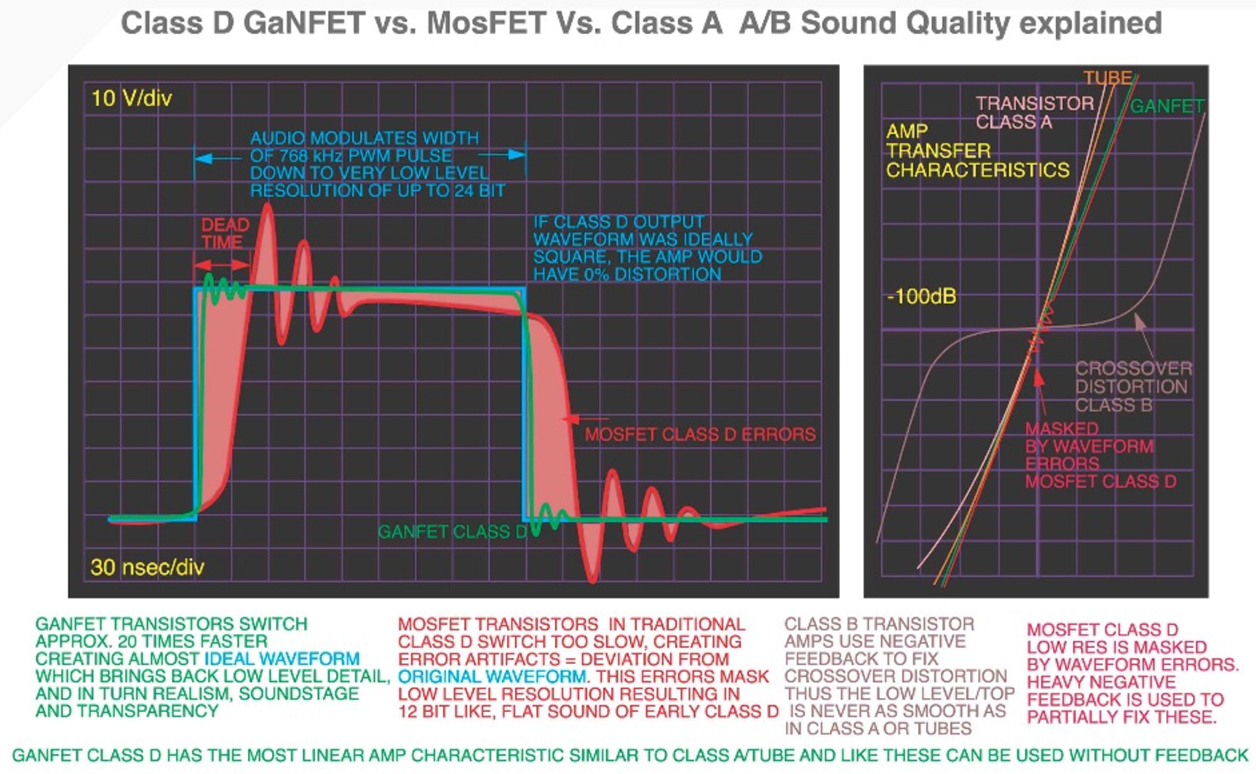
This graph from their website shows the 'how' by way of switching speeds, associated dead time between transistor on/off states and the consequences on wave-form fidelity. Another graph on Mytek's website shows a colder/warmer tone-colour scale, where on it various types of amps tend to fall and how their own $10K Empire stereo amp is voiced. It's a useful reminder. Just like other amplifier types, class D circuits can be deliberately voiced for specific THD behaviour. In Mytek's view the primary decider is the amount of applied negative feedback. In my prior review of LAiV's GaNM we learnt that they use zero global negative feedback and switch their Infineon GaNfets at 384kHz. In short, very high feedback as championed by Bruno Putzeys is no longer the only way to do high-performance contemporary class D. A look at the Infineon webpage for their CoolGaN range shows parts from 60V-700V capable of continuous current from 4-100A. When we ask Google AI how fast they can switch, "over 1MHz or up to 10 x faster than silicon Mosfets. In specific applications, these parts can achieve switching transitions (turn-on/turn-off) in ~1ns." They show up "as 650V bidirectional switches in AI server power supplies for example". Versus such industrial demands, audio amplification for home hifi must be quite the breeze. Here we see that at Axpona the Beat's 5V feed powered a Volumio Rivo+'s 5V/3A input whilst the 15V feed supplied the companion Verse DAC. Clearly the Crescendo Beat has potential applications well outside the LAiV lineup.
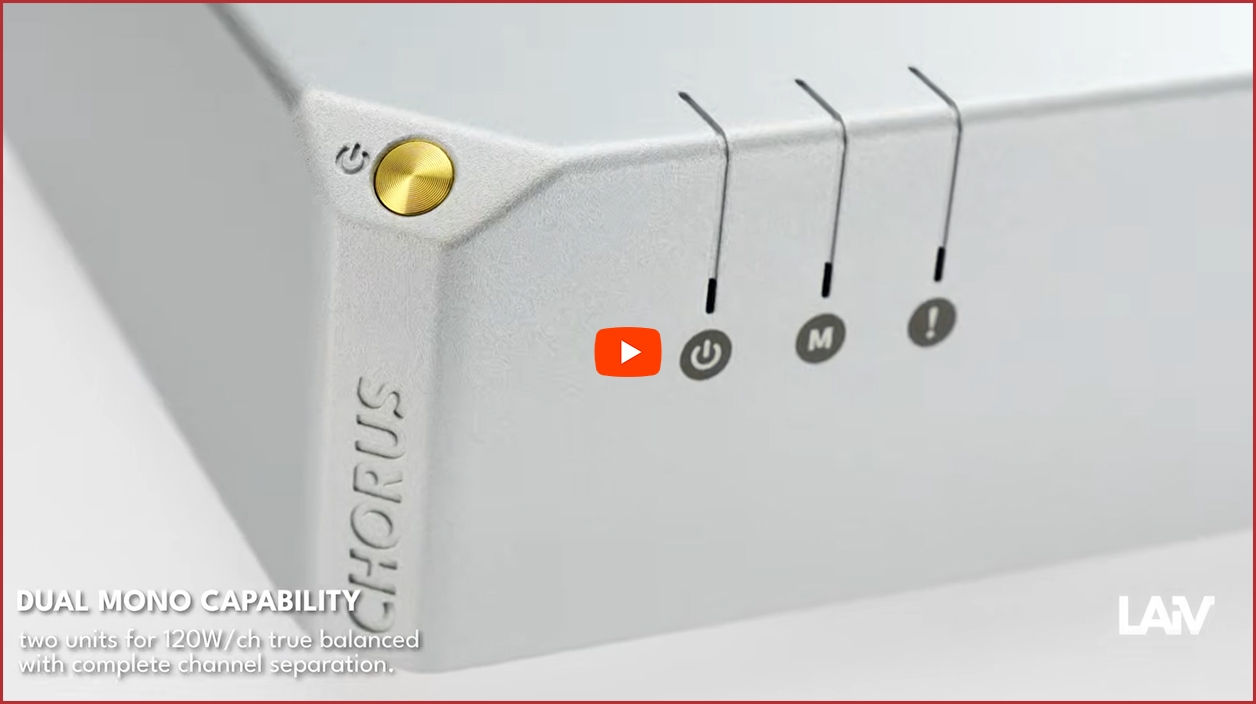
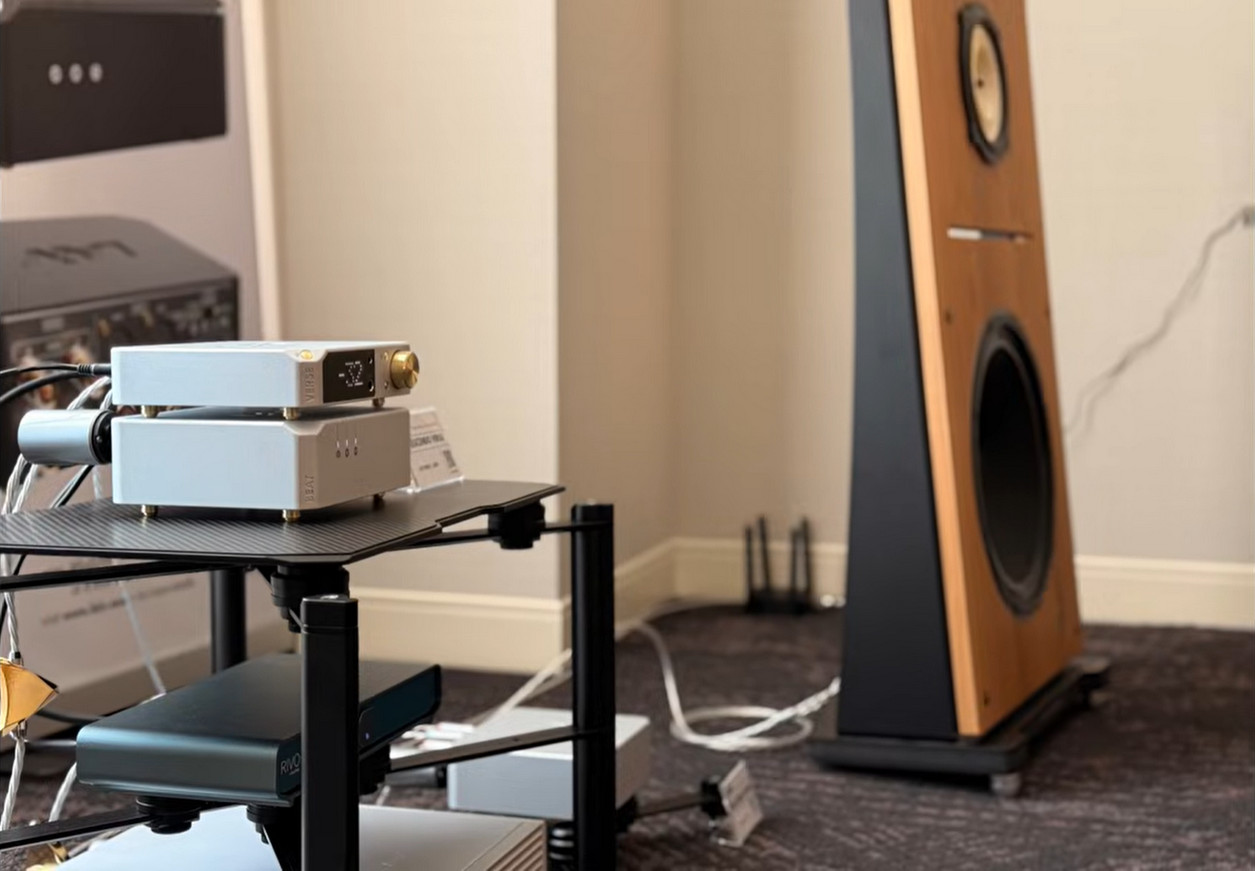 The Beat's three LEDs show power mains, 15V and 5V outputs live. Those of Chorus show power mains, mono mode and warning.