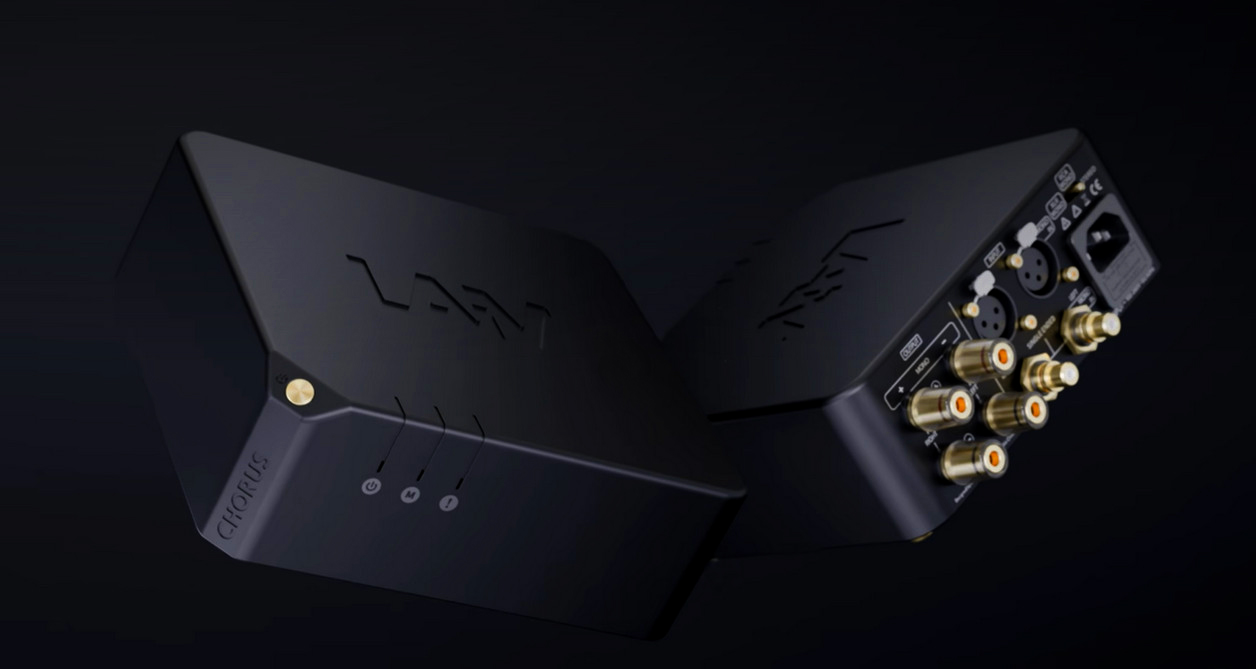
Back to Chorus 2Ω-stable even in mono mode, it delivers the same ~120W into 4Ω bridged as it does at 8Ω. That limitation is imposed by a 160-watt power supply whose design is otherwise similar to the bigger GaNM. Voltage gain on RCA/XLR is 28/22dB in stereo, 34/28dB in mono. S/NR is at least 100dB. The switching frequency of the output devices has nearly doubled over the bigger monos. For Chorus it is now 750kHz whilst the power supply runs at 85kHz so three magnitudes higher than a linear equivalent. Standby power consumption is under 2 watts, idle power below 20 watts. LAiV promote Chorus for always-on operation.
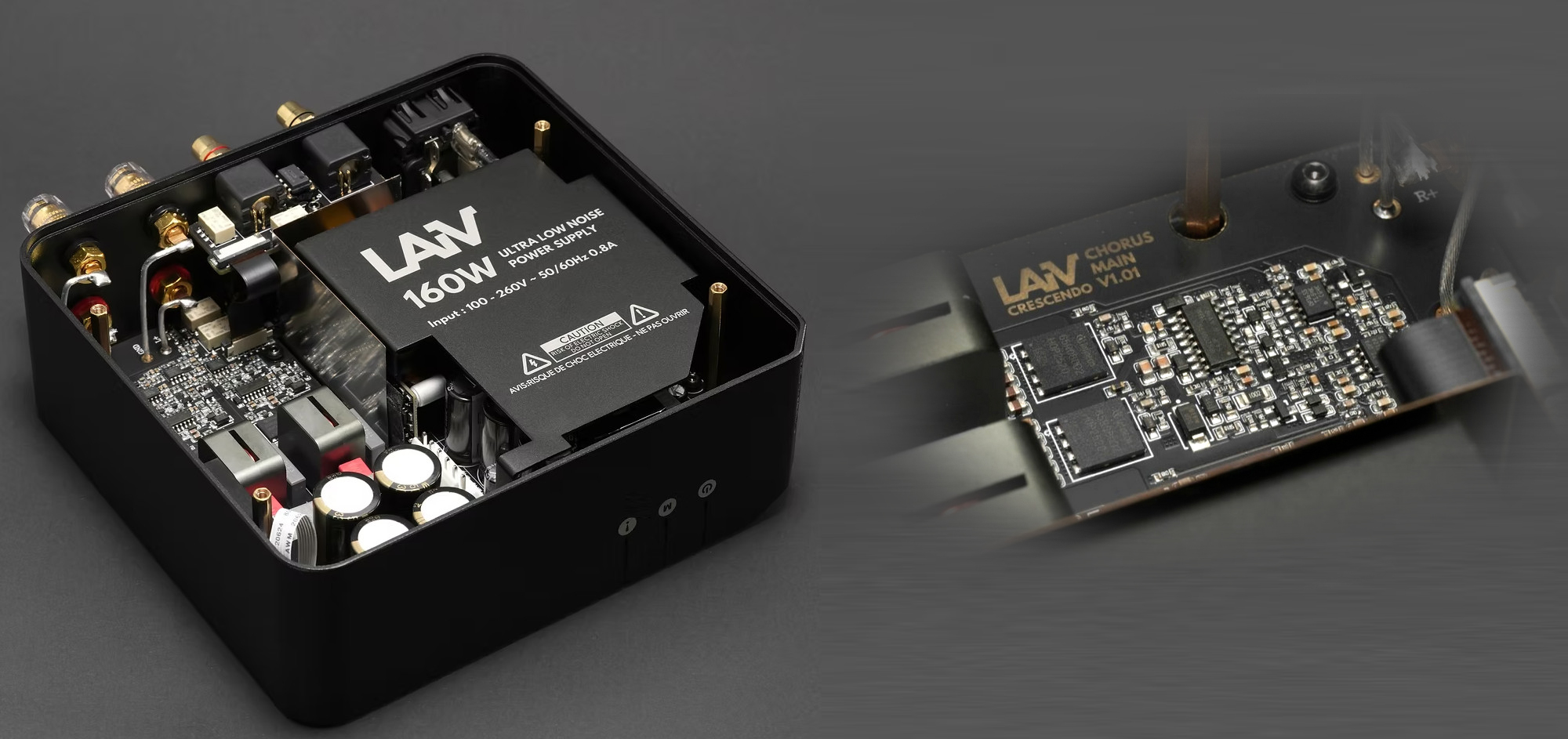 Like in classic amplifiers, about 2/3rds of the interior real estate are taken up by the power supply.
To explore the mono equation, I asked LAiV boss Weng Fai Hoh for two. He agreed. One Chorus, two Chorusses? Or is it Chori? "The plural of chorus is choruses. While sometimes spelled chorusses (dated), choruses is the standard and preferred form. It refers to multiple musical refrains or multiple groups of singers. Although chorus has Greek roots, the plural is not chori." Having Google AI call me dated was rather accurate so the rest should be factual, too. Two Choruses it shall be.
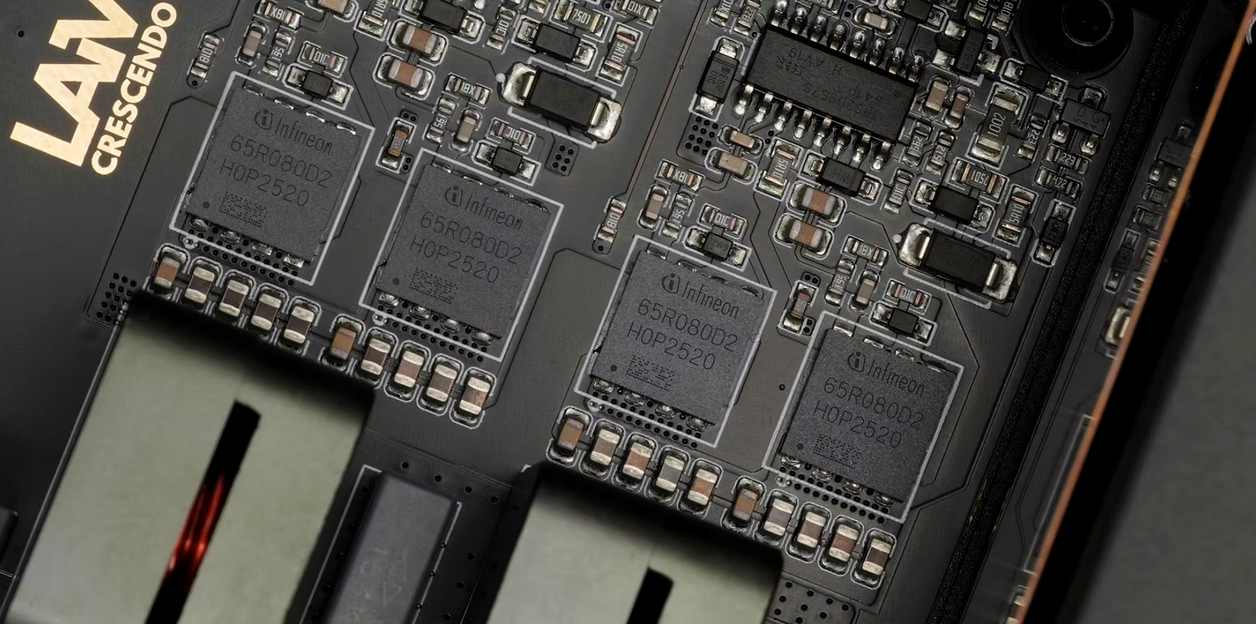 Just four output devices in total.
In the first YouTube review of these amps by the The Audiophiliac Steve Guttenberg, he found the Choruses to do unexpectedly well on his 40-year old Magnepan SMG dipoles which he finds "very difficult to drive". Paraphrasing Steve's overall takeaway, he called the LAiV monos tuned for "speed, resolution and spaciousness". Here it's worthwhile reiterating that in stereo, one Chorus works in regular mode whilst bridging flips one channel to counter phase to become dual differential or true balanced. To be perceived as approximately twice as loud, an amplifier must be 10 x more powerful than the quieter one of the same voltage gain. Twice the power only buys a 3dB loudness increase. That's not twice as loud. Hence here the real decider between stereo/mono isn't the raw watts. It's what generates them: standard vs. dual-differential drive. That includes its impact on THD cancellation and dedicating one power supply to each channel to in effect decouple them. One final bit of pre-landing diligence revisits the voltage-gain offset between RCA/XLR inputs. The RCA are 6dB hotter. Whilst in stereo mode the 28/22dB values neatly bracket our sector's unofficial 26dB standard, the whopping 34dB in RCA mono mode virtually equal what many integrated amplifiers produce by packing an active preamp stage. If that's how you end up using a pair of Choruses, a passive preamp or variable source of standard 2Vrms could be ideal. What you won't need is an unduly hot source of 6-12Vrms. If that's what you have, your source/preamp attenuator will sit at the very bottom of its range and quite possibly get too loud too quickly. Now XLR mono mode knocks back some of your excess amplification factor. Being able to bridge Chorus either way is a very useful feature. Ditto the micro SD slot on the belly whereby to upload possible firmware updates for a bit of future proofing. Speaking of which, standard warranty is 2 years extendable to 3 upon registration.








We don't expect D-class amps from brands of classic A/AB circuits whose appeal wraps up in size, weight and price when fast-switching outputs and power supplies so easily undercut the lot very significantly. Plus, designers who for 20-40 years already have specialized in popular classic circuits are probably not equally expert at working in class D. We thus wouldn't wait on such amps from Dan D'Agostino or Nelson Pass. On name recognition, the closest class D has to such legacy luminaries is arguably still Bruno Putzeys. Though under Mola-Mola his circuits package at high-end stickers, I doubt whether to public perception, the ~€17K Kaluga monos carry equivalent weight to stalwart high-end brands. More likely in fact is that most buyers still equate him with Hypex, Ncore and its many OEM adoptees. Regardless of ever more mature sonics, I'd argue that to shoppers prepared to part with five figures for a stereo power amp, class D still hasn't levelled up to classic variations. Here LAiV's Choruses won't help. They're too cheap, cute and stylish. They're far more likely to be tarred with the 'lifestyle' brush than considered equals. Also, whilst an 8wpc 300B SET can ask and get silly money, a 50-watt transistor amp not in class A remains a low-powered anomaly. Will all of it hold once we forward the clock by a decade? Will high-end audio have successfully absorbed class D in its top echelon, crowned its best designers as recognized industry celebrities? Will it have become so ubiquitous in the mid and lower sectors as to list classic amplifiers only in the minority report?
It's something to ponder on a rainy day. Mine was very sunny just then. A published reply to reader Frank's April 23rd question, about reviewer burn-out, explains why. "…harder for me is the ongoing escalation of the sector's pursuit of the very wealthy. A lot of the stuff that gets press coverage at shows and in reviews I find less and less relevant. It's not what excites me. If that's all there was, I'd burn out very quickly. Thankfully we live in a Golden Age of more affordable hifi getting better and better. It's simply a matter of canvassing the field. So no burn-out for me because I'm careful what I focus on." Being careful about what we allow into our mental sphere to then play on our emotional life is a good strategy to help shape our reality. For that our attention is a powerful filter. We could focus on the deluge of €20K+ amps—replace that figure with whatever displaces you—and feel sorely out of place. Or, we can instead focus on more affordable nicely styled kit like a Chorus or two to feel more in the thick of things whilst the sun shines warmly down on us. Again, replace the LAiV ask with whatever suits your budget. Whatever that is, today offers more choices than ever. We must just figure out where to look.