Nice? Mind fuck was more like it. But let's mind our French. Cognitive dissonance sounds more artsy. And artful was how our precocious minis acquitted themselves. Just look at them crumpets on Dazzle's big griddle iron below. Once my mind let go of the f-word, performance aspects presented like presentation slides: Illuminated. Holographic. Very unexpected bass control. Zero self noise. Then the prior page syndicated. Beat fidelity. Harmonic spritzer action. In short, my office performance walked next door to transplant intact. Bigger more gravitational speakers and the midfield performed small alterations in perceived weightiness. This added a few degrees of relaxation. But essentially it was a perfect handover. Sign here to assume custody. Of course let's not overlook a €2'000 ask. Just because LAiV's form factors shrunk the punk, for most shoppers this isn't cute coin. Once cognitive dissonance becomes the new normal, we ask whether the sound is commensurate with the coin, never mind the Lilliputian airs. The answer to that is an unqualified yes. And can we ever handle that truth. You mean, we really don't need class A furnaces or shelf-bending hulks to enjoy big theatrical high-level sound? Whilst the legacy mainstream committed to the olden ways should hesitate to respond, my ears are free to acknowledge a fact. Across the quarter century at this helm witnessing Bel Canto's original Tripath, EJ Sarmento-sanctified ICEpower, Aavik-tweaked Pascal, Boenicke-blessed PowerSoft, AGD & Merrill GaNFet now LAiV – class D has earnt its shiny epaulettes of high-end credibility. Even if sonics vs class A/AB were a wash, what already usurps legacy turf are higher operational efficiency, lower power draw and temps, smaller chassis and costs. But depending on which aspect we inspect, this newer breed of non-silicon switching devices even has sonic advantages. Last year a Dublin dealer sent out a salesman to pick up six class A amps I no longer needed. They'd disseminate to their most loyal clients as thanks for patronage. None of those minor space heaters had Chorus-like speed, clarity or resolution. They had/did other things you might well prefer. I didn't. Without global figures for listener-preference percentages, I still know that I'm not alone in my taste when Goldmund and Kinki Studio for just two cater to it so successfully. If their sound—direct-coupled, high bandwidth, high slew rate, low distortion class A/B—appeals to you, the LAiV Chorus might have your number. To now ring it for extra certainty, we'll head upstairs for a mano-i-mano against Kinki Studio's 250wpc EX-M7 at a current retail of $2'800 or €2'400. It's more money but not enough to discredit a comparison. It's also twice the power but bridged Chorus actually has higher voltage gain to play louder for a given setting. And—it's what I had.

My French is beaucoup reservé so no more f-bombs. Fab must suffice. First, context. The below sound|kaos Vox3awf rate to below 40Hz compliments of horizontally opposed 5¼" carbon-fibre woofers loaded through a narrow slot port. For 1st-octave assist, I can run a 2×9½" sealed force-cancelling Dynaudio sub in augmentation mode on a 4th-order/40Hz low pass. The monitors run wide open and are responsible for mid and upper bass. That's the vast majority of LF action. I've never considered these Swiss uncivilized loads though common math adds up small woofers + minimal cubic volume + low F3 = gnarly phase angles + wicked impedance peaks. I now had to concede the likely wisdom of such predictions. Why? Because at chez Ebaen's, it suddenly was disco. I streamed Prem Joshua whose style is best called funky WorldBeat. Aside from sitar, bansuri and Indian-style hand percussion, there are Western instruments for groovy mixology at work. And it was the G-spot of groovy—music's engine room laying down de riddim—which suddenly hogged the spotlight. This wasn't subwoofer territory but what happened in the two octaves above. Those petite Armin Galm woofers behind their bronze-wire grills were rather more capable than I knew them to be from my twice-powered Kinki. From groovy to funky is one small step which the entire read now took into deeper sass 'n' swagger. This was Naim-style pace, rhythm and timing writ large. Swiss neutrality had broken bad. My phrasing is deliberately loose to convey the raw fun of this shift.












My inner critic—born and bred in industrious rationalist Germany—of course had to know why. Too bad this guy can't get down. To get him off the hook and me back to fun, I proposed as answer fast-recovery switching power capable of very high on-demand current. Having no comeback, back into his hole he crawled. But it probably was the pertinent point which did for him. It clearly wasn't brute force where the EX-M7 can actually dispatch 310wpc/4Ω, more on peaks. The difference was made elsewhere. Class D has always enjoyed a bass rep and in fact started its victory lap in subwoofers. In any case, the lightweight all-switching LAiV outmuscled the heavyweight linear champ. They also outsmarted him on the intensity of 3D staging and top-down illumination, here a joint venture between Enviée widebander and upfiring Raal ribbon. In short, perking up occurred across the bandwidth and not just in the bassment even if there it signalled first given the sequence of my playlist.
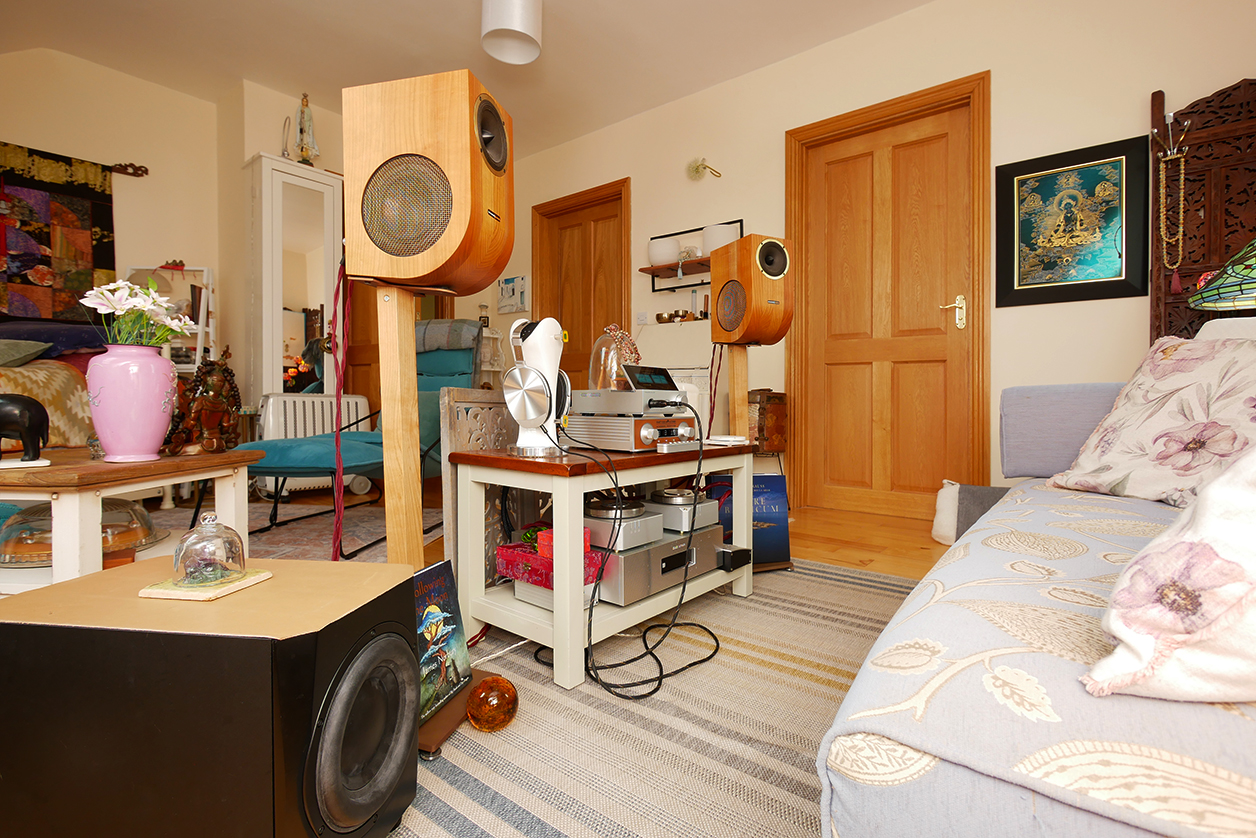
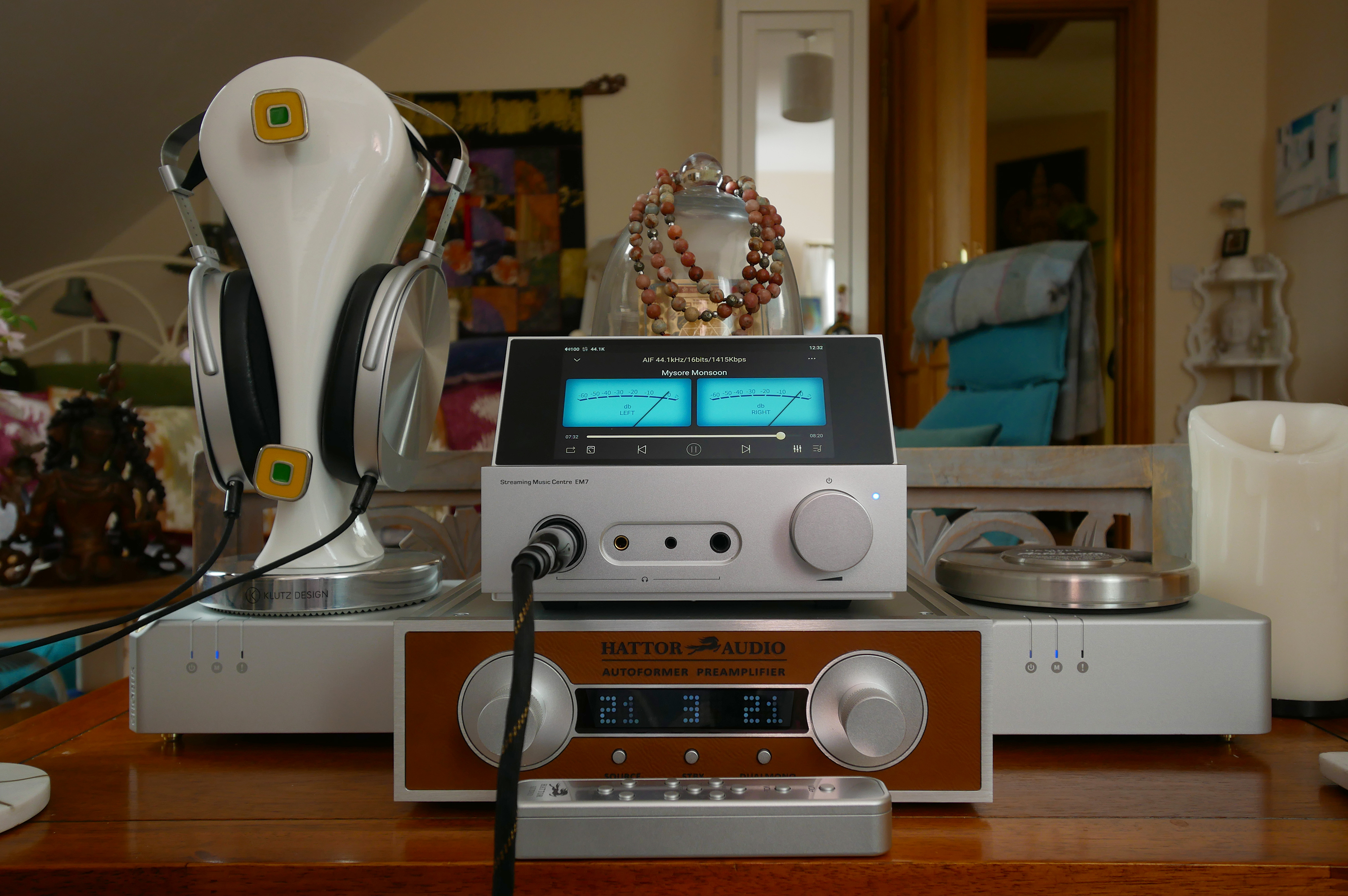
To present that setup at a glance, I rejigged the above and parked the Choruses on top deck. This rig could still simplify if we remove the fully balanced quad of silver-wired autoformers in the passive-magnetic preamp then run the Shanling Music Centre with its 1TB microSD library via its variable not line-out function. But that Hattor actually works as accelerator and energizer. It transforms voltage to current rather than burning off unwanted signal as heat via the ubiquitous resistors. Here the more voltage we cut, the more current an inverse log function generates. Math is a personal blind spot but I once had actual hard figures on that function from an engineer. With the high gain of bridged Chorus, funky fun i.e. ff for fortissimo had me at 21/61 so in deep attenuation—ideal conditions for an AVC. If you call that a co-conspirator for the described action, not really. The Kinki amp benefitted from the same. What I heard was all on LAiV.
If my more poetic than prosaic interlude lacked any subliminal pointers at lean or explicit, it's due these transducers. AlNiCo motors. Bronze baskets. Solid-wood builds. Passive inline noise reduction via built-in LessLoss skin filtering. Custom cellulose widebanders operated well past music's highest fundamentals. Their entire raison d'être is max tone. They need no amplifier-injected padding. It's why Enleum's 25wpc AMP-23R is often seen at sound|kaos demos. Naught else is needed. Or so I thought with my own AMP-23R. These Choruses now had me seriously question that conclusion. Warsaw contributor Dawid Grzyb runs his Vox3awf as mains. He recently made a similar discovery with high-power Pascal-based Aavik amplification to likewise point at unexpected bass gains. It now has me twice certain that this small speaker from Switzerland's civility is in fact quite the contrarious brute. That it doesn't take €6'500 of Enleum coin to fully tame was a lovely surprise. Ditto for class D + widebanders ribbing puritans who tend to think SET. Not necessarily. Not anymore. It segues back at The Audiophiliac testing his Chorus loaners on open baffles with 15-inch woofers and Voxativ widebanders on top. It also reminds us of his brilliant results with 40-year old Maggies which he dubbed very difficult loads yet the Choruses sailed right through the challenge. Not only are power and size not everything; they could be far less than we were traditionally led to believe, period.