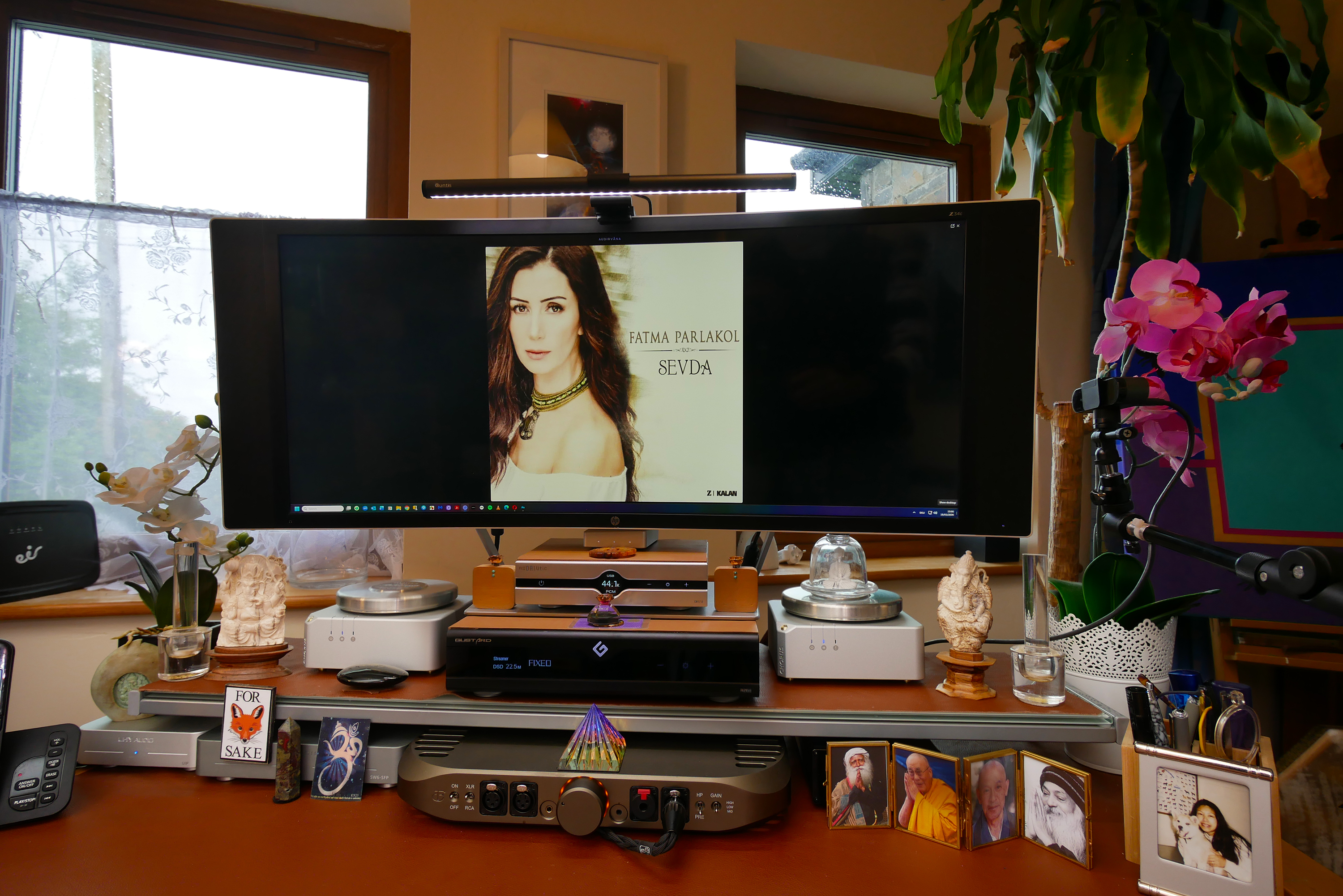
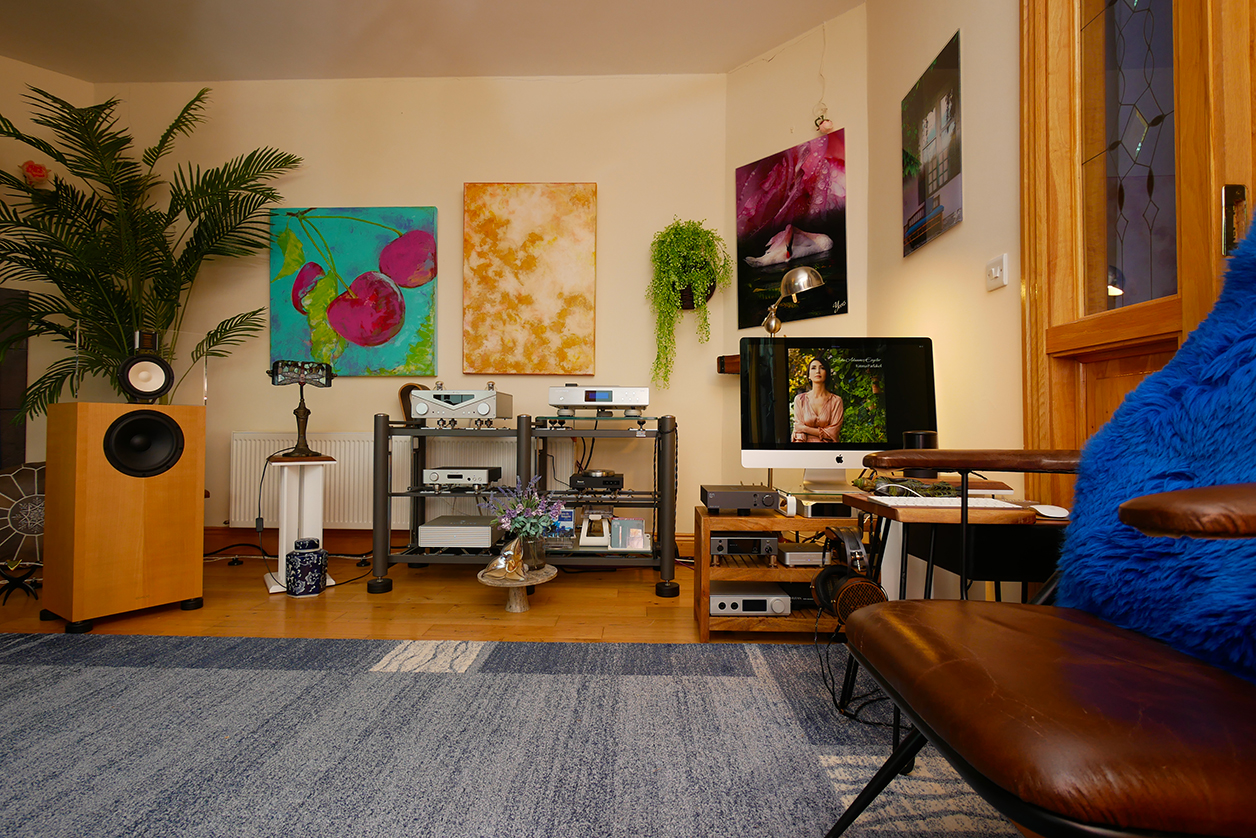
Hi + rez = surgical? To some, high resolution suggests the bright lights—not of a nocturnal metropolis but sterile clinical surgery. And my mega-feedback class D specimens certainly exude that fluorescent bluish tint. It's why the 700w/4Ω specimens drive one sub-100Hz 15-inch woofer each whilst the less potent Danish versions hog the bleachers. Run full range, they come across as squeaky clean but dry, pale and overdamped. It means rigid, a bit clipped and cardboard-y. Warm bassy fulsome speakers can appreciate such treatment and on balance perform better than very fluid generous amps that turn their bass woolly, ill-defined and the general scenery too humid. With my desktop speakers, bridged Chorus got nowhere near lean and was tonally compelling without turning ripe. The bass continued those midrange textures rather than default into chiselled jackhammering so typical of class-D-for-subwoofers notions. My biggest desktop takeaway concerned tone as insight into timbres. Again, I grew up around and with instruments. I played in a band then chamber-music ensembles then symphony orchestras. It had me closer to instruments than the front-row audience. Much of that harmonic spritzer effect loses effervescence when distance increases and reflective hall sound takes over. If one wants to be closer to the live nearfield frisson, many systems are stale champagne. One would like to throw in a sugar cube to reactivate the bubbles. The Choruses even on the heavier long-throw carbon-fibre mid/woofers of the office gave me a fine depth view into timbres so their harmonic makeup. It's a playback quality I value and most recently highlighted in the Fruity! editorial. The li'l LAiVs did this well indeed; in form factors my office desk accommodates with room to spare whilst my beloved Kinki amps wouldn't fit; and better than my B200 monos. Another Chorus asset I exploited at the end of a workday just before powering the office down was happy hour on the SPL tap. High nearfield levels can quickly get gnarly should edge, glass and stridency bare their retractable claws. With the Chorus twins, my normal SPL just scaled up without skewing shape, tonality or texture. True, happy hour in the nearfield corral isn't synonymous with a big room's farfield mayhem. But in my office—preamp set to no gain so an amplification factor of 1 yet already in party mood at 10'00" because the Gustard DAC dispatches 5Vrms fixed off its XLR—I was in high-output heaven without anything getting out of shape.
 Weighty mass-loading discs from Artesanía Audio prevented heavy power cords from lifting up the amplifier fronts.
 If like me you're a diehard fan of the Jacques Loussier canon but want to hit overdrive in a big Merc on the Autobahn, reach for Eugen Cicero's Rokoko Jazz and "Bach's Softly Sunrise". With superlative playing, even the 24/88.2kHz file of this 1965 production renders the master improviser's concert grand a bit tinkly and hollow. With two Choruses in tow, that truth remained true. If you're a sound-first listener and apply ECM's Tord Gustavsen standards, you won't last long. That's just what this album sounds like even over my fanciest headphones. I suspect that the 200-watt Harmony GaNM monos with no global feedback—Chorus uses "a little"— would inject a bit of gratuitous body to play to the rocking-chair galleries. These smaller faster-switching cooler outputs do not. One must be a music-first consumer to focus on Cicero's stupendous artistry and be glad that someone captured it for posterity whilst accepting that his Queen of Instruments sounds more like a cheap upright piano. If you love the playing and want more, try the following year's Swinging Tschaikowsky and start with "Altfranzösisches Lied". The musical intelligence at work behind these black'n'whites really speaks to me. Meanwhile my inner grump wishes that mic and mixing choices had captured more tone wood and less high-tensile steel strings in the mid and upper registers. The copper-wrapped bass strings naturally sound darker. Towards the end of his career, Loussier ran his own recording studio to take full control over his recorded legacy. The Romanian nicknamed Golden Hands was the even more consummate pianist but tolerated lesser production values. Chorus served up all these fixings without applying any. Enter a personal belief. It's easier to gain than lose weight. Whilst true also for our bodies, I meant musical equivalents. Following a quick incisive amplifier with deliberately fat or fuzzy cabling never mind speakers easily counter-steers. It adds sugar or milk to tea. Removing sugar or milk from tea again is rather harder. Once musical blur and bloat are 'in' the signal, how to take them out? Personally, I'd rather err on the side of adroit and articulate then bolt on whatever ballast I need. Starting heavy and soft then straining to accelerate and shape up isn't nearly as effective. But clearly, the Chorus tuning will 'out' brisk lean recordings faster than a weightier more sonorous amplifier.










Flipping sides as it were are good recordings. The reveal of their low-level cues marking spatial and harmonic detail now goes farther. That creates more complete and thrilling listening experiences. Our tunes literally have more to say. That's behind the common drivel of "hearing what the performers intended". Only the performers knew their intent; and perhaps their mixing engineer unless that chap went rogue with his own ideas. Nobody else has a clue. It's more accurate to say that higher resolution digs deeper so we may hear deeper. What that means is deeply subjective, personal and morphs daily. Whilst on this tangent, many audiophiles apply a co-creationist attitude to playback. They shape the outcome according to personal preference. If massed strings feel too wiry, they tone them down and call it more realistic. Most civilians meanwhile accept music at face value. Its sound is what it is whilst it funnels through their hardware. Taking an interest to influence the sound is the beginning of audiophilia. We become our own mixing/mastering engineers. Instead of knobs and sliders, we mix 'n' match in hardware. Today's kids EQ their headphones to countless target curves. Anything goes. Some call it a quest for more realism as though they'd recognize realism of recorded data which can't be verified directly. We can only inspect these data with hardware which leaves inevitable fingerprints. Before this tangent runs away, let's get back in the chorus line to see what other handouts we can score. First up: microdynamic gradations. Following a Vicente Amigo number from his Un momento en el sonido album, I enjoyed not only how precisely the various handclaps as typical Flamenco accompaniment localized; but how precisely they rode dynamic patterns atop rhythmic patterns. These palmas provide not mere time-domain material of beat keeping but amplitude-domain motion with selective rhythmic emphasis: tiny flickers atop bigger ripples. Those flickers painted out small dancing melodies not in pitch but microdynamic variation to intersect and counter the solo guitar's passage. Moving onto orchestral flamenco with Gerardo Nuñez led me from Vicente's finely nuanced recorded dynamic range to red-lined compression. Given the massive data of tone colours and instruments at play, this always-loud fest became even more obnoxious than less resolving gear would make it. There's no escaping the fact that hearing more cuts both ways: into the good, the bad and the ugly. If you buy a low-slung Corvette as a weekend fun car, you'll choose your roads wisely. You won't pick rutted muddy one-lane country paths that only lead to abandoned barns or cottages in disrepair. Hi-res listeners do likewise; or accept the occasional wipe-out and scraped undercarriage.
Next up was general beat fidelity so all things percussive and staccato: steeply rising, quickly stopping. Such data felt extra snappy. Punctilious. On time. In the pocket. It mattered not whether the sound makers were drum skins, metallic objects or plucked/struck guitar, upright, qanun, cymbalom or hammered Latin piano. Like a fakir's bed fitted with upright nails; or the unrehearsed reflex after unwittingly touching a scalding hob… such sounds had needle-prick alacrity and on-point precision. Hence beat fidelity. The 'fi' in 'hifi' can mean fidelity to tone and frequency response. It can be fidelity to dynamic contrast. It can be fidelity to time keeping via music's rhythmic markers. Traditionally those are the chief domain of the percussion section and bass player atop which rise harmonies and melodic lines. It's why the absence of beat markers in so-called space or New Age music strikes groove-based listeners as disconcerting and weirdly floating. Ideally of course high fidelity would treat all recorded performance aspects equally. In practice, strengths and weaknesses, sins of commission and omission, are relative inequalities of fidelity; our infidels. Suffice to say that a Chorus strength was this time-domain accuracy of rhythms, beats and jagged impulsive data. I call that quick. The tunes aren't over sooner because we tweaked a speed controller. Their rhythmic markers better clear surrounding legato thicket as fast-growing weeds stand above slower-growing grass after a lawn mow. Energetically our playback feels spikier and more electrified. Quickened. More edge of seat than recliner. Returning to my Topping monos gave the departed Choruses the nod in this beat-fidelity discipline; and that of fruitier tone. Fine you say. What about manlier loads? Leaving my suddenly lady-like office loads behind, let's cross the hallway. Here my Product of 2025 as Kinki/Vinshine's Dazzle—~€7.3K, 300wpc/8Ω class AB—holds the fort against Qualio IQ 3-ways. Forget pleasantries at the till. This wasn't price competitive; or even about it. This simply connected the Chorus line with full-range floorstanders. For a reasonable amp-to-amp duel, I had other plans. The next round was just about a bigger load and room. David, meet Goliath. Play nice.