D10 -1. When my Vienna show sample arrived, I was surprised to find the SFP port unaccompanied by its classic RJ45 copper comrade. My comparison would be limited to network fibre vs USB. Huh? That's neither the same protocol nor the same customer. As though to mock me, the included 1m single-mode fibre link then produced no joy. The D10's STRM input kept flashing and the device was undiscoverable on the network. Thankfully the 2m cable was a good sport and I in biz. Over USB, Audirvana identified the device as 'Speakers (COS D10 Playback) and showed PCM768 compliance with no DSD. I promptly tried Audirvana's r8brain upsampler and successfully streamed 44.1kHz as 705.6kHz. Check. In UPnP mode, Audirvana only showed PCM192 support yet DSD128. When r8brain resampled to DSD128 to check, the D10's display merely showed /24 but no signal lock so remained mute though my software player kept streaming as though it saw an active receiver. Uncheck. On my Gustard R26II DAC, UPnP streaming supports higher sample rates than USB. Stephen Gong: "Yes, the streaming module comes in two flavors, RJ45 copper or SFP fibre. They don't co-exist. We will send you an RJ45 module so you can compare. And you're correct, the streaming module caps at 192kHz/DSD64, USB at 768kHz/DSD256. The D10 does accept DSD but converts to PCM before D/A conversion." Just so I had no joy having the D10 produce sound with DSD. Whilst the latest version of Audirvana allows one to manually override the sample-rate ceiling the player auto-detects the first time, UPnP was limited to PCM192. Nothing higher would play whilst USB happily supported four times higher rates. Before the RJ45 module arrived, it was already fair to comment on cable routing. If you're a hardwired hermit running 20-30 metre copper spurs from router to sundry final destinations along floorboards, beneath carpet across a hallway even up stairs, the far thinner diameter of fibre optics over CAT5-8 Ethernet makes such runs far easier to dress and conceal. Even where fibre has no sonic advantages over copper, it clearly wins on installation convenience and cost particularly as distances grow.
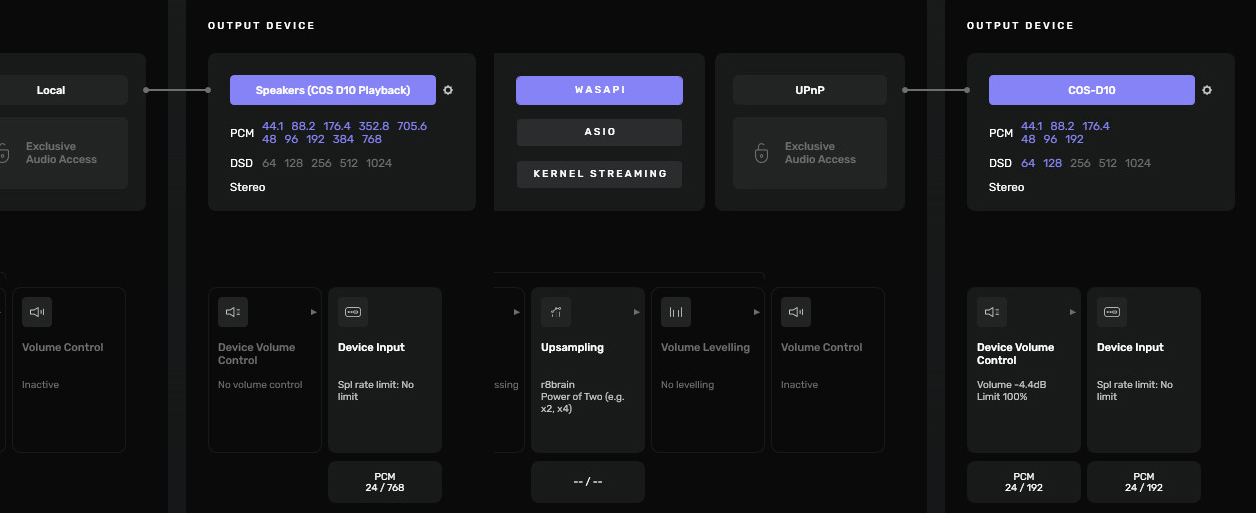 USB left, UPnP right, volume control integrated in Audirvana.
With the RJ45/SFP comparisons contingent on exchanging hardware modules whilst powering the system down, I didn't exactly consider my chances of catching anything in flagrante rosy. With USB vs SFP involving no shenanigans other than switching paths in Audirvana software, that's how I began. Below is that setup. Because I hear advantages using the r8brain sample-rate engine whilst exploiting my workstation's vastly greater computing resources over a hifi component's more limited on-chip equivalent, I ran USB at 705.6/769kHz, UPnP at 176.4/192kHz. If that gave USB an unfair advantage, tally ho. In this game, not pressing advantages would be irrational. Ditto my LHY UIP. When streaming gained its own performance boost with the €3'100 SP6/LPS1 combo in fibre-optic mode, good ol' USB certainly deserved its own $499 isolator. For context, let me reiterate that with my discrete Gustard R2R DAC, network streaming beats USB sonics.
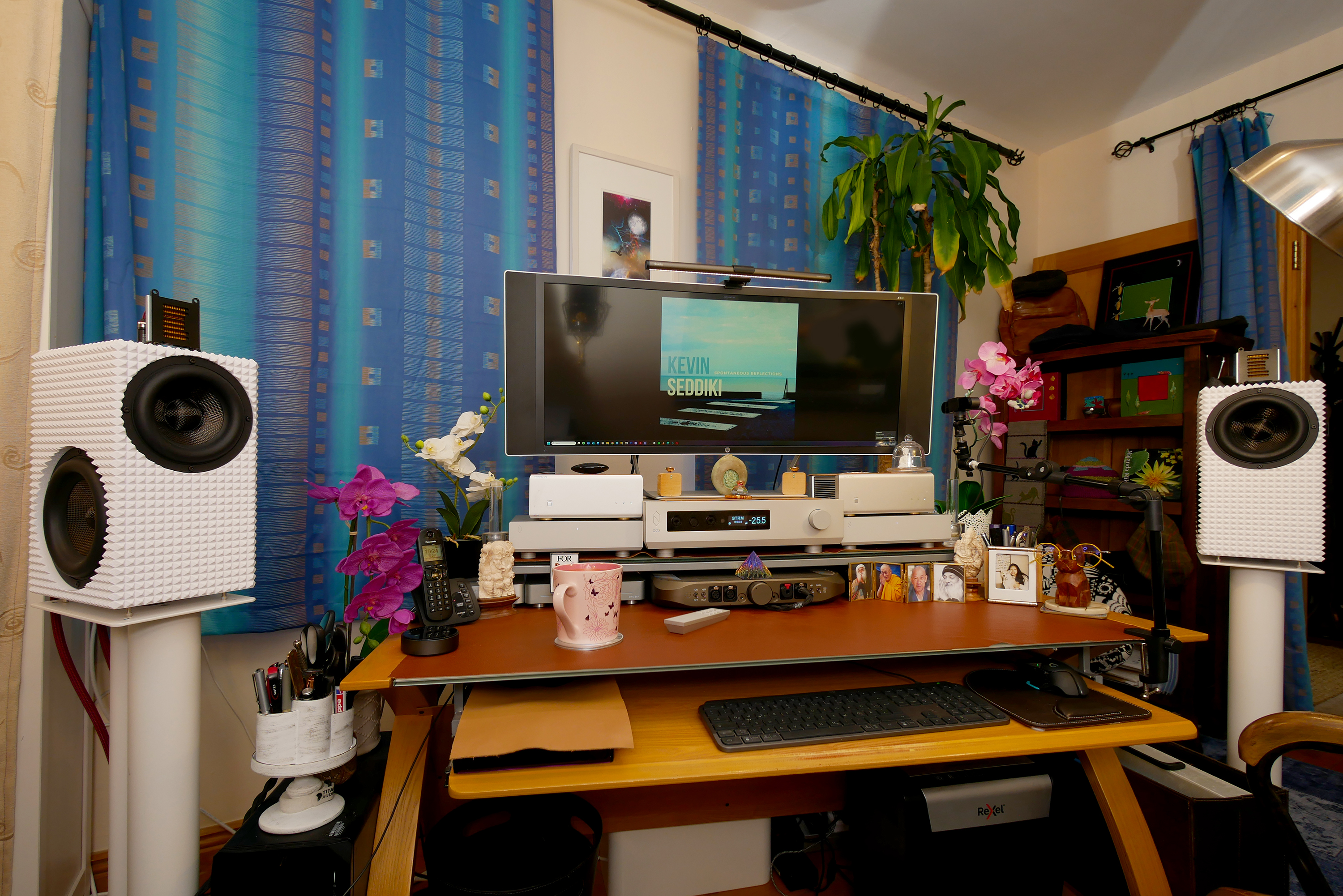









Ditto D10, never mind the sample-rate offset. UPnP had the resolution advantage. It sounded like fresh sparkling water whilst USB felt like a dark broth; not as impeccably enunciated, of somewhat slower thicker tongue. If we emphasize insight's 'in' as our eye's ability to penetrate thus parse a scenery, fibre-optic transmission went deeper. USB's inward motion stopped sooner past the surface. It reminded me of my annual water-mains interruptions here in rural Eire. Once the faucets flow again, the water is brown. It takes 24-48 hours before it regains normal translucence. In that visual, USB sat at ~36 hours post incident. The water is no longer brown but, filled glass against bright light, still shows some fine sediment opacity. Switching from that back to the STRM input instantly removed it. Voilà, higher resolution in action: pure and very very simple. That's how true greater magnification power works. There's no subtle shift in tonality, no skewing of soundstage coordinates. We simply hear and see more. Our ear/brain has extra data points to work with. If we pay proper attention, that supports a more complex experience. Greater completeness from deeper insight is what some commentators refer to as "hearing the artists' intentions" as though anyone beyond the recording's personnel could know them. Just so, our comprehension of the musical meaning certainly clarifies by easier understanding music's sub structures of melody, harmony, rhythm, timing, phrasing, dynamic contrast, tone modulations and image placement. What of it we notice and value depends on focus and listening habits. It's the opulent Las Vegas-style buffet. For our plate or bowl we pick certain delicacies. In others we show no interest. With higher resolution our buffet options expand. That mechanism is very basic. It just doesn't make it any less effective or relevant. Despite me hating hot and heavy on routing playback over the LAN—doing it for local files seems idiotic in fact when USB can happily remain offline—I must admit that streaming cloud files through the router into a switch out the switch into a DAC whilst the control PC hangs off the same switch sounds better still than well-isolated USB. Why? I haven't the faintest. After my R26II, this D10 is now simply the second network-enabled converter to have my ears make that pronouncement. Given my inherent dislike of sharing my listening choices with Big Brother over the local area network, I'm curious whether my inbound I²S-enabled Gustard U26 bridge preceding its stablemate converter can undo LAN's lead. I'd prefer the USB⇒I²S route. But until things reset, my ears find networked streaming ahead of USB; where that's an option. With no upstairs Internet, I've never focused on networking DACs. For downstairs, must I now reconsider my focus? This next photo underlines my prior routing comment. These fibre-optic runs for domestic network applications are very skinny.
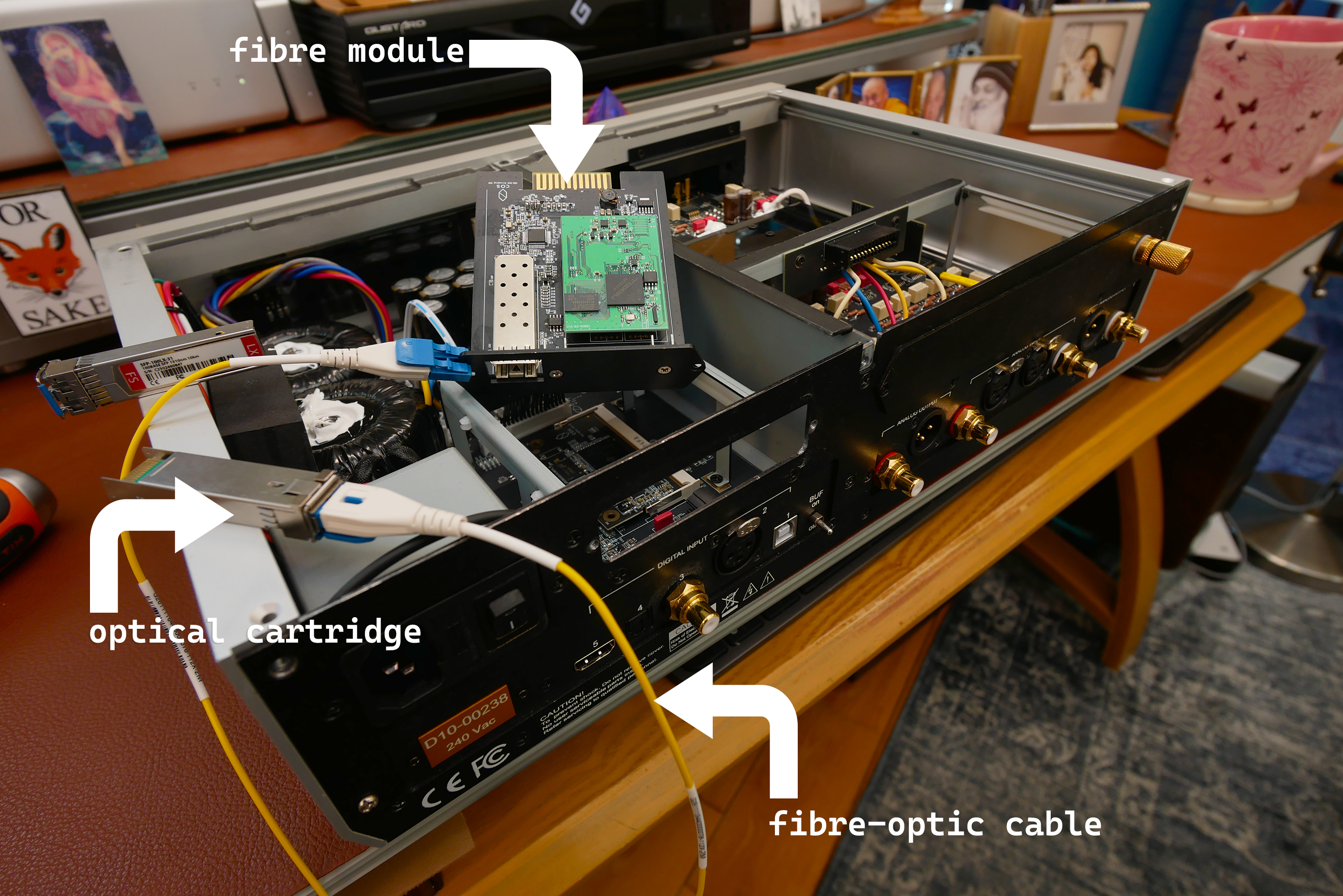 The D10's rail system for its modular cards supports secure connections.