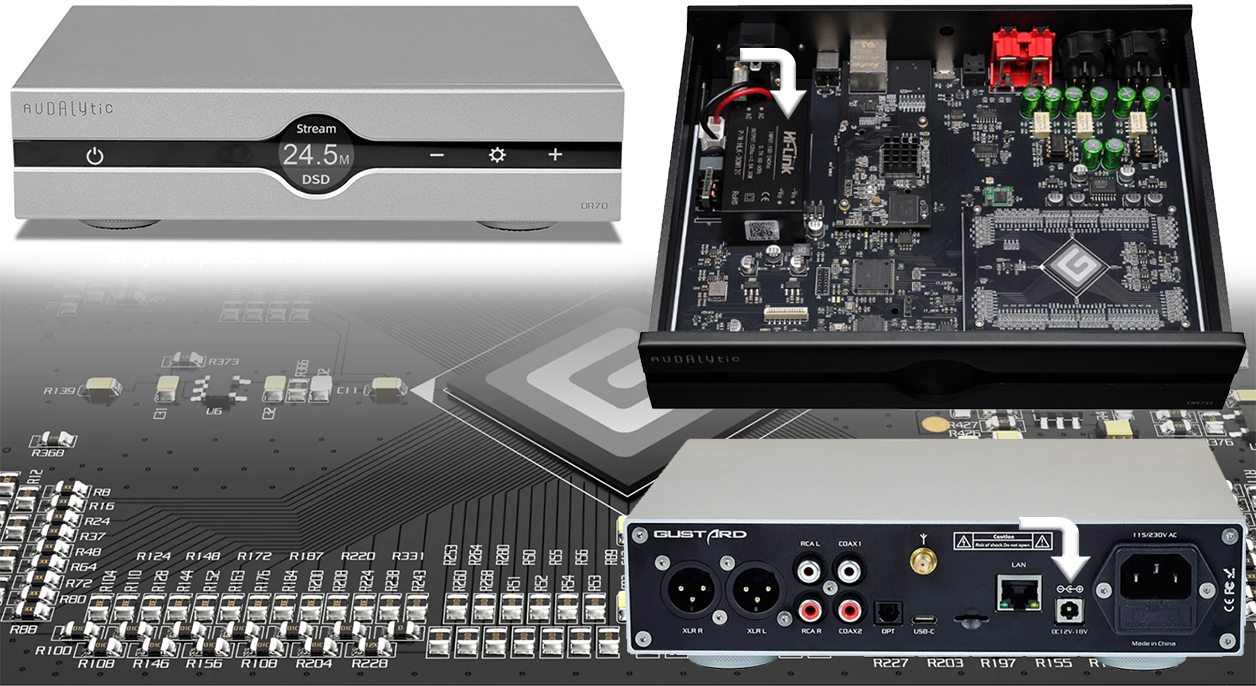
Adding up my evidence, Sino ¥ buys more materials and labour than Taiwan $. On said score the COS S6 was seriously disadvantaged against my desktop's and main system's LHY lot. Sonically it was perfectly on the level if tuned for slightly different harmonic padding. My real discovery was taking the LPS1 beyond its own brand and leashing it up to a DAC with 12VDC power option. That replaced the matchbox-sized Hi-Link switch-mode power module inside the below component. Forget marginal. Forget golden ears. Forget ultra-tweaked ancillaries. Forget così cosà. This was a properly substantial change to get hot about. Being able to juice two low-current 12V components, globally aware hifi shoppers should pencil the name COS Engineering LPS1 into their little black book. It's a genuine peach just waiting on an appropriate date. Once we embrace the 80% 'rule' of power supply relevance, already a small €399 DAC like my DR70 becomes fair COS game. Offboarding our power generator to eliminate exposure to radiated fields can have more benefits for sensitive signal-path circuits than just provide them with ultra low-noise super-stable voltage. True, a standalone power supply doesn't seem like a sexy pursuit. If so, ask what upgrading to a "3 x bigger" shinier DAC buys. If I look at my R26II from the same design team as the DR70, it's primarily a more elaborate twin-toroid linear power supply of higher capacitance and isolation, not a tiny switcher. Point made.
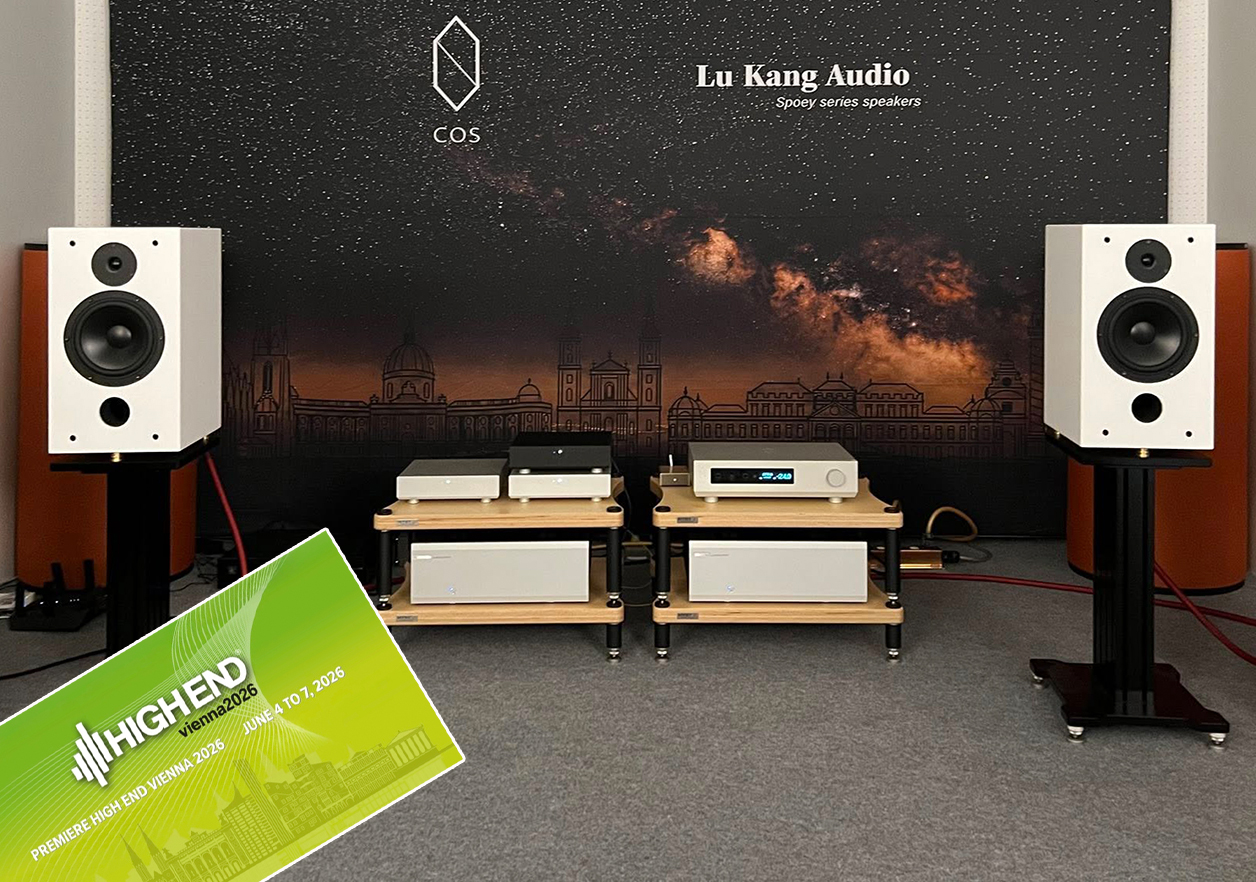
As to a still missing point—the S6's fibre-optic port—"we would also like to ship you a D10v4 with fibre optics for review. If that's okay, we'll pick up everything afterwards then forward it to the June Vienna show." The D10 is a 5-in-1 DAC with phono, headfi, preamplitude and streamer. I'd awarded it before but never tested its SFP functionality. With that of the v4 finally perfected, it made sense to report on that feature compared to standard RJ45-based copper off the S6.







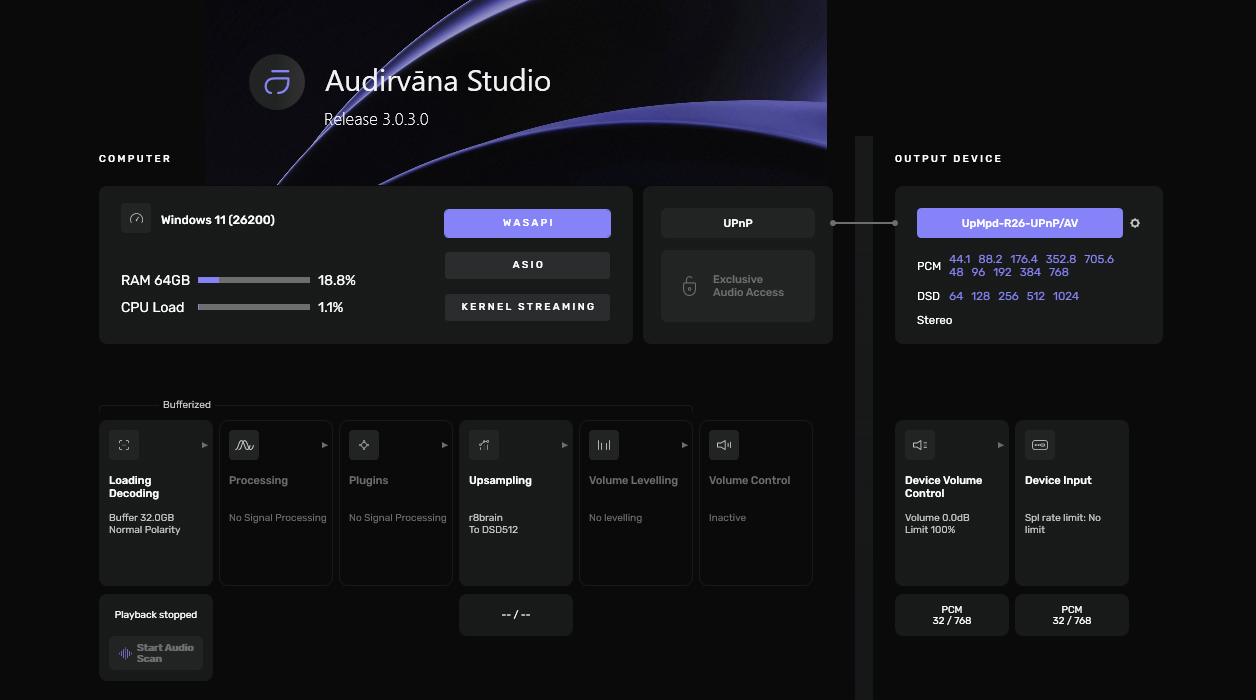 Audirvana's UPnP connection to Gustard's R26II streaming input.
Before I accepted, I downloaded the D10's manual. It said that as a headless streamer, it wants the MConnect app on a smartphone for configuration and access. WiFi gives me headaches. I don't use it unless it's an in-car emergency or travel necessity. Was the v4 UPnP-ready to access from inside my Audirvana install with embedded Qobuz Sublime subscription? If so, I'd have the same fully wired workaround I already use for my desktop's R26II DAC in DSD 24.5MHz streaming mode. If not, I had to turn down the follow-up request.
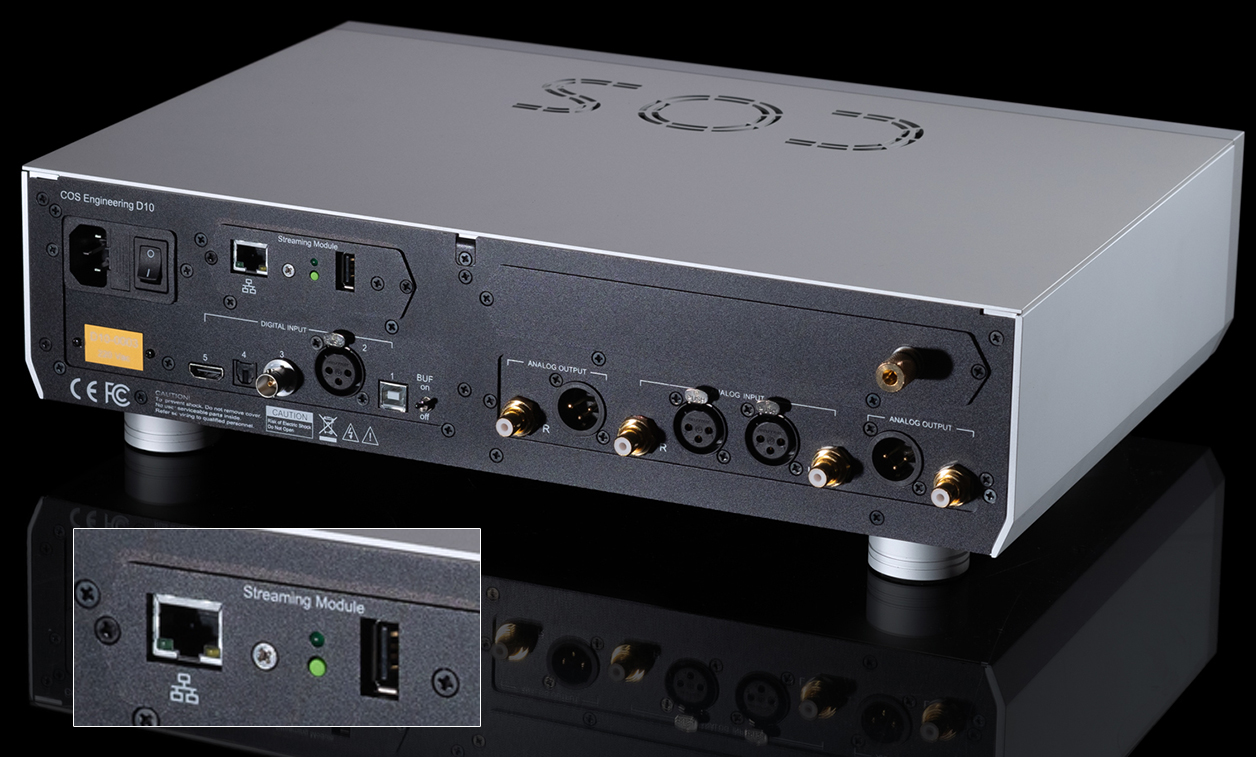 Photo credit: hifiknights.com, of an earlier D10 iteration prior to the SFP addition
"Yes, the D10 is UPnP¹ compatible. We never used Audirvana but it works fine with JPlay so should work fine with Audirvana, too." For extra assurance, I suggested that Stephen Gong download a free trial version of Audirvana. "I just did and it works fine." Feeling certain that my planned scenarios were copasetic, the follow-up gig was on. It would focus solely on one simple question. With nothing else changed to eliminate variables, would fibre-optic LAN signal have an edge over classic copper? As logistics worked out, my D10 shipment happened after the Vienna show closed its doors. "The show went pretty well; perhaps better than Munich. Much interest in S6 & LPS1, thank you very much. By Monday we shall send the D10 with fibre optics to you." In the meantime regular Warsaw contributor Dawid Grzyb had published his take on the S6/LPS1 combo which tracks mine quite tightly indeed.
¹ You'd think that given the acronym's meaning of 'Universal Plug'n'Play', all audiophile servers would run it. "UPnP is a set of networking protocols allowing devices on the same local network such as smart TVs, printers and gaming consoles to automatically discover and communicate with each other, often bypassing manual router configuration and automating port forwarding." Sadly, that's not the case. I've had to turn down multiple server review solicitations because of it. This is typically where 3rd-party control apps intercede; if we can or care to host them when not every interface is as dialled as Lumin. If WiFi is out and with it mobile apps are out, we're down to either an app our PC/Mac can run via a browser interface; or a music player like Audirvana whose UPnP facility can communicate with a headless server over the LAN. Roon isn't UPnP ready and instead uses its own RAAT protocol. To use Roon with a UPnP streamer, we need a 3rd-party fix like rooUPnP or Ims-to-uPnP. So much for easy universal networking. On that score, USB's 'universal' is far more real. That said, UPnP's self-generated port mapping without security passwords can circumvent Firewall protections so security-conscious users may look elsewhere.