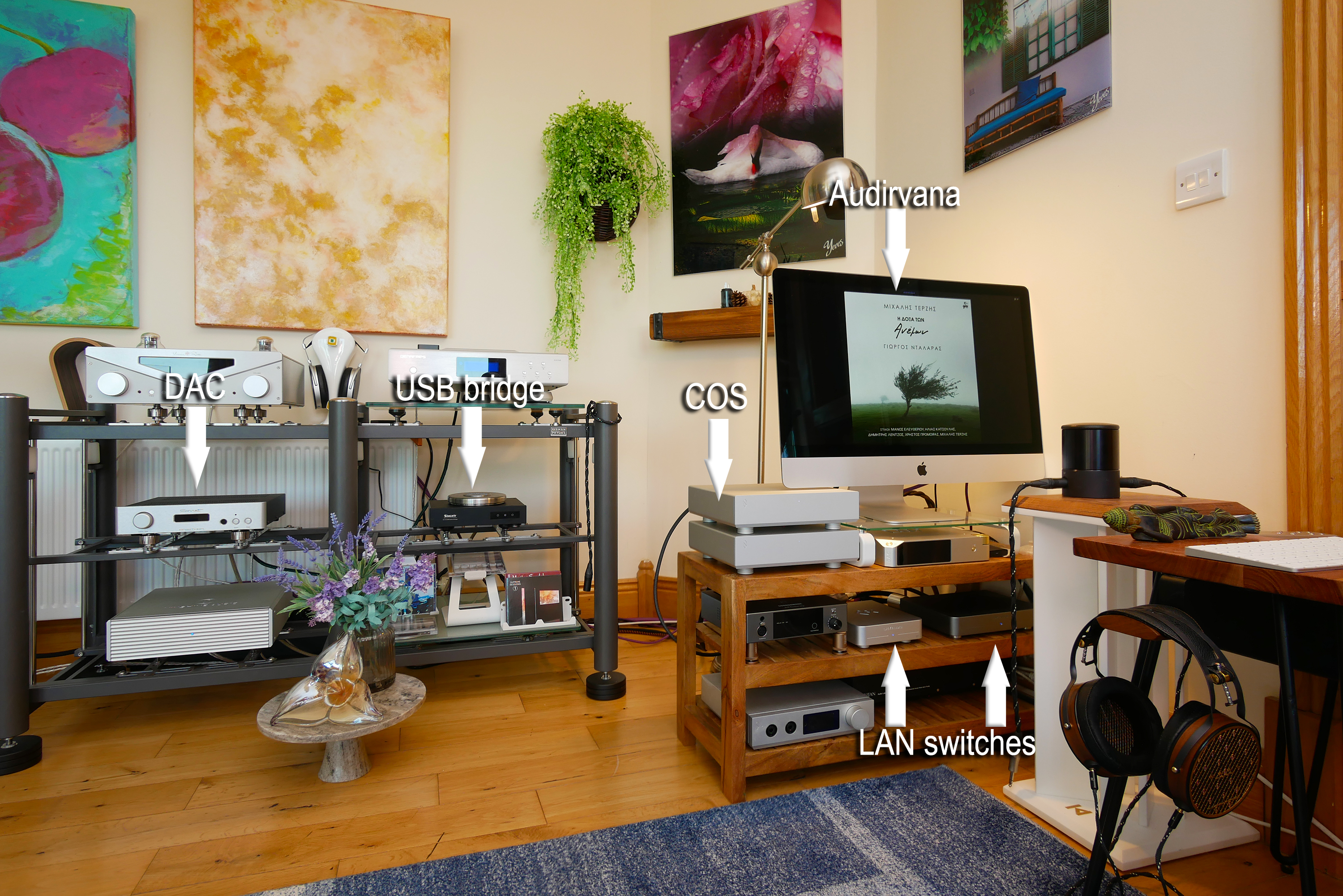
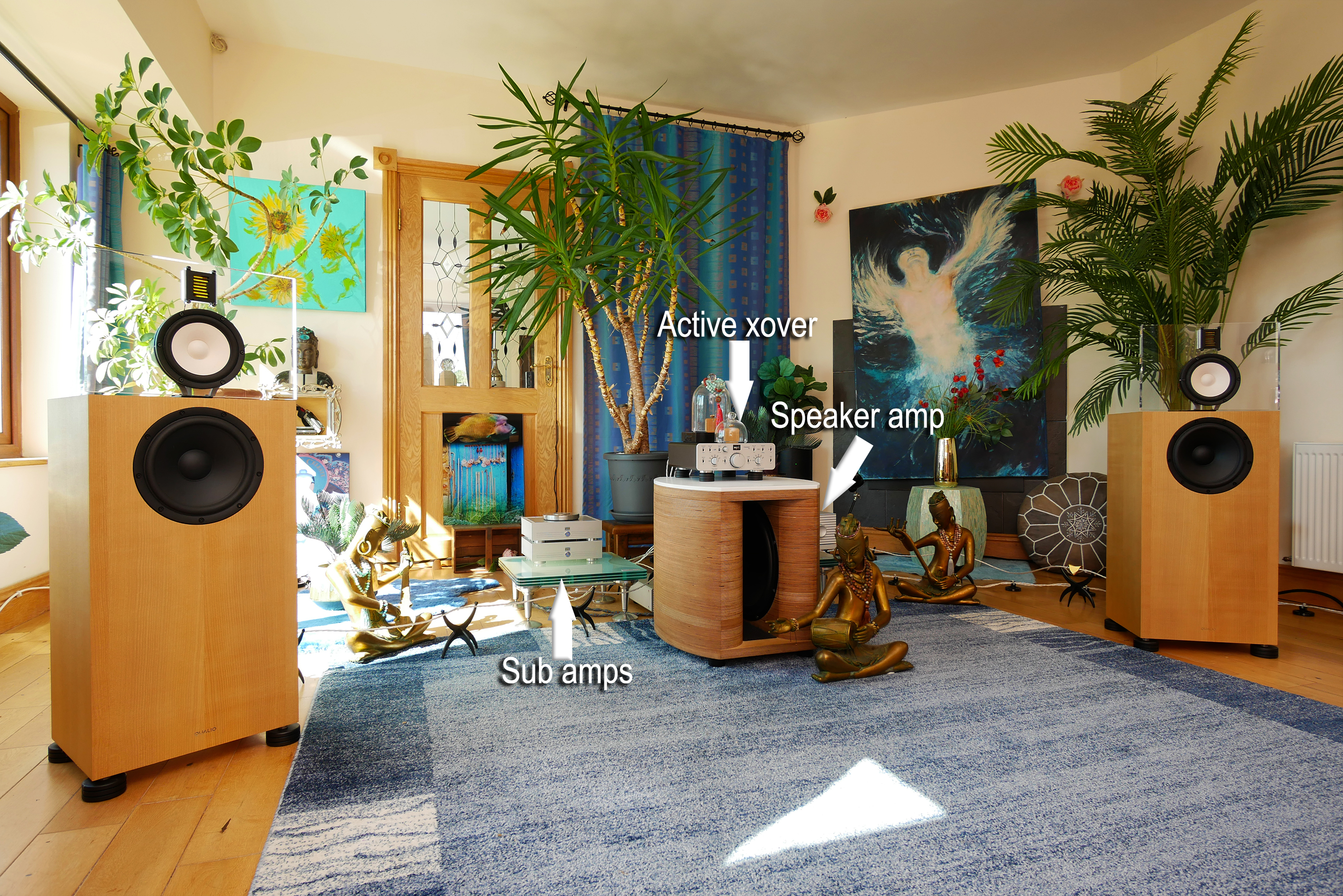
Here's my main system so test station N°2. The numerous arrows are self-explanatory. The Taiwanese twins had to wrestle my series-strapped LAN distributors aka network switches from the PRC's LHY Audio, a now direct-selling subsidiary of Jay's Audio. One of these is a multi-port reclocked switch like the S6, the other a twin-port copper⇒fibre⇒copper isolator. The USB bridge between music-dedicated iMac and DAC is a super-cap powered Singxer SU-6, the converter a multi-stage R2R Sonnet Pasithea.
Against the front wall sit an spl audio Crossover MkII to split the incoming full-range signal into a 4th-order 100Hz high pass for a 300wpc class AB Kinki Dazzle amp driving Qualio IQ speakers; and a mirror-imaged low pass into NCore 500-based Nord Acoustic 700W/4Ω monos powering a 2 x 15" sound|kaos Ripol sub. Twin PSI Audio active bass traps in the front corners work up to 160Hz and mimic the effect of 1m² holes in the wall to bleed off pressure build-up in those areas. Together with the quasi-cardioid folded-open-baffle sub, this is my room tuning without conventional big passive bass absorbers. The speaker ports are stuffed, too. To set this table, "… whenever I use a CD player or a CD transport, I'm always curious about which optical mechanism is used. Nowadays the surprise element is gone when it comes to SACD mechanisms. Since Teac/Esoteric stopped selling their optical mechanisms to third parties, D&M (Denon & Marantz) remain the sole supplier of SACD mechanisms. This explains why Bricasti, Accuphase, Goldmund, Wadax, CH Precision, Playback Designs and several other high-end manufacturers use these mechanisms as a basis for their transports. Of course, although CD mechanisms, servo systems and their associated signal processing ICs can exhibit specific sonic signatures, this does not mean that all players will sound identical. The power supply and overall design also significantly influence the sound, not to mention the implementation of the digital interface. I've actually heard players with identical optical mechanisms sound very different." That's from Christiaan Punter's review which published just then. It's a fitting reminder. Digital transports don't all sound alike. Whilst network switches aren't officially labelled digital transports, their signal likewise remains in the digital domain. Now a mental connection to mechanical transports makes it easier to appreciate that just because the 1s and 0s don't change, how a subsequent D/A converter will process them needn't create identical results. Onto my own results. My 1st round in the main system swapped two Ethernet links—incoming and outgoing—to contrast COS⇒iMac with LHY⇒LHY⇒iMac. The short link between the two LHY boxes remained undisturbed. My 2nd round compared router⇒iMac to router⇒COS⇒iMac. Where I expected the first comparison to be about marginal flavour shifts at best, the second seemed far more relevant as in, why add an audiophile switch to a system when our garden-variety router has sufficient ports already? That struck me as more representative of potential buyers than comparing one aftermarket LAN purifier to another. The 3rd round eliminated the LPS1. Here I expected less than half the performance delta over adding the S6 to my router-direct path. Did reality conform to my expectations?









Unlike in other areas of my life, it did. The delta between €3'100 COS stack and ~€1'400 LHY duo was purely about minor tonality shading. My mainland China residents struck me as slightly more emphatic on the upper harmonics of timbres to feel a tick brighter but lighter. The Taiwanese cadre from across the causeway felt heavier on the 2nd harmonic. Nothing changed position or size. No other detail diminished or came to the fore. As far as my ears were concerned, whatever anti-noise trickery either designer administered, it was equally effective. The remaining small harmonic offset felt due to deliberate tuning via strategic parts choices, not µV differences of residual noise. Whilst a puckery portemonnaie pout presented on the cost delta, country of origin explained it. Taiwan's economy is closer to EU pricing than the PRC. Plugging my 20 metre CAT8 stretch directly into my iMac's network card then back into the S6 was far more decisive. That's because it shut down an entire dimension of ambient atmosphere. Whilst the primary stage actors or images stayed put, without the S6 they no longer embedded in audible space. Instead they presented like a shadow-play puppet show: figures in a vacuum, all connective tissue sucked out. Audiophile lingo refers to the absence of venue ambience as 'dry'. Reflective haloes and microscopic decay trails meanwhile seem 'wet' like a film director might deliberately hose down a street's blacktop for a night shoot so car lights and commercial neon signage reflect better for that stylish crime noir look. The disappearance of this contextual plankton was my primary observation when first switching from S6/LPS1 to router direct. When I reinserted the COS twins, I also noticed how the reappearance of venue moisture created more tonal fullness. Think plumper sound balls. This before/after delta was significant. On a mature system of high resolution, I pegged it on the order of comparing 320kbps Spotify to 24/44.1kHz Qobuz. If you can't hear that difference, don't contemplate COS. Connect directly to your generic router. Your system, music and/or ears won't appreciate anything more on the LAN yet. First things first.
Replacing the LPS1 with the small MeanWell wall wart lightened/brightened overall tonality. With the LPS1, things were earthier and chewier. Yet as predicted, this delta was half or less than following up my router lead with the S6/SMPS combo. As to the 'lesser' power umbilical, I thought that perhaps its HF were a mite steelier. I thought that to widen the significance of that small cable tweak probably takes a system of higher resolution than where I play. That phrase propelled me right back into the office. It's where I play a lot. As it happens, my small Audalytic DR70 discrete R2R DAC with native DSD256 sports a 12-18VDC input should we wish to bypass its internal SMPS. My $390 LHY LPS80 2 x 15V power supply usually wishes so. Now I could wish the LPS1 on the DR70; and did. Crickey. Instantly more moolah meant more oompah. Weight, dynamics, scale and profundity all grew by at least a shirt size. At €2'000 for PSU and umbilical, the DAC's own €400 sticker had spawned quintuplets. On paper this made no sense at all even if it did bend a pliant knee to the "power supply is 80%" belief. But as a reviewer temporarily freed from the need to think cash, the results really spoke for themselves. This went beyond getting my trusty Volvo C30 T5 back from a major tune-up which eclipses basic annual oil and filter changes to include new spark plugs, timing belt and brake pads. Whilst the same old car suddenly drives fresher and crisper, the LPS1 addition still felt more like a mod-shop's bore job. You step on the gas and whoa, where did all the extra power and sheer authority come from? Hifi discourse is prone to exaggeration, unhinged jaws and floor wipes. With a knowing glance in that direction, I was still taken aback by the magnitude of this change—particularly its dynamic crest factor. So the LPS1 on my budget DAC reshuffled today's review order. This wasn't at all how I had foreseen wrapping once the power supply had leashed up to the S6 stablemate. Obviously a LAN distributor's place on the sonic importance pole sits well below a DAC. Now I had simply heard the truth of it. Ideally then I'd have had more kit to throw at the LPS1 in its new role as headline act. Sadly my inventory wasn't amenable. Yet as far as I went, this power supply heavy for its size had become this gig's chief attraction. All I can meaningfully add to underscore it is that the DR70+LPS1 combo now performed very close to the €1'600 Gustard R26II DAC—and indeed eclipsed it on dynamic vigour.