The Viper concept. With Cobra as hyper Viper, understanding the small box understands the bigger one. When classically trained audiophiles read the word 'widebander', they instinctively see a single-driver big speaker whose Lowther, Voxativ, Cube, AER or Rethm bi-cone covers as much bandwidth as possible via acoustic assist from a folded rear horn or quarter-wave tube. Those trained in contrary executions know of Camerton who put a far smaller single driver in a small ported box; and outliers Lindemann and MonAcoustics who add an AMT to a small ported Markaudio Alpair (Mon use isobaric twins). Their separate tweeters stand in for whizzers that attach to the main cone. The novelty of Qualio's IQ was exploiting an SB Acoustics Satori 6-inch midrange well into pure harmonic bandwidth. It's augmented only in the top octave by an add-on tweeter. Where IQ deserted the widebander res was with a 9½" woofer in a large ported bass bin. That seemingly made it a conventional 3-way. And technically IQ's 'wideband' midrange clearly covers far less LF bandwidth than a purist version does without filter. IQ's upper filter simply sits well above a typical 1-3kHz crossover. That moves the transition out of the range where our hearing is most keen. For Viper, Grzegorz worked through all commercially available 4" and 5" widebanders he knew. None suited. He finally investigated subwoofers that could play to 5kHz. That identified a candidate in Dayton's Epique catalogue. Though miniaturized, this little beastie looks every inch the classic bass pump with its high-mass rubber surround for extreme throw and a mega motor behind a lightweight carbon-fibre cone. It's very dark decibel years removed from the low-mass ~100dB Lowther archetype of ±1mm excursion. Hence classically trained widebander freaks might diss Viper on pure principle.

They could still concede genre-defying bass extension and power particularly with Viper's horizontally opposed passive radiators. Yet in the very next breath they'd predict obvious limitations in the upper mid and lower treble regions. But Grzegorz Rulka knows his widebanders. There's compound genius in his Epique choice. First, it produces loud low bass beyond 40Hz in a 7-litre box and really does run straight past the highest musical fundamentals of a piano and violin with excellent off-axis response to boot. Two, to perform as intended only wants high power of low impedance and high damping. That looks straight at class D even on low budgets. With 'normal' speakers such amps might sound at bit dry, monochromatic and clipped. On Viper they won't. Its tuning builds in wetness, saturation and tone-colour intensity as is. No extras are required or desired. Hence classic class A amps fancied for injecting those very qualities could actually upset Viper's native balance and get too lush and soggy. The rabbit hole of exotic direct-heated triodes which classic widebanders adore is completely sealed off. The upshot is more genius. Even beginners with zero experience in multi-layered system tuning will make advanced sound by combining Viper with PWM circuits in the Fosi, SMLS or Topping class. That's the method in Viper's subwoofer madness. Cobra piles on. The above photo illustrates Greg's miniaturization mission. Whilst the dual 15" subwoofer between Viper added a bit of extra output below 30Hz and some extra LF dynamics during crunch hour, in my 6x8m room at my SPL that was purely optional. Though IQ and Viper did diverge on certain sonic details, on matters of bandwidth and personal loudness needs they were comparable. Disbelievers chanting "impossible" move to bigger targets. Where my IQ is already too large a visual obstruction—many households don't host a dedicated listening room like I get away with—might Cobra fit the bill?







Enter Virtual Hifi's hybrid sales scheme: studio direct from Poznan/Poland; or local dealer. For Viper the pre-VAT price is €4'400 with worldwide shipping, the flat dealer price €6'900. The latter is identical to IQ direct. Given equivalence of performance, that's consistent. Punters preferring to self import particularly into countries of low or no VAT can book attractive savings. "The video I sent earlier was of Cobra's very first power-up running with a simple 1st-order crossover just to get a feel for the potential. The current setup uses a 2nd-order filter on both sides and to paraphrase, is something of a d'Appolito alignment. I'm printing final cabinets now. As for the Topping B200 mono, it's a very good amp, neutral and refined though perhaps a bit less dynamic than your Kinki. For the money it's a no-brainer. For my own needs I actually clipped Viper on the B200 and found the SMSL PA200 to give me the gain I needed. Still, sonically I'd say the B200 is the stronger amp. The Laiv GaNM really impress me. They bring a midrange richness reminiscent of class A yet still deliver dynamics at my listening levels. With full-range drivers I can live happily with tubes but on multi-way speakers I miss kick. The Laiv feel like a very interesting blend: wide soundstage, strong dynamics and midrange richness. I use them as a reference while tuning Cobra where the SMSL PA200 represents speedy neutral/dry qualities and the Laiv richness and scale to find the best middle ground. I'll also implement 3-position attenuation for the Cobra AMT and these amps are helping me set the optimal edge values now."
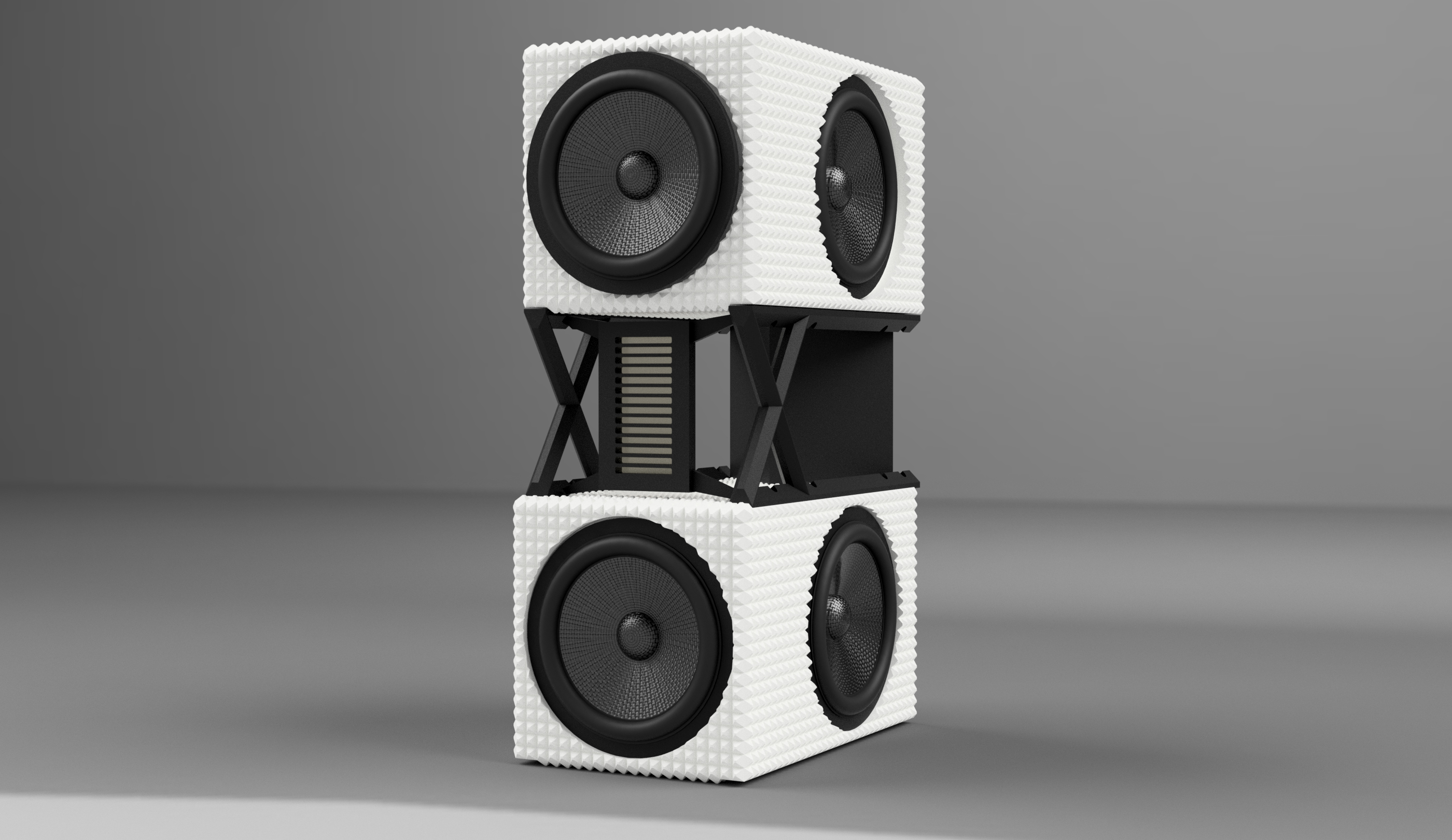 Concept render.
"The crossover point for the Mundorf AMT sits at ~2'300Hz. I opted for a lower cut to maximize the performance of this truly stunning driver. To complement its quality, I've rewired it with Mundorf 1mm round silver/gold solid core. Additionally I use Mundorf MCap Supreme silver/gold/oil capacitors priced at €300/ea. which offer a significant sonic improvement over the aluminum Evo in Viper. My goal is to make this the best possible speaker I can envision." In a few sentences, Cobra's nature shifted. Its widebander covers 6+ octaves from ~2.5kHz to 25Hz, a premium dipole tweeter handles the full three treble octaves. It's the opposite of how contemporary Rethm and Voxativ's Alberich² split that task. Their widebanders extend past 20kHz but take an early LF exit to hand off to self-amplified bass systems. Cobra cosmetics remain in the reptile family with textured cabs printed in 3D from PET-G in a variety of solid colours. Once again the AMT sets back for time alignment but rather than Viper's mohawk, would fly in a quasi d'Appolito centre position according to this render.