Once the Warsaw show opened its doors October 24th, Greg had photos of his exhibit with finalized Cobra demonstrators. "I've introduced some changes. The external cabinet pattern has been updated and the fronts become dressy acrylic panels. White speakers will have white fronts, darker colours black fronts. I've reduced wall thickness to 5mm, added internal bracing then pour in a 6mm layer of very soft elastomer mixed with a few kilograms of stainless-steel micro particles. This hybrid approach nets a perfect composite with stunning self-dampening properties." As these photos show, Greg brought his studio system of T+A streaming DAC 200 and Laiv Audio monaural GaNFet class D amps whilst his Vibron isolators appeared on both pairs of speakers plus, in a double layer, under the electronics. Vermillion cables provided the hook-up. His approach clearly lionized maximal minimalism. The only way to go more minimalist requires streaming active speakers. Thinking people already wonder. How do the electrical connections between upper and lower elongated cubes establish: via an invisible connection prior to docking; or by rear-panel jumpers or bi-wire terminals? Though the gap between stacked cabs is very narrow, the upper one clearly floats atop the lower one via an isolator interface. Though Cobra is more than twice of everything Viper packs, the visual increase viewed from the front remains reasonable. More extra pounds add in depth to generate the cubic volume necessary to not only load this driver artillery as intended but house the upscale large filter parts. The taller Mundorf AMT now leans into an elaborate brace for extra stability.
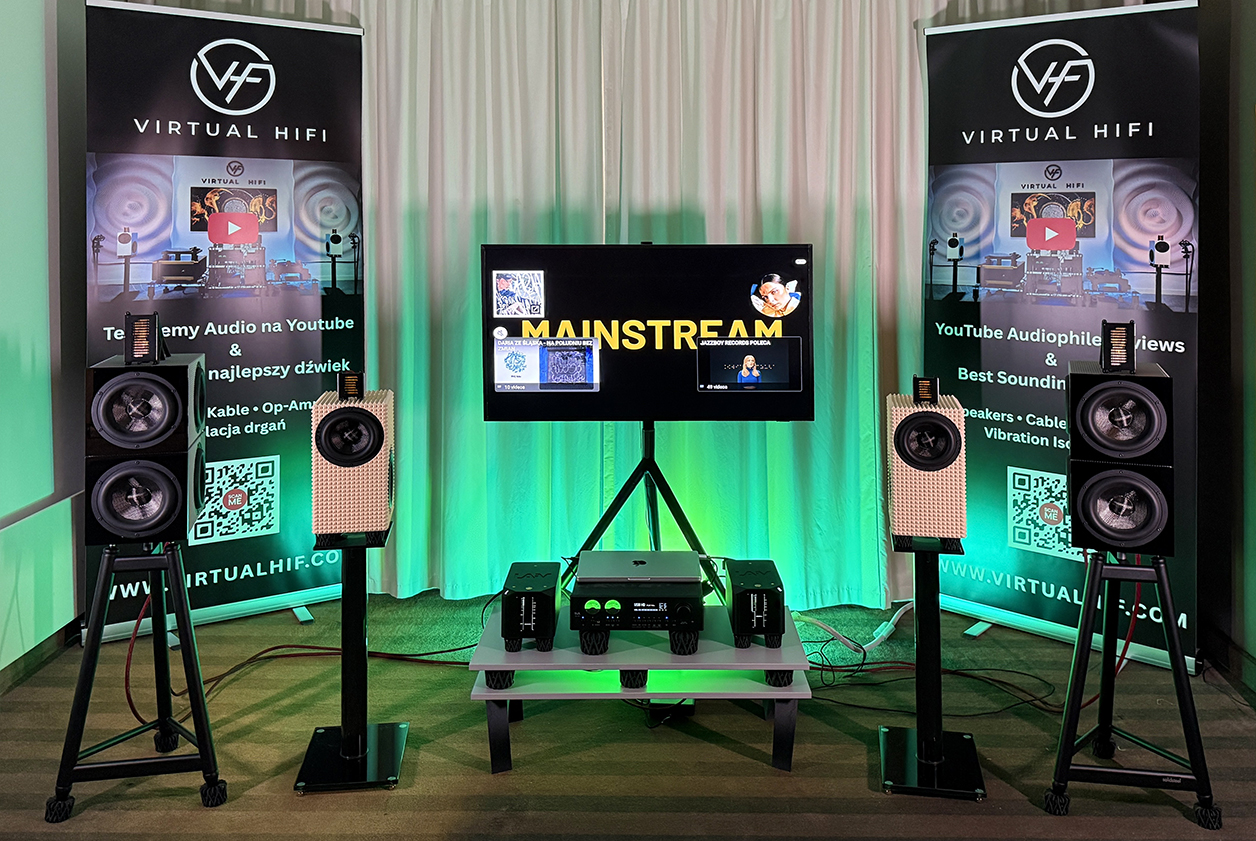
 "The acrylic front panels mount with professional 3M double-sided thick tape so can replace if needed. I'm also exploring making them magnetic for easier interchangeability. For the connectors, the two modules arrive pre-coupled with stainless steel bolts and elastomer spacers. One of these spacers located in the middle routes the cables connecting the crossovers so for easy single wiring without jumpers there is just one pair of terminals on the back. Efficiency is ~86dB presented as 4Ω. Cobra performs best with quick amplifiers that offer good control and a neutral character. Similar to Viper it appreciates plenty of current so class D amplifiers of 200-300 watts or more are perfect to reproduce the live concert experience at home. By the way, at the Warsaw show I was running YouTube as source. Since my brand is Virtual HiFi and I do YouTube tests with music samples, I often hear people claim that YouTube compression makes serious listening impossible. My answer is that perhaps it's not YouTube that makes it impossible. Plenty of visitors were blown away and adding music video to the sound enhanced the listening experience and immersion. Finally, Cobra's frequency response is 25Hz-28kHz."
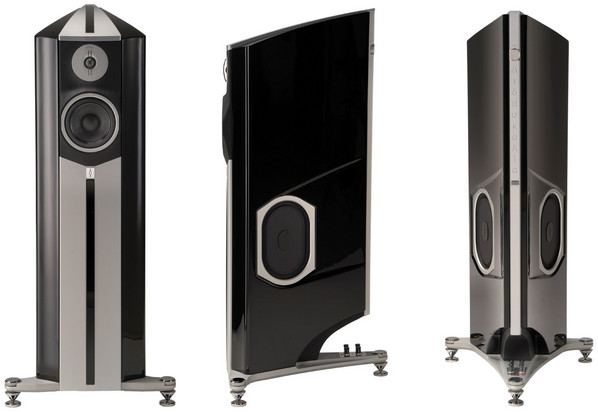
For a passive stand-mount of non-obscene dimensions, that's wicked bandwidth. The six passive radiators per channel work hard for a living to earn their keep in the dark mines of low bass. For another reference of a classic 2-way floorstander augmented by passive radiators, consider Diapason's new Didascalìa. It mates an 180mm mid/woofer to a 29mm soft-dome tweeter then adds horizontally opposed 'force-cancelling' 220 x 260mm oval radiators. It too promises 25Hz to 30'000Hz bandwidth but weighs 62kg and demands €59K/pr. That's about six times more than Cobra so a completely different audience. For that we buy solid Walnut, Panzerholz, HDF, Baltic Birch ply, aluminium and eco leather; industrial design by Paolo Tezzon formerly at Sonus faber; and unique 3-stage adjustable damping on the passive radiators without adding or removing physical weights. Diapason's product page reiterates their clear preference for the performance purity of 2-way speakers whilst acknowledging such concepts' baked-in limits on bass extension, power and scale. Hence Didascalìa's custom ScanSpeak radiators. Juxtaposing this very posh Italian to our Polish 3D-printed challenger drives home once more how pedal-to-the-metal ambitious Cobra is about squeezing equivalent bandwidth and SPL stability from a 2-way stand-mount whose dimensions probably mimic the Diapason's head once severed from its body.









"The new acrylic fronts look attractive and could probably even execute in satin if someone wanted. I'll check with my supplier. The tweeter brace adds the industrial vibe I like. Without it, this 13cm tall tweeter would look just a bit strange and fragile." Enroute to Warsaw's finish line we saw an MTM notion explored then discarded; a costly crossover-parts swap party; experiments with different wall compositions, internal braces, wave traps and surface texturing; and an evaluation of paint finishes which gave way to acrylic frontal dress plates. Typical reviews start at the finish line of final production. Wherever I can chronicle the preceding process because a maker like Grzegorz Rulka is happy to let us in on it, I appreciate the opportunity.
Now that lengthy backstory is a wrap; except for a final development inspired by the show. "I noticed something important regarding the range of my AMT regulation. My studio is 40m² with plaster walls but here in a small 16m² room at the Sobieski hotel, the AMT setting needed to be completely opposite. In my studio I use a 15Ω resistor, at the show I switched to a 9Ω resistor. If someone were to use an even warmer-sounding amplifier than my Laiv GaNM, it would require an even more open setting¹. I thus decided to increase the tweeter tuning range to five points, covering 7-16Ω for extreme adjustability. Of course this entails four more silver WBT RCA sockets and Mundorf precision resistors but I believe ensures 100% satisfaction." Asked how all of it reflects in the final price, "well, I went on a real spending spree when it came to the parts in this project. What might be a bit sad is that I now cannot downgrade to anything less so Cobra became a truly high-end monitor with a direct price tag of €9'500/pr ex VAT. This also reflects a 35% price increase for Dayton drivers and radiators of which each pair of Cobra requires 16 combined units."
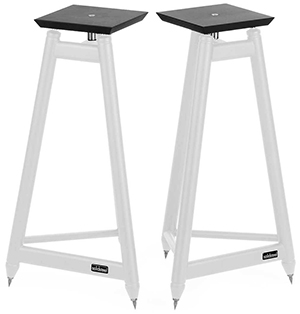 "Since my 6mm steel back plates are out by about a week, I'll print you new cabs with 5-point tweeter regulation and magnet slots to swap the acrylic dress baffles." My Cleopatra moment was nigh. "There is another interesting phenomenon with these speakers. The lower your listening volume, the fuller they sound. While the Mundorf tweeters are very efficient to typically become proportionally louder as SPL reduce, the oversized passive radiators are exceptionally effective themselves. This results in excellent low-frequency presence even during quiet listening. Essentially Cobra naturally counteracts the Fletcher-Munson curve. Regarding the tweeter RCA array, moving from the front to the back gradually decreases the AMT's output. For matching stands, Cobra's footprint for ideal top plate sizing is 20x33cm WxD. I currenty use the SolidSteel SS-6 welded tripods of 60cm height [left]. I'd generally expect 50-60cm tall stands to be ideal for most seating arrangements." Preferring wood with rubber cones for my landlord's parquet flooring, I opted for Buchardt's equivalent Oaken tripods in all white.
¹ Cobra can't trim its bass balance to suit shrinking rooms when its radiators are passive so not electrically connected. To maintain correct tonal balance adjusts the high frequencies instead. As LF room reinforcement rises, these tweeters want ever less cut so treble amplitude increases in lock step with the room gain in the bass. Playing a room far smaller than his own demonstrated to Grzegorz the potential need to turn up the AMT even more than his highest of three original values accounted for. Alternate compensation would simply switch to the smaller Viper if the room at our disposal doesn't suit what essentially behaves like an ~18" 2-way. Just because it doesn't look it doesn't mean that its combined cone surface doesn't add up to it. Or as dad said when he gave his 18-year old son the keys to his Porsche, "be careful". On that score, my small office where Viper brackets my work desk on tall stands runs one channel in 80Hz high-pass mode so only one full-range. Otherwise my nearfield setup produces too much bass for my tastes. Already the smaller Dayton radiators on Viper are very capable.