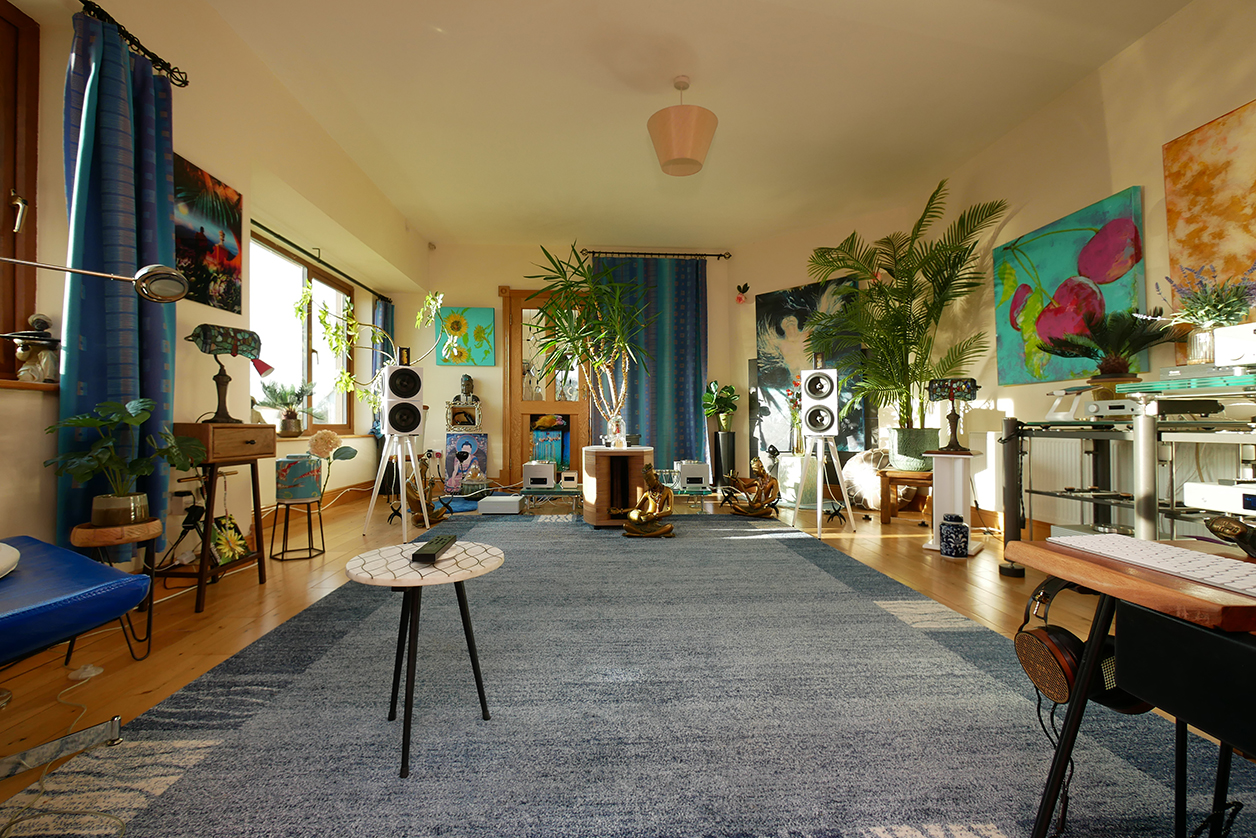
Cobrasino? Time to count my chips in the lounge. To make sense of the math, some bassic boilerplate first. That big 2×15" sound|kaos subwoofer isn't there to add bass. It subtracts bass. Huh? As a folded open baffle it's of the cardioid hence directional persuasion. In-phase front and out-of-phase rear energies cancel as they wrap around the box. That eliminates sidewall and minimizes floor/ceiling reflections. Even its output at the front wall is less than what aims at the seat. That radiation pattern minimizes a lot of acoustic gain which omni bass systems invoke to then trigger room resonances. With a precision discrete analogue outboard crossover set to split the full-range signal into symmetrical 4th-order Linkwitz/Riley high/low-pass streams at 100Hz, my 35/70Hz room modes fall into this cardioid cancellation window. To eliminate remaining pressure build-up in the front corners, two active PSI Audio bass traps absorb below 150Hz. I then leave the door behind my listening seat permanently open. It vents the room, has it act bigger and doesn't turn pressure chamber. In short, that sub is very effective if not exactly invisible room treatment. Whilst it does add a bit of LF reach below my usual Qualio IQ, that's not its primary purpose at all. A better time response is whereby bass textures shed their blurry ringing from snookering late-arriving reflections endemic to classic ported or sealed bass. Meanwhile the Lifesaver Audio Gradient Box II has a remote-triggered 'bypass' function. It instantly defeats its crossover function to instead send full-range signal to the main speakers. It can A/B cardioid vs omni bass, at will from the seat. Cobra's massive bass artillery obviously radiates in all directions. Even its mid/woofers lack the figure-8 cancellation benefits of my usual IQ.
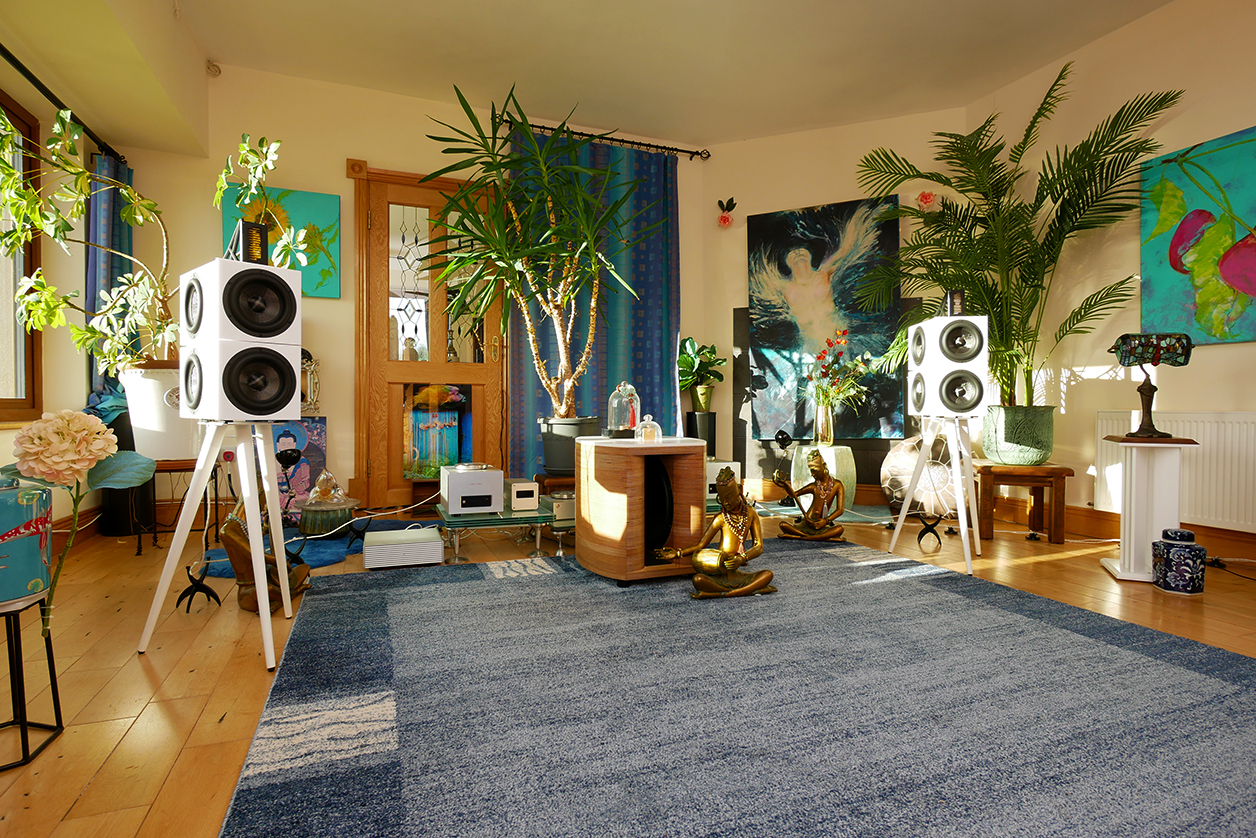
Wherein lies a very short tale. Being allergic to lumpy ringy bass to have followed down the rabbit hole of stereo 2.1 and cardioid radiators in the first place, I couldn't listen to Cobra full-range. Period. Reverting from 'bypass' to 2.1 instantly drained the LF swamp. Above 100Hz I still had more sidewall involvement than I'm used to. But that extra fat I could somewhat compensate with a higher tweeter setting. Without applied high pass, Cobra's secondary emissions simply overloaded my room and rode its primary modes. It's why I no longer really review big passive speakers of potent bass. As a function of sub 100Hz omni dispersion, they all behave the same. If that is our reference—untreated rooms are the default to make that most listeners—bass which lingers to not stop on time is perfectly normal. Very few people can turn off their reflective bass elements to sample a far cleaner alternative though comparing good headfi certainly subtracts the room as a useful arbiter. And yes, DSP can linearize our bass amplitude but not fix timing errors unless we use multiple subs for strategic cancellation interference. It's important to understand that this critique isn't specific to Cobra. The same would be true for any other good-to-25Hz passive speaker not a dipole. For being so compact, Cobra is simply unnaturally hung. That exacerbates the omni-bass issue beyond what the eye expects. But again it stops being an issue if it's all we know, expect and accept. Ignorance and bliss. With that handled, let's investigate Cobra as a stereo 2.1 speaker whilst recalling that my residents are the 9½" 3-way IQ with 6" dipole widebander and smaller dipole Mundorf AMT.







The Cobra concept doesn't pretend at Swiss neutrality. We know how Greg strategically cherry-picked his capacitors, resistors and drivers for their sonic steering. It clearly was in pursuit of a super-chunky dynamically very boisterous profile that's at once voluptuous yet muscular for a happily pumped-up aesthetic with extreme cardio. With loaded kick on drums and a rich meaty midrange spread across two paralleled drivers, this sound is all about very deep materialism not ultimate layering, separation and high-brow airs. Because this setup had Cobra fully play the room unlike my office whose nearfield zone and low SPL seriously downplay it, I ended up moving the tweeter padding to its lowest resistance. That injected extra light into the rich moist earthy milieu whilst incurring no forwardness. Despite not arriving at IQ's resolving power and teased-out airy holography, it helped in that direction. Just so, the earlier observation about the fundamentally divergent gestalt between acoustic and amplified concerts stayed put. Cobra's climate was the sound-reinforcement gig groomed for Rock not string quartets, substance over space, shove over spiderwebs. Yet inside that meatpacking district factored absolutely phenomenal treble somewhat like a soufflé served next to a tomahawk steak. One is aerated fluffiness incarnate, the other deeply grounding and dense to dominate. Cobra makes for a heavy not light meal. It also wants to be played louder to fully come into its own despite Greg's Fletcher-Munson observation being true. At my desktop levels, bass intelligibility into the first octave was astonishing. Of course in this bigger system my sub handled that job for its much reduced room interaction. To fully follow this shift of performance values over against my Qualio residents would take a few days of acclimatizing to stand on its own. Apples and oranges. After all, had Greg meant to author another Qualio speaker, this wouldn't have become a Virtual Hifi model. With first Viper now Cobra, he gets to explore a different aesthetic. For that I just had to reboot my audiophile operating system.
Whilst my brain remapped itself—sorry there was a problem, please try again—a few more cosmetic comments. One, if you're a stickler for tight gap tolerances, fret not. The magnets of the acrylic dress plates allow just enough play to achieve perfectly continuous edges and a parallel gap between them. Two, be it wallpaper, a fine sportscoat or upholstery, seams against small repetitive patterns are a pain royal. As he already mastered on Viper, Greg's sizing of this now triangular motif against the cab's outer dimensions creates perfectly counter-reinforced longitudinal edges without the driver holes' unavoidable partials. That's clearly no coincidence but testament to very crafty design work. Following my running updates whilst working on this review, "your observations are spot on. The goal with Virtual HiFi speakers is to recreate a real-life concert experience. I aim for the enormous wall of sound, scale, presence, immersion and palpable bass that you feel in your gut at a live show. I attend concerts (acoustic, jazz, indie pop and electronic) monthly to calibrate my listening and remind myself of the scale I am striving for. Cobra is tuned for that experience. It's about turning up the volume and experiencing live concerts at home. And just to illustrate what I am in for, after living with Cobra for a few months then a Chris Botti concert last month, I already hunger for an even bigger speaker to pressurize my 40m² room to the max." Tool. Job. Right. Incidentally, my own playback ambition is not to recreate a life-concert experience. The vast majority of music I spin up is a carefully curated studio construct not livestream. Most of the amplified gigs I attended were way too loud. Except for small-scale chamber music, the acoustic symphonic variants would never fit into my room in the first place. Teapot tempest more like it. In fact max pressurization is completely antithetical to my pursuit. Horses. Courses. With Greg's confirmation of my initial Cobra take—"spot on" is about the best reviewers can manage—I clearly wasn't the prime target customer. No matter. As punters by proxy, reviewers put themselves into various shoes to identify a best fit. It's immaterial whether that's also their own. Rewind to my earlier tweeter comments. At ~3½ metres from Cobra not 1m, uncut AMT power moved this tall dipole to the very top of my personal tweeter peak. The half-sized stablemate had already lived there slightly above Raidho's famed planarmagnetic tweeter. It explains why three of my four speaker systems feature the small Mundorf AMT; why the fourth one doesn't do a classic soft dome either but a Raal ribbon. Once more, Cobra's tweeter preceded by its custom silver/gold wiring and filter parts overtook my former triumvirate¹ to usurp the Treble High Throne. I leave diamond and beryllium domes to others. I find these folded large-diaphragm jobs superior. After I published this page, Grzegorz had this: "I see you appreciate the high frequencies of the larger AMT. It is indeed amazing, compared to the smaller Viper AMT a bit fuller and more balanced in sound, its midrange and overall full-range presentation next level. To achieve the best openness, detail and truly showcase what the larger AMT can do, I went all out on parts quality. Those for the high-frequency section of each channel alone are valued at approximately €1'500. This includes one large Mundorf AMT (€650), two Jantzen Amber 5.6µF copper caps in parallel (~€450/pr) plus five Mundorf resistors and WBT terminals. Based on my experiments, what you are experiencing is the pinnacle of what this AMT can deliver."
_________________________
¹ Ancient Rome's first power-sharing trio was the unofficial coalition of Julius Caesar, Pompey and Crassus later mirrored by Antony, Lepidus and Octavian. Triumvirate: a rule of three.