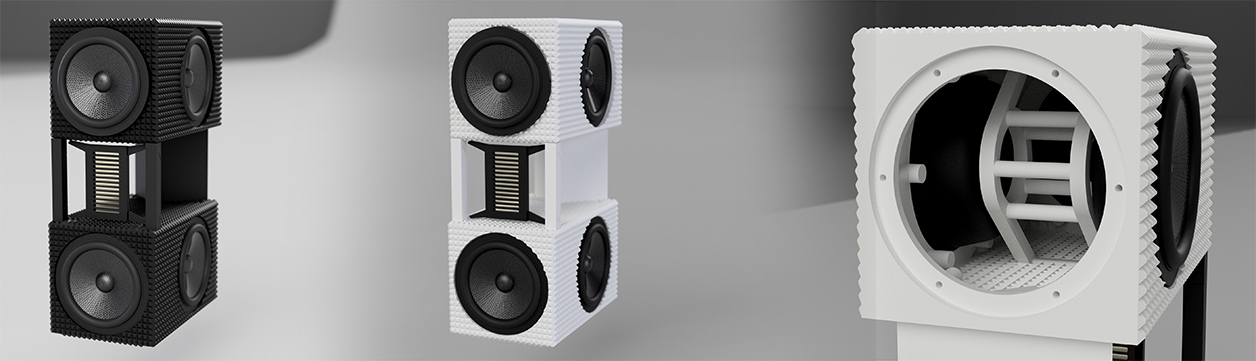
 "When it comes to the d'Appolito layout, it definitely enhances midrange presence and soundstage precision. The presentation gets more directional vertically, with less up/down spread than when the Mundorf sits on top yet overall musicality and goosebump factor are far stronger in the MTM arrangement. As you noted, it's key to keep the Mundorf tweeter open to the room. Hence I work with a minimalist frame and triangular rear section which houses the crossover. Visually the speakers must remain modern and minimalist while staying true to their high-tech DNA. The frame will be the last element to perfect. I have a few concepts to test but believe less is more applies. An all-black frame with white speakers has a lofty bold character while full black or full white feel calmer and more settled. Those are likely the directions I'll refine further. On the last render below you can see additional bracing that uses the baskets of the passive radiators as stiffening elements. And yes, here cabinet rigidity is crucial so the sound avoids any trace of 'bad subwoofer' character."
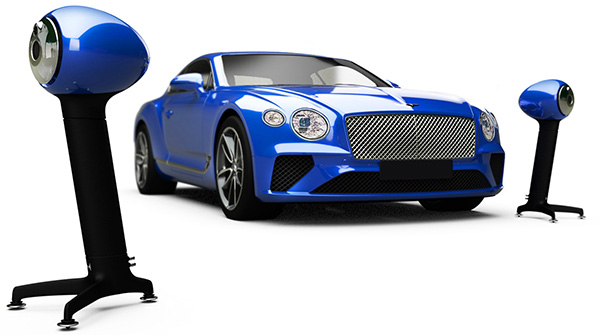
I really appreciate Grzegorz's resourcefulness on the 3D printer. There's the mass array of flutes of different lengths forming enormous rippling waves in his on-wall room treatment. There's the complex weave of his Vibron footers and now the Viper and Cobra chassis. It's as though he invented a new language to talk audio design. Where others cut, glue, bolt or chemically weld flat panels of MDF, metal or synthetic stone, he grows textured cabinets one drop at a time. The closest thing to it I reviewed was this £30K/pr Hylixa spheroid by Node Audio. Where the blue eggs with spiral transmission line need cutting-edge equipment and specialty labour to execute their printing process, Greg gets away with hatching his edgier eggs¹ in consumer-grade 3D printers. It's very clever.
___________________
¹ To keep our serpentology in shape, King Cobras do lay eggs; in fact 21 to 40 in one clutch. They build nests of vegetation and guard them until their brood hatches. The eggs incubate with the heat generated by the decaying vegetation. Humans clearly aren't the only ones gifted with smarts. Do you think remote controls cool? Pit vipers and pythons have infrared perception which forms thermal images even in the complete dark like the predator Arnold Schwarzenegger stalked in the jungle.
As my Warsaw correspondent Dawid Grzyb put it, talking to Grzegorz in his native tongue will have you think him a blue-collar bloke just off the bus from a day's labour on a demolition site. Yet invite him over to your place and within minutes he'll have pegged your sound and won't shy away from pointing out weaknesses should you ask. Not everyone clever likes to be obvious. But it means that Greg knows exactly what he likes; and can communicate it. Unlike myopic designers blind to what the competition is up to, for years already Grzegorz has attended Munich HighEnd with a custom rig of dual Schoeps microphones and a camera recorder. With it he has documented an astonishing number of exhibits. We might question the utility of us hearing show systems through the YouTube compression algorithm over our computer speakers or headphones. But for a speaker designer who attended the event to later have a sonic record he can revisit in his own system is a bit like a chef collecting recipes abroad – extremely useful once back in his restaurant. It's more resourcefulness by what in August 2025 was still a Polish underground microbrand. But even a solitary chap must make a decent profit to stay and grow in business.








 Would-be DIYers tabulate perceived parts, printing and packaging costs then add a marginal bonus for the maker to set their tolerated final sell price. This overlooks R&D and operational costs. To judge realistic value, we look at the competition. What does the global market have in would-be Cobra challengers? Since max bandwidth and SPL vs miniaturization are at play, we focus on fellow stand-mounts of similar size. For the Viper review I managed to list a handful of potential candidates. For Cobra we'd come up short at Focal, Magico, Sonus faber, Stenheim and Wilson. Their €18K Diablo Utopia Colour Evo, €15.6K A1, €12K Electa Amator III, €25.8K Alumine 2 or €18K TuneTot don't meet the specs. Likewise for the Viking armies at Audiovector, Børresen, Dali, Dynaudio, Raidho and Storgaard & Vestskov.
It should be possible to identify something. I'd simply need to be pointed at it. Whatever credible competition² one might spot—it should be in this general pricing segment—certainly won't be legion. That begs an interesting question. Just what might Grzegorz unleash if asked to chuck his current miniaturization ambitions and go after a size-be-damned Big Daddy effort? If we envision dual 18-inch woofers just for argument's sake, how much space would that have to take up? For most of us, such an imaginary exercise should quickly and breathlessly return us to Cobra and an appreciation for its attempt to combine real-world considerations with drag-strip mayhem. Time to consider the air-motion mayhem inside these boxes to grasp how passive radiators work.
______________________________
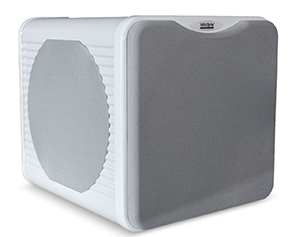
² In actual subwoofers, Velodyne's MicroVee X combines a 6½" active carbon-fibre woofer with dual 6½" passive radiators in a 23cm³ aluminium cab. Cobra adds a third radiator then doubles up on the boxes and adds a tweeter. Meanwhile Velodyne's driver is -3dB at 180Hz, not 5kHz.
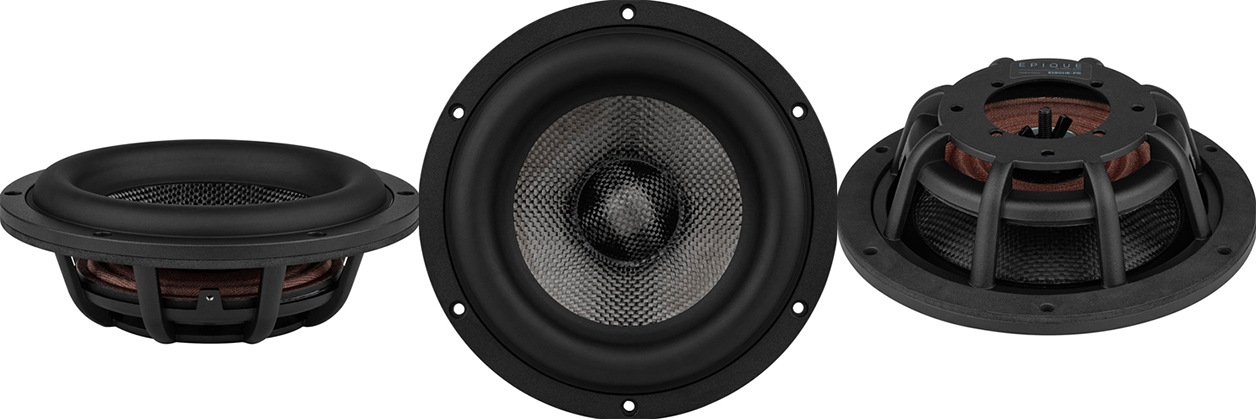
"A passive radiator is a cone without voice coil or magnet. It's a tuned mass/spring system. The cone is the moving mass, the air trapped in the enclosure the spring. When the active driver moves out, internal air pressure drops. The higher atmospheric outside pressure pushes the radiator in. When the active driver moves in, internal air pressure rises. That pushes the passive radiator out. It seems that the passive moves out of phase yet at the system's resonant frequency, this relationship changes. Around this frequency pressure fluctuations from the active driver combined with the inertia of the radiator's mass cause the passive to move in phase. At or below the resonant frequency, the active driver still moves but output drops off. Now the passive moves with much larger excursion to take over a significant portion of the sound. It acts like a tuned port but instead of letting air escape, its mass and size resonate with the enclosure volume. The radiator converts internal air pressure changes into LF output. It's about synchronized motion at specific frequencies to reinforce bass. For a long time I didn't fully understand how passive radiators work nor was I particularly interested. I could achieve excellent bass with cabinet size and ports. However, if you want small passive speakers with powerful, deep and fast bass, a port can become physically impossible. This is where radiators shine. Across their range, we essentially treat them like active woofers. They are limited since the active woofers set their max excursion. However, for scale, pressurization and sheer impact around the tuning frequency, they can be viewed like normal woofers. They almost behave like a passive subwoofer driven by the main cone's energy. It's not just about cone area (Sd) but moved air volume (Vd). The Dayton radiators have a maximum excursion of ±19mm, essentially twice what normal woofers can do.
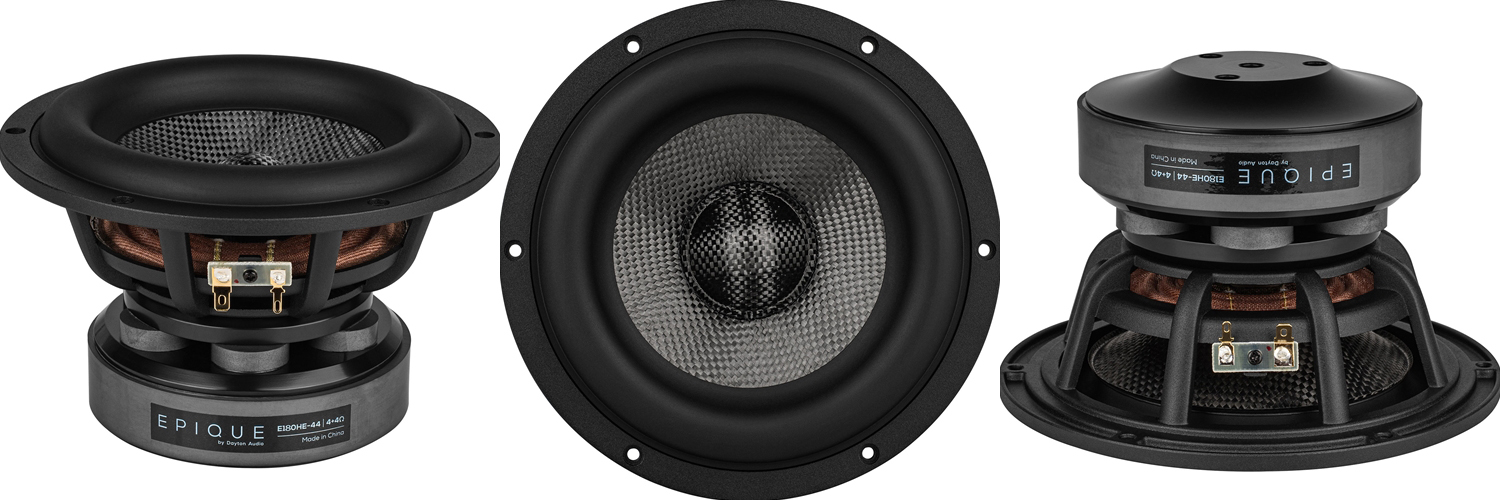
"For Cobra, six radiators per side have a total Sd of ~817cm² and Vd of ~1'552cm³. Many 15" woofers have an Sd of ~830cm² but to maintain 19mm excursion, we'd need an active 15" sub not just PA driver. Cobra is smaller than a 15" sub. Of course an active sub would be able to do more since ultimate output of the radiators is set/limited by the two active Dayton woofers. Still, it's an incredible solution. Even more intriguing with multiple radiators is that the internal cabinet volume now has very little influence on the tuning frequency. Since that depends on the mass of the radiators as much as internal volume, we simply add a bit more mass to all of the radiators to shave off enclosure volume. We make the box smaller. For optimal response and low distortion, it's best to keep each radiator of the box as close in width and distance as the others. Since I have two boxes per channel, I considered experimenting with different radiator tunings. But for now there's no need to offset their tuning. The balance between drum kick and deep electronic bass is excellent already. As to the frame connecting them, the final design will determine the material I use but if a printed frame works, I'll still add a threaded metal-rod core to ensure that everything is incredibly solid. I want the speakers to ship fully assembled so they must be overengineered to give me peace of mind."