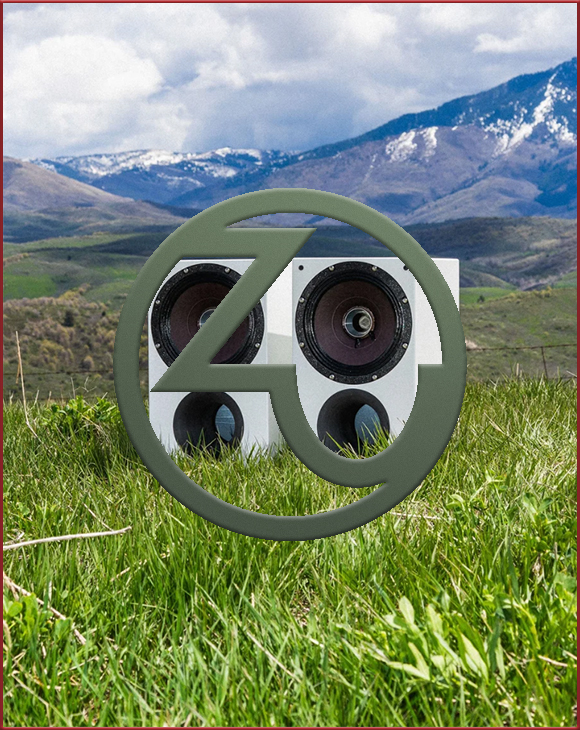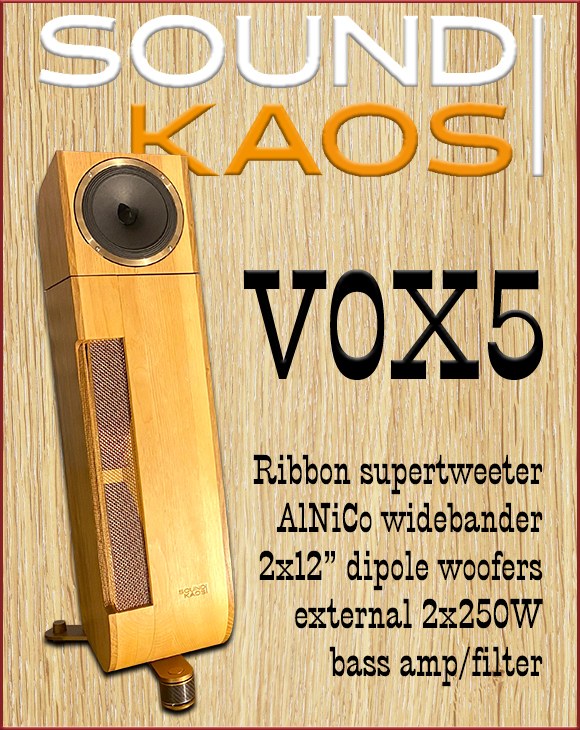
If true, it ain't – bragging that is. Such sentiments would now warm the hearts of music lovers traditionally feeling left out whilst perusing reviews of big speakers and dreaming of all the grandeur and authority their rooms and ears will never know. Most living rooms double-tasking as listening lounge will be able to accommodate Quanteen even if not as divorced from wall hugging as shown here. If this sound|kaos sub strikes you as too grandiose, my upstairs 2×9½" Dynaudio 18S is far more compact to easily slip beneath one of these Buchardt tripod stands. Onto this sonic shopping list: Gargantuan soundstaging. Light-filled highly aerated imaging with energized inter-sound space. Able to play counterintuitively loud without coming apart at the seams due to crossing out high'n'steep. Sophisticated tone of fine modulation powers. Superlative bass extension and control. Adaptive tonal balance by careful tweaking of the bass attenuator. The latter two points are generic stereo 2.1 truths if one has as capable a frequency divider as spl's high-voltage Crossover MkII; and 700W/4Ω of highly damped current-capable class D power on the woofers. Whilst clearly two peas in a pod, IQ and Quanteen were also brothers from another mother. More dipole bandwidth gave IQ an edge on perceived spaciousness and ultimate midrange expressiveness. It also had the advantage on rhythmic propulsion and dynamics because the transitional area of lower mids to upper bass enjoyed decisively higher cone surface. Think greater substance. On machine-gun foot stomps on a Gerardo Nuñez Flamenco number for example, IQ better conveyed the floor sound of the dancer's rapid heel trills. Yet this was no one-sided victory. Quanteen had the upper hand in perceived speed and illumination to feel still more lit up from within; more lively. I even heard fewer reflections because its box presents far smaller surfaces. Perhaps call this difference gush factor. Or, call IQ more materialized and earthy, Quanteen more spiritualized if that distinction speaks to you. I think that most people participating in my A/Bs would have accorded each presentation its own distinctive strengths; and that opinions might well have split a final vote on which model won. By fitting into many more environs, that was a very strong showing for our fourth-born Qualio son. On a personal aside, I've always felt self-conscious about knee-capping IQ, thus countering my long-held opinion that a properly planned 2.1 solution keeps its main speakers small and with them only buys as much bass as a seamless handshake with a sub requires. With Quanteen, I'd finally walk that talk also in my main system rather than preach with forked tongue.
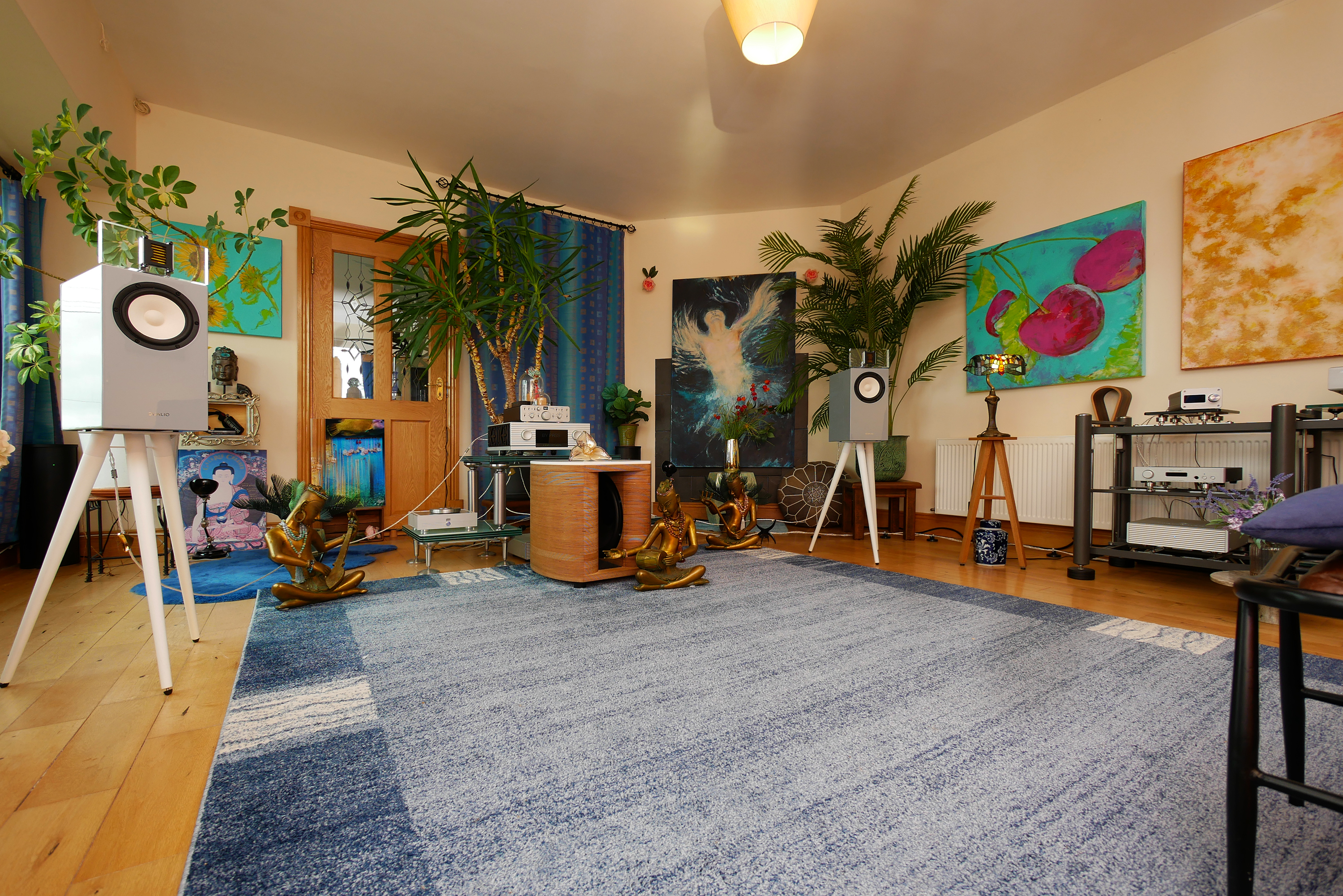 Singxer SU-6 USB bridge ⇒ Sonnet Pasithea split-processing R2R DAC ⇒ Lifesaver Audio icOn4 balanced autoformer volume controller ⇐ Vinshine Tai Hang power distributor.
Because my active crossover deliberately kicked in well above Quanteen's bass-reflex tuning to avail myself of RiPol propagation's room-mode/gain cancellations, I tried plugging these ports as I already do with IQ. However, here I preferred the port tubes open. The midrange sounded even more open and immediate perhaps because now the plastic pipes converted to simple breathing bores for some pseudo dipole freedom to help depressurize the cones' backsides rather than add resonant bass. In any event, I had identical bandwidth to my domestic setup, just a different distribution of radiation pattern, cone surface and filter points to shift relative perspective on certain aspects. As such, I began to think of Quanteen as BabyQ. That's because it goes places IQ's size won't; because properly high-passed plus a subwoofer, it becomes not only a head-on alternative for larger rooms and higher SPL but now exceeds solo IQ on LF bandwidth, control and adjustability. Once we combine IQ + sub as I have for already years, the tables turn again. But now we're admittedly gilding the lily; and gelding the load. The only thing I know of that's still closer to a baby IQ is daudio's M1. That combines the twice-sized dipole Mundorf AMT which Qualio use on the IQ30 with an AudioTechnology mid/woofer also on an open baffle. Hence that speaker must augment at 120Hz with a sub or there won't be any bass, period. With Quanteen, a sub is purely optional. That makes it an altogether different proposition. Yet if we do head down the scenic Route 2.1 via the outboard crossover offramp, Quanteen's ported bandwidth allows filter hinges from 40-120Hz; even different slopes. That begs beaucoup bets to best blend behaviour to room and taste. By contrast, the immutability of purely passive speakers with its implied promise of one size fits all is quite primitive.
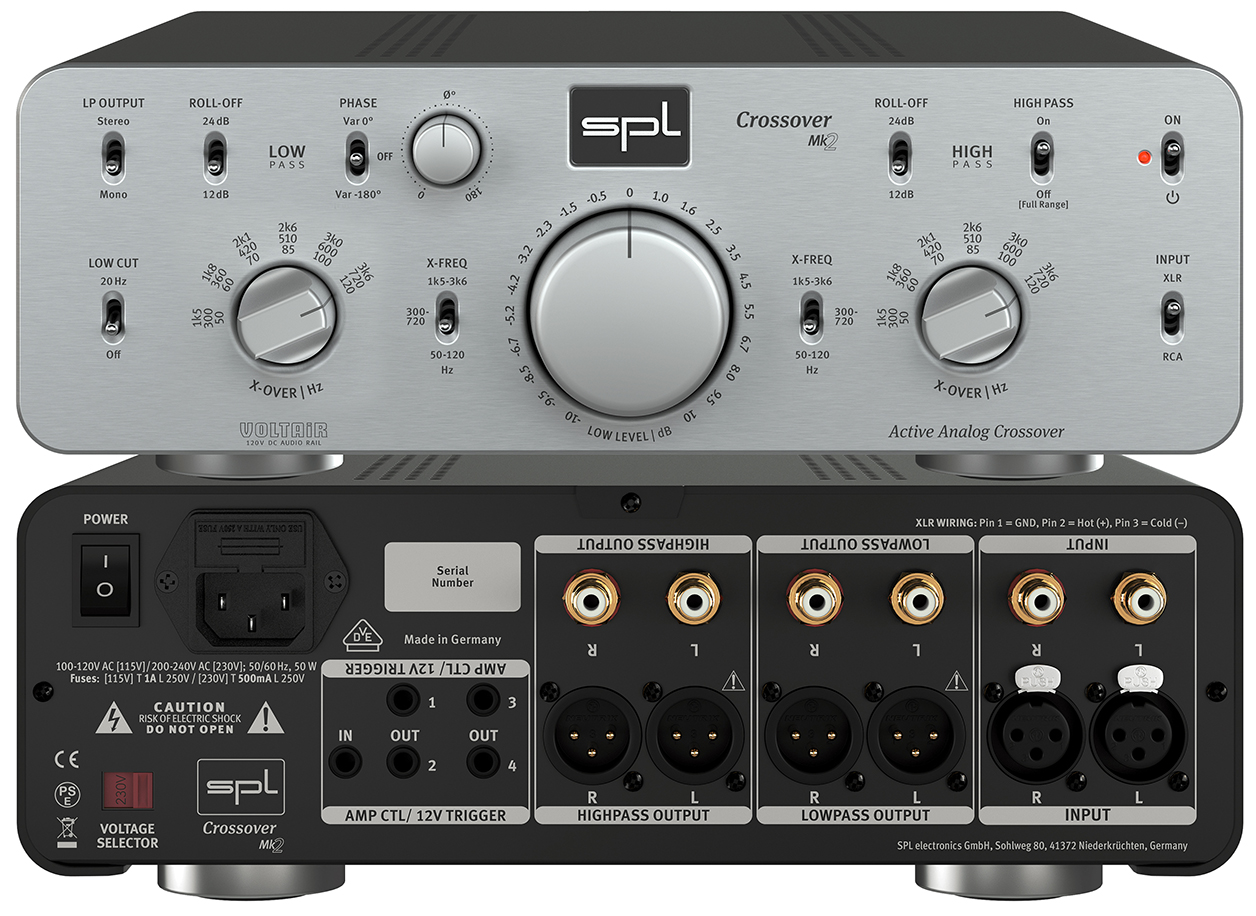







What way, José? Off the record, chat to a variety of speaker designers. Many will admit that to really get serious, we need a 4-way. What's ideal for low and infrasonics—a high-stroke high-mass bass pump—is too heavy for upper bass whilst a midrange must be lighter and smaller still. Of course a 4-way requires a far more complex crossover and the lower its dedicated woofer enters, the bigger the inductors get. Passive filter parts create electrical phase shift and energy absorption. Hence purists prefer fewer filter parts. If in pursuit of more ways than one, they often gravitate toward minimum-phase 1st-order filters. The main reason why proponents of 2½-ways favour them over 3-ways is that their upper mid/woofer runs wide open on the bottom. It only filters on top against the tweeter. It avoids a classic 3-way's twin screws of a low and high pass on the musically most important driver. A so-called 1½-way operates its widebander filterless but segues in a 'super' tweeter anywhere between 8-15kHz often on a lone cap. To my ears, Quanteen is a quasi 1½-way. As far as sonics go, it behaves far more like a widebander than classic 2-way with 1-2kHz crossover. Technically of course it is a textbook 2-way. Adding a sub via my favoured type of external crossover turns that into a proper 3-way. The vital distinction is that the high pass on the widebander now shuns energy-absorbing phase-shifting passive parts. It's a far more invisible analog electronic filter without any DSP latency. To conclude José's detour, any of these ways of treating the audible bandwidth has proponents and admirers. In my book, listeners into widebanders or minimum-phase speakers prioritize time-domain accuracy over a ruler-flat frequency response. It's their creed to which Quanteen speaks loudest whilst talking right past the single-driver SET purists who see two drivers, learn of an 18dB/oct. filter separating them and run for the hills. What they overlook is that in our hearing's most critical band, this solution actually creates a more linear response whilst its high 4kHz hinge causes far less obscuration than it would do two octaves lower at the classic 1'000Hz transition.
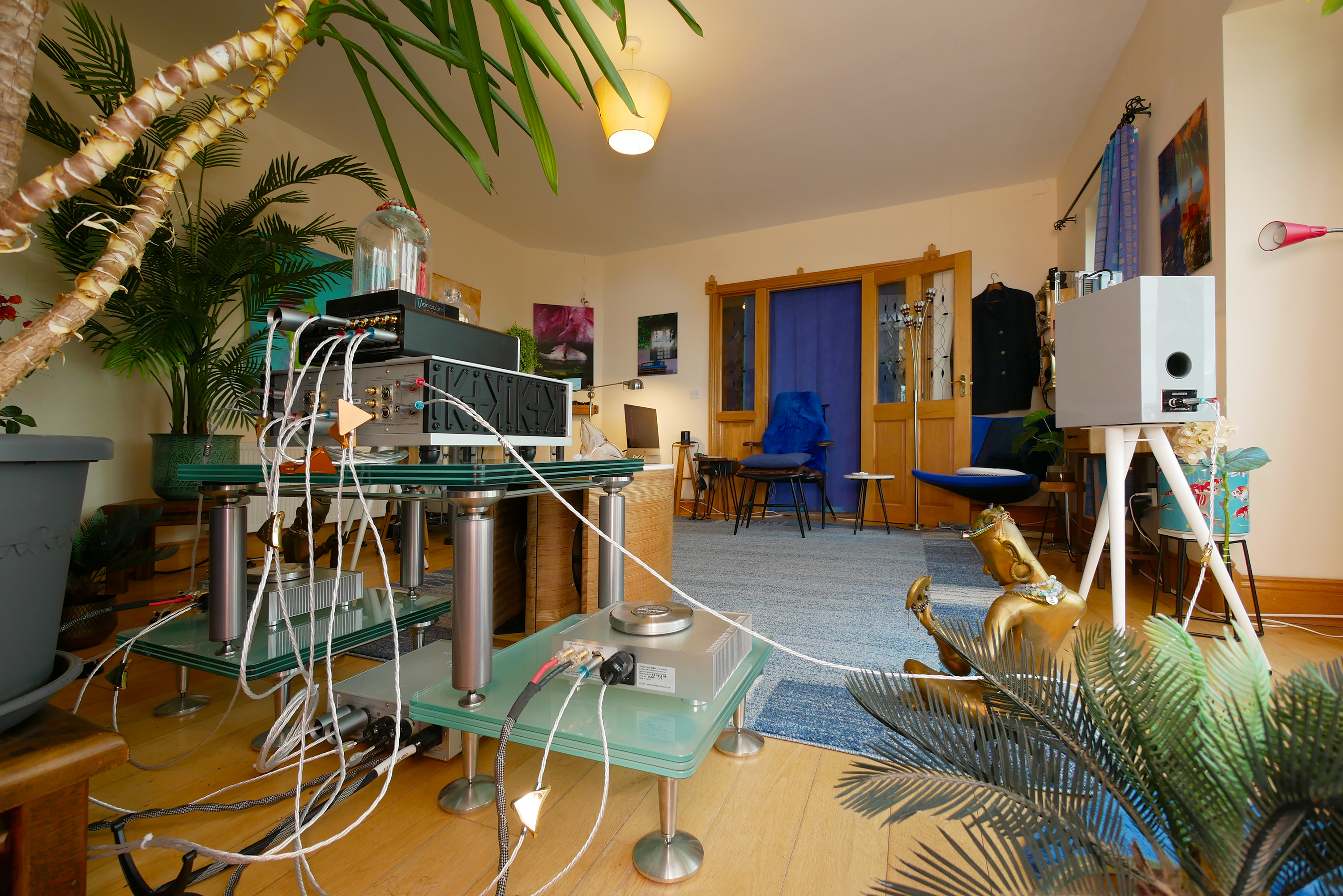 Kinki/Vinshine Dazzle in preamp bypass on the monitors; nCore-500 Nord Acoustics monos on sub; Vinshine Tai Hang power distributor; spl Crossover MkII as 2.1 traffic cop.
All petals and perfume, no thorns? What Quanteen can't do is the type dynamics which a 3-way's bigger woofer entering high enough to cover the upper-bass/lower-mid band can. That's a function of moving mass and stroke. Whilst some of that could be stoked with a bigger mid/woofer of 8 inches, it'd sacrifice lucidity higher up and enforce a more classic crossover point to give up the widebander attributes. These are the pros and cons of Quantum's design choices. It's where, even with a sub, it naturally plays second fiddle to IQ even if both are on the same subwoofer through the same outboard filter. Contrasting Quantum + sub to IQ solo, the 2.1 combo wins on bandwidth. If high-passed, it also nabs gold on in-room linearity and flexibility. Because that suits rooms where IQ's 39x73cm frontal box profile (which doesn't yet count the 39x28cm translucent baffle) becomes a cosmetic objector, Quanteen enjoys more universal appeal whilst creating surprisingly similar sonics. But of course for each 2.1 listener in our space, there are a thousand (10K?) who don't want a subwoofer. To finish up on the correct note, we'll thus head back up the stairs into the nearfield system as my favourite setting for Quanteen solo. If you thought about the implications of my 1½-way take, you'll appreciate how this speaker behaves like a virtual point source to be ideal for close-proximity applications.