W³. Adding a 3rd win is size vs bandwidth. Unless I were to dedicate yet another room's layout to hifi—even this audio nut has his limits—my beloved downstairs IQ just wouldn't fit into this upstairs nearfield 'nook'. It's no nook physically, just functionally. By design there's loads of free space around these speaker locations. The room has basically no say over their performance. Close hot-seat proximity means minimal distance losses. That nets excellent whisper performance and high SPL with far less transducer stress. It also maximizes a speaker's low end. What may want assist at greater distances and higher outputs is perfectly sufficient at ~1.3m from a listener. In short, here Quanteen was ideal stand-in for IQ whose three-way array wouldn't cohere yet; whose bigger woofer would overpower the action; whose broad-shouldered box would visually cancel the entire gig. A 9½" Satori woofer sloping in below 400Hz obviously dispatches more upper-bass heft. That and below feel more hung. Conversely, Quanteen behaved more fleet-footed and aerated—not that IQ would ever work in this scenario. It makes any such give'n'take academic; though it would be give'n'take. That should be sobering when it equals realization that an extra top-quality woofer with premium low-pass filter parts only adds about 10 cycles of reach, general air motion, dynamics and loudness potential whilst ballooning the enclosure. If we don't need any of it, Quanteen not only saves money. It's the better fit.
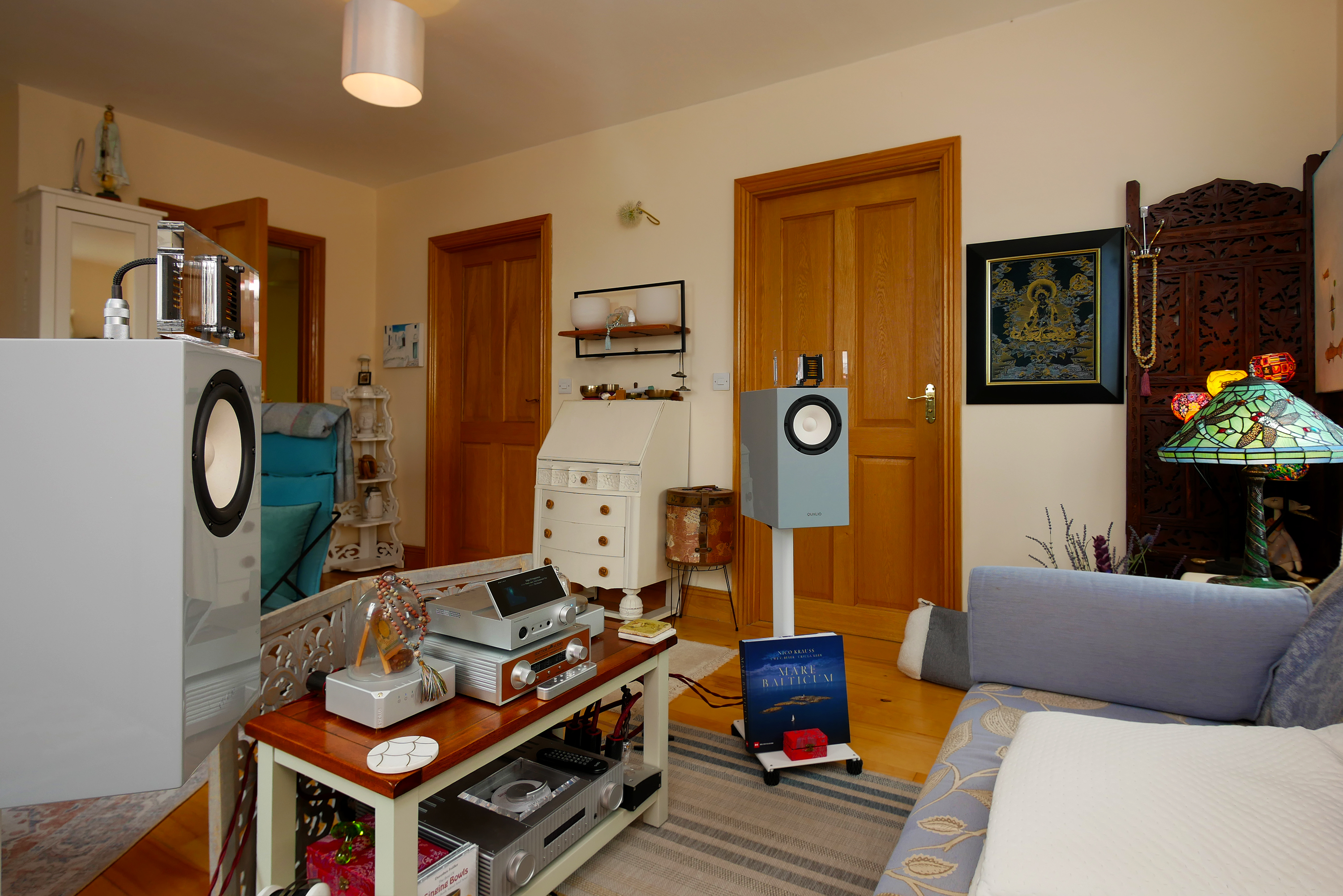
Hifi veterans take one look at these photos and instantly recognize enormous soundstage potential for such a wide steeply toed-in nearfield array without nearby boundaries. Add high-output dipole tweeters with no box to pressurize a standard dome's rear. Potential becomes glorious reality. It's a basic function of first setup then specialized parts. For soundstage acuity contingent on gossamer ambient cues, less in-room bass energy is actually beneficial. It's why Quanteen could and did image like a wish-fulfilling djinn. It's right back at the lead-in's 3rd W. A capable smaller driver strategically mated to a bass-reflex port in a compact cosmetically inconspicuous box can be just what the doctor ordered if we have the right circumstances. Anything more then isn't just unnecessary. It's counter-productive.
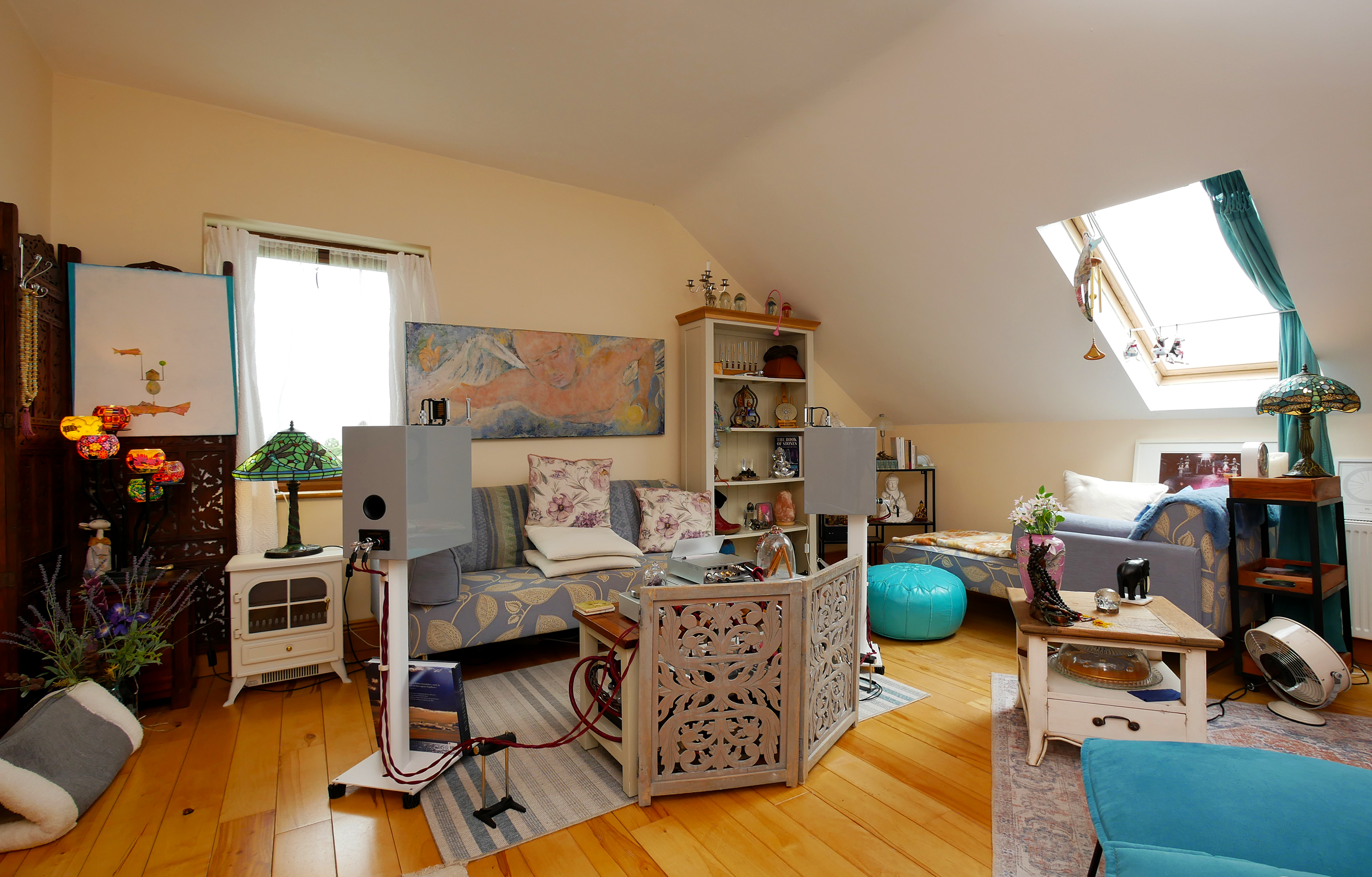
This leads us to the 4th W where less becomes even more. Enter stereo 2.1 where a quality active analog crossover splits the signal into separate high and low pass feeds on identical mirror-imaged 4th-order slopes. For each octave we cut from our monitors, their mid/woofers must stroke four times less. That reduces distortion, lowers voice-coil temps, minimizes rising resistance and concomitant dynamic compression. If we build a system with adjustable active bass for the bottom ~2 octaves, it's irrational to look at and spend on big floorstanders. We'd (ouch!) only castrate them. Before you insist that fronting our quasi widebander with a high pass would diminish even cancel its special virtues, not so with an electronic filter. That doesn't suffer the energy storage of passive filter parts. It's one reason why active speakers beat their passive counterparts. Another is preceding their gain circuits with filter networks. Stereo 2.1 does so as well. Our main amp/s no longer see/s low bass to stress less. Active speakers also have the advantage of adaptive bass. This too stereo 2.1 can mirror with its active user-adjustable subwoofer. For that we move down the corridor into my second upstairs system.









Psych eval. When Qualio first launched IQ, concept, execution and direct-selling price all made quite the splash. Comparable hybrid dipoles then were limited to daudio, Nola and Wolf von Langa. Once Qualio served up seconds with Quantum, it followed a routine of shrinking the tried'n'tested. They returned to the same well when expanding to the IQ30. Psychology knows that we only ever to get make one first impression. With Qualio's now 4th repackaging of the same recipe back in the honey-I-shrunk lane, the novelty factor has long since eroded. Of course adding bigger/more drivers—or subtracting/shrinking 'em—is exactly how any other speaker house builds out their multi-tiered portfolio. Hello new four-deep Dexter range by Mårten introduced during the June 4th 2026 Vienna show. Everyone does this. It's not about lack of creativity or innovation. It simply gives customers what they've come to expect from a brand of clearly defined identity. Just so, the original buzz surrounding true novelty usually won't fully revive. We've seen and heard a given recipe already. With that psych eval in hand, you now might anticipate a slightly lukewarm Quanteen reception from me when I've already trod this path three times before. And looking back, it's true. I was most enthused by the first. However, Qualio's latest had me gung-ho all over again like déjà vu; never mind the name. It's because with a properly dovetailed sub—here a sealed 15-inch Zu Method via a Lifesaver Audio icOn autoformer volume control with built-in analog hi-lo-pass filter—it plays commensurate with albeit not identical to IQ then goes new places as in, rooms that couldn't host the far broader boxier floorstander.
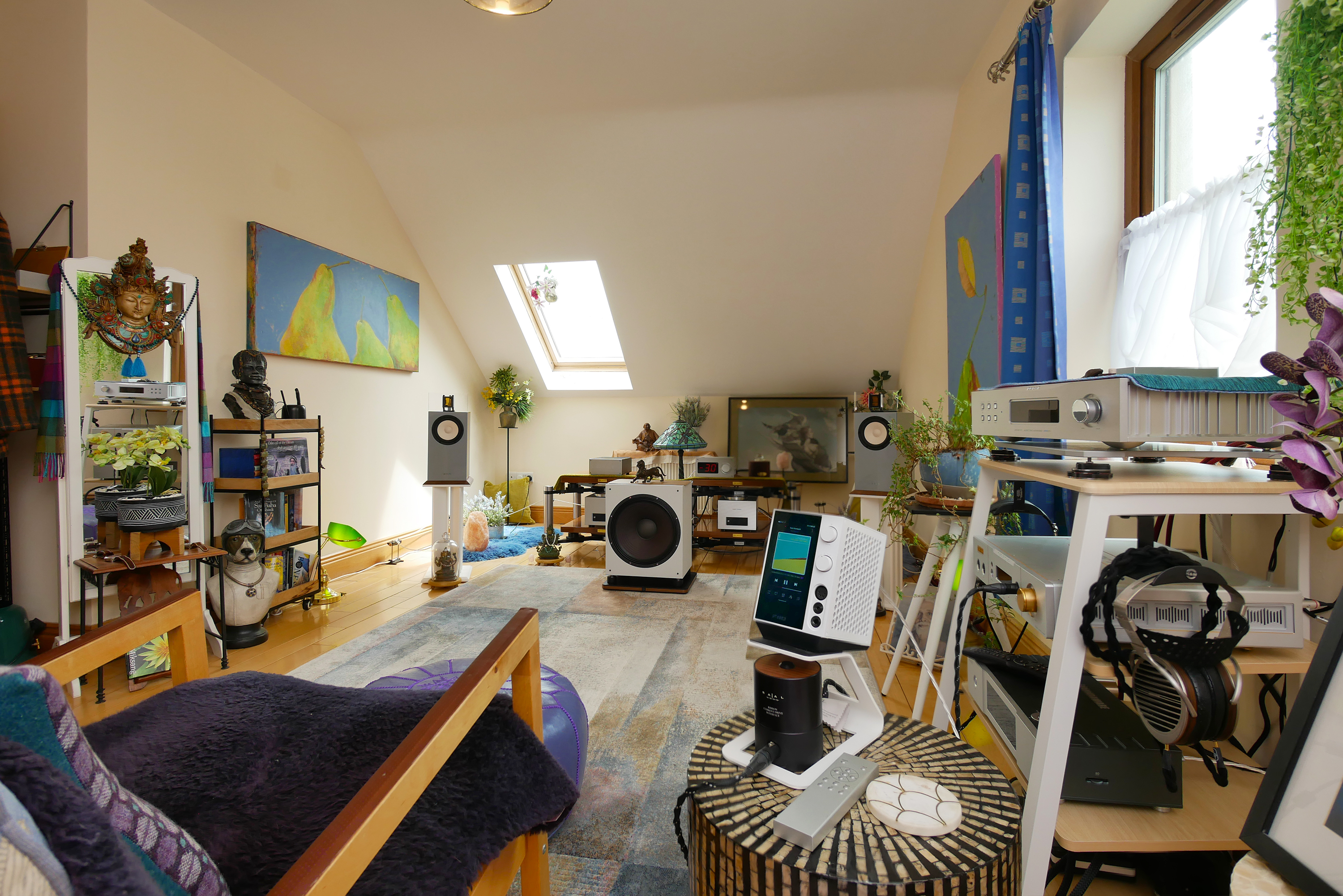
Out-of-box soundstaging and that peculiar vocal frisson I recognized from classic widebanders were the two main attractions of this install where my electronic crossover sat at a low 4th-order/40Hz for just some 1st-octave fill whilst removing the same signal from the monitor voice coils. 250W/8Ω monos were clearly overkill for the SPL I find suitable for this smaller room. The autoformer-based passive-magnetic volume control had me 30dB below the DAC's output voltage. These amps are simply my default in this room. That's germane in this context by not being low-power triode amps yet working splendid so without any tell-tale signs of overdamping. With classic widebanders those signs tend to be premature bass ejection by up to an octave; a stiffer drier demeanour in the midrange; and an overemphasis between 1-6kHz depending on driver Ø. From 120W GaNFet-based class D to now 2.5MHz DC-coupled class AB, Quanteen didn't play amplifier favourites. To be clear, I roped in the Zu sub because I had it. For most intents and purposes, in this room it wasn't necessary. For my last listening station and the ambient and electronica section of my library, a sub was required meanwhile. It's because here a 100Hz/4th-order frequency divider has a 15-inch woofer per channel handle low, mid and half the upper bass. No matter how chuffed over a port tube, now a 6-inch mid/woofer just can't compete in the discipline of air motion and its related impact and gravitas. Instead my question became, how would IQ's dipole 6er compare to Quanteen's box-loaded equivalent? How would the two octaves between 100-400Hz usually handled by IQ's 9-incher register vs Quanteen's 6er?
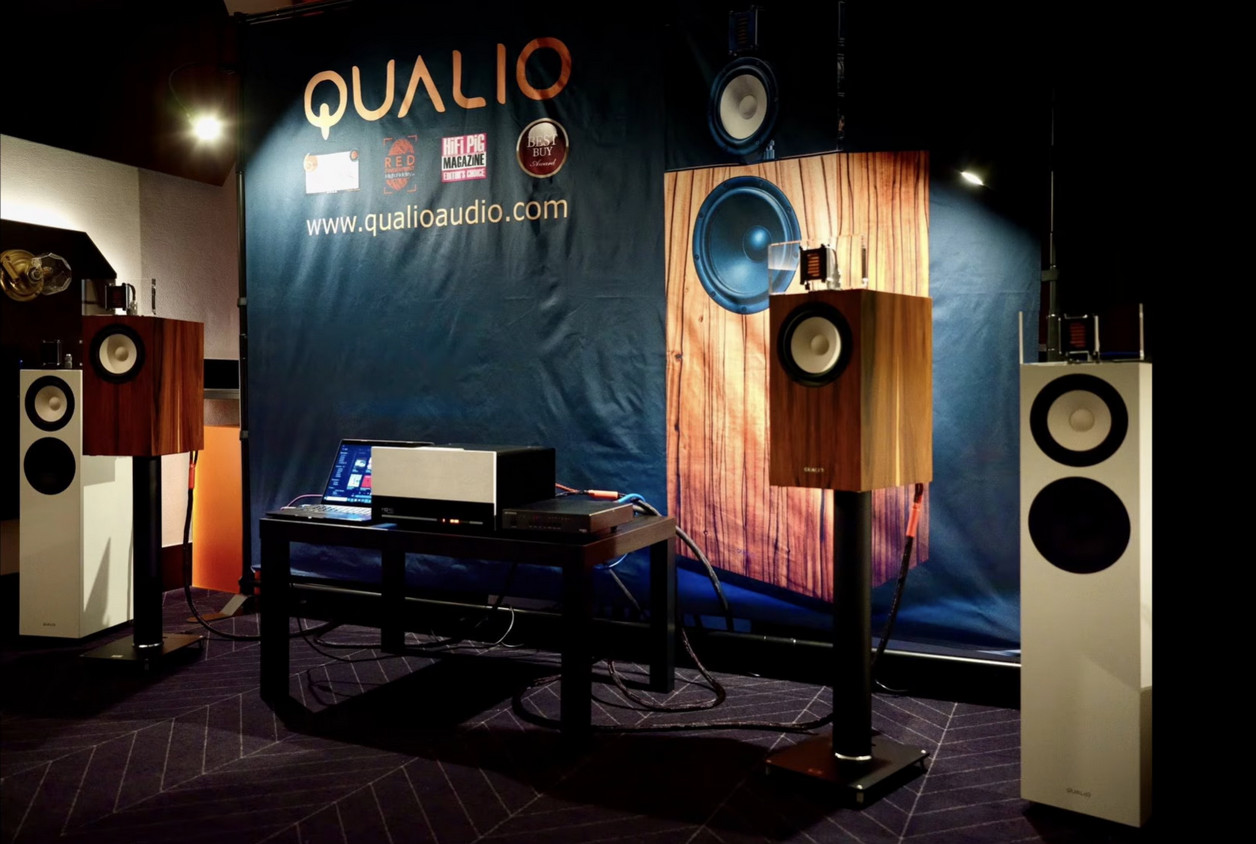 Quanteen vs. Quantum at the Prague Hifi Show 2026.