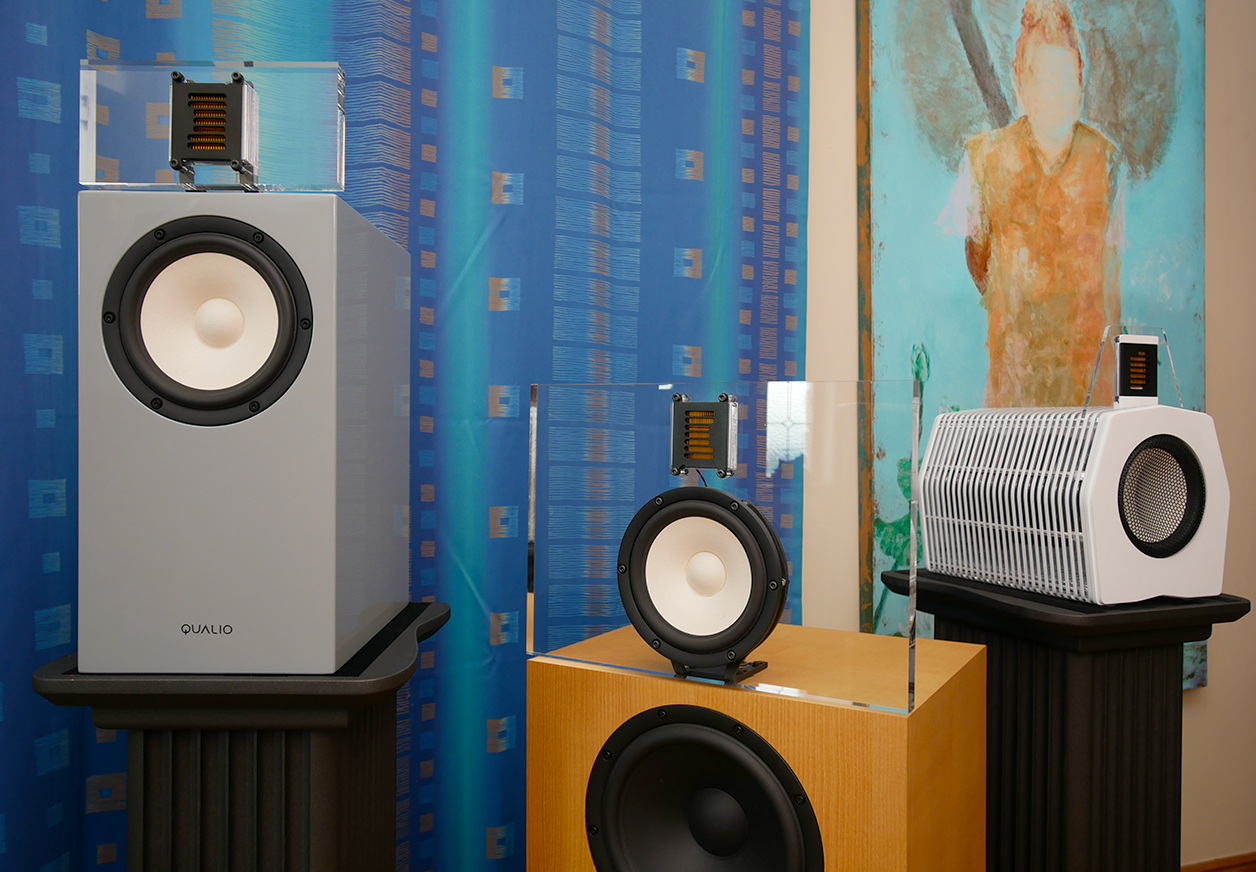
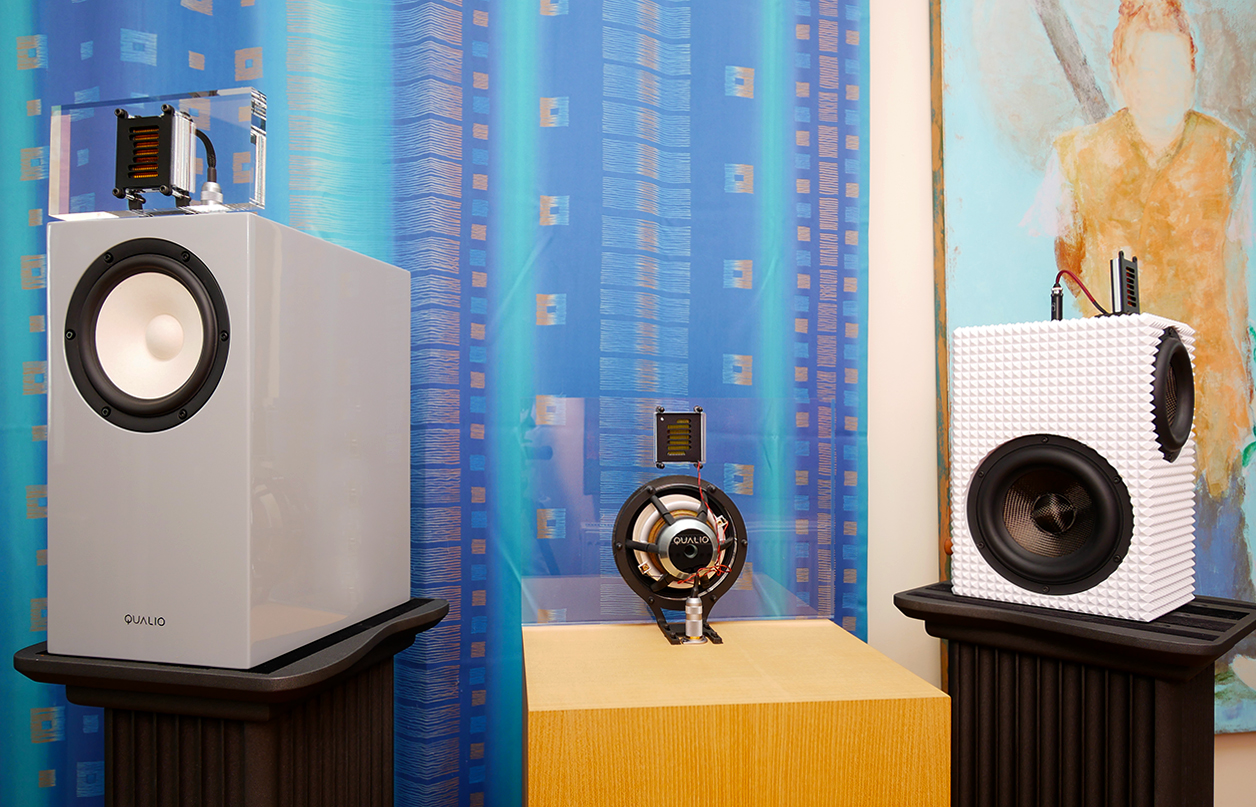
The tell. Before sonics, let's visit combat sports' tale of the tape where a pugilist of longer limbs is said to have the reach advantage. Below we see Quanteen, IQ and ModalAkustik's MusikBoxx all flying the same tweeter. The German's acrylic layer stack not only flaunts the lowest cubic volume. It's a sealed box. That gives ported Quanteen about an octave's worth of reach advantage, albeit with faster acoustic roll-off and more group delay. Compared to IQ, Quanteen exploits the exact same drivers; minus of course the 9½" woofer which bolts on ten extra cycles, requires a more complex crossover but brings more air-motion chops to the party; and a profile twice as wide.
Compared to Virtual's Viper below the break, it's single port vs dual passive radiators; papyrus cone vs. carbon cone of extreme stroke with massive rubber-roll surround. That Dayton Epique mid/woofer specs like a mini subwoofer. Viper's bass loading needs less cubic volume, applies greater moving mass and cone surface to have the obvious advantage on reach, tautness and shove. However, Quanteen's cellulose-based cone more akin to classic paper-core widebanders has its own advantage. Enter my tale of the tell on my desktop where Viper usually holds court. This signal path splits between USB and Ethernet. USB runs Spotify Plus and YouTube through a LHY Audio UIP isolator into an Audalytic discrete 25-bit R2R DAC. Ethernet runs from my router into a LHY Audio SW6-SFP switch into Audirvana Studio with my Qobuz Sublime account on a Win 11/64 work station. That software player's SRC converts all PCM to DSD512 which runs back out through the switch into a Stack Audio Ethernet regenerator before hitting Gustard's discrete 26-bit R2R DAC called R26II. Both DACs then run through a FangSound Dionysus active preamp into a pair of Topping B200 200wpc/4Ω class AB monos. As it happened, my Viper/Quanteen sessions pitted a 3D-printed Grzegorz Rulka design against an MDF-based Marek Kostrzyński version as the two men who jointly formed Cube and Qualio but since branched out into solo ventures. Greg's has long since been public. Marek's own is already booked for a first review with my regular Warsaw contributor Dawid Grzyb at HifiKnights.










The tell. Imagine yourself out of deep meditation which stilled your mind and left a tangible energy of calm connectedness in your body. Now do your favourite workout. Get the blood pumping. Feel any residual staleness flush from your body. Cheeks rosy, forehead sweaty, step onto the balcony. Look around. The same old scenery you see every day suddenly has sharper relief. It's more vibrant, more direct. Sensory apathy which our usual preoccupied mind and suppressed vitality insert has replaced with… what? Higher resolution? The grass didn't suddenly intensify in greenness. The bird song didn't get sweeter, the dance of the leaves no more complex than before. This change in aliveness—from a calmed nervous system operating far better without the monkey mind's constant chatter—is all down to us. Likewise for my switch from carbon-fibre miniature subwoofer to papyrus-cone mid/woofer beneath the same tweeter. The ivory-coloured driver portrayed higher midrange aliveness whose enabler we just agreed to call higher resolution. As a generic hifi term, it works well enough. Parlaying its actual effect simply far transcends the usual caricature of suddenly hearing the 2nd violin section's third chair creak. Hence my lead-in exercise. Widebander vocabulary calls the effect greater immediacy, suchness, directness, more intense clarity or lucidity. The underlying enabler is a quickening of perception, an increase in subjective wakefulness hence noticing. It reduces the sensory distance between us and the sounds of music's molecular building blocks. The experience of said difference is instant and instantly obvious. Returning to Viper's long-stroke driver just as instantly re-inserted some energetic distance. Its sound grew warmer, denser and chewier. Yet the primary distinction of a very familiar tell was sacrificing this higher state of Quanteen's aliveness.
That higher octave of aliveness was the tell-tale signature of classic Cube/Voxativ-style paper-based widebanders without a presence-region xover. Period. Anything I'll now write merely elaborates on this statement. The core observation won't shift one millimetre. It's all about a quickened state of sensory hookup. My vocabulary correlates it with higher speed, crisper timing and elevated microdynamic action. Energy-absorbing filter parts which still separate Quanteen from a purist (single-driver) widebander operate out of band past all fundamentals. This Satori driver's cone also has more in common with a traditional widebander than the Dayton. That's likely part of this equation. Port loading then gets more bass from a smaller box than rear-hornloaded purist widebanders. The rakish AMT adds finesse in the high treble and the kind of airy soundstaging and expanse which Boenicke speakers with their rear-firing ambient tweeters are famous for. Would Voxativ's small Alberich² feel still more aspirated and alive? I believe so. I also think that in the Viper/Quanteen showdown, Quanteen well more than halved the distance. That's my intended takeaway—and the cause for personal enthusiasm. Without needing low-damping SET of high output Ω or suffering bandwidth restrictions, Quanteen accomplishes 75% of classic widebander magic with none of their special dietary restrictions. And re: wonky measurements, I predict far fewer deviations with Marek's 4kHz/3rd-order crossover than filterless designs are (in)famous for. That's a win/win for listeners into this quickening effect.