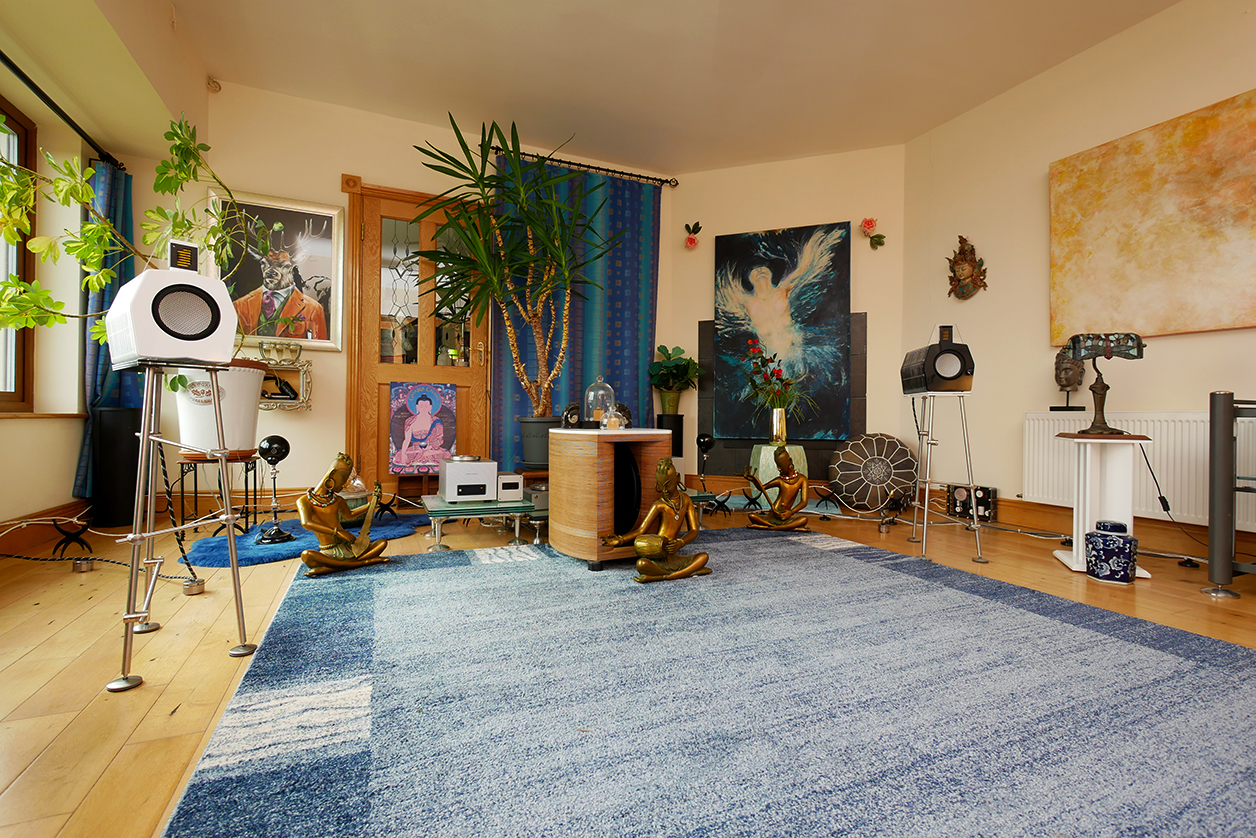
Tickling the toe-in, sweating the sub. Thinking readers knew it already. Bypassing the sub with its concomitant loss of gravity could want less treble. That means less to no toe-in depending on speaker width and chair distance. What they can't know is how credible or not soloing a diverse library is with just the Boxx. Does the sound get too anti gravitational? Is it sufficient except for unnaturally hung tracks where synth bass goes places that remain off limits to acoustic bass? How does a smaller room factor into this? Before I could fully answer that, I had to go downstairs and experience the Boxx in my bigger room. So let's dig into the solo question whilst still upstairs. Was classic stereo 2.0 unconditionally satisfying or already conditional upon picking the right music? At the risk of upsetting equivocation haters, it depends. If you've lived with subs to know your files uncut, you'll notice what's missing on most music. If you don't, the Boxx could surprise. That's especially so if setup works in its favour. In mine, sans sub was warmer. The twin locations of the monitors created more room involvement in the upper bass. This interaction thickened the stew with reverb. The single more forward location of the sub bled out that follow-on haze. Not only did the sub cover low tones that the Boxx missed or barely hinted at. Its textures didn't contain the same temporal bloat. Sailing solo whilst circumnavigating my SD library demonstrated how due to greater room involvement, the Boxx was unexpectedly successfully at disguising its omissions.
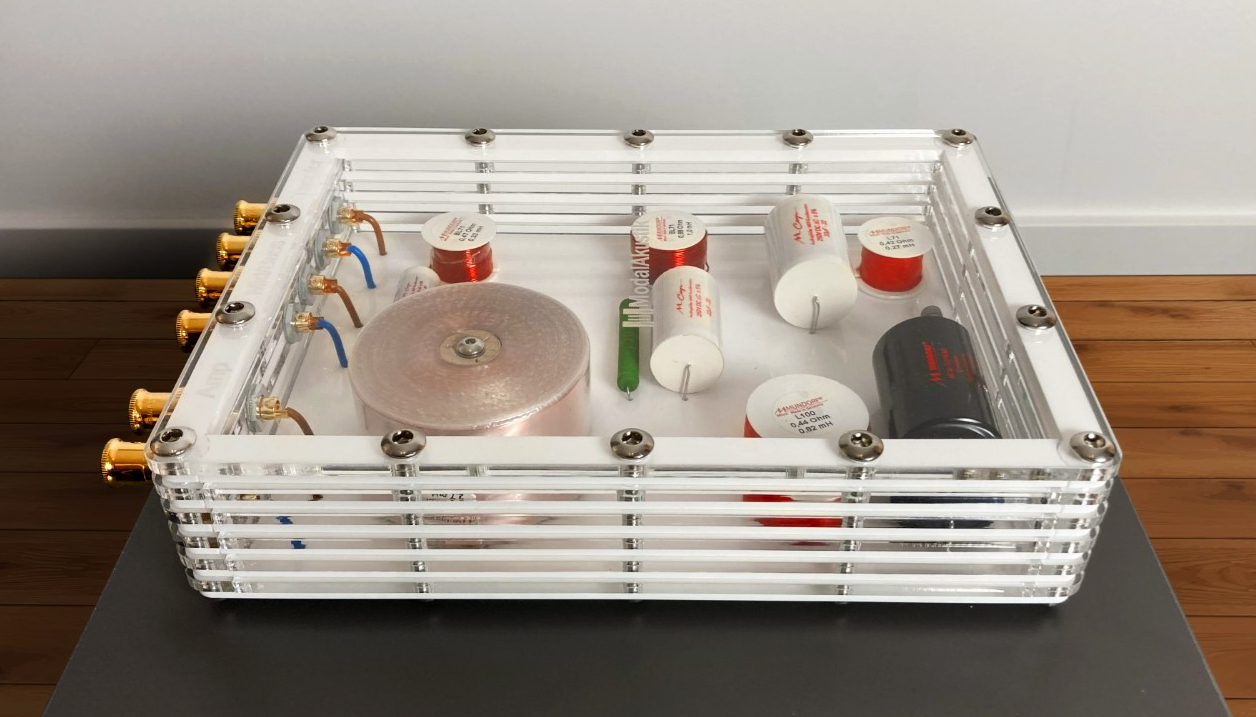
What's more, it traded clarity points for filler at the belt line. Hence double-blind listeners wouldn't have identified an Accuton driver. In solo mode and my 4 x 8m room, a lazier tongue made diction less precise, rounder and more like that of a cellulose membrane. As a stereo 2.1 devotee, I clocked these differences to have a clear preference. Meanwhile a visitor unfamiliar with my status quo exposed to just the Boxx would have been astonished by the apparent size/sound discrepancy and non-ceramic signature. It's about how shrinking room dimensions raise the frequencies of our main resonance modes. Should one of those coincide with where our small speaker drops off, we get a useful amplitude boost paid for in the time domain. It's one more it-depends qualifier. Your room and exactly where you place your speakers and seat have a lot to say on the matter. To shift us from soft equivocation to harder fact, my assessment of solo mode returns to price. Of anyone prepared to lay out €8'097 for this lot of two each speaker boxes, filter boxes and stands, I'd anticipate sharp ears and very informed expectations. We're not talking beginners or casuals but mature refinement freaks. Even in a smaller room those will want a subwoofer and ideally a high pass just as I assumed from the start.











Given that, downstairs passed on going solo. Side by side with our usual Qualio IQ, we see virtual height equivalence. Even the Accuton's size closely matches that of the papyrus-cone 6.5" SB Acoustics Satori. The far bigger visual difference is the 9½" Satori woofer with a free-air resonance of 24.5Hz here in a capacious bass-reflex box. Visible only on the spec sheet is the IQ's 89dB sensitivity; that this AMT enters very high on an 8kHz/2nd-order slope; that the midrange adopts 1st-order exits on either end. The woofer enters at a high 600Hz on another 2nd-order filter. At €6'900/pr, the IQ is obviously a lot more speaker for the money but in 100Hz high-pass mode, its primary extra of the woofer's lower two octaves is cut. Rather decisively however, that woofer remains active well into the lower midrange to give its transition into the upper bass greater cone surface. Another big difference is AMT bandwidth. Just as my upstairs Mon Mini does and Zu do with their add-on tweeters, Qualio run their folded Mundorf part as a quasi 'super' not full tweeter.
 In this juxtaposition, the Boxx really does look like the IQ's top array turned into an enclosure.
For 2-tone fans, here's the setup with colour-inverted stands. To my eyes, the white Boxx atop the black stand really works it. Because I had the space, here the filters hugged the sidewalls as far away from the speakers as the included cables allowed. "The stands are placed in the wrong direction. The single foot should be in front so the rear rubber feet on the speakers stand on the holes of the two screws of the stand. Now the back of the speaker is not actually on the plate but directly on the metal rods. That's also why the rubber feet have different height so when placed correctly, the speaker sits parallel to the plate." So the following shows (cough) how not to do it.